Puntos clave:
1. Los recubrimientos nano de cuero para interiores de automóviles integran tres sistemas funcionales — nano-Ag/Cu antimicrobiano, nano-ATH retardante de llama y nano-SiO₂ hidrófobo — logrando >99% de tasa antibacteriana, clasificación de llama V-0, resistencia al moho Grado 0.
2. Las regulaciones de Calidad del Aire en el Interior del Vehículo (VIAQ, por sus siglas en inglés) (GB/T 27630-2025, VDA 278) están impulsando el cambio de recubrimientos nano a base de solvente a base de agua, con reducciones de COV del 85-95%.
3. El desafío técnico crítico es la adhesión y resistencia a la flexión de los nanorrellenos en sustratos de cuero flexible — las nanopartículas de núcleo-coraza + matrices de poliuretano flexible representan la solución principal.
Los interiores de los automóviles representan la interfaz de contacto de mayor duración para los ocupantes del vehículo y son una fuente principal de contaminación de la Calidad del Aire Interior del Vehículo (VIAQ). Los asientos de cuero, los volantes y los revestimientos del salpicadero son altamente susceptibles al crecimiento de moho en condiciones de alta temperatura y alta humedad, mientras que la inflamabilidad inherente del cuero natural y sintético plantea riesgos de seguridad significativos en incendios de vehículos. Recubrimientos nano de cuero antimoho y ignífugos para interiores de automóviles han surgido como un material de recubrimiento funcional de alta tecnología impulsado por estos requisitos de rendimiento multidimensionales.
A diferencia de los procesos tradicionales de dos pasos (remojo con inhibidor de moho + pulverización ignífuga), los recubrimientos nanointeriores modernos integran funciones antimicrobianas, ignífugas e hidrófobas antiincrustantes en un único sistema de recubrimiento nanocompuesto, logrando protección multifuncional al tiempo que simplifican significativamente la cadena de procesos de postratamiento para componentes interiores. Más importante aún, los cargas funcionales a escala nanométrica penetran de 5 a 20 μm en los espacios entre las fibras del cuero, formando una protección "incrustada" en lugar de un recubrimiento de simple "cobertura", lo que significa que la funcionalidad protectora no se degrada rápidamente por la flexión y fricción repetidas del cuero.
Por qué los interiores de automóviles necesitan recubrimientos nano antimoho ignífugos — normativas, seguridad y experiencia del usuario
Respuesta directa: El “efecto invernadero” en cabinas de vehículos cerradas (temperaturas interiores de 70-80°C con >80% HR tras aparcar en verano) crea condiciones ideales para la proliferación de moho. Las pieles naturales y sintéticas sin tratar son materiales inflamables (Índice Límite de Oxígeno típicamente de 18-22%). GB/T 27630-2025 restringe aún más los límites de 8 COV incluyendo formaldehído, acetaldehído y compuestos de benceno — los recubrimientos nano antimoho ignífugos abordan simultáneamente las tres dimensiones de requisitos rigurosos.
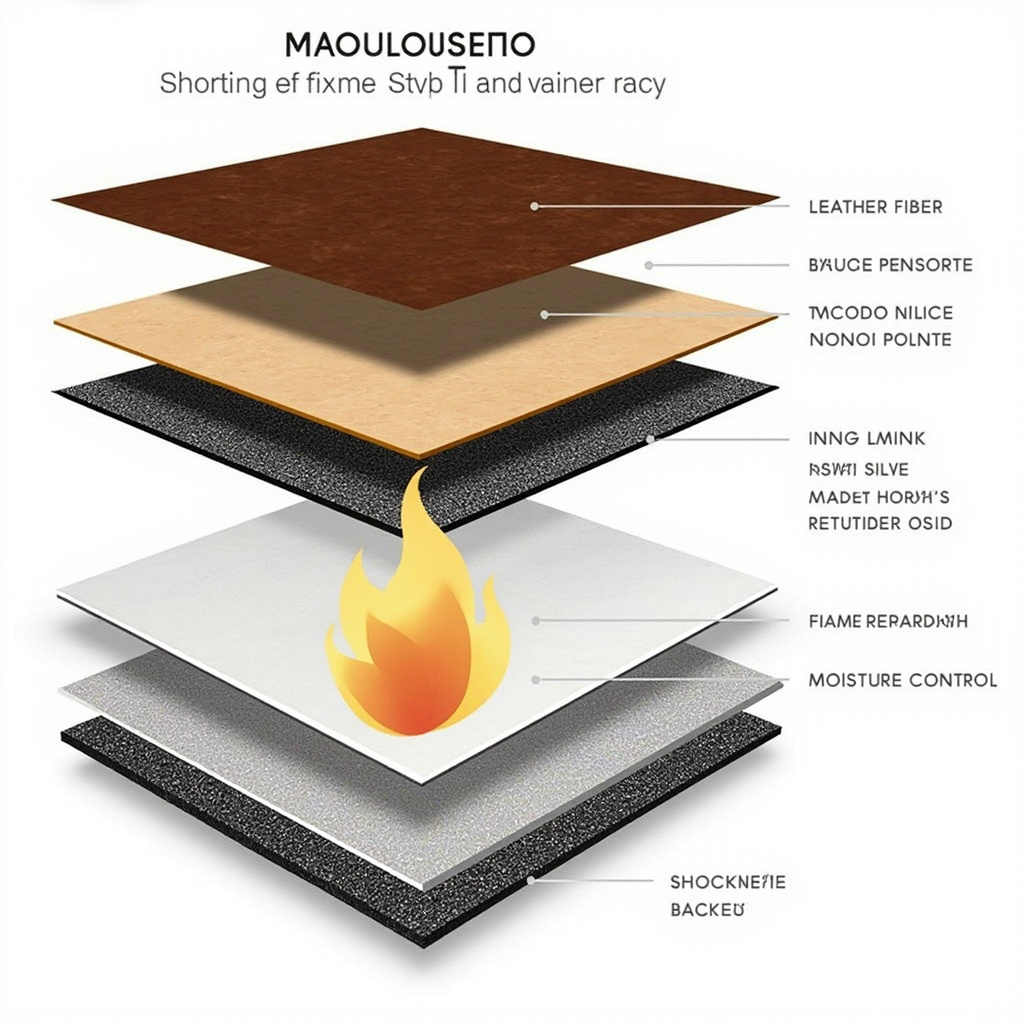
Mecanismo — Dimensión 1: Antimoho y Antibacteriano. Las grasas, proteínas y polisacáridos residuales del proceso de curtido de cuero proporcionan abundantes nutrientes para los microorganismos. En la temporada de lluvias del sur de China, los asientos de cuero sin tratar pueden desarrollar moho visible en 2-3 semanas. La plata nano (Ag NPs) y el cobre nano (Cu NPs) operan sus mecanismos antimicrobianos a través de tres vías: (1) Los iones Ag⁺/Cu²⁺ liberados penetran las membranas celulares bacterianas/fúngicas, uniéndose a proteínas que contienen azufre y bases de ADN, alterando el metabolismo y la replicación celular; (2) Las especies reactivas de oxígeno (ROS) generadas en las superficies de las nanopartículas dañan oxidativamente los lípidos y proteínas de la membrana; (3) Las nanopartículas de alta área superficial físicamente se adsorben sobre las superficies microbianas, bloqueando los canales de absorción de nutrientes. Esta triple sinergia proporciona una cobertura antimicrobiana de amplio espectro contra Aspergillus niger, Penicillium, Trichoderma, Staphylococcus aureus y Escherichia coli comúnmente encontrados en ambientes vehiculares.
Mecanismo — Dimensión 2: Retardancia a la llama. El trihidróxido de aluminio nano (ATH, Al(OH)₃) y el dihidróxido de magnesio nano (MDH, Mg(OH)₂) funcionan mediante descomposición endotérmica — el ATH libera agua cristalina a ~220°C (Al(OH)₃ → Al₂O₃ + 3H₂O), absorbiendo ~1050 J/g de calor mientras el vapor de agua liberado diluye las concentraciones de gas combustible. El producto de descomposición Al₂O₃ forma una capa protectora densa tipo cerámico en la superficie del material, aislando contra el oxígeno y la transferencia de calor. Ventaja del ATH/MDH de grado nano: reducir el tamaño de partícula de micra (5-20μm) a nano (50-200nm) aumenta el área superficial específica ~100× y la eficiencia retardante de llama 2-3×, lo que significa que para lograr una clasificación de llama equivalente (UL94 V-0) solo se requiere 15-25% en peso de adición frente a 40-60% en peso — reduciendo drásticamente los impactos negativos en el tacto del cuero, la transpirabilidad y las propiedades mecánicas.
Apoyo de datos: Según datos de la Asociación China de la Industria de Procesamiento de Plásticos de 2025, el uso anual de retardantes de llama nano-ATH/MDH en interiores de automóviles nacionales ha superado las 12.000 toneladas. Las pruebas de terceros de SGS muestran que los recubrimientos de cuero PU con solo 50-100 ppm de nanoplata alcanzan una tasa antibacteriana >99,9% (GB/T 21866-2008). El mercado global de recubrimientos para interiores de automóviles alcanzó aproximadamente 4.200 millones de dólares en 2025, con recubrimientos funcionales (antimicrobianos/retardantes de llama/antiincrustantes) creciendo a una CAGR del 8,5%, superando significativamente a los recubrimientos decorativos (CAGR 3,2%).
Fuentes: GB/T 27630-2025, GB/T 21866-2008, UL94, Research and Markets 2025, SGS Testing Reports
Sistema Central de Tecnología — Selección, Dispersión y Efectos Sinérgicos de Nanorrellenos
Respuesta directa: La filosofía central de diseño de formulación para nanorecubrimientos de interiores de automóviles es la “sinergia de tres componentes” — antimicrobiano (nano-Ag/Cu/ZnO, 0,01-0,5% en peso), ignífugo (nano-ATH/MDH/LDH, 15-25% en peso), resina matriz (poliuretano acuoso/emulsión acrílica, 70-85% en peso), con modificadores de superficie (agentes de acoplamiento de silano KH-550/KH-560) que logran el enlace covalente entre los nanorrellenos y la matriz de resina orgánica.
Mecanismo — Desafíos de dispersión de nano-relleno: Aunque el alto área superficial específica proporciona un rendimiento superior, también provoca una fuerte aglomeración por fuerzas de van der Waals — los aglomerados secos de nano-SiO₂ pueden alcanzar escala micrométrica o incluso milimétrica, perdiendo completamente los efectos nano. La solución es una “estrategia de dispersión en tres etapas”: (1) Pre-dispersión — dispersor de alta velocidad (3000-5000rpm) con solvente y dispersante para romper inicialmente los grandes aglomerados; (2) Asistencia ultrasónica — los efectos de cavitación generan microzonas localizadas de alta temperatura y alta presión (~5000K, ~1000atm) para delaminar aún más los aglomerados submicrométricos en nanopartículas primarias; (3) Modificación superficial — adición simultánea de agentes de acoplamiento de silano (p. ej., KH-550 γ-aminopropiltrietoxisilano) durante la dispersión, donde el extremo -Si(OR)₃ se hidroliza y condensa con grupos -OH en las superficies del nano-relleno, mientras que el extremo -NH₂ reacciona con grupos -NCO o -COOH en la matriz de resina, formando puentes covalentes “nano-relleno—agente de acoplamiento—resina” — anclaje químico en lugar de mera dispersión física.
Soporte de datos: La caracterización por TEM muestra que el nano-ATH en PU acuoso tras dispersión en tres etapas + acoplamiento con silano logra una reducción del tamaño de partícula de dispersión promedio de 8.5μm (aglomerados) a ~120nm (cercano al tamaño de partícula primaria de 80-150nm), con la clasificación de flama UL94 mejorando de V-2 a V-0 (misma carga de 25wt%). El análisis de tamaño de partícula por DLS confirma una distribución de pico único con PDI <0.2.
Fuentes: Progress in Organic Coatings (2024), Polymer Degradation and Stability (2025)
Preguntas frecuentes
P: ¿Es seguro para los humanos el recubrimiento antimicrobiano de nanoplata?
Los recubrimientos de nanoplata curados son seguros: las nanopartículas quedan atrapadas en la red de entrecruzamiento de la resina, con tasas de liberación de iones de plata típicamente <0,01 μg/cm²/día, muy por debajo de la Ingesta Diaria Admisible (IDA = 5 μg/kg de peso corporal). Durante la aplicación (estado líquido/aerosol), son obligatorias mascarillas N95 y guantes.
P: ¿Cuánto tiempo dura la eficacia antimoho?
Las nano recubrimientos antimoho de calidad mantienen su funcionalidad durante 3-5 años en uso normal. El principal mecanismo de degradación es el desgaste superficial que reduce la exposición de la capa funcional; las zonas de alta fricción, como los refuerzos de los asientos, pueden requerir una nueva aplicación de mantenimiento tras 2-3 años.
Q: ¿Afecta el recubrimiento ignífugo a la suavidad y la transpirabilidad del cuero?
Los recubrimientos nano ignífugos tienen un impacto significativamente menor que los tratamientos tradicionales: la ATH nano a 15-25% en peso alcanza la clasificación V-0, frente al 40-60% en peso de la ATH de grado micrónico. Sin embargo, la reducción de la transpirabilidad de ~15-25% no se ha eliminado por completo.
P: Recubrimientos interiores base agua frente a base solvente — ¿ventajas y desventajas?
Ventajas: reducción de COV del 85-95% (400 g/L), emisiones nulas de benceno o formaldehído, cumpliendo con los requisitos VIAQ más estrictos. Desventajas: secado más lento (requiere horneado a 50-80 °C durante 10-20 min), resistencia al agua ligeramente menor (compensada mediante optimización de la formulación del reticulante), costo de materia prima 30-50% superior.
Q: ¿Se pueden utilizar recubrimientos nano antimoho ignífugos en asientos de tela?
Sí, pero el sistema de recubrimiento debe ajustarse a formulaciones de baja viscosidad adecuadas para impregnación o pulverización de tejido. La resistencia al calor del tejido (poliéster/nailon) supera la del cuero, lo que permite temperaturas de curado más altas (100-120 °C) para una mejor densidad de entrecruzamiento y durabilidad. El consumo de recubrimiento para asientos de tejido es típicamente de 15-25 g/m², aproximadamente 1.5-2× el del cuero.
Referencias: GB/T 27630-2025, GB 8410-2023, GB/T 21866-2008, GB/T 1741-2020, VDA 278, UL94, REACH (CE) 1907/2006, Progress in Organic Coatings (2024), Polymer Degradation and Stability (2025), Research and Markets 2025
Publicado: 6 de julio de 2026 | Categoría: Conocimiento técnico