Wesentliche Erkenntnisse:
1. Die Photooxidation von PP/TPO-Automobilkunststoffen folgt Norrish-I/II-Freie-Radikal-Kettenmechanismen — Nano-TiO2/ZnO blockiert die Photoinitiierung an der Quelle durch Bandlücken-UV-Absorption (<390nm), während HALS bereits gebildete Radikale abfängt, um die Kettenpropagation zu unterbrechen.
2. CPO-Haftvermittler nutzen „Gleiches löst Gleiches“ — das CPO-Polyolefin-Grundgerüst interdiffundiert mit dem PP/TPO-Substrat, während polare Chloratome H-Brücken- und kovalente Ankerpunkte für den 2K-PU-Decklack bieten — wodurch die Haftung von 5 MPa steigt.
3. Der globale Markt für Lackierungen für Automobil-Außenkunststoffe erreichte 2025 ~3,5 Mrd. USD; „molded-in-color“ (Farbgebung in der Form + Nanoklarlack-Schutz) ist die am schnellsten wachsende Technologieroute — sie eliminiert Primer/Basislack-Schritte und reduziert VOC um >60 %.
Moderne Pkw enthalten Kunststoffe, die über 20 % des Gesamtfahrzeuggewichts ausmachen – Stoßstangen, Kühlergrill, Schwellerleisten, Spiegelgehäuse und Heckklappenverkleidungen bestehen nahezu vollständig aus PP, TPO oder PC/ABS-Legierungen. Diese Polymerwerkstoffe weisen eine kritische Schwäche gemeinsam: extreme UV-Empfindlichkeit. Tertiäre C-H-Bindungen in PP/TPO (Bindungsenergie ~381 kJ/mol) unterliegen unter UV-Photonen mit Wellenlängen 363 kJ/mol) einer homolytischen Spaltung, die eine freie radikalische Kettenautoxidation (Norrish-I/II-Mechanismen) einleitet, die makroskopisch als Vergilbung, Kreiden, Glanzverlust und mechanische Eigenschaftsverschlechterung in Erscheinung tritt. Die unstabilisierte PP/TPO-Bewitterungslebensdauer im Freien beträgt bis zur sichtbaren Schädigung lediglich 6–12 Monate.
Polymer-Photooxidationschemie — Wie „tötet“ UV Kunststoffe?
Direkte Antwort: Die Photooxidation von PP/TPO ist eine radikalische Kettenreaktion in vier Stufen: (1) Photoinitiierung — UV-Photonen (<330nm) spalten tertiäre C-H-Bindungen oder restliche Ti/Al-Katalysatorfragmente und erzeugen Alkylradikale (R•); (2) Kettenfortpflanzung — R• + O2 → ROO•, das H-Atome von benachbarten PP-Ketten abstrahiert und Hydroperoxide (ROOH) sowie neue R• bildet; (3) Kettenverzweigung — ROOH zerfällt unter UV/Wärme in RO• + •OH (zwei hochreaktive Radikale), die Radikalkonzentration wächst exponentiell; (4) Terminierung — zwei Radikale koppeln oder disproportionieren, aber die PP-Ketten haben bereits Spaltung, Vernetzung und oxidative Funktionalisierung durchlaufen (Bildung von Carbonyl-, Hydroxyl- und Carboxyl-Chromophoren, die Vergilbung verursachen).
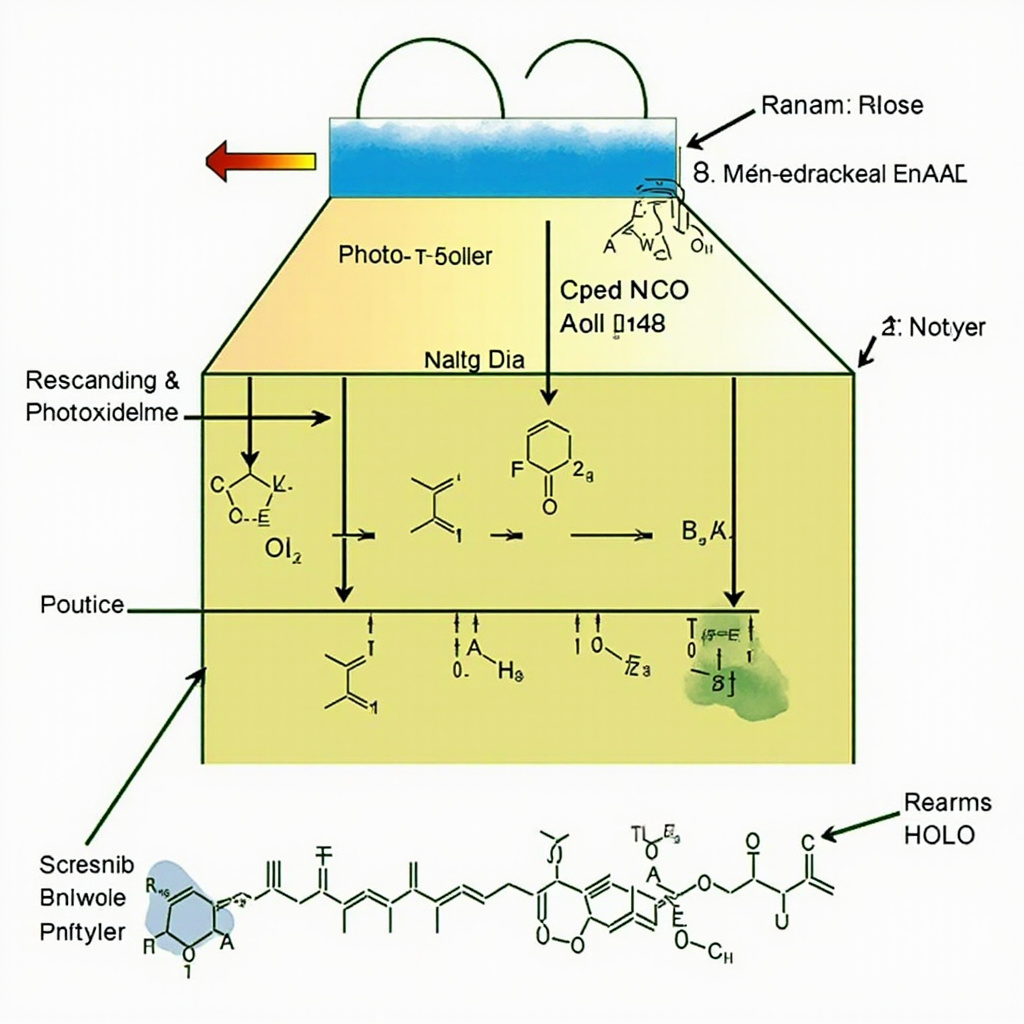
Nano-TiO2/ZnO-UV-Abschirmung: Nano-TiO2 (Rutil, Bandlücke 3,0–3,2 eV, Absorptionskante ~390 nm) absorbiert alle UV-Strahlung <390 nm (UVA 315–400 nm, UVB 280–315 nm, UVC <280 nm). Elektronen und Löcher kehren anschließend durch nicht-strahlende Rekombination (Wärmeabgabe) oder Reaktion mit oberflächenadsorbiertem H2O/O2 unter Bildung von ROS in den Grundzustand zurück. Wichtige ingenieurtechnische Überlegung: direkt photoerzeugte ROS können die Harzmatrix der Beschichtung selbst oxidativ abbauen — Nano-TiO2 muss oberflächenpassiviert sein (SiO2- oder Al2O3-Beschichtung), um ROS-Diffusionswege in die Harzmatrix zu blockieren. Nano-ZnO (Bandlücke ~3,3 eV, Absorptionskante ~375 nm) bietet zusätzliche Weißpigment-Funktionalität (RI 2,0) und stärkere UVA-Absorption.
Datenunterstützung: Bereits 2–3 Gew.% Nano-TiO₂ (Rutil, 15 nm, SiO₂-beschichtet) in einem 2K-PUR-Klarlack reduzieren die UV-Transmission (300–380 nm) bei 50 μm DFT von >85 % (reines Harz) auf <5 %. Nach QUV 4000 h (ASTM G154, UVA-340) beträgt ΔE 85 %. Ungeschützte Kontrolle: ΔE >15 nach 2000 h, Glanzerhalt <40 %.
Quellen: SONGWON SABO®STAB, ASTM G154, ExxonMobil Exxtral™ TPO Datenblatt
CPO-Haftvermittler — Lösung des Problems „haftet nicht“
PP und TPO sind notorisch schwer zu beschichtende Substrate – extrem niedrige Oberflächenenergie (~29–31 mN/m gegenüber PU-Beschichtung ~40 mN/m) und völlig unpolar. CPO-Haftvermittler führen Chloratome (Elektronegativität 3,16) in das PP-Rückgrat ein und erzeugen C-Cl-Dipole, die die Oberflächenenergie auf 35–40 mN/m anheben – und so polare Ankerpunkte für Beschichtungsharze bieten. Die einzigartige „amphiphile“ Molekülstruktur von CPO: (1) Das Polyolefin-Rückgrat (homogen mit PP/TPO) interdiffundiert und verstrickt sich mit den Oberflächenketten des Substrats; (2) die chlorierten Segmente (15–30 Gew.% Cl) liefern Wasserstoffbrücken- und Dipol-Dipol-Wechselwirkungen mit den funktionellen Gruppen der PU/Acrylat-Beschichtung. Maleinsäureanhydrid-pfropf-COPO (CPO-g-MAH) bietet zusätzlich kovalente -NCO-Reaktionsanker.
Datenunterstützung: Unbehandeltes PP: 2K-PU-Haftzugfestigkeit 80 %.
Quellen: Handbuch für Automobillacke und Beschichtungen, ASTM D4541
FAQ
Kann der Nano-Klarlack den UV-Schutz des Basislacks vollständig ersetzen?
In eingefärbten Formteilsystemen trägt der Nano-Klarlack die alleinige Verantwortung für den UV-Schutz – hierfür sind höhere Nano-TiO2/ZnO-Gehalte (3–5 Gew.% gegenüber 1–2 Gew.% konventionell) sowie höhere HALS-Konzentrationen (1–1,5 Gew.%) erforderlich, um eine Außenbeständigkeit von >10 Jahren sicherzustellen.
F: Ist der Chlorgehalt des CPO-Primers umweltschädlich?
Der CPO-Primer weist eine extrem geringe Trockenfilmdicke (DFT) auf (3–5 μm, ~3–5 g/m²), entsprechend ~200–400 g festem CPO pro Fahrzeug. Im Vergleich zur PVC-Unterbodenbeschichtung (8–15 kg chlorhaltiges Material pro Fahrzeug) ist die Umweltauswirkung von CPO vernachlässigbar. Halogenfreie Haftvermittler (wässrige PP-g-MAH-Dispersionen) befinden sich in der Entwicklung und sind für die Massenproduktion in den Jahren 2027–2028 vorgesehen.
Referenzen: SONGWON SABO®STAB, ASTM G154, SAE J2527, Handbuch für Automobillacke und -beschichtungen, ExxonMobil/SABIC/LyondellBasell TPO Datenblätter
Veröffentlicht: 6. Juli 2026 | Kategorie: Technisches Wissen