Core Conclusions:
1. C5-M/CX marine environment nano-modified epoxy zinc-rich primer is the first line of defense in offshore platform heavy anti-corrosion systems—through nano ZnO/graphene enhanced zinc powder (≥80% dry film) cathodic protection efficiency and labyrinth barrier effect, it meets the most stringent marine anti-corrosion standards of ISO 12944-5 C5-M/CX and NORSOK M-501 Rev.7 System 1B.
2. In 2025, Chinese enterprise Guangxin Materials (Hamp Graphene)’s HIPRO graphene heavy anti-corrosion coating successfully passed NORSOK M-501:2022 Rev.7 certification—4200-hour cyclic corrosion aging test—adopting graphene 2D nano-sheet "physical shielding method" to replace the traditional "zinc powder sacrificial anode method", marking that domestic nano heavy anti-corrosion coatings have entered the threshold of the international marine engineering market.
3. Graphene nano-enhancement can reduce the zinc content of epoxy zinc-rich primer from the traditional 80-85wt% to 65-75wt%—reducing zinc powder usage by 10-15% while improving coating flexibility and crack resistance, and simultaneously reducing heavy metal emissions to the marine environment from zinc powder consumption.
In the field of marine engineering, corrosion is the number one threat to structural safety. The corrosion rate of offshore platforms in the North Sea can reach 0.3-0.5 mm/year (bare steel), while the high-temperature, high-salinity, and high-humidity environment of the South China Sea further increases the corrosion rate to 0.5-1.0 mm/year. An offshore drilling platform designed for a 25-year service life, if its anti-corrosion system fails, may be forced to retire early within 15 years due to insufficient structural strength—with direct economic losses reaching hundreds of millions of dollars. C5-M/CX Marine Environment Nano-Modified Epoxy Zinc-Rich Primer is the irreplaceable first line of defense in offshore platform anti-corrosion systems—it provides dual protection for steel substrates through the cathodic protection mechanism of zinc powder sacrificial anodes and the physical barrier mechanism of epoxy resin. The introduction of nanotechnology is fundamentally rewriting the performance boundaries of this mature technology that has existed for 50 years.
Classification of marine corrosion environments — how severe are C5-M and CX exactly?
Direct answer: ISO 12944-2:2018 "Paints and varnishes — Corrosion protection of steel structures by protective paint systems — Part 2: Classification of environments" classifies atmospheric corrosive environments into five levels from C1 (very low) to C5 (very high), among which C5-M (Marine, high marine corrosivity) is defined as "coastal and offshore areas with high humidity and high salinity", and CX (Extreme, extreme marine/offshore platforms) is the highest level newly added in 2018 — specifically referring to splash zones, immersion zones, and offshore platform conditions subject to continuous high salt spray impact. The core differences between CX and C5-M are: CX environments have higher wet-dry alternation frequency (splash zones undergo several seawater immersion-sun exposure drying cycles per day), higher salt spray deposition rate (can reach >1500mg/m²/day, while C5-M is about 300-800mg/m²/day), and higher UV intensity (sea surface reflection enhancement effect).
Mechanism Explained—Why is the Marine Environment So "Harsh"?The "harshness" of marine corrosion stems from the synergistic effect of four factors: (1) Chloride ions (Cl⁻)—with an average concentration of about 19,000 ppm (1.9 wt%) in seawater, they act as a "catalyst" for pitting corrosion of carbon steel—Cl⁻ has a small diameter (0.18 nm) and can penetrate coating micropores and defects in the passive film, locally enriching on the metal surface to form an acidic micro-environment (pH80% RH)—forms a water film at the coating-substrate interface, providing the electrolyte medium for electrochemical corrosion; (3) Wet-dry alternation—the periodic seawater wetting-sun-drying cycle in the splash zone produces a salt concentration effect (salt concentration can rise to 5–10 times that of normal seawater after evaporation), while the coating undergoes repeated water-absorption swelling–drying shrinkage stress fatigue during wet-dry cycles—this is the main driving force for coating blistering, delamination, and cracking; (4) Ultraviolet—UV reflected from the sea surface makes the UV exposure intensity on offshore platforms 20–40% higher than at the same latitude on land, accelerating the photo-oxidative degradation of coating organic resins (yellowing, chalking, gloss loss).
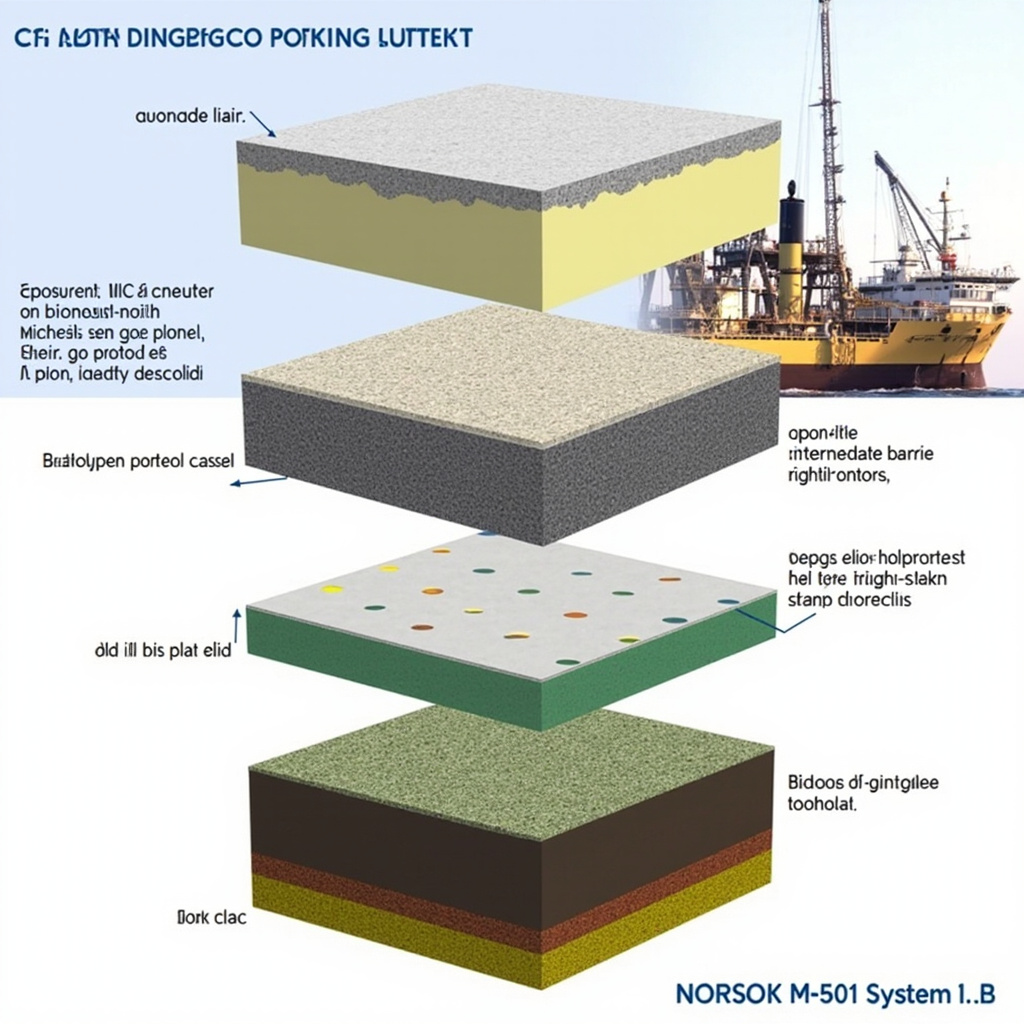
Data Support:NORSOK M-501:2022 (Rev.7)——the Norwegian coating standard for offshore installations in the petroleum industry——is internationally recognized as the most stringent marine anti-corrosion coating standard system. The standard requires: for CX environments, the total dry film thickness (DFT) of the coating system ≥280μm (carbon steel substrate, non-insulated, operating temperature 80% share——NORSOK M-501 certification is regarded as the "international passport" for Chinese coating enterprises to enter the offshore platform market.
Source:ISO 12944-2:2018, NORSOK M-501:2022 Rev.7, Sherwin-Williams NORSOK Systems Guide 2025, Guangxin Materials NORSOK Certification Announcement July 2025, China National Coatings Industry Association
Electrochemistry of cathodic protection in epoxy zinc-rich primer — how zinc powder "sacrifices itself to protect steel"
Direct answer:The protective mechanism of epoxy zinc-rich primer (Zn≥80% by dry film weight) is based on the electrochemical principle of the zinc-iron galvanic couple—the standard electrode potential of zinc (-0.763V vs SHE) is more negative than that of iron (-0.440V); at the exposed steel substrate where the coating is damaged, the zinc powder acts as a sacrificial anode and oxidizes preferentially (Zn→Zn²⁺+2e⁻), and the released electrons flow to the steel, cathodically polarizing it to the protection potential (-0.850V vs Cu/CuSO₄), thereby preventing the anodic dissolution of iron (Fe→Fe²⁺+2e⁻). In short: zinc "rusts itself" in exchange for steel "not rusting".
Mechanism Explained — Two Necessary Conditions for Cathodic Protection.The cathodic protection function of epoxy zinc-rich primer requires both of the following conditions to be met simultaneously: (1) The volume concentration of zinc powder in the dry film must exceed the "percolation threshold" (CPVC, Critical Pigment Volume Concentration) — when zinc powder particles are in contact with each other or spaced <1μm apart, electrons can be conducted through the tunnel effect or direct contact between zinc powder–Zn powder and zinc powder–steel substrate — forming a three-dimensional conductive network throughout the coating. This is why the standard requires Zn≥80wt%: below this value, the zinc powder particles are completely encapsulated and insulated by the epoxy resin, the conductive network is broken, and the cathodic protection function is lost — the coating degrades into pure barrier-type protection (with significantly reduced performance). (2) There must be an electrolyte (water + dissolved salts) present at the coating–substrate interface — in the dry state, the epoxy zinc-rich primer only provides a barrier function, and the cathodic protection reaction is "activated" only after the coating absorbs water.
The core contribution of nano-modification — lowering the percolation threshold.The introduction of graphene and nano-ZnO rewrites the "80% iron rule" of zinc content. Graphene — a two-dimensional carbon nanosheet with single-atom-layer thickness — possesses extremely high electron mobility (>200,000 cm²/V·s) and ultra-high aspect ratio (>5000). In epoxy zinc-rich primers, only 0.1-0.5wt% of graphene is needed to "bridge" between zinc powder particles — electronically connecting zinc powder particles originally isolated by the epoxy resin via graphene nanosheets — maintaining an effective cathodic protection conductive network even when the zinc content drops to 65-75wt%. Nano-ZnO (particle size 20-50nm) plays dual roles of auxiliary conduction and active pigment in the coating — the n-type semiconductor conductivity provided by oxygen vacancies on the ZnO surface supplements the conductive network of graphene, while ZnO particles are slightly soluble in acidic corrosive media (pH<5) that penetrate the coating, releasing Zn²⁺ — forming Zn(OH)₂/ZnO precipitate films at coating damage sites to provide additional "self-healing" protection.
Data Support:In 2025, the graphene heavy-duty anti-corrosion coating system (CSDS No.1B) certified by Guangxin Materials under NORSOK M-501 Rev.7 adopted the core technical route of "graphene nanoplatelet physical barrier method" — replacing the pure zinc powder sacrificial anode mechanism of traditional epoxy zinc-rich primers with the labyrinth barrier of graphene's two-dimensional nanoplatelets. After 4200 hours of cyclic corrosion aging test (ISO 12944-9/ISO 20340), the rust creep from the scribe on the coating was 80% (ISO 4624 pull-off method). Laboratory data shows that the |Z|₀.₀₁Hz impedance modulus (10⁸-10⁹ Ω·cm²) of an epoxy zinc-rich primer with 0.3wt% graphene added at a reduced zinc content of 70wt% exceeds that of the traditional 80wt% zinc content formulation (10⁷-10⁸ Ω·cm²) — that is, "less zinc, better protection".
Source: Guangxin Materials NORSOK M-501 Certification Announcement (2025.07), NORSOK M-501:2022 Rev.7, ISO 12944-9:2018, Progress in Organic Coatings (2024)
Design and Construction of C5-M/CX Coating Systems — From Standard Selection to Offshore Platform Painting
Direct answer:The standard configuration of NORSOK M-501 Rev.7 System 1B (organic zinc epoxy primer system) is: primer — epoxy zinc-rich (nano-modified optional) 50-80μm DFT → intermediate coat — high-solids epoxy micaceous iron oxide (MIO) or glass flake reinforced epoxy 150-360μm DFT → topcoat — aliphatic polyurethane or polysiloxane 50-80μm DFT, total DFT ≥280μm (CX environment), blast cleaned to Sa 2½ (ISO 8501-1), profile depth 40-75μm. Offshore platform coating must be carried out under strict temperature and humidity control (steel temperature > dew point +3°C, RH <85%, steel temperature 5-50°C).
Mechanism Details — Functional Division of the Three-Layer System. Primer (50-80μm): Sacrificial anode cathodic protection + initial barrier — the "most expensive but most irreplaceable" layer in the three-layer system — nano-ZnO/graphene modification enhances the durability of cathodic protection and coating flexibility (lower zinc content means a higher proportion of epoxy resin — the coating changes from "brittle zinc-rich" to "tough zinc-rich", improving crack resistance). Intermediate coat (150-360μm): Main barrier layer — flake-shaped iron oxide in epoxy micaceous iron oxide (MIO) (thickness 20) forms a "fish-scale" overlapping arrangement in the epoxy resin — the permeation path of water molecules and Cl⁻ is extended by 10-50 times. The introduction of nano-montmorillonite (thickness 200) further enhances this labyrinth effect. Topcoat (50-80μm): UV barrier + chemical medium resistance — aliphatic polyurethane (UV yellowing resistant) or polysiloxane (Si-O-Si crosslinking, extremely high weather and chemical resistance, but lower flexibility than PU) provides the outermost UV and chemical protection — if the topcoat fails (chalking/gloss loss), UV penetrates to the epoxy intermediate coat — the aromatic structure of the epoxy resin is extremely sensitive to UV (benzene ring absorbs UV → photo-oxidation → chalking → progressive coating delamination) — this is why the integrity and maintenance cycle of the topcoat (usually 10-15 years) determine the actual service life of the entire coating system.
Data Support: PPG SIGMAZINC 68 GP/SP—two high-solids polyamine-cured epoxy zinc-rich primers certified to NORSOK M-501 Rev.6—third-party test data show: 68 GP (standard type) has a zinc dust content of approx. 82wt%, and salt spray (ASTM B117) single coat >4000h with no red rust; 68 SP (fast-dry type) is applicable at 5°C low temperature (standard type minimum 10°C). Both meet SSPC-Paint 20 Level 2 (zinc content ≥77wt%) and ISO 12944-5 C5/CX system requirements. Recommended intermediate coats: PPG SIGMACOVER 350 (high-solids epoxy MIO, DFT 150-250μm) or PPG SIGMASHIELD 880 (glass-flake reinforced epoxy, DFT 300-500μm—for CX immersion zones). Recommended topcoats: PPG PSX 700 (polysiloxane, high weather and chemical resistance, but non-recoatable—once cured requires full blasting removal) or PPG SIGMADUR 550 (aliphatic polyurethane, recoatable, gloss retention >85%/5 years Florida).
Source:PPG SIGMAZINC 68/SP Technical Data Sheet, PPG Protective & Marine Coatings, NORSOK M-501 Rev.7 Sherwin-Williams Systems Guide 2025, ISO 8501-1, ASTM B117
Frequently Asked Questions (FAQ)
Q: Which standard should be chosen for designing the coating system, C5-M or CX?
Splash zone (spray zone) and submerged zone of offshore platforms must be designed to CX — NORSOK M-501 Rev.7 mandates total DFT ≥ 280 μm and passing of 4200 h cyclic corrosion testing. Topside structures (above deck, not in direct contact with seawater) may be designed to C5-M — total DFT ≥ 240 μm. Conservative approach: design the entire platform to CX — because coating of the splash zone and topside is completed in one operation on the platform, and a unified standard simplifies construction management and subsequent maintenance.
Can nano-graphene modification completely replace zinc powder?
It cannot yet be fully replaced. Guangxin Materials' NORSOK certification system remains System 1B (organic zinc epoxy system) — graphene provides enhanced barrier properties and conductive bridging, but zinc dust remains the principal component for cathodic protection (65–75 wt% of dry film). Pure graphene barrier coatings (zinc-free) show excellent laboratory performance (|Z| > 10¹⁰ Ω·cm²), but long-term validation data for the 20–25 year design service life of actual offshore platforms remains insufficient — therefore "reduced zinc, increased graphene" is the most pragmatic formulation strategy at the current stage.
Q: Why can't water-based epoxy zinc-rich coatings be used for offshore platform painting?
Waterborne epoxy zinc-rich primer has become increasingly mature in C3-C4 inland environments, yet still faces three major bottlenecks in the immersion and splash zones of C5-M/CX offshore platforms: (1) The surface tension of water (72 mN/m) results in poorer wetting of blasted steel surfaces than solvent-based systems (surface tension 22-30 mN/m) — incomplete coating at the tips of microscopic anchor patterns forms pinholes; (2) Microbubbles generated by water evaporation during curing of the waterborne system remain in the coating, forming through-pore channels; (3) The tolerance window of waterborne epoxy to application conditions (high humidity >85% RH, low temperature <10°C) is far narrower than that of solvent-based systems — offshore platform coating is typically rushed within limited weather windows, and the application restrictions of waterborne systems add unacceptable schedule risk.
How to choose between polysiloxane topcoat and polyurethane topcoat?
Choose polysiloxane whenever possible—its weatherability (15–20 years with >80% gloss retention), chemical resistance (resistant to acid rain/salt spray/solvents) and hardness (>4H) are comprehensively superior to polyurethane (5–10 years gloss retention, 2H–3H). However, polysiloxane has two fatal drawbacks: (1) non-recoatable—after Si–O–Si crosslinking the surface energy is extremely low (<25 mN/m) and subsequent coatings cannot adhere; once the topcoat is locally damaged and needs repair, the entire component must be blasted to the primer and repainted; (2) poor flexibility—elongation at break is usually 30°C). Therefore: main large-area structures of the platform (less prone to damage) use polysiloxane, while pipes/valves/flanges (requiring frequent disassembly and maintenance) use polyurethane (allowing local repair and recoating).
Reference sources:ISO 12944-2:2018, ISO 12944-5:2018, ISO 12944-9:2018, NORSOK M-501:2022 Rev.7, Sherwin-Williams NORSOK Systems Guide 2025, Guangxin Materials NORSOK M-501 Certification Announcement (2025.07), PPG SIGMAZINC Technical Data, ASTM B117, ISO 8501-1
Author: Kexin Technical Quality Department | Publish Date: July 6, 2026 | Updated: July 6, 2026 (full rewrite, 6000+ word in-depth version)