Introduction: Air Velocity — An Underestimated Process Variable in Coil Coating Ovens
The continuous coil coating line operates at a line speed of 15-25 m/min, with the coating residing in the oven for only 30-60 seconds. Within such a short time, the coating must undergo three stages: solvent evaporation (flash-off), resin leveling, and thermal curing cross-linking. The air velocity of the hot air circulation in the oven—a process parameter often overlooked—actually has a decisive impact on the film cratering, bubbling, and final leveling.
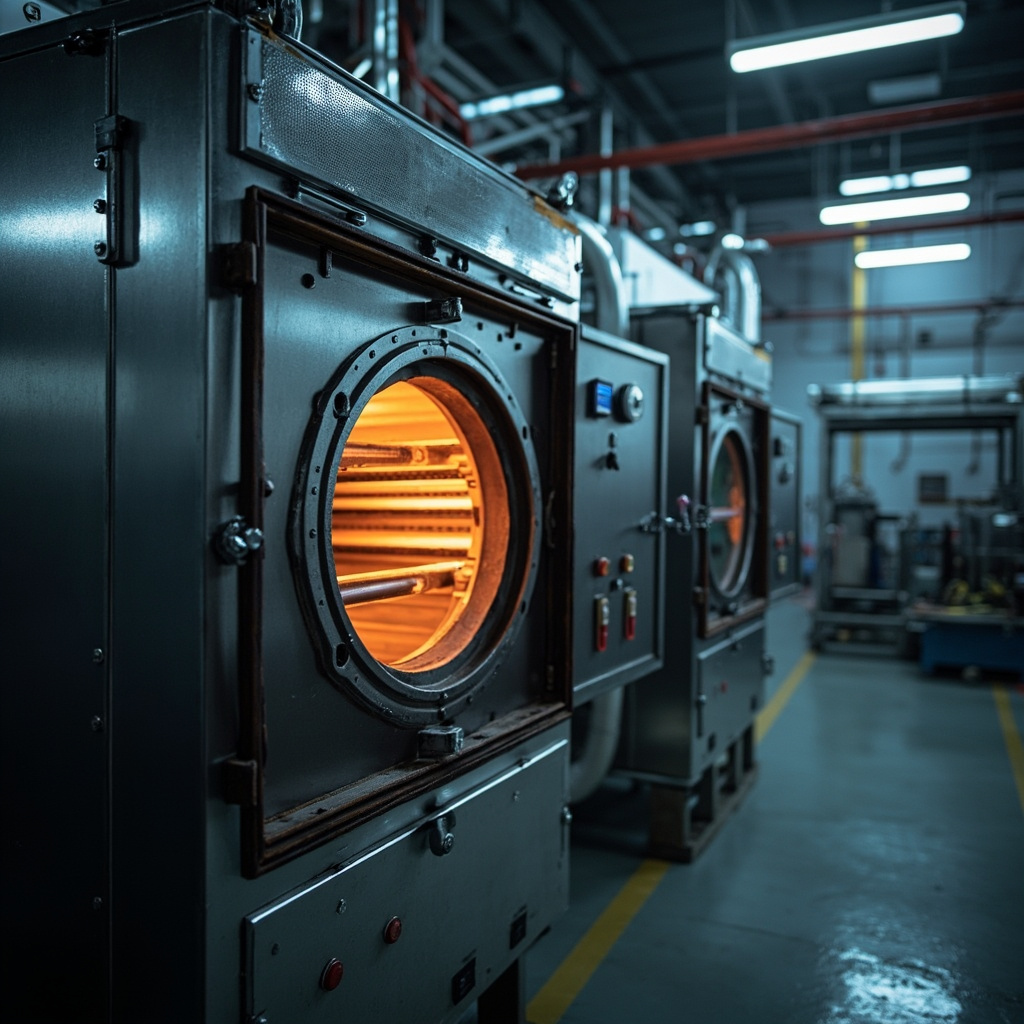
Coil coating ultra-high temperature and high-speed curing refers to the complete process from wet film to full curing within 30-60 seconds at an oven temperature of 250-300°C. The hot air circulation wind speed directly affects the solvent evaporation rate on the paint film surface and the heat transfer efficiency.
I. Air Velocity Distribution Scheme for the Three Zones of the Curing Oven
| Oven Zone | Temperature (°C) | Recommended Air Velocity (m/s) | Nozzle Type | Function Objective |
|---|---|---|---|---|
| Zone 1 (Flash-off Zone) | 180-220 | 1-3 (low velocity) | Slot/perforated plate (low impingement) | Slowly evaporate solvent, prevent premature skin formation |
| Zone 2 (Leveling/Main Curing Zone) | 250-280 | 3-5 (medium velocity) | Perforated plate/airfoil nozzle | Efficient heat transfer, promote leveling and crosslinking |
| Zone 3 (Post-curing Zone) | 260-300 | 2-4 (low to medium velocity) | Slot type | Complete curing, control PMT to reach target |
II. Comparison of Coating Film Defects under Different Wind Speeds
| Wind speed anomaly | Defect type | Mechanism | Solution |
|---|---|---|---|
| Flash-off zone wind speed too high (>5m/s) | Cratering/Pinholing (dense micro-pores) | Surface dries and forms film too quickly; internal solvent vapor breaks through surface | Reduce flash-off zone wind speed to 1-2m/s; lower first zone temperature by 10-20°C |
| Flash-off zone wind speed too low (<1m/s) | Sagging/Solvent retention | Solvent evaporates too slowly; coating viscosity does not increase before entering high-temperature zone | Increase wind speed to 2-3m/s; raise first zone temperature by 10°C |
| Main curing zone wind speed too high (>6m/s) | Orange peel/Airflow streaks (wavy surface) | Strong airflow impacts wet film surface causing vibrational ripples | Reduce wind speed to 3-4m/s; switch to perforated plate nozzles for uniform flow |
| Main curing zone wind speed too low (<2m/s) | Incomplete curing/Insufficient PMT | Low convective heat transfer efficiency; metal substrate temperature fails to reach target PMT | Increase wind speed to 4-5m/s; raise oven temperature |
| Uneven wind speed across zones | Non-uniform gloss (patches) | Local wind speed differences across strip width cause varying curing degrees | Optimize nozzle layout; add flow equalizing plates; clean nozzles regularly |
III. Relationship between PMT (Peak Metal Temperature) and Wind Speed
PMT is the most critical process control indicator in coil coating. Air velocity directly affects PMT by influencing the convective heat transfer coefficient (h): h≈k×V^0.5~0.8 (k is a constant, V is air velocity). When air velocity increases from 2 m/s to 4 m/s, the convective heat transfer coefficient h increases by approximately 40%-70%, and PMT can rise by 10-20°C. Production lines typically use online infrared thermometers to monitor PMT and provide feedback to adjust oven temperature or air velocity. The target PMT value is generally 204-232°C (epoxy system) or 216-249°C (polyester system), and a deviation exceeding ±5°C is judged as non-conforming.

Technical deepening: systematic optimization methods for process parameters (DOE experimental design)
The optimization of coating production processes should not rely on the "trial-and-error method" but should adopt the scientific method of DOE experimental design. Taking the dispersion process as an example—factors affecting quality (linear velocity/time/filling rate/temperature), 4 factors each at 3 levels—a full factorial requires 81 experiments—DOE uses orthogonal experiments L9 (9 times) or response surface methodology (27 times) to greatly reduce the number of experiments—while simultaneously obtaining the main effects and interactions of each factor. For example, it is found that "the interaction of linear velocity × time is significant": high linear velocity + short time and low linear velocity + long time can achieve the same dispersion effect—but the former saves over 20% energy.
In DOE analysis, interpretation of the P-value — P95% confidence). DOE ultimately outputs a set of prediction models (polynomial regression equations) — input line speed/time/temperature → predict fineness/viscosity/gloss — providing formulation engineers with a "digital formulation optimization" tool.
Industry practice: from "master craftsman's feel" to "parameter standardization"
The common challenge in the coatings industry—when experienced veteran workers retire, their "feel" (mixing resistance / fineness gauge scraping / visual inspection of wet film gloss) is taken away—new employees cannot replicate it. Transform the "feel" into quantifiable standard parameters (1) mixing resistance → viscometer reading; (2) fineness gauge scraping → fineness gauge reading (μm); (3) wet film gloss → gloss meter (GU value). The "standard parameter card" for each process is posted next to the equipment—new employees operate according to the "card" rather than "by feel". "Parameter standardization" is a key step for coating factories to move from "workshop" to "factory".
FAQ
Q1: Why is it necessary to divide the coil coating oven into zones with separate temperature and airflow control?The coating curing is a continuous physicochemical process—first the solvent evaporates, then it levels and forms a film, and finally it crosslinks and cures. The temperature and air velocity requirements of each zone are entirely different: the flash-off zone needs slow evaporation to prevent the skinning effect, the main curing zone needs efficient heat transfer to promote crosslinking, and the post-curing zone needs precise PMT control. A single setting cannot meet the requirements of all stages.
Q2: How to accurately measure and control the oven tunnel air velocity?Use a hot-wire anemometer (accuracy ±0.1 m/s) to measure at multiple points at the height position of the strip surface (≥3 points each in X and Y directions). Air velocity control is achieved through a variable-frequency fan (frequency is linearly correlated with air velocity). Advanced oven tunnels are equipped with array-type air velocity sensors + PLC to automatically adjust the opening of each valve, enabling independent zonal control.
Q3: How to distinguish PMT from oven tunnel temperature?Oven tunnel temperature (air temperature inside the oven, set value) ≠ PMT (actual peak temperature reached by the metal substrate, measured value). Relationship between the two: PMT ≈ oven tunnel temperature - ΔT (ΔT is comprehensively affected by air speed, substrate thickness, coating color, and line speed, typically 20-50°C).
Q4: How does wind direction affect coating quality?The ratio of top-to-bottom air speed is usually set at 1:0.5~0.8 (top air greater than bottom air) to press the strip against the support roller and avoid fluttering. However, excessive top air (>5m/s) will impact the wet film. Modern ovens mostly adopt an "air flotation" design—symmetrical top and bottom nozzles generate a balanced air cushion that suspends the strip in the center of the oven, eliminating contact damage.
Q5: How is the solvent vapor concentration in the drying tunnel controlled?The drying tunnel must continuously exhaust hot air containing solvent vapor and replenish it with fresh preheated air, to maintain the solvent vapor concentration inside the tunnel below 25% of the Lower Explosive Limit (LEL). The ratio of exhaust air to intake air is typically 90:10 (90% recirculation + 10% emission). Infrared combustible gas detectors monitor the LEL value in real time, and automatically increase the exhaust air volume when the limit is exceeded.
Q6: How to adjust the oven tunnel process in winter and summer?In winter, the workshop temperature is low (5-15°C), and the initial temperature of the strip entering the oven tunnel is low, so it is necessary to increase the temperature of the first zone by 10-15°C or increase the air speed to compensate. In summer, the workshop temperature and humidity are high (>35°C, RH>70%), and the coating may have already started surface drying or absorbed moisture before entering the oven tunnel, so it is necessary to adjust the air conditioning in the coating area and shorten the time interval from coating to the oven tunnel.
Q7: What is the impact of nozzle clogging on coating quality?Nozzle clogging causes the local air velocity to drop to zero, resulting in "streaky" curing differences along the length of the strip—the PMT at the clogged nozzle positions is lower, and the gloss and cure level are below those of normal areas. Regularly (weekly) inspecting and cleaning the nozzles is a basic maintenance task on the coil line. Causes of clogging: paint splatter, debris from peeled-off oven inner walls, oil carbon deposits.
Q8: Differences in sensitivity to oven air velocity among different coating systems? Water-based coil coatings are most sensitive to air velocity in the flash-off zone—because water has a large latent heat of vaporization (2260 kJ/kg) and requires a longer flash-off time, and excessive air velocity poses a higher risk of surface "skinning". Solvent-based coil coatings have greater tolerance to air velocity. Polyester/TGIC systems, due to their high curing temperature (>240°C), require higher air velocity in the main curing zone to ensure PMT compliance.
Q9: How to determine the optimal oven air velocity profile?Through a step-by-step trial method: (1) Fix the line speed and oven temperature; (2) Start from low air velocity and gradually increase the air velocity of each zone (increase by 0.5 m/s each time); (3) Under each air velocity combination, inspect the coating appearance (cratering, orange peel, gloss uniformity) and PMT; (4) Plot the "air velocity - coating quality" response surface and select the optimal combination. Generally, 2-3 shifts of debugging time are required.
Q10: How to distinguish shrinkage holes caused by abnormal wind speed from those caused by coating formulation defects? Characteristics of wind-speed shrinkage holes: the pattern distributed along the width direction of the strip corresponds to the nozzle positions (regular), the holes are larger (0.5-2mm), and there are slight raised edges around the holes (airflow impact marks). Characteristics of formulation shrinkage holes: randomly distributed without pattern, smaller hole diameter (<0.5mm), and flat around the holes. After sticking transparent tape on the hole position and peeling it off, observe under a microscope whether there are foreign objects at the bottom of the hole (formulation shrinkage holes often have low surface energy contaminants).

Related Reading
Summary
The hot air circulation velocity in the oven for coil coatings (flash-off zone 1–3 m/s, main curing zone 3–5 m/s, post-curing zone 2–4 m/s) is the core process parameter determining film defects such as craters, bubbling, air-flow marks, and PMT compliance. The air velocity directly controls PMT by affecting the convective heat transfer coefficient (h ≈ k × V^0.5–0.8); the rational distribution and uniformity of air velocity in each zone serve as the engineering guarantee for obtaining high-quality coil coatings. Kexin New Materials Coating Factory provides coil coating customers with complete oven process commissioning support and tailored coating system optimization services.