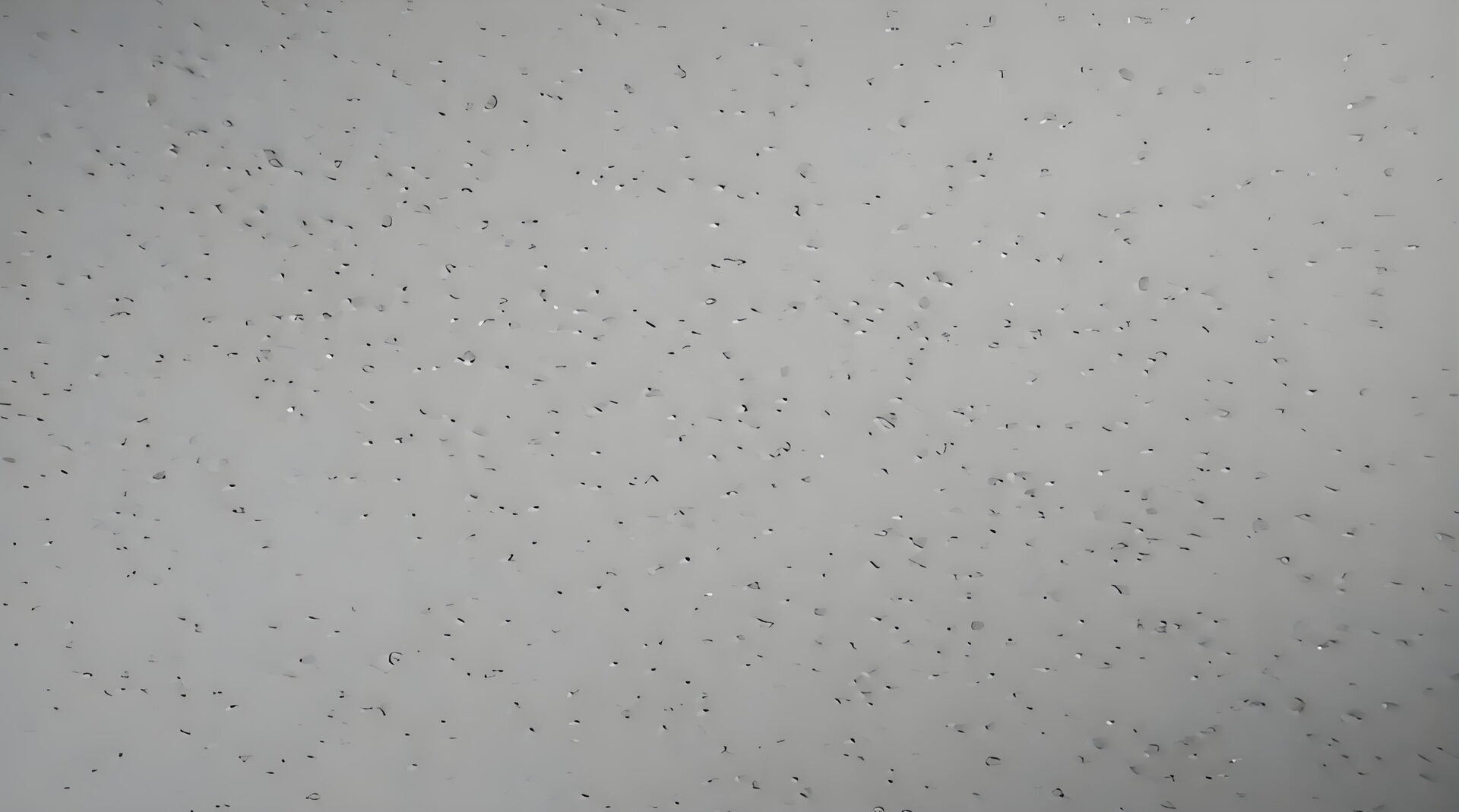
Pinholes and solvent pop (boiling, also called boil, fish-eyes in some trades) in furniture coatings are the two end states of a single film-formation defect: air or solvent vapour sealed inside the wet film fails to escape before the surface closes over, and the escape channel then freezes in place — where the crater breaks through and opens down to the substrate you have a pinhole; where the bubble stays capped by a thin skin and reads as a raised micro-dot you have solvent pop. The causal chain is identical, so the useful question on a finishing line is not "is this a pinhole or a boil" but "how thick is this wet film, how far apart are the surface and bottom evaporation rates, and how many seconds do I have for degassing".
This article reduces that chain to checkable quantities: relative solvent evaporation rates, the latent heat of vaporisation of water, bubble rise times calculated from Stokes' law, and the assessment conventions set by GB/T 4893 and ISO 4628. A parameter table for the shop-floor work instruction follows at the end.
One-minute summary (TL;DR)
- One defect, two looks. Pinhole and solvent pop both come from a surface-to-bottom evaporation mismatch plus gas that cannot get out. Field scale is roughly 0.1 mm (100 µm) in diameter — the same order as earlywood vessels in oak, measured at 100–400 µm, which is why ring-porous species are high-risk under a built-up finish.
- Water is the tail. On the butyl acetate = 1.0 scale, water has a relative evaporation rate of 0.36, falling to 0.06 at 65% RH — about 1/17 of the reference. A waterborne topcoat already has a shorter "no skin yet" window than a solventborne one, and humidity closes it further.
- Film build is the leading variable. Keep a single waterborne pass at 15–20 µm dry; above 25 µm dry the boil risk rises sharply. For solventborne PU, a wet film of 80–120 µm is already the practical ceiling.
- Stage the bake. Ambient flash-off 5–10 min, then 50–60 °C for 5–8 min, then 75–85 °C for 10–15 min. Moving panels straight into a oven above 70 °C is a frequent shop-floor error.
- Degassing time is calculable. By Stokes' law a 50 µm bubble crosses a 60 µm wet film in about 4.4 s at 100 mPa·s but needs roughly 18 min at 1 000 mPa·s. The tens of seconds before touch-dry are the entire budget.
- Delayed onset. Residual high-boiling coalescent keeps leaving for 1–3 days, so a same-day pass does not certify the batch — especially with crosslinking and UV-hybrid systems.
- Acceptance is standardised. GB/T 4893.7-2013 (heat and cold cycling) inspects at 4× magnification and fails a specimen on any blister, without regard to shape, size or count. ISO 4628-1:2016 expresses quantity and size separately on 0–5 scales.
1. Telling them apart: pinhole, boil, crater, blister, orange peel
Definitions
The common industry split is that a boil is an unbroken micro-bubble while a pinhole is the depression left after that bubble bursts; they share one origin and differ only in whether rupture happened. An unbroken boil feels like a hard dome under the fingertip; a burst one leaves a funnel-shaped cavity, narrow at the mouth and wide below, which catches light obliquely and shows badly on dark stains.
Two look-alikes must be excluded at the same time. A crater comes from substrate or intercoat contamination and usually shows residue or a bare patch on its floor: its cause lies in surface tension, not in degassing. Orange peel is continuous waviness from insufficient levelling, not discrete holes. Excess defoamer produces craters that look remarkably like pinholes, and this is the main misdiagnosis on site — lengthening flash-off time to fix a crater problem makes both defects worse.
Field identification table
| Defect | When it forms | Morphology | Opens to substrate? | Leading control variable |
|---|---|---|---|---|
| Pinhole | At or shortly after touch-dry, or burst during cure | Discrete small round opening, 50–100 µm, collapsed mouth | Yes, and it telegraphs into the next coat | Film build × surface/bottom evaporation difference |
| Solvent pop / boil | Early in the bake; can appear 1–3 days later | Unbroken micro-domes, densely distributed, dulled tops | No; a cavity sits inside the film | Ramp rate and flash-off time |
| Crater | Immediately, while wet | Depression with residue or bare spot on the floor, raised rim | Not necessarily | Surface tension and substrate cleanliness |
| Blister (wet film) | During spraying | Large and soft, elastic under pressure, bursts on pricking | No | Air entrained in mixing, atomisation pressure |
| Orange peel | During levelling | Continuous waviness, not discrete holes | No | Viscosity and open time |

Blistering and delamination after a recoat. Blistering and pinholes share the same "gas trapped between layers" pathway; the only difference is whether the surface was broken through.
2. Mechanism: solvent leaves in two stages, and the surface skins over
Stage one: evaporation control
The first part of volatile loss is evaporation-controlled and depends on the solvent itself — volatility, film temperature, vapour pressure. This stage decides whether the wet film builds cohesive strength quickly enough to resist sag. Industry blends solvents against butyl acetate = 1.0: fast volatiles (acetone 7.2, ethyl acetate 5.25, methyl ethyl ketone 4.65) set the film quickly, medium ones (toluene 1.95, xylene 0.68) carry levelling and aluminium flake orientation, slow ones (propylene glycol methyl ether acetate PMA 0.34, cyclohexanone 0.25, butyl glycol 0.10) stretch open time.
Failure sits at both extremes. Published technical literature records a very specific case: an aliphatic polyurethane sprayed with the "light" (fast) reducer on a hot day or a hot panel produced hundreds of fine pinholes. Same formulation, same gun — only the reducer evaporated too quickly, the surface sealed early, and the solvent below had nothing to do but break through.
Stage two: diffusion control and free volume
Once the surface has dried in, the remaining solvent can no longer evaporate freely; it must diffuse through a viscoelastic film. The usual working image is a crowded room: the voids left between resin molecules are the corridors, and crosslinking narrows them continuously, so solvent molecules have to shuffle from one gap to the next. Some get out slowly; some never do. Three consequences follow:
- The thicker the film, the longer the diffusion path — the penalty on degassing time scales with the square of thickness, not linearly.
- The earlier crosslinking starts, the faster the diffusion coefficient collapses; a surface that crosslinks ahead of the bulk welds the channels shut.
- Baking raises solvent activity and simultaneously accelerates surface closure: internal pressure rises and, if diffusion cannot keep up, blisters or pops form.
What the skinning model quantifies
The one-dimensional numerical model for spin and solution casting (Bornside, Macosko and Scriven, 1987, DOI: 10.1063/1.343754) reaches a directly transferable conclusion: a solid "skin" of low solvent concentration, high viscosity and low binary diffusivity develops from the free surface downward, and defects appear if convective flow has not ceased by the time that skin forms. The same model gives two suppression routes, which map exactly onto two shop-floor actions: use a mixed solvent package (high and low volatility together), and partially saturate the overlying gas with solvent to slow surface solvent loss. The first is why reducers are graded for summer and winter; the second is why an oven needs forced extraction — solvent vapour must be removed rather than allowed to saturate the chamber.
Evaporative cooling: the same humid day gives you blush and pinholes
Evaporation costs heat. Water's latent heat of vaporisation is about 2 454 kJ/kg at 20 °C (2 501.0 kJ/kg at 0 °C, 2 257.2 kJ/kg at 100 °C), whereas butyl acetate needs only 309.3 J/g at its boiling point — water removes about 7.9 times more heat per unit mass. A waterborne film therefore cools its own surface far more than a solventborne one; once that surface falls below the dew point, moisture condenses into the film. Scattered light reads that as blushing, and the condensed water adds yet more volatile that has to get out. One chain — evaporative cooling, condensation, degassing — explains why blush and pinholes arrive together in the rainy season.
3. Where the gas comes from: three sources and their budgets
Source one: air entrained in the paint (this part is calculable)
High-shear mixing, circulation pumps and gravity-cup return lines all pump air into the paint. Whether a bubble escapes follows Stokes' law, terminal velocity v = 2r²(ρliquid−ρgas)g / 9η: velocity is proportional to the square of bubble radius and inversely proportional to viscosity. Taking a density difference of 999 kg/m³ and a 60 µm wet film to cross:
| Bubble diameter | Wet-film viscosity | Rise velocity | Time to cross 60 µm of wet film |
|---|---|---|---|
| 50 µm | 100 mPa·s | about 13.6 µm/s | about 4 s |
| 50 µm | 500 mPa·s | about 2.7 µm/s | about 22 s |
| 50 µm | 1 000 mPa·s | about 1.4 µm/s | about 44 s |
| 10 µm | 100 mPa·s | about 0.54 µm/s | about 110 s |
| 10 µm | 1 000 mPa·s | about 0.054 µm/s | about 18 min |
The conclusion is blunt: raising viscosity from 100 to 1 000 mPa·s multiplies degassing time tenfold for the same bubble, and reducing the diameter from 50 µm to 10 µm — precisely the scale produced by high-shear atomisation and fine fluid tips — multiplies it another twenty-five times. Let the mixed paint stand 5–10 min to degas, drop atomising pressure from 0.5–0.6 MPa to 0.3–0.4 MPa, and use a 1.2–1.5 mm fluid tip rather than a finer one: all three actions are supported by this single table. Newtonian thickeners such as hydroxyethyl cellulose recover viscosity quickly after application and tend to cap bubbles in place; associatively thickened polyurethanes shear-thin and recover slowly, which leaves the bubbles the time they need.
Source two: atomisation, gun handling and compressed air
Excess atomising pressure injects air into the mist and lays a dry skin on the film; too little pressure gives coarse droplets and traps air between overlapping passes. Put these on one checklist: dynamic inlet pressure measured at the gun with the trigger pulled (not the wall gauge), compressor and water-separator drain condition, whether an inline oiler is in the paint circuit, fan overlap of 1/2 to 2/3, gun distance 15–25 cm, travel speed 30–50 cm/s, and panel temperature matched to air temperature — a hot panel is equivalent to using too fast a reducer.
Source three: substrate outgassing
Earlywood vessels in ring-porous species are open-ended microtubes. Oak earlywood vessel diameters commonly fall in the 100–400 µm range, and in red oak the heartwood vessels are almost devoid of tyloses, so the cavities remain channels for both air and capillary uptake the moment the substrate dries. As the sealer coats over, the trapped air is pushed out and, if it cannot escape, leaves a pinhole; a single sealing pass above 80 µm wet makes this much more likely. Solventborne and UV systems add a second route: vessel walls are rough, with ray cells and micro-burrs, so filler cannot expel the air inside, and on cure or baking that residual air expands and domes the surface into boil-like bumps. The countermeasure is to separate the duties: make the first sealer pass a thin 40–60 µm wet "wick" coat that lets the pores vent, then build flatness in the second pass.
4. Formulation side: the triangle of volatility gradient, defoaming and levelling
Post the solvent table in the let-down room
| Solvent | Relative evaporation rate (butyl acetate = 1.0) | Normal boiling point / °C | Role in the pinhole–boil chain |
|---|---|---|---|
| Acetone | 7.2 | 56–57 | Skins almost instantly on a warm panel |
| Ethyl acetate | 5.25 | 75.5–78 | Fast set; needs a slow partner in nitrocellulose and sealers |
| Methyl ethyl ketone | 4.65 | 79–80 | Strong solvent, fast; avoid high loading in summer |
| Toluene | 1.95 | 110–111 | Medium-fast; balances set and levelling |
| Xylene | 0.68 | 139–142 | Medium-slow; typical in winter blends |
| Water | 0.36 (0.06 at 65% RH) | 100 | The tail component in waterborne systems, humidity-sensitive |
| Propylene glycol methyl ether acetate (PMA) | 0.34 | about 145 | Coalescent; raise its share in summer to suppress pinholes |
| Cyclohexanone | 0.25 | 155–156 | Slow; extends open time, but excess causes sag and late boils |
| Butyl glycol | 0.10 | 169–173 | Very slow cosolvent; high retention risk |
The blending logic is a fast–medium–slow gradient: fast volatiles build strength, medium ones complete levelling, slow ones keep an internal pathway open. In waterborne systems a common coalescent blend is roughly medium-volatility ester : fast ether : slow glycol ester ≈ 7 : 2 : 1, dosed at 5%–7% of resin solids. Above about 8%, the high-boiling coalescent only starts leaving after the film has largely crosslinked, and boils appear one to three days later — the classic "passed today, complained about on day three" origin.
You cannot run defoamer and flattener at full dose
Defoamers break and suppress foam; polyether-modified silicone types are typical at 0.2%–0.5%, and dosing them in two steps (about a third at the grind, two thirds at let-down) is more stable than a single addition. Levelling and wetting additives lower surface tension to promote substrate spread, typically 0.1%–0.3%, bringing the paint surface tension to roughly 30–35 mN/m (dyn/cm). The conflict is structural: push surface tension too low or overdose the defoamer and the bubbles are gone but craters appear; run defoamer alone without a levelling aid and the burst hole has no mobility left to close behind it. Fixing pinholes requires rebalancing both, not "adding more defoamer".
Resin, PVC and crosslink rate
Three easily missed formulation variables. First, if the waterborne resin's minimum film-forming temperature (MFT) is too high, latex particles do not fuse at ambient temperature and the film is itself porous, so escape paths become erratic; an emulsion with MFT ≤10 °C markedly improves ambient coalescence. Second, at high pigment volume concentration (PVC), pigment aggregates entrain air and the film's diffusion path becomes tortuous — hydrophobically overcoated pigments plus 0.3%–0.5% wetting dispersant are the standard answer. Third, in self-crosslinking or two-component systems, a fast crosslink rate welds the diffusion channels shut early; trimming the crosslinker or moving to a blocked variant with a higher deblocking temperature trades a little early hardness for a real degassing window.
5. Application side: film build, flash-off and cure schedule
Process window table
| Step | Recommended range | Consequence of exceeding it | How to verify on site |
|---|---|---|---|
| Stand time after let-down | 5–10 min | Entrained air goes straight into the film | No foam or froth on the surface; no chained bubbles when pouring |
| Booth conditions | 20–30 °C, 40%–60% RH | Above 70% RH drying stalls and pinhole probability rises; above 85% the substrate condenses | Thermo-hygrometer plus dew-point comparison against panel temperature |
| Atomising pressure | 0.30–0.40 MPa | Too high entrains air and dry-sprays; too low coarsens the mist | Dynamic inlet pressure measured at the gun, trigger pulled |
| Fluid tip size | 1.2–1.5 mm | Finer tips shear harder and generate more bubbles | Confirm against product TDS and solids content |
| Wet film per pass | 40–60 µm (waterborne); 80–120 µm is the PU ceiling | Boils in thick areas become almost certain | Wet-film comb on selected panels each batch |
| Dry film per pass | 15–20 µm, ceiling 25 µm | Beyond 25 µm the degassing budget is insufficient | Dry-film gauge (GB/T 4893.5 method) |
| Intercoat flash-off | 5–8 min, extend to 10 min at high humidity | Bottom volatiles are sealed in by the topcoat | Touch dry, not tacky; keep a control panel from each batch |
| Cure schedule | Ambient 5–10 min → 50–60 °C 5–8 min → 75–85 °C 10–15 min | Straight into high temperature seals the surface instantly | Record oven ramp rate and measured panel temperature |
| Recoat after sealer | Within 4–8 h of cure | Beyond 24 h intercoat adhesion drops and sanding is required | Cross-cut sampling per GB/T 4893.4 |
How to judge flash-off, and what misjudgement costs
Flash-off exists so the lower coat can finish its evaporation-controlled stage before it is covered. "Touch dry, not tacky" is a good field test, but there are two systematic errors. The first is false dry: the surface is set while the bulk is still solvent-rich, so covering it puts the defect between layers, and late boils and poor intercoat adhesion then appear together. The second is over-flash: once the bottom coat is fully dry, the topcoat's solvent re-swells it, and on dark open-pore finishes you get local lifting and pale patches. The discipline is to log flash-off time together with panel temperature on the traveller, rather than judging by the weather.
Three practices to avoid
- Moving panels into an oven above 70 °C immediately after spraying: the ramp outpaces solvent diffusion and the surface seals at once.
- Adding 10%–15% thinner to speed up output: viscosity collapses, the thixotropic structure is destroyed, sag and pinholes appear together, and diluted solids make actual film build even harder to control.
- Pointing fans at freshly sprayed panels: forced airflow strips solvent from the surface and manufactures exactly the sealing condition you are trying to avoid.
6. Judging and verifying: standard criteria and objective testing
What GB/T 4893 actually asks you to do
GB/T 4893, "Test of surface coatings of furniture", currently runs to ten parts (Part 10 on scratch resistance, GB/T 4893.10-2024, was issued 2024-09-29 and became effective 2025-04-01). The part that bears directly on this defect is Part 7: heat-and-cold cycling is 1 h at 40 ± 2 °C and 95% ± 3% RH, then 1 h at −20 ± 2 °C, transfer within 2 min, for three cycles; specimens are 250 mm × 200 mm, conditioned for 7 days after finishing in still air at not less than 15 °C. Assessment excludes a 20 mm zone from the edges, uses a 4× magnifier on the central area, and a specimen fails if any crack, blister, obvious gloss loss or discolouration appears — the shape, size and number of the defect are not considered. That is a strict criterion, worth stating explicitly in contract technical terms.
Part 4 (adhesion by cross-cut, GB/T 4893.4-2023, issued 2023-11-27, effective 2024-06-01) applies to total film thickness up to 250 µm; cut spacing is 1, 2 or 3 mm depending on thickness and substrate hardness — for soft substrates such as wood at 0–60 µm the spacing is 2 mm — and flaking is graded 0 to 5 by affected area using a 4–6× magnifier (grade 1 means at most 5% of the grid affected). Visual assessment should be carried out under the illumination specified by GB/T 37356: pinholes visible under raking light can simply disappear under diffuse light, which is a frequent cause of buyer and seller reaching different conclusions from the same panel.
Quantifying it with ISO 4628-1
Where a number has to be handed over, use the designation system of ISO 4628-1:2016 (Paints and varnishes — Evaluation of degradation of coatings). Defect quantity and defect size are each rated 0 to 5 — grade 0 invisible under 10× magnification, grade 1 visible at 10×, then increasing to visible to the corrected naked eye, 0.2–0.5 mm, 0.5–5 mm and above 5 mm — and results are written in the form "blisters 2 (S2)", meaning quantity grade 2, size grade 2. Scattered micro-defects are counted by the grid method and illumination follows ISO 13076. Note that ASTM D 610 rates the same condition on an inverted 10–1 scale, so comparing the two sets of numbers directly gives the opposite conclusion.
Proving residual solvent objectively
To establish that a batch of boils really is solvent entrapment, skip the opinion. Take coating chips from the defective area and seal them immediately into a septum vial so no solvent escapes (wrap tightly in clean aluminium foil if no vial is available), then run gas chromatography (GC) or GC-MS in the laboratory to identify and semi-quantify by retention time. Where an intact blister exists, draw its liquid with a syringe through a clean puncture and transfer it to a glass septum vial, testing for both solvent and soluble salts — hydrophilic alcohols, glycol ethers and their acetates trapped beneath a film attract water osmotically and form liquid-filled blisters. This is established practice in heavy-duty corrosion work and transfers directly to batch disputes on furniture finishes.
7. Rapid diagnosis: symptom, likely cause, first action
| Observed on site | Likely cause | First action |
|---|---|---|
| Uniform fine bubbles while still wet | Atomising pressure too high, air entrained in mixing | Drop to 0.30–0.40 MPa, fit a 1.2–1.5 mm tip, let the paint stand 5–10 min |
| Wide fields of pinholes and boils after baking | Immediate high temperature, surface sealed | Switch to a staged bake and lengthen ambient flash-off to 5–10 min |
| Many in heavy areas, none in light areas | Single pass too thick, diffusion path too long | Two thinner passes; return dry build to 15–20 µm |
| Passed today, boils on day one to three | High-boiling coalescent leaving late | Cut coalescent to 5%–7% of solids, raise the medium-volatility share, extend the bake |
| Scattered patches in random positions | Substrate contamination or poor wetting — actually craters | IPA wipe-down, check compressed air for oil, review levelling additive dose |
| Only on open-pore species and filled areas | Residual air in vessels expanding on cure | First pass a 40–60 µm wet wick coat, flatten in the second; build filler in thin passes |
| Outbreaks in the rainy season, with blushing | Humidity stalls water release; evaporative cooling condenses moisture | Dehumidify to 40%–60% RH, avoid topcoating in wet weather, switch to a slow reducer |
Frequently asked questions
Three minutes on site — how do I separate pinholes from craters?
Look at the floor of the hole. A pinhole has a collapsed mouth and funnel walls pushed out by gas, and on dark stains it shows a reflective ring under raking light. A crater has residue or a bare patch on its floor with a raised rim. Then run a recoat test: apply one thin pass over the same area. Craters usually grow because the wetting problem persists; pinholes ease off once build and flash-off are corrected. Misclassifying a crater as a pinhole and extending flash-off wastes cycle time and aggravates both.
We already spray thin — so why do we still get boils?
Thin application solves the diffusion path, not the total residual load. If the slow-solvent or coalescent fraction is too high, those components leave only after the film has largely crosslinked, when the channels have already narrowed. Reduce the high-boilers (in waterborne systems keep the coalescent within 5%–7% of resin solids), lengthen ambient flash-off, and re-verify the final temperature-and-time combination rather than pushing the oven harder.
On humid days, should I add drier or raise the bake temperature?
Do not force it with heat. Above about 70% RH water release is already retarded, and extra heat only accelerates surface set while the total water burden is unchanged. In order: dehumidify the booth to 40%–60% RH, extend intercoat flash-off to 10 min, switch to a slower reducer so the volatility gradient matches the new conditions, and adjust the cure schedule last.
Can a UV-cured topcoat still pinhole?
Yes, but the weighting shifts. UV systems carry little thermally volatile material, so the causes move to: high oligomer viscosity plus short levelling time, so bubbles freeze before they can rise; moisture or solvent left in the substrate, filler or waterborne base expanding during the lamp's heat input; and volatiles released by the UV powder or hybrid layer itself. Countermeasures are a longer dark-out (flow-out) dwell, control of lamp temperature and dose per pass, and making sure the lower layer has fully released its volatiles before the UV topcoat.
Can we just spray another topcoat over pinholed panels?
A thin FloCoat will usually not hide it — the defect telegraphs into the next layer, because the gas is still there and the old cavity walls already form a channel. The workable rework is to sand back below the affected layer, re-apply a sealer and then the topcoat (follow the grit-sequence guidance in the related article), or, for isolated large blisters, puncture, vent, touch in and leave a verification period. The accept/reject line should be the GB/T 4893.7 blister criterion, not whether the panel looks acceptable on the day.
Our inspection and the customer's inspection disagree — whose criterion applies?
Write the criterion into the specification and half the conflict disappears: state which part of GB/T 4893 governs, the magnification used, whether illumination follows GB/T 37356, whether a 20 mm edge zone is excluded, and that disputes resolve against GB/T 4893.4 cross-cut and GB/T 4893.7 heat-and-cold cycling. Where a transferable number is needed, express results as "quantity (size)" under ISO 4628-1:2016 and note explicitly that ASTM D 610 runs the other way.
Do these countermeasures cost hardness or chemical resistance?
Some of them do, which is why a verification loop is mandatory. Longer flash-off and a lower coalescent dose are generally neutral or positive for hardness and chemical resistance. Reducing crosslinker or moving to a higher deblocking temperature can lower early hardness and solvent resistance. Raising slow-solvent content increases sag risk. Any such change should go back through the GB/T 4893 cold-liquid, dry-heat, adhesion and abrasion items, with results recorded on the traveller — the same discipline used when balancing NCO:OH ratio, pot life and hardness development in two-component polyurethane furniture coatings.
Sources and scope of the figures
- GB/T 4893 "Test of surface coatings of furniture", ten parts in total: Part 1 cold liquids GB/T 4893.1-2021; Part 3 dry heat GB/T 4893.3-2020; Part 4 adhesion by cross-cut GB/T 4893.4-2023 (issued 2023-11-27, effective 2024-06-01); Part 7 heat and cold cycling GB/T 4893.7-2013; Part 10 scratch resistance GB/T 4893.10-2024 (issued 2024-09-29, effective 2025-04-01). Technical committee: National Furniture Standardisation Technical Committee of China (SAC/TC 480).
- GB/T 37356 "Paints and varnishes — Illumination conditions and methods for visual assessment of coatings"; GB/T 4893.5 thickness; GB/T 37361 ultrasonic dry-film thickness.
- ISO 4628-1:2016 (fourth edition, issued 2016-01-15): the 0–5 designation system for defect quantity and size, with normative reference to ISO 13076 illumination and grid counting per ISO 10289. ASTM D 610 uses the inverted 10–1 scale.
- Relative solvent evaporation rates on the butyl acetate = 1.0 scale: acetone 7.2, ethyl acetate 5.25, methyl ethyl ketone 4.65, toluene 1.95, xylene 0.68, water 0.36 (0.06 at 65% RH), PMA 0.34, cyclohexanone 0.25, butyl glycol 0.10, dibutyl glycol ether acetate family down to 0.01. Butyl acetate (CAS 123-86-4): normal boiling point 126.1–126.6 °C, heat of vaporisation 309.3 J/g at the boiling point, density 0.8825 (20/4 °C), vapour pressure 1.33 kPa at 20 °C, solubility parameter 17.58 (J·cm⁻³)^0.5.
- Latent heat of vaporisation of water: 2 501.0 kJ/kg at 0 °C, 2 382.5 kJ/kg at 50 °C, 2 257.2 kJ/kg at 100 °C (interpolated about 2 454 kJ/kg at 20 °C).
- D. E. Bornside, C. W. Macosko, L. E. Scriven, "Spin coating: One-dimensional model", 1987, DOI: 10.1063/1.343754 — the numerical model of the low-concentration, high-viscosity, low-diffusivity solid "skin" that forms at the free surface.
- Journal of Protective Coatings & Linings, March 2014, on solvent entrapment: two-stage solvent release (evaporation plus diffusion), the free-volume picture, the aliphatic polyurethane case in which a fast reducer on a hot day produced hundreds of fine pinholes, and chip sampling for GC/GC-MS with blister-liquid extraction.
- Stokes' law v = 2r²(ρ₁−ρ₂)g/9η, computed here with a 999 kg/m³ density difference, g = 9.81 m/s² and a 60 µm wet film. Vessel and tylose figures for oak are cited in the related internal article on open-grain filling, drawing on dendrochronological measurement and X-ray CT literature.
- Process parameters (film build, flash-off, staged cure, defoamer and additive dosing, booth conditions) are taken from published technical material of waterborne wood-coating and polyurethane furniture-coating suppliers and from typical TDS values. They are engineering ranges, not acceptance limits: re-verify them against the TDS of the product you actually use, your own panel format, substrate and equipment. Restricted substances follow the currently effective edition of GB 18581.
Related reading on this site: Blushing and early water resistance of waterborne wood topcoats (the other end of the same evaporative-cooling chain) | Oak open grain and grain filling with waterborne filler (the substrate outgassing side) | Two-component polyurethane furniture coatings: NCO/OH ratio, pot life and hardness development (trading crosslink rate against the degassing window) | Sanding in wood finishing: grit sequence and intercoat sanding (carrying out the rework) | Harmful substances in wood coatings: GB 18581 limits and the waterborne route | Blocking resistance and the recoat time window of waterborne topcoats (the far end of the intercoat clock).
Last updated: 2026-10-25
Kexin New Materials (Guangdong) Co., Ltd. — a technical note for B2B customers and finishing process engineers.