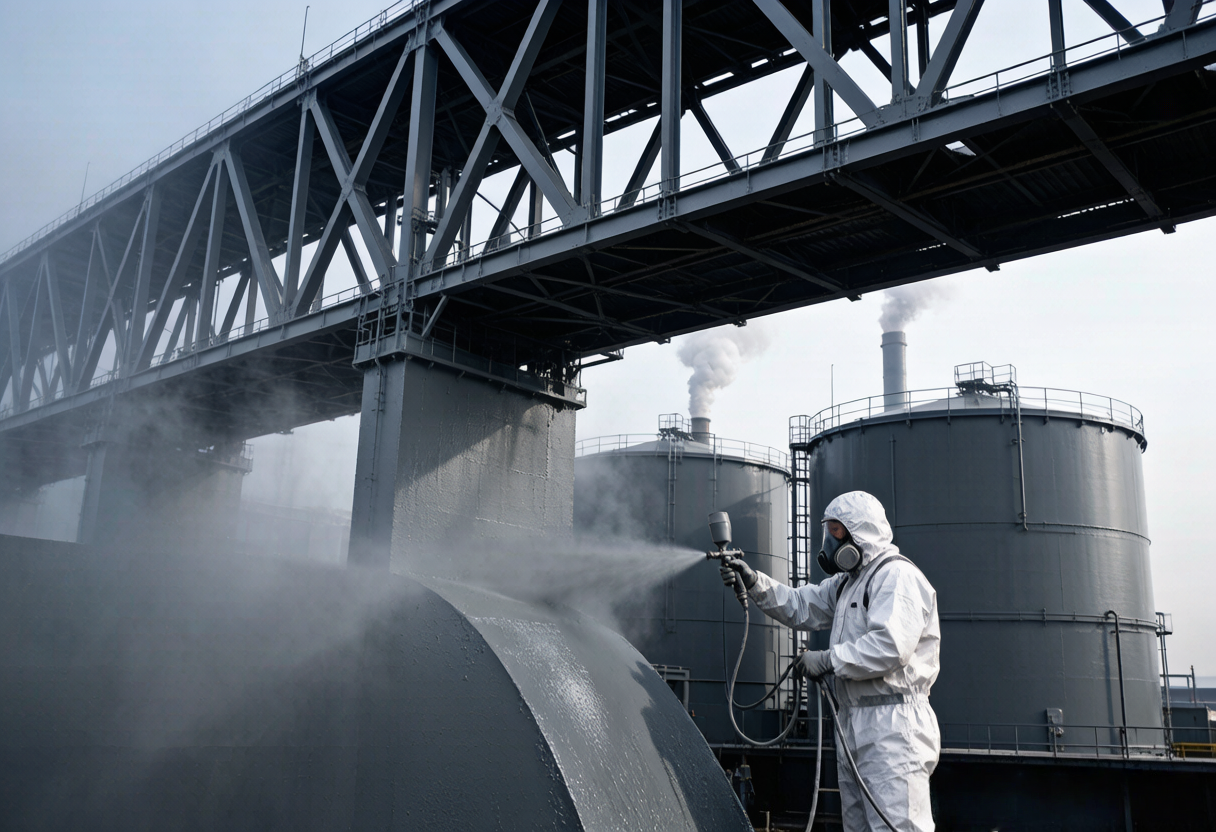
Corrosion is the "invisible killer" of industrial assets. According to industry estimates, the direct economic losses caused by metal corrosion globally each year account for about 3%–4% of GDP, and most of these losses can be avoided through proper coating protection. For steel structures, storage tanks, pipelines, and mechanical equipment, industrial anti-corrosion paint is currently one of the most cost-effective and flexible protective measures in terms of application.
But many procurement officers and engineers are confused: the market is flooded with epoxy zinc-rich primers, polyurethane topcoats, and acrylic anti-corrosion paints—so how exactly should they be paired? This article uses a "indicators—system—selection—application" logic to help you clearly choose the right anti-corrosion coating.
I. Understand the three core indicators
When selecting anti-corrosion paint, don't rush to compare prices—first understand three key hard indicators:
- Salt spray test hours (h): Measures the coating's resistance to neutral salt spray corrosion, and is the most intuitive threshold for heavy-duty anti-corrosion. Ordinary industrial environments often require 480h–1000h, while harsh environments such as cross-sea and chemical industries require over 2000h.
- Dry Film Thickness (DFT): Protection relies on "film thickness". For example, according to ISO 12944 standard, the matching dry film thickness for C5-M (highly polluted industrial + marine atmosphere) environment usually needs to be 200–320μm, and applying only one coat is far from enough.
- Corrosivity category (ISO 12944): from C1 (dry indoor) to C5-M (marine/high pollution), CX (extreme), and then immersed environments Im1–Im3. The harsher the environment, the more "heavy-duty" the coating system needs to be.
Practical advice: First determine which C-level or Im-level your environment belongs to, then work backward to the required film thickness and system, rather than deciding on a product first.
II. Classic "Primer-Intermediate-Coating-Topcoat" Matching System
In the vast majority of heavy-duty anti-corrosion scenarios, what works is a three-layer system, not a single product:
- Primer — Epoxy Zinc-Rich Primer: Zinc content is typically ≥70% (≥80% for high-performance systems). It prevents steel from rusting through cathodic protection by "sacrificial anode", and serves as the anti-corrosion foundation of the entire system.
- Intermediate Coat — Epoxy Mica Iron Oxide Intermediate Coat: Filling, thickening, and shielding, increasing overall film thickness and blocking moisture penetration, offering high cost-performance.
- Topcoat——Polyurethane topcoat (or fluorocarbon topcoat): Weather-resistant, retains gloss and color, UV-resistant, determining how many years the coating can "hold up" on the facade.
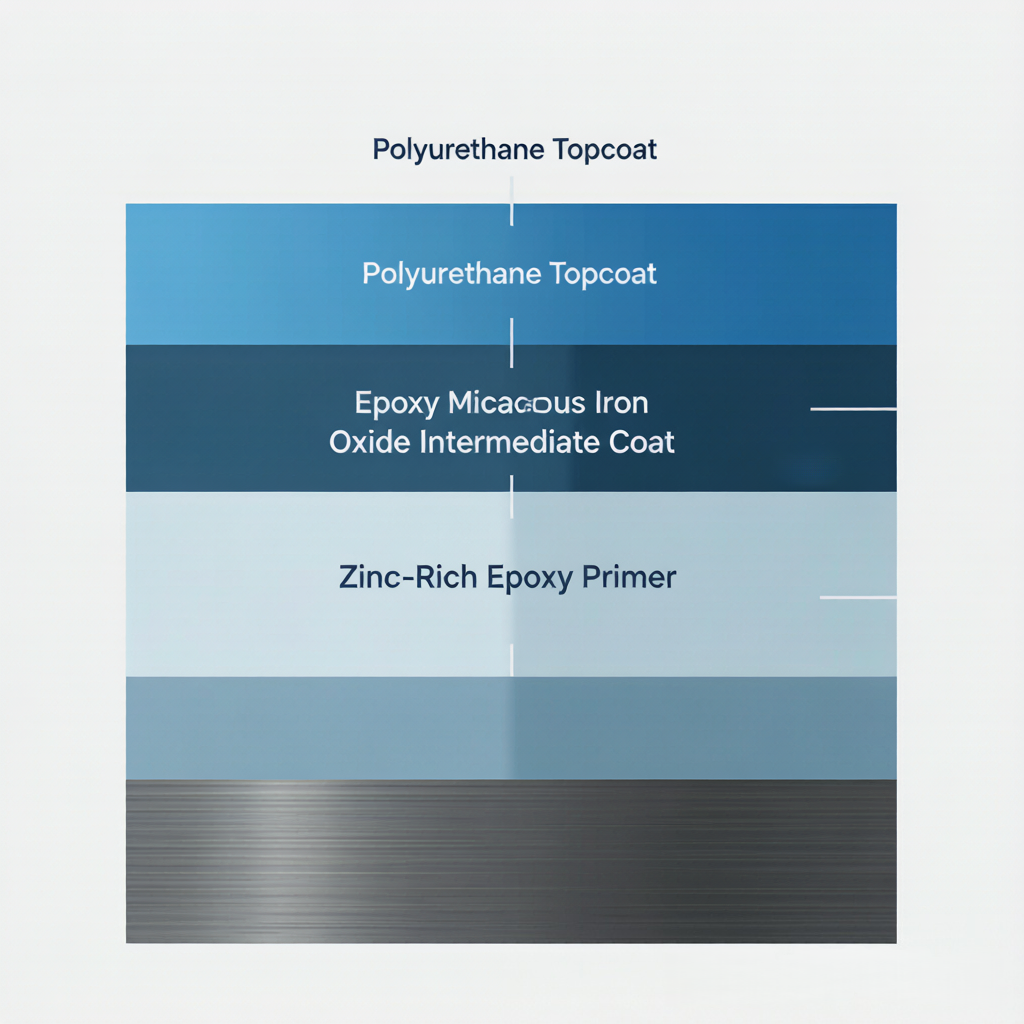
This "epoxy primer + epoxy intermediate + polyurethane topcoat" combination is the golden partner most commonly used for bridges, factories, and storage tanks. To learn about our industrial paint product matrix, please check the Industrial Coatings Series and Heavy-duty Anticorrosive Coatings.
III. Selection Based on Environment and Substrate
- Atmospheric environment (C3–C5-M): such as sea-crossing bridges, chemical plant buildings, coastal equipment → heavy-duty anti-corrosion system of epoxy zinc-rich primer + epoxy micaceous iron oxide intermediate paint + polyurethane topcoat.
- Immersion / wet environment (Im2): such as water tanks, underwater steel structures, buried pipelines → mainly pure epoxy systems, emphasizing density and adhesion, refer to epoxy paint products.
- High-temperature conditions: such as exhaust pipes, boilers, flues → require heat-resistant paint (silicone/ceramic-based), ordinary organic coatings will fail rapidly above 200℃.
Different substrates (steel, aluminum, stainless steel, plastic, wood) have different requirements for primer systems; the substrate type must be specified when selecting the product.
IV. Four Key Points in Construction (Determining Success or Failure)
Even the best coating is useless if the application is not done properly.
- Surface treatment is fundamental: Steel should be blasted to Sa2.5 (near-white grade), with roughness controlled within an appropriate range; oil stains and mill scale must be thoroughly removed.
- Coating system and film thickness: Strictly follow the specified coating system to achieve the required DFT; prefer multiple thin coats rather than one thick coat.
- Recoating interval: Primer, intermediate, and topcoat must be applied within the "recoat interval"; if the interval is too long, roughening treatment is required.
- Environmental Control: Pay attention to temperature, humidity, and dew point — substrate temperature must be at least 3°C above the dew point; excessive humidity easily causes flash rust and blushing.
V. Three Common Misconceptions
- ❌ Applying only topcoat without primer: Without cathodic protection and an adhesion base, the topcoat will quickly blister and peel off.
- ❌ Insufficient coating thickness: To save costs, the coating is thinned, and as soon as salt spray hits, it perforates.
- ❌ Random recoat interval: Poor interlayer adhesion, greatly reducing the overall protective lifespan.
Conclusion: Professional Selection, Free Samples
There is no "best" anti-corrosion paint, only the "most suitable" one. Kexin New Materials (Guangdong Foshan) specializes in nine major series including industrial paint, automotive paint, wood paint, architectural paint, and nano coatings. Factory direct supply, supports free sampling based on substrate and environment free sample (regular samples shipped within 48 hours, with TDS/MSDS attached).
For further selection support, please feel free to contact us at any time.
Further Reading:Primerless Process (3C1B/3-Wet) and Compact Painting · Low-Temperature Curing Coatings and Energy Saving & Emission Reduction