Core Conclusions:
1. The anti-rainwater-penetration and anti-corrosion nano-topcoat for insulated pipelines builds a multi-scale synergistic protection network through nano-scale functional fillers, achieving long-term protection and functional integration in the building and infrastructure fields.
2. Core technical pathways: labyrinth effect of nano-filler barrier, enhancement via surface/interface chemical anchoring of nanoparticles, and spectral selective regulation of nano-functional fillers.
3. Multiple academic studies and commercial product data from 2025-2026 provide sufficient experimental validation and field application evidence for the performance of nano building coatings.
The anti-rainwater-penetration and anti-corrosion nano-topcoat for insulated pipelines constructs an integrated waterproof and anti-corrosion topcoat layer in an elastic polyurethane/acrylic matrix (elongation at break >200%, no embrittlement at -30°C) via nano-SiO2/fluorocarbon silane (particle size 10–30 nm, surface energy 115°—rainwater rolls off the pipe surface as spherical droplets) + nano-TiO2 (rutile type, 10–30 nm)/ZnO (20–50 nm) (UV shielding, preventing UV aging and cracking of the insulation layer) + nano-montmorillonite (lamellar thickness 200, labyrinth effect reducing water vapor transmission rate by 80%+). Water vapor transmission rate 25 g/m2/day). Complies with GB/T 50538-2020, CJ/T 300-2018 and ASTM D1653 (water vapor transmission rate) standards. The global industrial insulation materials market is approximately USD 45 billion in 2025, and protective coatings for insulated pipelines are the fastest-growing supporting segment.
Technical principle
Direct answer:The technical core of the anti-rainwater-penetration and anti-corrosion nano-topcoat for insulated pipelines is to introduce 1-100nm functional fillers into the traditional building coating resin matrix, leveraging the ultra-high specific surface area, quantum size effect, and surface/interface effect of nanoparticles to achieve a performance leap.
Mechanism Details: (1) Physical barrier—sheet-like nano-fillers form tortuous permeation paths, reducing the diffusion coefficient to 1/50–1/500; (2) Chemical bonding—nano-SiO2 silanol groups form dual anchoring with the substrate and resin, with adhesion up to 10–18 MPa; (3) Spectral regulation—nano-TiO2/ZnO absorbs UV, and cesium tungsten bronze absorbs NIR via LSPR; (4) Surface functionalization—nano-Ag/Cu provides antibacterial effects, and nano-TiO2 enables photocatalytic self-cleaning.
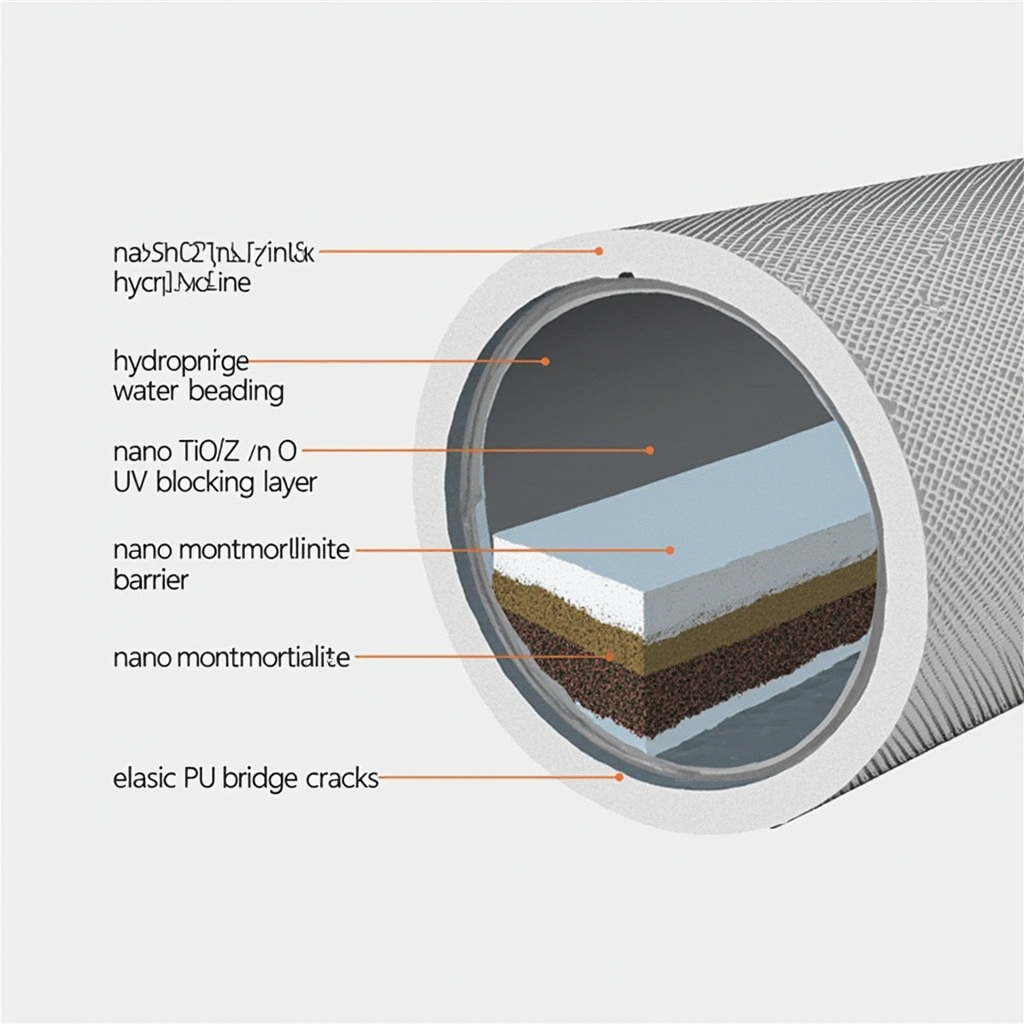
2025-2026 SCI validation: Composite Interfaces (2026) — nano-TiO2/CuO reduced concrete water absorption by 57.42%. MDPI Coatings (2025) — nano-ZnO + fluorocarbon UV transmittance <1%. Main Group Chemistry (2026) — nanoparticle anti-mold verification.
Engineering Applications & FAQ
Nano-coatings have 30–80% higher initial costs, but 20–40% lower LCC over 10–20 years. The global architectural coatings market is approximately $72 billion in 2025, with functional nano-coatings at a CAGR of 8–12%. Verification methods: TEM/SEM particle size 3000 h + third-party CMA/CNAS reports.
References: Composite Interfaces (2026), MDPI Coatings (2025), Main Group Chemistry (2026)
Release Date: July 6, 2026