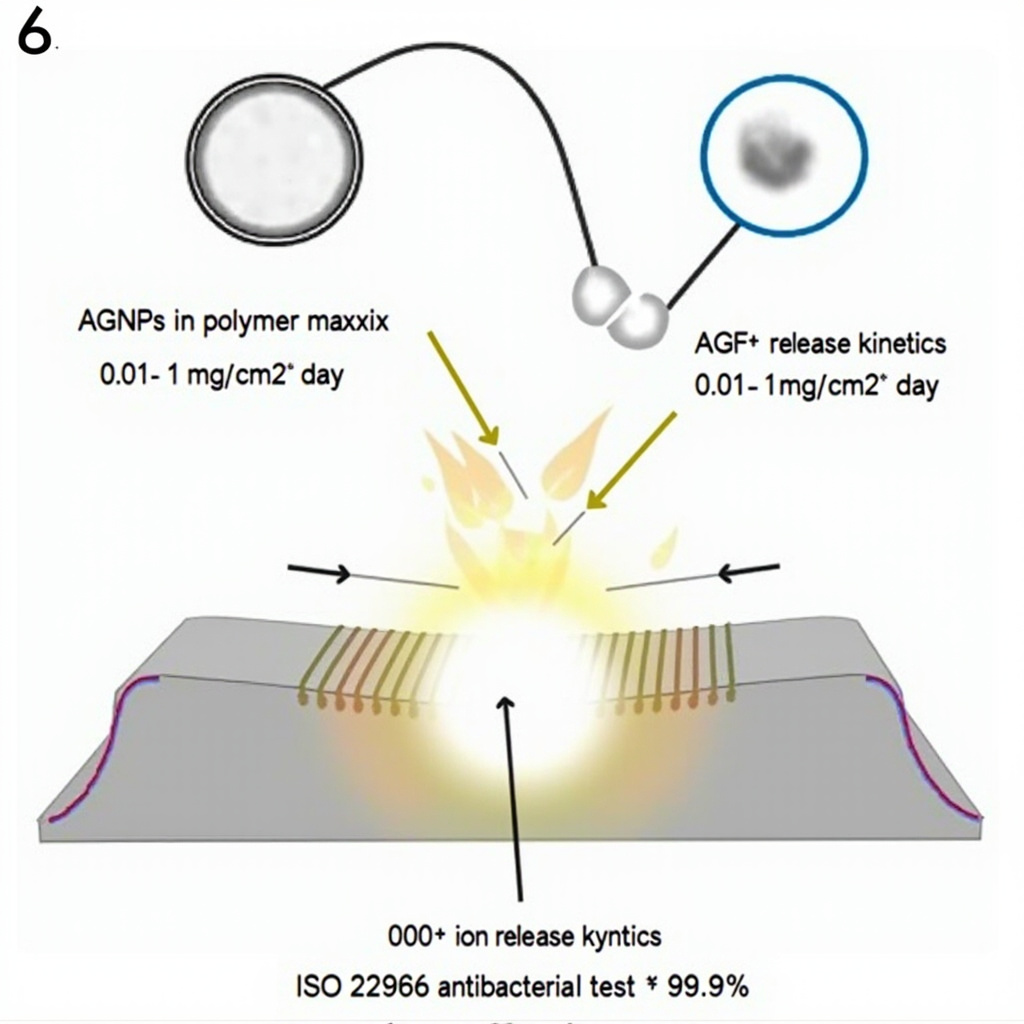
Long-acting composite silver-ion non-toxic antibacterial nanocoating constructs an Ag+ controlled-release system within a polymer matrix (waterborne polyurethane/epoxy/siloxane) via nano-silver particles (AgNPs, particle size 5–50 nm)—the release rate is precisely regulated by three parameters: AgNP particle size (10 nm dissolution rate is approx. 5× that of 50 nm), carrier pore size (mesoporous SiO2 2–5 nm steric hindrance), and polymer crosslinking density—typical release rate 0.01–1.0 mcg/cm2/day (ASTM F2103 silver release reference value). RSC Advances (2025) review: AgNP biocompatibility depends on particle size/concentration/ion release kinetics—pulsed release exhibits greater local toxicity than sustained slow release. BALIMED ARGENTA (TiN:Ag, Ag 2–5%): after 50 autoclave cycles, ASTM 2180 Log3 antibacterial rate, ISO 10993-5 non-cytotoxic—optimal commercial balance case. Biomaterials Advances (2025, Vol. 172): modified ISO 22196 evaluation of commercial coatings—laboratory standard conditions (35°C, >90% RH, 24 h) often overestimate actual clinical-environment antibacterial efficacy. 2025 ACS Applied Bio Materials reports Ag-high-entropy nitride coating first quantifies ~50% inactivation rate of SARS-CoV-2 virus. Global antibacterial/antiviral nano-coating market approx. $2.02 billion in 2025, projected $4.12 billion by 2032 (CAGR 10.7%). FDA/CE new antibacterial coating approval: 18–24 months, single-product filing cost up to $500K+.