Core Conclusions:
1. Matte self-healing nano topcoat achieves controllable matte finish (60° gloss <10 GU, no haze) without traditional SiO₂ matting agents through carboxyl-functionalized PUD + carbodiimide chemical crosslinking, breaking the inherent contradiction of "high haze + low scratch resistance" in traditional matting systems.
2. The nano-scale thermally activated reflow mechanism of memory polymers endows the coating with self-healing ability—scratches and swirl marks automatically disappear at 60°C/2 h or under direct sunlight, with 85° gloss recovery rate >90%.
3. Matte self-healing is the fastest-growing segment in the automotive coating field—the global market is approximately USD 1.8 billion in 2025, and the matte color trend in high-end EV models such as the Tesla Cybertruck and BMW i-series is the core driver.
Matte paint finishes are experiencing an unprecedented revival in the field of automotive design. From the stainless steel matte raw finish of the Tesla Cybertruck, to the BMW i-series "Frozen" limited edition matte paint, and to the Porsche Taycan's satin optional color—matte is no longer a synonym for cheap "solid paint", but has become a core element of high-end personalized design language. However, matte paint finishes have a fatal engineering pain point: once scratches or swirl marks occur, they cannot be repaired by polishing like glossy finishes—polishing destroys the microscopic rough structure of the surface, turning the matte into irregular "semi-gloss patches". Matte self-healing nano topcoat was born precisely to resolve this contradiction.
How is matte finish "achieved"? — From SiO₂ matting agents to filler-free chemical matting
Direct answer: Traditional matte clearcoats achieve their effect by adding micron-sized SiO₂ matting agents (particle size 2-10μm) into transparent resin—the SiO₂ particles protrude on the coating surface to form microscopic roughness, causing incident light to undergo diffuse reflection rather than specular reflection. However, SiO₂ matting agents introduce three major problems: (1) Haze increases—the mismatch in refractive index between SiO₂ and resin (1.46 vs 1.50) produces internal light scattering; (2) Scratch resistance decreases—the protruding SiO₂ particles become stress concentration points, and slight friction flattens them to form "polished spots"; (3) Self-healing is impossible—SiO₂ particles possess no repair capability whatsoever.
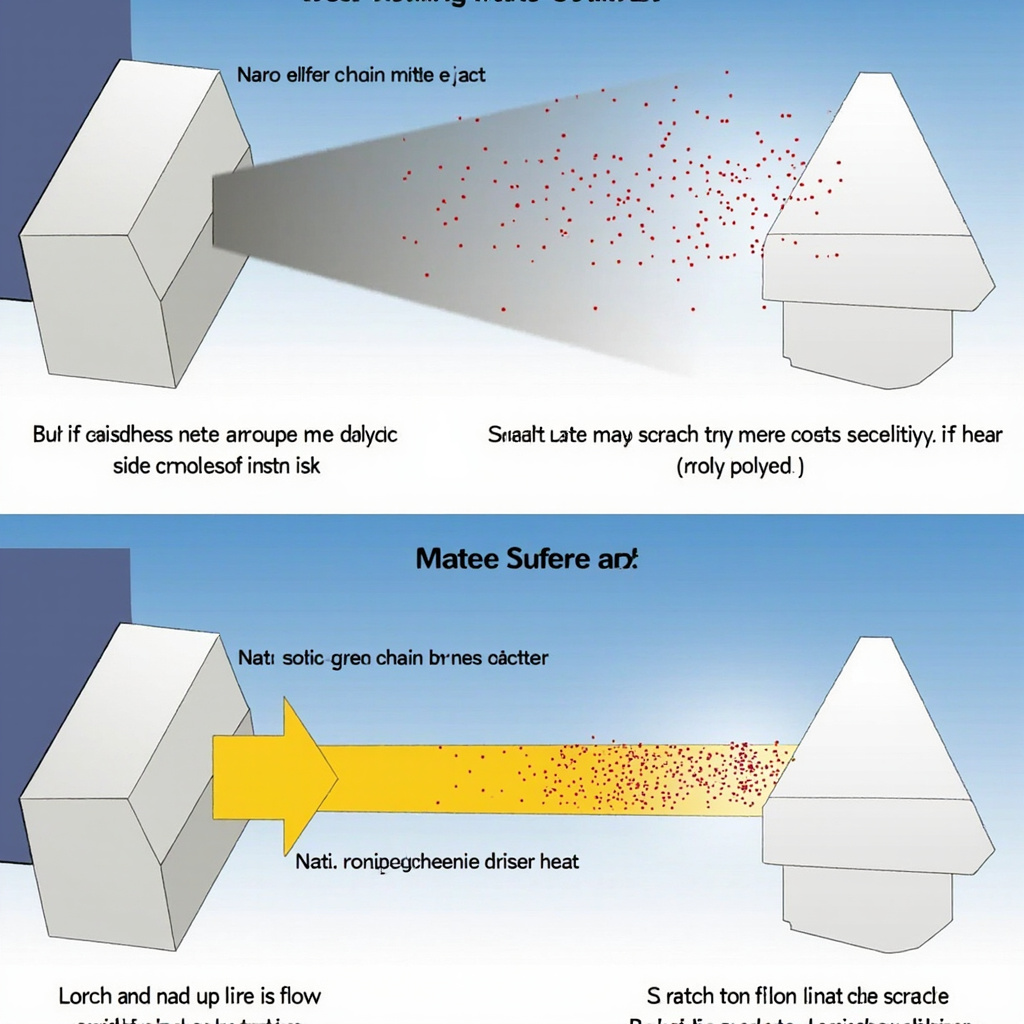
Mechanism Explained — Chemical Matting of Carboxyl-Functionalized PUD.Stahl's technical breakthrough published in PCI Magazine in 2025 represents a paradigm shift in matte coatings. Its core innovation lies in: instead of relying on externally added SiO₂ particles to create surface roughness, it utilizes carboxyl-functionalized polyurethane dispersions (PUD) and carbodiimide crosslinkers to spontaneously form nano-to-micro scale phase-separated structures during curing. Carboxyl groups (-COOH) react with carbodiimide (-N=C=N-) to form N-acylurea crosslinks; the locally uneven distribution of crosslink density causes the coating surface to form irregular microdomains of approximately 0.5–2 μm — the refractive index difference between these microdomains (Δn approximately 0.02–0.05) is sufficient to produce diffuse reflection matting effect, yet because no discrete SiO₂ particles are contained, the coating as a whole maintains high transparency (no haze).
Data support: Stahl's experimental data shows that the 60° gloss of this system can be precisely controlled within 5-30 GU, with haze <5% (traditional SiO₂ matting systems typically 15-25%), and Taber abrasion (CS-10 wheel, 500g, 1000 cycles) weight loss is only 8 mg (vs SiO₂ system 25-35 mg). Chemical resistance: sunscreen (4 hours), ethanol (1 hour), hot coffee (24 hours) all leave no marks.
Source:PCI Magazine (April 2025), Stahl Technical Data
The chemistry of self-healing — how do memory polymers "reflow" at the nanoscale?
Direct answer:The core material of self-healing nano-coatings is the "memory polymer" — a polymer network with dynamic covalent bonds or supramolecular interactions. When the coating surface is scratched, the polymer segments at the scratch are stretched or broken; when an external stimulus (heat, light, or solvent) is applied, the dynamic bonds (such as Diels-Alder adducts, disulfide bonds S-S, hydrogen bonds, or metal-ligand coordination bonds) re-exchange or recombine — the polymer segments "flow back" to fill the scratch depression, and the surface recovers its smoothness.
Mechanism Explained — Kinetics of Thermally Activated Reflux.Feynlab's 2025 self-healing ceramic nano-coating (SiO₂+Si₃N₄+SiC ternary system) is a typical commercial case. Its self-healing mechanism is based on: (1) flexible polymer chain segments (low Tg about -20 to 0°C) embedded between nanoparticles are in a high-elastic state at room temperature — when scratched, the chain segments stretch and deform but do not break; (2) when heated (>40°C, achievable under direct sunlight), the thermal motion of the polymer chain segments intensifies, and the stretched chain segments retract to the equilibrium state — macroscopically the scratch "disappears"; (3) Si₃N₄ and SiC nanoparticles (hardness far exceeding SiO₂) provide a structural skeleton to prevent the coating from collapsing during reflux.
Key parameters for healing efficiency: temperature (healing rate is proportional to e^(-Ea/RT), where Ea is the healing activation energy), time (healing degree increases exponentially with time), and scratch depth (healing rate >90% when depth <50% of coating thickness, drops sharply to 80%).
Data support:Stahl matte self-healing system 85° gloss recovery data: initial 13.6GU → decreased to 13.6GU after scratching (scratches have little effect on gloss in matte systems but are visible to the naked eye) → 12.7GU after 24h self-healing (basically recovered). Feynlab coating 20° gloss recovery rate reaches 92-97% after 60°C/2h repair. pH 1-14 chemical resistance (industrial grade), water contact angle >110°.
Source:Feynlab Technical Press Release (2025), PCI Magazine (April 2025)
Frequently Asked Questions
Q: What is the difference between matte self-healing automotive paint and ordinary matte wrap film?
Matte PPF achieves matte finish through micro-structured surface extinction on the TPU film—strong physical protection but a somewhat "plastic" tactile feel. Matte self-healing paint is liquid-applied chemical matting—offering more natural paint tactile feel and gloss transition. Film replacement costs about 1/10 of the whole vehicle ($3,000–8,000), while coating is done at the OEM factory or by professional spraying.
Will the self-healing function degrade over time?
Yes. The dynamic bonds of memory polymers exhibit "repair fatigue" during repeated repair cycles—cumulative irreversible damage remains after each repair. Experimental data show that after approximately 50 repeated scratch-repair cycles, the repair efficiency drops to 60–70% of the initial level. Under normal use conditions (several car-wash swirl marks per month), the repair function remains above 80% within 3–5 years.
How to maintain a matte painted surface in daily use?
Three taboos: absolutely do not use polishing compounds containing abrasives (irreversibly damages the matte structure); do not use silicone-oil-based gloss sprays (causes irregular shiny spots); avoid the stiff brushes of automatic car washes. Recommended: pH-neutral rinse-free car wash solution + ultra-fine microfiber towel for gentle wiping.
How much more expensive is matte self-healing paint than traditional matte paint?
The raw material cost of Stahl PUD chemical matting system is about 2-3 times that of the traditional SiO₂ matting system, but with the elimination of matting agent dispersion and anti-settling processes, the overall manufacturing cost is only about 30-50% higher. The market premium for optional OEM full-vehicle matte self-healing paint finish is $2,500-5,000, approximately 2-3 times that of optional high-gloss metallic paint.
Reference sources:PCI Magazine (April 2025), Stahl PUD Technical Data, Feynlab Press Release (2025), Smart and Functional Coatings (De Gruyter, 2025)
Publish Date: July 6, 2026 | Category: Technical Knowledge