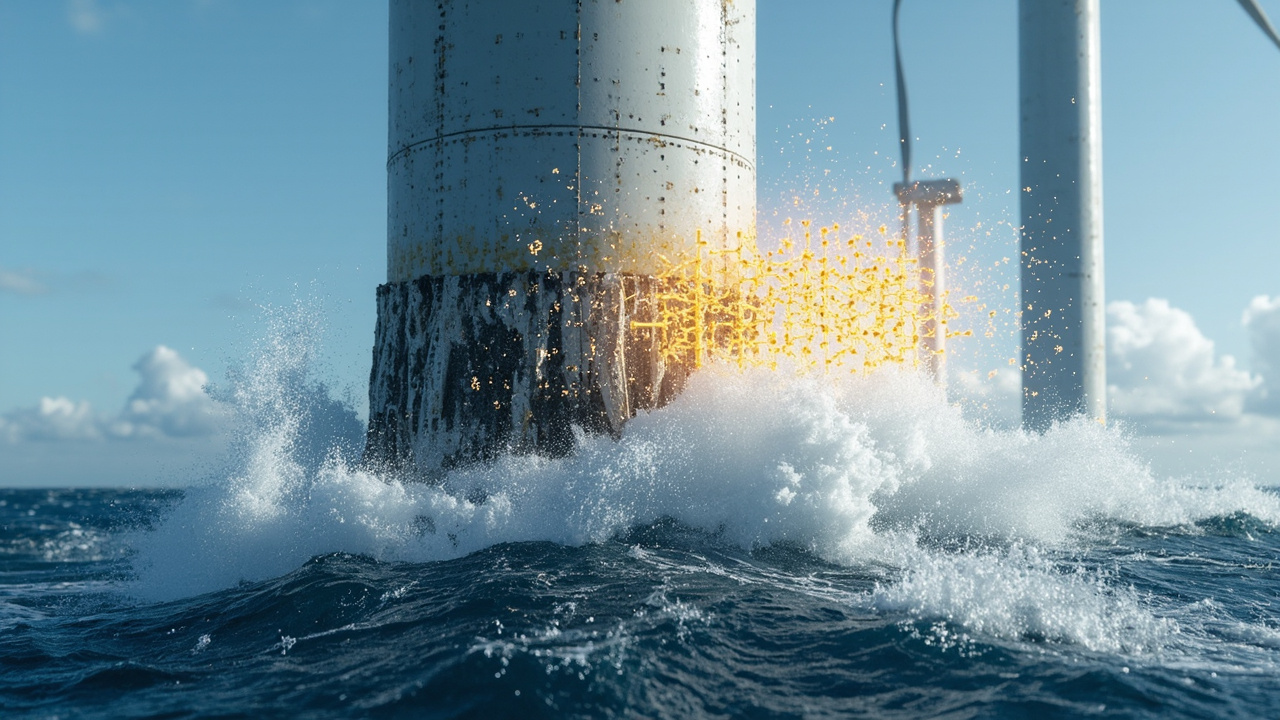
In April 2026, an industry news item brought "marine anti-corrosion" into the spotlight: Suzhou Jiren High-Tech, in collaboration with the Suzhou Institute of Nano-Tech and Nano-Bionics of the Chinese Academy of Sciences, developed a nano functional anti-corrosion coating for marine new-energy equipment, claiming a protection lifespan of 25 years and a cost about 1/3 lower than foreign products. Two figures in the report were particularly striking—the marine corrosion rate is 28 times that on land, while over 94% of China's high-end marine coating market is monopolized by the top 5 foreign companies. As offshore wind installed capacity accounts for 75% of the global total, anti-corrosion coatings have become the invisible armor in the supply chain that is "bottlenecked."
I. Why is offshore anti-corrosion so difficult?
Marine corrosion is a "combination punch" of multiple superimposed mechanisms. The first is chloride ion pitting: about 3.5% sodium chloride in seawater turns into salt spray; chloride ions penetrate ordinary coatings to reach the steel and destroy the passive film, forming a self-catalytic occluded cell at defects. The second is crevice corrosion: accumulated water at tower flanges, bolts, and weld edges are the weak points where coatings most easily fail. The third is splash and scouring: the splash zone is subject to mechanical impact from waves, and coatings are easily torn repeatedly. The fourth is marine biofouling: barnacles and algae attach and damage the paint film while accelerating local corrosion.
The traditional epoxy + polyurethane system typically chalking and cracking in 3–5 years under such conditions, while offshore maintenance requires large crane vessels and high-altitude work, with a single cost reaching several million yuan, and maintenance often accounts for over 80% of the total life-cycle anti-corrosion cost. More tricky is that corrosion often starts from internal weld seams and flange crevices; by the time external rust is visible, structural damage is already irreversible, which makes "long lifespan" the toughest assessment metric for offshore equipment.
II. How does nano rewrite the anti-corrosion mechanism?

The introduction of graphene upgrades anti-corrosion from "relying on zinc powder sacrifice" to "barrier + activation" synergy. The mechanism has two layers: the two-dimensional sheets form a dense physical barrier layer in the coating, greatly extending the penetration path of corrosive media; at the same time, the conductivity of graphene can "activate" the zinc powder, allowing less zinc powder to provide stronger cathodic protection.
Jiren High-Tech's breakthrough lies in in-situ graphene-coated metallic zinc: traditional zinc-rich primer has a zinc powder content above 80% and a lifespan of only about 10 years; the new technology uses pure-carbon thin-layer graphene to coat zinc, reducing zinc powder content to 30–60% with graphene addition below 1%, and through the three-in-one mechanism of "2D physical barrier + nano corrosion inhibition + conductive activation of zinc," raises protection lifespan to 25 years, cuts cost by over 20%, and also provides marine biofouling resistance. It must be emphasized that nano coatings also need to work with cathodic protection: when the submerged section of the tower is supplemented with sacrificial anodes or impressed current, if the coating undergoes cathodic disbondment, the protection current will surge and the sacrificial anodes will be depleted prematurely; therefore, cathodic disbondment resistance must be a core metric, balancing adhesion and electrical insulation in the formulation.
III. Three types of nano anti-corrosion systems
Titanium-based graphene heavy-duty anti-corrosion: using nano organic titanium polymer as the main film former and compounded with graphene filler, artificial accelerated aging ≥5000h (traditional polyurethane ≤1000h), salt spray resistance ≥5000h (traditional epoxy zinc-rich ≤720h), adhesion ≥15MPa, hardness ≥6H, low VOC, replacing highly polluting thermal-sprayed zinc with cold-sprayed zinc. Differentiated配套 according to corrosion zones, total dry film 320–600μm, design life ≥25 years.
Graphene-modified anti-corrosion: taking the Sixth Element SE1132 as an example, salt spray resistance reaches over 3000h; in powder coatings, neutral salt spray improves 6×, thermal conductivity 7×, and aging resistance 4×. Its production line of 150 tons/year graphene and 1100 tons/year graphene oxide already supports scaled supply.
Nano functional coating (systematized): Jiren's solution develops three complete配套 for the atmospheric zone, splash zone, and full-immersion zone, filling the domestic technical gap in splash and full-immersion zones; underwater protection uses solvent-free super wear-resistant epoxy with moisture-tolerant surface curing, eco-friendly low VOC, lead-free and heavy-metal-free. This approach of "zoned design, separate配套" according to corrosion zones essentially treats the marine environment as a set of non-uniform working conditions rather than using a single coating to hard-resist all erosion, and is also the core logic by which long-life systems differ from traditional "one-size-fits-all" solutions.
IV. From concept to engineering site
Nano heavy-duty anti-corrosion is rapidly moving out of papers. In May 2026, Hongjia's high-performance graphene heavy-duty anti-corrosion system was used on the core load-bearing steel structure of China's first recyclable rocket base, proposing a long-effect anti-corrosion goal of no less than 25 years; offshore wind farms, sea-crossing bridges, and port machinery towers and piles are also batch-validating nano systems. AkzoNobel simultaneously planned to launch the ecosparc-enhanced Interzone 954 heavy-duty anti-corrosion coating in Australia, indicating that international majors have also incorporated graphene into mature product systems. From an industry perspective, nano heavy-duty anti-corrosion is upgrading from a "material" to an "asset life management tool"—customers no longer only ask the unit price per kilogram, but ask how many years the system can last, how much outage maintenance it can reduce, and whether it can pass project acceptance; thus coatings are incorporated into life-cycle cost accounting.
V. Data comparison: nano system vs traditional epoxy + polyurethane
| Dimension | Nano composite system | Traditional epoxy + polyurethane |
|---|---|---|
| Salt spray resistance | 3000–5000h+ | ≤720h |
| Artificial accelerated aging | ≥5000h | ≤1000h |
| Adhesion | ≥15MPa | 5–8MPa |
| Zinc powder usage | 30–60% (graphene activated) | Above 80% |
| Design life | ≥25 years | Hard to stably achieve |
| Eco-friendliness | Low VOC, cold-spray zinc/solvent-free | High VOC, thermal-spray zinc pollution |
VI. Full Lifecycle Account
There is a counterintuitive truth in marine engineering anti-corrosion: initial coating cost accounts for only about 15% of the total lifecycle anti-corrosion cost, while later maintenance exceeds 80%. A traditional 3–5 year maintenance cycle means a 25-year project requires 4–7 repairs, each costing 2–3 times the initial application. The nano long-life system reduces maintenance to once or even zero, cutting maintenance cost alone by over 40%, and combined with one less shutdown, less solid waste and VOC, it better fits green and low-carbon goals. Jiren's solution claims its system cost is about 1/3 lower than foreign brands, and maintenance can save 50%.
Kexin New Materials (Guangdong) Co., Ltd.'s heavy-duty anti-corrosion coating system has deep accumulation in the matching of epoxy zinc-rich primer, high-build intermediate coat and weather-resistant topcoat, providing a formulation basis for introducing graphene and nano ceramic fillers to improve salt spray resistance and adhesion, and is also a part of domestic coatings moving from "usable" to "25-year reliable". Holding the core resin synthesis and nano filler dispersion capability in hand is the prerequisite for avoiding homogeneous price wars and building a moat in the high-threshold marine anti-corrosion track.
VII. Standards and Localization
Based on the ISO 12944-9 international standard and GB standards, nano systems are generally designed for 25-year service life; splash zone and fully immersed zone配套 must pass certifications such as NORSOK M-501. Industry-university-research collaboration is bridging the gaps—Jiren's two-year research with the Suzhou Institute of Nano-Tech and Nano-Bionics, Chinese Academy of Sciences, is an example of transforming frontier nano achievements into industrializable marine coating systems. For developers, it is recommended to consider nano anti-corrosion at the selection stage to exchange for long-term O&M cost reduction; for suppliers, strengthening cooperation with material institutes and developing formulations for marine environments is key. For more background, see Offshore Wind Power Moving to Deep Sea: How Heavy-duty Anti-corrosion Coating Withstands 25 Years of Salt Spray Erosion.
VIII. Practical Thresholds of Construction, Inspection and Scale-up
No matter how good the formulation is, it relies on the construction closed loop. Surface treatment must be blasted to Sa2.5 grade, roughness 40–70μm, thoroughly removing scale and salt; factory coating mainly uses high-pressure airless spray, strictly controlling temperature (≥5℃) and humidity (<80%); welds, edges, and corners must be pre-coated with emphasis. Quality inspection covers dry film thickness, adhesion and holiday detection—splash zone and immersed zone especially need holiday detection to ensure no pinhole penetration. Later maintenance follows the rhythm of "first 2 years every six months, then annually". In terms of scale-up, the cost and dispersion stability of nano fillers, as well as the adaptation of coating equipment, remain the key for domestic systems to move from demonstration projects to batch supply; whoever can stably replicate the laboratory data of adhesion ≥15MPa and salt spray resistance of thousands of hours to every production line truly holds the ticket to 25-year service life.
FAQ
Is graphene anti-corrosion just concept hype? Early on there was indeed conceptual packaging, but by 2026 it has entered the mature product systems of international majors and national-level engineering sites, with quantified indicators (salt spray resistance improved several times, zinc powder usage greatly reduced) verified by third parties, belonging to an already implemented technology route.
Can nano coating prevent marine biofouling? Some nano functional coatings, through surface energy and filler design, have the ability to inhibit barnacle and algae attachment, and can be integrated with anti-corrosion, but still need to be evaluated in combination with specific sea area conditions.
What is the practical significance of domestic substitution? Reduce technical dependence on foreign coatings and avoid "chokepoint" constraints on key offshore equipment; at the same time, support the scale-up of offshore new energy with lower full-lifecycle cost, which is a consideration at the industrial security level.
Further reading: Offshore Wind Power Moving to Deep Sea: How Heavy-duty Anti-corrosion Coating Withstands 25 Years of Salt Spray Erosion · Nano Coating Technology: Principles, Preparation and Multi-field Applications · Industrial Coating System Product Center