Why New Energy Vehicles Treat "Automotive Paint" as a Strategic Weapon
In the first half of 2026, a thought-provoking phenomenon emerged in China's new energy vehicle market: from the "Wumei Zijiang" (plum sauce) color of the XPeng MONA L03, to the "Cherry Red" of the Xiaomi YU7 GT, and then to the "Flaming Red" of the Tesla Model Y, three major brands successively launched heavyweight exclusive vehicle colors within just half a year. Behind this lies not merely marketing tactics, but a deep game of technology, craftsmanship, and supply chain on the coating industry side.
According to data from the Maahuasu Research Institute, the global automotive coating market reached USD 16.34 billion to 18.68 billion in 2025, and is expected to grow to USD 17.17 billion to 19.49 billion in 2026. In this rapidly growing market, the competitive and cooperative landscape between global coating giants such as BASF and PPG and Chinese local enterprises is being quietly rewritten due to the extreme pursuit of personalized colors by new energy vehicle companies. For the painting industry, color is no longer just the physical presentation of a coating, but an externalized expression of brand tone and design philosophy.
Multi-layer Nano Structure Clear Coat: Pushing Gloss Above the Industry Baseline
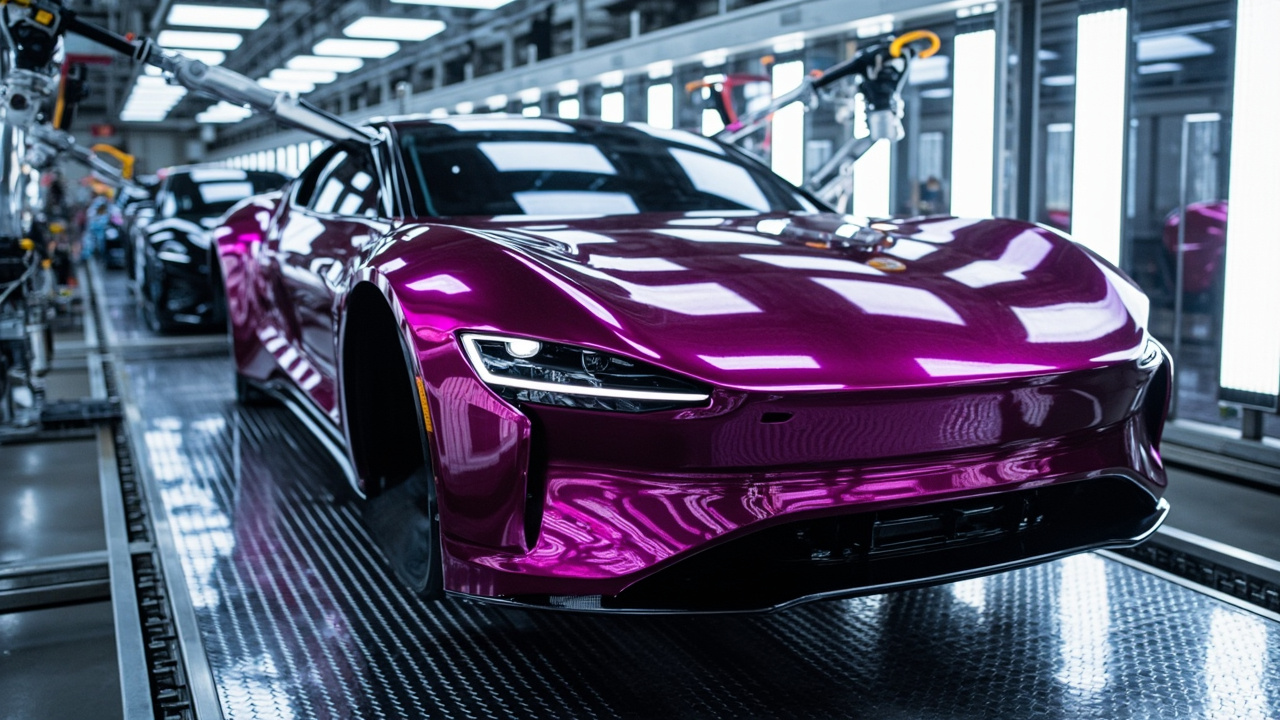
Taking the "Wumei Zijiang" (plum sauce) color of the XPeng MONA L03 as an example, this low-saturation tone between purple and pink is supported by the "Progloss Plus" multi-layer nano structure coating technology jointly developed by XPeng and BASF. The entire vehicle adopts BASF high-gloss clear coat and 3C2B high-end spraying process, with a maximum gloss of over 93, far exceeding the industry's conventional standard of about 85, and the clear coat layer thickness increased to 50 to 70 microns.
The core of the 3C2B (three-coat two-bake) process is to introduce nano-scale fillers and a controllable leveling system into the multi-layer structure of primer, pigmented paint, and clear coat, enabling the clear coat to maintain mirror-level flatness even at greater film thickness. This process imposes extremely high requirements on the resin synthesis and dispersion stability of coating enterprises—the uniform dispersion of nano pigments in the pigmented paint layer directly determines the final color saturation and the flip-flop effect.
The "Cherry Red" of the Xiaomi YU7 GT takes another technical route: a double-layer translucent red structure. By separately regulating light transmission and reflection in different film layers, the red presents a layered variation from dark to bright at different lighting angles. This type of "structural coloration" solution does not rely on simply increasing pigment content, but works at the optical level, demanding higher precision in controlling coating thickness and interlayer interfaces.
Low-temperature Curing Electrophoretic Paint: Synchronous Leap in Green and Efficiency
The foundation of vehicle body anti-corrosion is electrophoretic coating. In 2026, PPG launched a new generation of high-performance electrophoretic coating product—a green low-temperature environmentally friendly electrophoretic paint, achieving upgrades in three dimensions: core performance, production efficiency, and comprehensive cost:
– Adopts tin-free catalyst, reducing impact on human health and the environment, lowering organic volatile compound content, and reducing wastewater discharge; – Lower-temperature curing process, as low as ultra-low 140℃, greatly reducing production energy consumption; – Excellent hiding power against common defects in thin-film pretreatment, reducing manual sanding and lowering rust risk from local film thickness reduction; – While maintaining low VOC, achieves improved self-antibacterial performance.
The product was first implemented at a leading Chinese new energy vehicle enterprise in May 2025. By the first quarter of 2026, it had successfully covered 8 painting production lines of this leading enterprise. Low-temperature curing brings not only energy consumption reduction, but also optimization of production line rhythm—shorter residence time in the baking oven means higher unit-time output.
"Subtraction" Restructuring of Painting Lines: From Rotational Dip Coating to Digital Color Matching
Facing market demands for multi-model mixed lines and rapid switching, the traditional linear production model is no longer sustainable. The painting line market is expected to grow from USD 8 billion in 2025 to USD 10.63 billion in 2030, with automation and digital monitoring becoming core trends.
Durr's newly released RoDip Ezy electric rotational dip coating process reconstructs painting infrastructure with a "subtraction mindset." The vehicle body rotates around its own axis, requiring only a shorter dip tank to complete dipping, flood rinsing, and draining, showing outstanding performance in space saving and resource utilization. As an upgraded product of RoDip E, it follows the proven rotational dip coating principle, can be applied to pretreatment and cathodic electrophoretic coating, and supports flexible curve layout.
On the color side, BASF Coatings won the 2026 Coatings Industry Ringier Technology Innovation Award with its customized color "Twilight Rose," and is accelerating the deployment of robot-assisted automated spraying in the refinish paint field, deeply integrating digital color management with practical application. Although the three technical paths have different focuses, they jointly point to one proposition: how to define the next-generation standard of automotive painting in a simpler, smarter, and more aesthetically and efficiently valuable way.
Domestic Zero-VOC Smart Production Line: Breaking Long-term Overseas Monopoly
The fully zero-VOC emission smart automotive paint production line that topped the hot search in the past week is a milestone event for domestic automotive paint brands to break the overseas monopoly. This brand-new domestic production line achieves full autonomous control from core raw materials to production processes, and the high-end automotive paint it produces fully meets international top-level performance indicators, and even achieves overtaking in aspects such as low-temperature curing and special effect presentation, fully satisfying the production needs of high-end new energy vehicle models.
In the past, the domestic high-end automotive paint market was long occupied by overseas brands, with high procurement prices and long new color development cycles, severely restricting the product innovation pace of vehicle companies. The comprehensive breakthrough of domestic high-end automotive paint directly provides domestic vehicle companies with more flexible and efficient choices. Against the backdrop of China's new energy vehicles rapidly going overseas, the collaborative model of "whole vehicle export + supporting materials export simultaneously" is opening up broad global market space.
As an enterprise long focused on industrial protective and functional coating systems, Kexin New Materials (Guangdong) Co., Ltd. is also continuously paying attention to the full-chain technical trend of automotive painting extending from "appearance decoration" to "battery armor," and accumulating engineering experience in the direction of integrated insulation, heat conduction, and anti-corrosion coatings.
Capability Comparison Between Traditional Process and New Energy Painting
| Dimension | Traditional Fuel Vehicle Painting | New Energy High-end Painting |
|---|---|---|
| Clear coat gloss | About 85 baseline | Above 93 (nano structure clear coat) |
| Clear coat film thickness | 30 to 50 microns | 50 to 70 microns |
| Electrophoretic curing temperature | 160 to 180℃ | As low as 140℃ ultra-low temperature |
| Color positioning | Optional item | Brand emotion carrier |
| VOC control | Conventional control | Zero-VOC smart production line |
| Production line mode | Linear single-model | Rotary dip coating + flexible shared line |
Several Insights on the Synergy of Materials and Processes
First, the essence of color competition is the competition of coating material science. Low saturation and high flop effect rely on nano pigment dispersion and multi-layer optical structure design. Coating enterprises must engage in R&D from the resin end, rather than simply tinting.
Second, green manufacturing is shifting from "compliance requirement" to "efficiency dividend". 140℃ low-temperature electrophoretic curing reduces consumption while improving production line tact time, indicating that environmental protection and cost are not a zero-sum game.
Third, the flexibilization of painting production lines is an inevitable trend. Rotary dip coating and robotic spraying reduce the marginal cost of multi-model shared lines, and also make small-batch customized car colors economically feasible.
Fourth, the window for domestic substitution has opened. The autonomous and controllable core raw materials and processes give domestic automakers the initiative in color development cycle and supply chain security.
FAQ
Q: What are the advantages of 3C2B process over traditional processes? A: 3C2B (three-coat two-bake) achieves higher gloss and mirror flatness under thicker clear coat film through the multi-layer structure of intermediate coat, pigmented paint, and varnish with nano fillers. The overall vehicle gloss can exceed 93, significantly better than the industry benchmark of about 85.
Q: Why can low-temperature curing electrophoretic paint save energy and reduce emissions? A: Ultra-low temperature 140℃ curing compared to traditional 160 to 180℃ greatly reduces baking oven energy consumption, while reducing organic volatile emissions and wastewater generation, and improving unit-time output on the production line tact.
Q: What is the core trend of automotive coating for new energy vehicles in the future? A: Personalized colors become brand carriers, low-temperature curing and zero-VOC become green bottom lines, flexible shared-line production becomes the key to efficiency, and at the same time the coating extends from the vehicle body outerwear to battery pack protection.
Further Reading
– The "Invisible Armor" of New Energy Battery Packs: Insulation, Fire-retardant, and Thermal Conductivity Three-in-One Coating Protection – Application of Nano Coating in Battery Thermal Management – Industrial Protective Coating Product System