Introduction: One drop of isocyanate + one drop of polyol — the "chemical marriage" of polyurethane coatings
The core chemical reaction of two-component polyurethane coatings is the addition reaction between isocyanate groups (-N=C=O) and hydroxyl groups (-OH) to form urethane bonds (-NH-CO-O-). The chemical essence of this reaction is that the carbonyl carbon of the isocyanate (electrophilic center/δ⁺) is "attacked" by the hydroxyl oxygen (nucleophilic center/δ⁻) in a nucleophilic addition — the hydrogen atom transfers from oxygen to nitrogen — forming the urethane bond. The reaction rate constant k at 25°C is approximately 10⁻²~10⁻⁴ L/(mol·s) (depending on the structure of the isocyanate and polyol / catalyst / solvent) — belonging to a moderate-speed reaction — therefore two-component PU coatings have a Pot Life of several hours after mixing for application use.
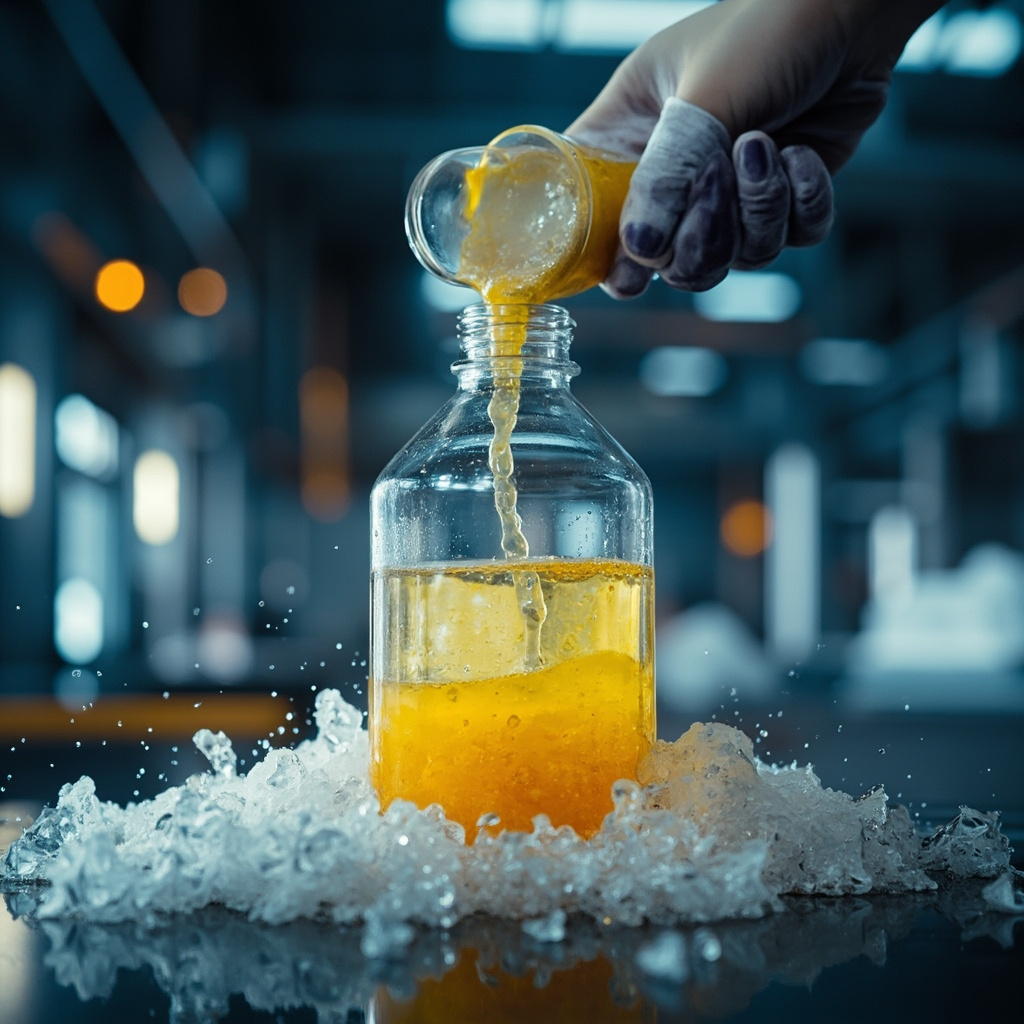
The first core parameter in polyurethane coating formulation design is the NCO/OH molar ratio—typically set at 1.05–1.15 (slightly excess NCO)—the excess NCO reacts with trace moisture in the application environment (H₂O + NCO → NH₂ + CO₂ → further reacts with NCO → polyurea)—serving as "additional crosslinking" compensation—making up for the loss of some NCO consumed by water. NCO/OH 1.2 (substantially excess NCO) → residual free -NCO in the coating—reacts long-term with atmospheric moisture → CO₂ microbubbles (coating pinholes) and urea (brittle and hard)—and free NCO is a respiratory sensitizer (environmental and safety risk).
I. Molecular Structures and Performance Positioning of the Four Major Isocyanate Monomers
| Isocyanate | Chemical Structure Features | NCO Content (%) | Weather Resistance | Reactivity | Cost Index | Core Applications |
|---|---|---|---|---|---|---|
| HDI (Hexamethylene Diisocyanate) | Linear saturated six-carbon chain / no benzene ring | 50 (monomer) / 21-23 (trimer) | Excellent (aliphatic / non-yellowing) | Medium | 2-3 | Outdoor weather-resistant topcoat (standard) |
| TDI (Toluene Diisocyanate) | Toluene ring / mixture of 2,4- and 2,6-isomers | 48 (monomer) / 12-14 (adduct) | Poor (aromatic / severe yellowing) | High (para-NCO activity >10× that of ortho) | 1 (baseline) | Indoor / primer (low-cost) |
| IPDI (Isophorone Diisocyanate) | Cyclohexane ring + alicyclic | 37 (monomer) / ~15 (prepolymer) | Excellent (alicyclic / weather-resistant) | Low (steric hindrance effect) | 3-5 | Weather resistance + chemical resistance (balanced) |
| MDI (Diphenylmethane Diisocyanate) | Two benzene rings / methylene bridge | 33 (monomer) / 15-25 (prepolymer) | Poor (aromatic) | Very high (both NCO groups active) | 0.8-1.5 | High reactivity / prepolymer |
II. Performance Comparison of the Three Major Types of Polyols
| Polyol Type | Hydroxyl Value (mgKOH/g) | Tg (°C) | Water Resistance | Oil/Solvent Resistance | Cost Index | Application Scenario |
|---|---|---|---|---|---|---|
| Polyester Polyol (PE) | 50-300 | -30~+80 | Medium-Good (ester bonds have average hydrolysis resistance) | Excellent (polar/oil resistant) | 1.2-2.5 | Anti-corrosion topcoat/automotive paint |
| Polyether Polyol (PTMG/PPG) | 30-200 | -70~+20 | Excellent (ether bonds hydrolysis resistant) | Poor (non-polar/not oil resistant) | 1-1.8 | Low-temperature flexibility/floor coatings |
| Acrylic Polyol (Acrylic) | 50-150 | 0~+80 | Good-Excellent | Good | 1.5-3.0 | Automotive OEM topcoat/high weather resistance |
III. Optimization Calculation of NCO/OH Molar Ratio
Formulation Calculation Example: A formulation uses 100g of HDI trimer (NCO content 21.5%) combined with acrylic polyol (OH value 100 mgKOH/g, solids 70%). Set NCO/OH = 1.10. Calculate the required mass of acrylic polyol: NCO equivalent = 4200/21.5 = 195 g/eq. OH equivalent = 56100/100 = 561 g/eq. Actual polyol usage = (195/561) × 100 / 1.10 = 31.6 g (solids) → divided by solids 70% = 45.1 g (wet weight).
Trend relationship between NCO/OH ratio and coating properties: (1) NCO/OH=1.0 — theoretically reacts completely — standard crosslink density; (2) >1.0 — excess NCO reacts with moisture in air → increases crosslinking points (polyurea structure) → Tg slightly increases (+3-8°C) → chemical resistance improves (+10-20%) → flexibility slightly decreases; (3) <1.0 — excess hydroxyl → crosslink density decreases → coating surface "tacky" (viscosity of residual polyol) — chemical resistance severely decreases — absolutely not allowed.
FAQ
Q1: Why is the reactivity difference between the 2,4- and 2,6-isomers of TDI more than 10 times?TDI 2,4-isomer (para-NCO)——the methyl group (-CH₃) on the benzene ring is an electron-donating group (hyperconjugation effect) → increases the electron density of the para-NCO → reduces the reactivity of the NCO. TDI 2,6-isomer (ortho-NCO)——the methyl group is not at the para position of the NCO (it is at the ortho position)——steric hindrance further limits the activity of the NCO. Industrial TDI is an 80/20 (2,4-/2,6-) mixture——overall reactivity is about 80-90% of pure 2,4-——controlling the TDI isomer ratio is the key to controlling the quality of TDI curing agents.
Q2: Why does IPDI react the slowest?IPDI's two NCO groups—one directly attached to the cyclohexane ring (secondary NCO / low steric hindrance / higher reactivity), and the other connected to the cyclohexane ring via a methylene (-CH₂-) group (tertiary NCO / high steric hindrance / significantly lower reactivity). The >5-10x reactivity difference between the two NCO groups causes the trimer/prepolymer made from IPDI to react unevenly during curing—the high-reactivity NCO reacts first → the low-reactivity NCO reacts later → the coating's crosslinked structure is uneven (early crosslinking + late post-curing)—this is the chemical root cause of the gradual property change of IPDI-system coatings (Tg slowly rising over time).
Q3: Why can polyester and polyether polyols not be interchanged? Polyester polyol contains ester bonds (-CO-O-)/polarity——it has good compatibility and adhesion with isocyanate curing agents and acrylic/epoxy primers——but hydrolysis of the ester bonds in alkaline/hot water environments leads to coating degradation. Polyether polyol contains ether bonds (-C-O-C-)/non-polarity——excellent hydrolysis resistance——but the non-polar ether bonds have poor compatibility with polar primers (epoxy/acrylic)——weak interlayer adhesion. Interchanging polyester and polyether means the interchange of coating water resistance and interlayer adhesion cannot be easily substituted.
Q4: How do catalysts (organotin/tertiary amine) affect the selectivity of the NCO/OH reaction?Organotin (DBTDL/dibutyltin dilaurate)——catalyzes NCO+OH→urethane——weak catalytic activity for NCO+H₂O→polyurea+CO₂Good selectivitycoatings produce few CO₂ microbubbles. Tertiary amine (DABCO/triethylenediamine)——strong selectivity for catalyzing NCO+H₂O→polyurea (>10 times)——high risk of generating CO₂ bubbles——used as catalyst only in polyurethane foam (requires CO₂ blowing)Not suitable for coatings (need to avoid CO₂ microbubbles).
Q5: Why is a polyurethane coating gentler (more flexible) than an epoxy coating?The crosslinked network of polyurethane contains urethane bonds (-NH-CO-O-)—hydrogen bonds can form between the N-H groups and the C=O groups of another molecular chain, known as intermolecular hydrogen bonds. The hydrogen bonds "non-covalently link" the molecular chains. Under strain, the hydrogen bonds reversibly break and reform—dissipating the applied energy—thus providing flexibility. The crosslinked network of epoxy coatings is mainly composed of C-C and C-O covalent bonds—which break irreversibly—with no energy dissipation mechanism—and are therefore more brittle. The hydrogen bonds in polyurethane are "molecular-level springs," which is the chemical essence of why polyurethane's flexibility surpasses that of epoxy.
Q6: Working mechanism of Blocked Isocyanate?The blocking agent (e.g., caprolactam/MEKO/phenol) reacts with -NCO at room temperature—forming a thermally unstable carbamate that undergoes reverse reaction upon heating (>120°C) to release free -NCO—which then undergoes normal PU curing with -OH. Blocked isocyanate makes PU a one-component baking coating (storage stable—cures upon heating)—widely used in coil coatings and automotive OEM primers. Key parameters—deblocking temperature of blocking agent: caprolactam (>160°C), MEKO (>120°C), phenol (>180°C)—select the appropriate blocking agent based on the available temperature of the baking line.
Q7: "Self-polymerization" trimerization/dimerization/carbodiimidization of isocyanates?HDI/TDI/IPDI can undergo self-polymerization (without polyol) under heating and catalysis—generating: (1) trimer (isocyanurate ring/heat-resistant + high Tg)—HDI trimer is the standard curing agent for weather-resistant topcoats; (2) dimer (uretdione ring/thermally reversible)—can be used as an alternative to blocked isocyanates; (3) carbodiimide (-N=C=N-/hydrolysis-resistant additive)—used in PU coatings to improve hydrolytic resistance. Control of the degree of polymerization (monomer→dimer→trimer→polymer) determines the final curing agent's NCO content and viscosity—the quality of these self-polymers (especially residual monomer content >0.5%—the national standard red line) is a core quality control indicator in the PU coatings industry.
Q8: The chemical boundary between polyurethane and polyurea — "twins" with the same -NCO but different reactants?Polyurethane = -NCO + -OH → -NH-CO-O- (carbamate). Polyurea = -NCO + -NH₂ → -NH-CO-NH- (urea). The hydrogen bond density of the urea bond (two N-H) is twice that of the carbamate (one N-H) — therefore polyurea has higher cohesive energy and Tg — hardness and chemical resistance superior to polyurethane — but poorer flexibility. The reaction rate of polyurea (-NCO + -NH₂) is >100 times that of polyurethane (-NCO + -OH) — therefore sprayed polyurea can cure in 30 minutes.
Q9: Degradation pathways of PU coating under outdoor exposure — Photo-oxidation vs Hydrolysis? Aliphatic PU (HDI) — extremely weak UV absorption. Photo-oxidation (Photo-oxidation/free radical chain reaction) is the main degradation pathway — adding HALS (hindered amine light stabilizer) + UVA (benzotriazole) is the protection strategy. Polyester PU ester bond hydrolysis (Hydrolysis/water molecules cleave ester bonds) is another degradation pathway — the service life of polyester PU in hot and humid outdoor environments is much shorter than that of polyether PU (hydrolysis resistant). The outdoor service life of aliphatic + polyester PU is about 10-15 years, aliphatic + acrylic PU about 15-20 years, and fluorocarbon + acrylic PU (FEVE) about 20-30 years.
Q10: How to adjust the NCO/OH ratio of waterborne two-component PU (WB 2K PU) versus solvent-based 2K PU?The NCO/OH ratio of waterborne 2K PU is usually set at 1.2-1.5, much higher than that of solvent-based (1.05-1.15) — because in waterborne systems, water reacts with NCO and consumes a large amount of NCO, and the extra excess NCO is used to compensate for the consumption by water. The "effective NCO/OH" of waterborne 2K PU (the NCO actually participating in -OH crosslinking after deducting water consumption) — about 1.0-1.1 — is the same as the design value of solvent-based. The NCO excess setting of waterborne 2K PU is the most error-prone step in formulation calculation — ignoring water consumption will lead to severe under-crosslinking (soft/sticky/non-compliant coating).
Related Reading
Summary
The core of polyurethane coating formulation chemistry lies in: isocyanate (HDI/TDI/IPDI/MDI) molecular structure determines weather resistance and reactivity; polyol (polyester/polyether/acrylic) determines flexibility and water resistance; NCO/OH molar ratio (1.05–1.15 for solvent-based, 1.2–1.5 for water-based) determines crosslink density. The competing reaction of water (H₂O + NCO → polyurea + CO₂) runs through the entire process of PU coatings—from formulation design (compensating with excess NCO) to application (controlling ambient RH to prevent CO₂ microbubbles) to curing (post-curing to enhance crosslinking)—and "water control" is the top priority in PU coating chemistry. Kexin New Materials provides customers with full-range isocyanate/polyol products and NCO/OH ratio technical support.