Introduction: The “aesthetic shelf life” of polyurethane topcoats starts with their chemical structure
The steel box girders of sea-crossing bridges—when coated with polyurethane topcoat they are “white as snow,” yet after 5 years of exposure they become “yellow like old newspaper.” Behind this lies the most core divide in polyurethane chemistry: aromatic TDI vs aliphatic HDI. TDI (toluene diisocyanate) contains a benzene ring—under UV light the benzene ring absorbs UV—the urethane bond breaks—aromatic amines oxidize to form quinoid chromophores—the coating yellows with ΔE>8 (QUV 200h); whereas HDI (hexamethylene diisocyanate) is a purely aliphatic C-C chain—no benzene ring—no chromophore formation—QUV 200h ΔE50% under equivalent conditions. The engineering cost of this chemical difference is: HDI costs 2–3 times that of TDI—but for outdoor steel structures with a design life >15–25 years—the topcoat must use an HDI system—”save on the topcoat, pay with recoating life.” Starting from the photo-oxidative degradation mechanism, this article compares the weathering data of aromatic/aliphatic PU—analyzes the Denisov cycle regeneration mechanism of HALS stabilizers—and provides formulators of PU topcoats with a systematic framework from molecular design to QUV testing.
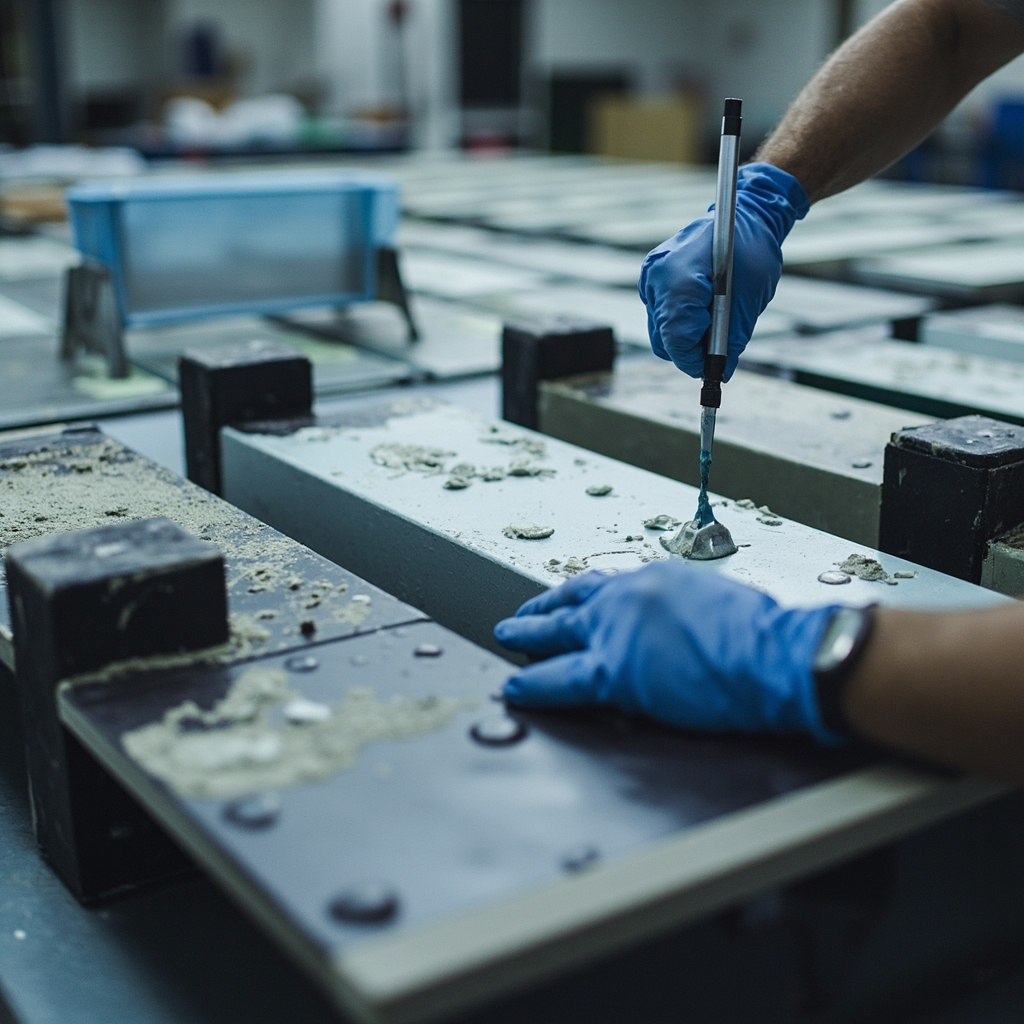
The weatherability of polyurethane topcoat depends on the chemical structure of isocyanates: aromatic TDI/MDI contains benzene rings—under UV (300-400nm) irradiation the benzene rings absorb photons—the urethane bond (-NH-COO-) breaks—aromatic amines oxidize to form quinoid chromophores—the coating yellows with ΔE>8 (QUV 200h)—irreversible; aliphatic HDI/IPDI—no benzene rings—C-C/C-N bonds are inert to UV—no chromophore formation—QUV 200h ΔE20 years of outdoor color and gloss retention. The QUV accelerated weathering test (ISO 4892-3/ASTM G154—UVA-340 lamp—8h light at 60°C + 4h condensation at 50°C) is the gold standard for evaluating the weatherability of PU topcoats—ΔE<3 is excellent—Δb (yellowing index)<2 is qualified.
I. Aromatic TDI vs Aliphatic HDI — A Comprehensive Comparison of Chemical Structure and Weather Resistance
| Comparison Dimension | Aromatic TDI System | Aliphatic HDI System |
|---|---|---|
| Chemical Structure Characteristics | Benzene ring conjugation — π electron cloud — strong UV absorption (300-400nm) | Pure C-C/C-N aliphatic chain — UV inert — absorption cross-section hundreds of times lower |
| QUV 200h ΔE (color difference) | 8-12 | 1.5-4 |
| QUV 200h Δb (yellowing index) | 8-12 | 1-3 |
| Chemical Nature of Yellowing | Benzene ring → quinonoid chromophore (irreversible) | No chromophore formation |
| Outdoor Yellowing Cycle | Visible to naked eye in 6-12 months | Color retention for 10-20 years |
| Weather-resistant Design Life | 1-3 years (indoor) | 15-25 years (outdoor C5-M) |
| Reference Price (RMB/kg) | 15-25 (curing agent) | 80-150 (HDI trimer curing agent) |
| Typical Applications | Primer / intermediate coat / indoor dark-colored topcoat | Outdoor steel structure topcoat / automotive clearcoat / aviation / wind turbine blades |
FAQ
Q1: Quinonoid chromophore—the “chemical culprit” of TDI yellowing—how is it generated step by step?TDI-based PU yellowing pathway under UV: (1) Benzene ring absorbs UV photons (hν—300-400nm)—benzene ring π→π* transition—excited state energy transfers to urethane bond (-NH-COO-); (2) Urethane bond homolysis—generates aromatic amine (Ar-NH2) and alkoxy radical; (3) Aromatic amine oxidized by O2—via benzoquinone monoimine intermediate—rearranges into quinoid structure (Quinoid—p-benzoquinone diimine—yellow chromophore). The conjugated π system of the quinoid chromophore (>6 π electrons) has strong absorption in the visible blue-violet region (400-480nm)—complementary color is yellow—the coating visually “turns yellow”. MDI is more severe than TDI—because MDI contains two benzene rings—decomposition generates bis-quinone imide—longer conjugation—deeper color (brown-yellow). “Benzene ring—=—yellowing—time bomb—UV—=—detonator—once triggered—irreversible”.
Q2: HALS’s Denisov Cycle — How does one HALS molecule “recycle” to capture hundreds of free radicals?HALS (Hindered Amine Light Stabilizer — based on a 2,2,6,6-tetramethylpiperidine skeleton) features the Denisov cycle, one of the most exquisite designs in stabilizer chemistry: (1) HALS (>NH) is oxidized by ROO·/RO· generated from photo-oxidation into a nitroxide radical (>NO·); (2) >NO· captures polymer alkyl radicals (R·) — forming an alkoxyamine (>N-OR) “capturing — the first — free radical”; (3) >N-OR reacts with peroxy radicals (ROO·) — regenerating >NO· + inert products “catalyst — regenerated — ready — for the next round — of capture”. Through the Denisov cycle, one HALS molecule can repeatedly capture >100–500 free radicals — until the HALS molecule is gradually consumed by side reactions. UVA (e.g., benzotriazole-type Tinuvin 328) acts as a “sunscreen” that preferentially absorbs UV and converts it into harmless heat — protecting the coating surface; HALS acts as a “deep antioxidant” that circulates inside the coating to capture free radicals. UVA + HALS combination = 20× the stabilization efficiency of UVA alone — after 2000–4800h QUV-A it still maintains “minimal change” — this is the “golden pair” for weather-resistant PU topcoat formulations.
Q3: QUV Testing — UVA-340 vs UVB-313 Lamps — Why “Acceleration” Does Not Equal “Equivalence”?UVA-340 (295-365nm — simulates the UV portion of sunlight “closest to natural exposure”) is the preferred lamp for evaluating the weather resistance of PU topcoats — recommended by ISO 4892-3 and ASTM G154. UVB-313 (280-315nm — short-wave UV — higher energy “over-acceleration”) — its short-wave UV (280-295nm) is almost absent in natural light at the earth’s surface (absorbed by the ozone layer) — but UVB lamps emit strongly — causing “unnatural — overly harsh — accelerated degradation” QUV results correlate poorly with natural exposure “UVB — only used for — rapid screening — not as a basis for — service life prediction”. Rule of thumb: 1 year of Florida 5° south-facing natural exposure ≈ UVA-340 QUV 1000-1500h — but this correspondence depends on resin type, pigment formulation, and climate zone “QUV ≠ natural — merely a — relative — comparison — tool”.
Q4: HDI trimer vs HDI biuret — both aliphatic — why is there still a significant difference in weather resistance?HDI trimer (isocyanurate ring — six-membered ring — three HDI molecules cyclized — NCO content 18-25%) — its six-membered isocyanurate ring has extremely high chemical stability — >300°C no decomposition — ring structure intact under UV “trimer = excellent in both weather resistance and heat resistance”. HDI biuret (two HDI + one H2O — condensation — contains urea bond -NH-CO-NH- — NCO content 20-23%) — the urea bond (-NH-CO-NH-) in biuret degrades more easily under UV than the isocyanurate ring — and biuret has higher viscosity — requires more solvent dilution — higher VOC. Experimental data: HDI trimer-based PU — QUV 3000h ΔE<3; HDI biuret-based PU — QUV 2000h ΔE≈3-5. "Trimer = standard configuration for automotive clearcoats — biuret = general industrial exterior use".
Q5: Polycarbonate diol (PCDL) vs polyester/polyether polyol — How much does the PU soft segment affect weather resistance?The weather resistance of PU coatings depends not only on the isocyanate (hard segment) — the polyol (soft segment) is equally critical. Polyether polyol (PPG/PTMG — contains ether bond -O-) — the H on the α-C of the ether bond is highly prone to hydrogen abstraction under UV — generating peroxides — chain scission “least weather-resistant”. Polyester polyol (adipate — contains ester bond -COO-) — the ester bond undergoes slow hydrolysis under UV+H2O “moderate weather resistance”. Polycarbonate diol (PCDL — contains carbonate bond -O-COO-) — the carbonate bond is more hydrolysis-resistant than the ester bond — and lacks the easily oxidized α-H of the ether bond “best weather resistance” QUV 500h Δb<2.5. "Hard segment (HDI) + soft segment (PCDL) = PU topcoat — the best — weather resistance — DNA".
Related Reading
Summary
The core watershed of weatherability in polyurethane topcoats—aromatic TDI (benzene ring → quinonoid chromophore—yellowing ΔE>8—irreversible—indoor use only) vs aliphatic HDI (no benzene ring—no chromophore—QUV 200h ΔE15-25 years). The combination of HALS stabilizer’s Denisov cycle (one molecule captures >100-500 radicals—cyclic regeneration) + UVA (converts UV into heat—”sunscreen”) provides >20× the stabilization efficiency of UVA alone—retains “minimal change” even after 2000-4800h QUV-A. Selection of QUV testing (UVA-340 lamp “closest to natural”—UVB-313 for rapid screening only) and HDI trimer (superior to biuret) are two key engineering decisions in formulation design. Kexin New Materials provides customers with complete weatherable polyurethane topcoat formulations and QUV accelerated weathering tests—”let—whiteness—withstand—20 years—of—sunlight”.