Core Conclusion:
1. Port machinery nano-topcoat enhances polysiloxane/fluorocarbon system with nano-SiO₂/graphene—achieving >5000h salt spray resistance (ASTM B117) and >15-year design life in C5-M/CX marine salt spray environments. The polysiloxane Si-O-Si crosslinked network provides dual functions—UV resistance (no yellowing) + chemical media resistance (hydraulic oil/diesel/cleaning agents).
2. Coating area for port bridge cranes/container cranes/stackers—a single large quayside crane (Super-Post-Panamax) can reach 8,000-12,000m²—coating cost accounts for 5-8% of total equipment cost—but downtime and repainting losses caused by coating failure far exceed initial coating cost.
3. Global port machinery market is approximately $8.5 billion in 2025—China's port throughput ranks first globally (2025 container throughput >300 million TEU)—port machinery holdings are the world's largest—making it the largest single market for heavy-duty anti-corrosion coatings in the port sector.
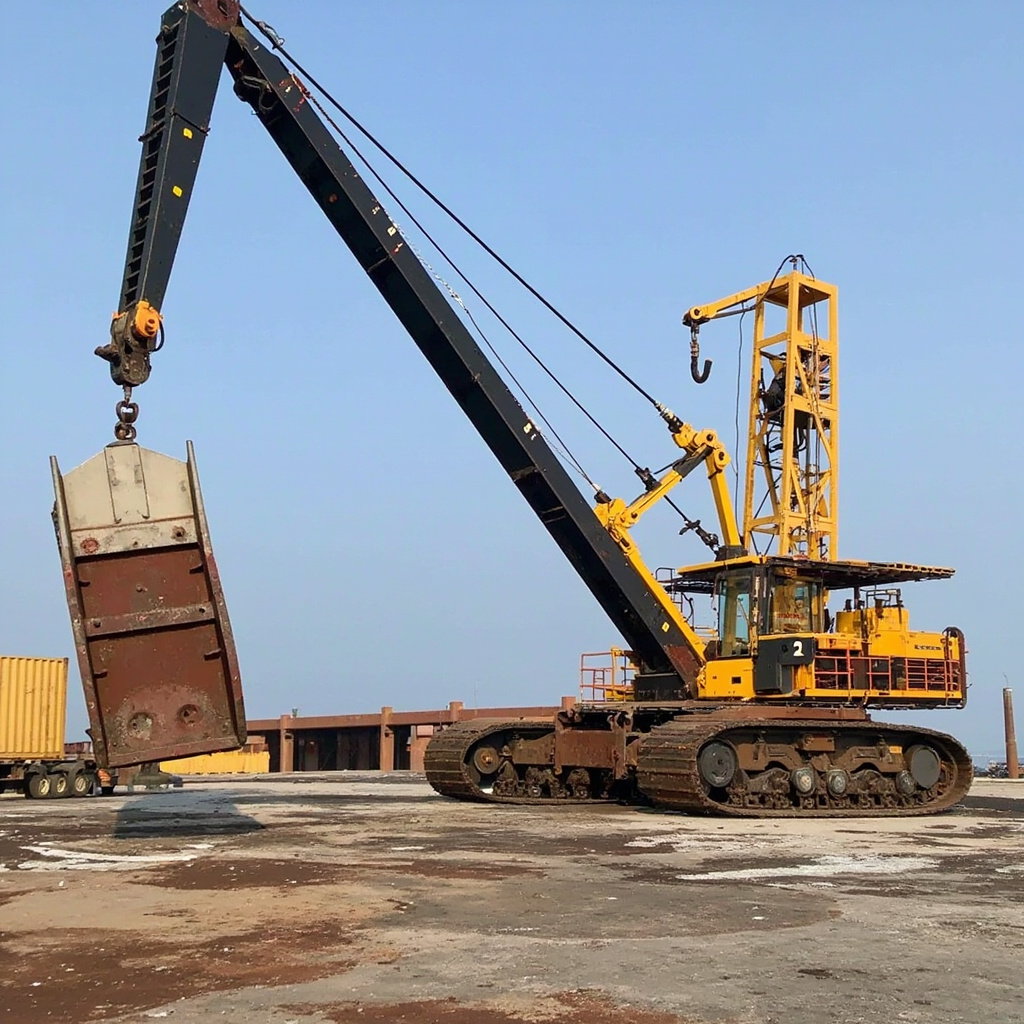
Port machinery (quay crane / yard crane / ship unloader / stacker-reclaimer) may be among the industrial equipment exposed to one of the most severe corrosive environments — C5-M/CX grade marine salt spray (salt deposition rate >800mg/m²/day) + high humidity (>80%RH year-round) + intense UV (enhanced by sea surface reflection) + mechanical wear (container handling / bulk grab / belt conveying). Port Machinery Salt-Spray-Resistant Heavy-Duty Anti-Corrosion Nano Topcoat is the last line of defense protecting these equipment worth tens of millions to hundreds of millions of yuan from marine corrosion — once the topcoat fails (chalking / gloss loss) — UV penetrates to the epoxy intermediate coat — the coating system ages rapidly — the safety reserve of the equipment's steel structure is gradually eroded by corrosion year by year.
The "corrosion accelerator" in C5-M port environments — not salt spray alone, but the synergy of salt spray and coal/ore dust.
Direct answer: There is already a wealth of data on the corrosion rate in pure marine salt spray environments (C5-M) — but the more severe condition faced by port machinery is the synergistic corrosion of "salt spray + industrial dust". Coal/ore dust (containing pyrite FeS₂/chlorides/sulfates) generated during loading, unloading, and storage at coal/ore terminals deposits on coating surfaces — under the wetting of sea fog, it forms an acidic micro-environment with pH 2-4 (pyrite oxidation: FeS₂+O₂+H₂O→FeSO₄+H₂SO₄) — accelerating the acid-catalyzed hydrolysis of coating resins and the pitting of the steel substrate. This is why the corrosion rate of port machinery at coal/ore terminals (0.3-0.8 mm/year) is significantly higher than that at container terminals (0.1-0.3 mm/year) — the "acidification enhancement effect" of dust is the key.
Data Support: Shanghai Zhenhua Heavy Industries (ZPMC) — global port machinery market share >70% — its quayside crane standard anti-corrosion system: epoxy zinc-rich primer (80μm) + epoxy micaceous iron oxide intermediate paint (200μm) + polysiloxane/fluorocarbon topcoat (2×50μm=100μm) — total DFT 380μm — ISO 12944 CX environment — designed maintenance cycle 15 years. For large quayside cranes (unit value 50–150 million RMB), anti-corrosion coating cost accounts for about 5–8% of total equipment cost — but the cost of one premature major overhaul (large-area coating failure → full-machine sandblasting and repainting) can reach 200–300% of the initial coating cost — due to the need to rent large floating cranes/gantry cranes for assistance + downtime losses (a single quayside crane out of service loses tens of thousands to hundreds of thousands of RMB in handling fees per day).
Source:ZPMC Coating Technical Specification, ISO 12944-5:2018, China Port Association 2025 Statistics
FAQ
Is a 15-year maintenance cycle for port machinery coatings realistic?
ZPMC's actual operational data from thousands of quay cranes worldwide shows that in pure container terminal environments (without industrial dust), the standard 380 μm system can achieve a 15-year maintenance cycle with actual coating integrity rate >80%. In coal/ore terminals, due to the acid-enhancing effect of dust, the maintenance cycle is shortened to 10–12 years, and partial repair (overcoating of topcoat) is recommended every 5 years.
How to resolve the difficulty of recoating polysiloxane topcoat on port machinery?
Large-area main structures of port machinery (girders/portal frames) — select polysiloxane (non-recoatable but 15–20 years weather resistance) — maintenance by overall replacement rather than local repair. Frequently damaged parts (operator cab/ladder platforms/pipeline supports) — select aliphatic polyurethane (recotable) — apply one topcoat every 5–8 years to extend service life.
Reference sources:ZPMC technical specification, ISO 12944-5, China Ports Association 2025
Deep Rewrite: July 6, 2026