Core Conclusion:
1. Rail transit vehicle body low-VOC nano topcoat uses water-based nano SiO₂/polyurethane or polysiloxane systems—VOC3000h ΔE<3) and chemical media resistance (cleaning agents/b dust) for aluminum alloy/stainless steel vehicle bodies—high-speed rail/metro vehicle body coating design life 25-30 years.
2. The Si-O-Si crosslinked network of polysiloxane nano topcoat provides dual functions—UV resistance (no yellowing) + chemical resistance (hydraulic oil/diesel/cleaning agents)—20° gloss retention>85% (10-year Florida exposure). The "special working conditions" of high-speed rail vehicle body coating—tunnels/bridges/coastal/plateau—temperature difference>60°C, strong UV, humidity span>90%RH.
3. China's high-speed rail operating mileage will exceed 50,000 km in 2025—over 5000 EMU trains—total vehicle body coating area over 50 million m²—making it the world's largest single market for rail transit coatings.
High-speed trains and metro car bodies are exposed long-term to extreme and variable climatic environments—within a single day they may experience coastal high salt fog (morning) → inland high-temperature arid conditions (noon) → mountainous high-humidity low-temperature (evening tunnel sections)—with a temperature span >60°C, humidity span >90%RH, and UV intensity varying by 2–3 times due to altitude/latitude differences. Rail transit car body lightweight low-VOC nano topcoat must maintain gloss and protective performance for 25–30 years under such "all-climate" operating conditions—while simultaneously meeting increasingly stringent VOC emission regulations (GB 30981.2-2025).
Anti-corrosion of aluminum alloy car bodies — "special challenges" distinct from those of steel structures
Direct answer: The main materials of high-speed rail/metro car bodies are aluminum alloys (6-series Al-Mg-Si and 7-series Al-Zn-Mg) — whose corrosion mechanism is completely different from that of steel structures. The Al₂O₃ passive film naturally formed by aluminum in air (stable within pH 4-9) provides basic protection — but in acidic (pH9) environments Al₂O₃ dissolves — bare aluminum corrodes rapidly. The primary function of coating on aluminum alloy car bodies is not "rust prevention" — but: (1) Decoration — providing the color and gloss specified by the high-speed rail/metro operating company; (2) Chemical resistance — protecting against cleaning agents (acidic descalers/alkaline degreasers), brake dust (abrasive dust containing Fe/Cu particles), hydraulic oil, and track grease; (3) Weather resistance — gloss and color retention under UV/temperature-humidity cycles; (4) Corrosion protection — supplementing the protective gaps of the Al₂O₃ passive film under extreme pH and mechanical damage (gravel impact).
Data support:CRH (Harmony) and CR (Fuxing) high-speed train car body coatings—Typical system: epoxy primer (50-80μm, anti-corrosion + adhesion) + polyurethane/polysiloxane topcoat (2×40-50μm=80-100μm, weather resistance + color)—Total DFT 130-180μm—Design overhaul interval 10-12 years (topcoat recoating)—Car body structural design life 30 years. CR400AF/BF (Fuxing standard EMU) adopts nano-modified polysiloxane topcoat—VOC90GU—QUV 5000h gloss retention>70%—Florida 10-year exposure ΔE<5.
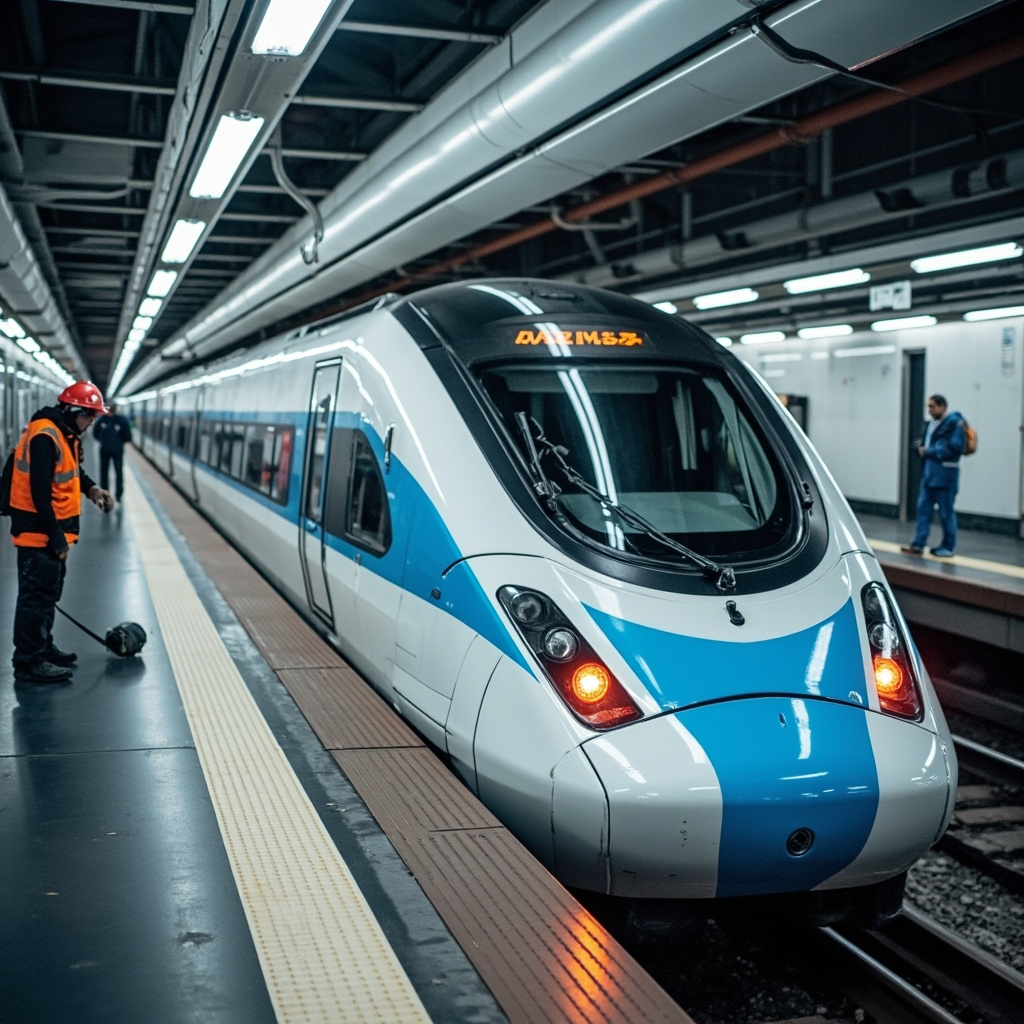
Source:GB 30981.2-2025, CRRC Coating Technical Specification, China Railway Corporation EMU Maintenance Regulations
FAQ
Why do high-speed rail topcoats have higher durability requirements than automotive topcoats?
Automotive topcoat is designed for a service life of 10–15 years (private cars) — high-speed rail topcoat is designed for 25–30 years. High-speed rail cannot be repainted frequently (huge revenue loss from service suspension) — it must be more durable. Meanwhile, the operating environment of high-speed rail is harsher — tunnels (high humidity/darkness), bridges (high wind/low temperature/salt spray), plateaus (extreme UV).
Proportion of waterborne topcoats in high-speed rail painting?
The waterborne coating adoption rate for China's high-speed rail painting increased from <5% in 2015 to approximately 30–40% in 2025—the main driver being the mandatory VOC limit of 60% will achieve waterborne conversion by 2030. Waterborne topcoats have already approached solvent-based coatings in gloss and durability—the main gap lies in drying speed during low-temperature winter application (5–10°C).
Reference sources:GB 30981.2-2025, CRRC Painting Specification, China Railway Corporation Standards
Deep Rewrite: July 6, 2026