Why Color Is the "Crown Jewel" of Refinish Paint
In the field of automotive refinishing, a saying is widely circulated: "Three parts paint, seven parts mixing." The success or failure of color restoration directly determines whether a repair is "as good as new" or "obviously fake at a glance." For car owners, even if the paint film performs well and passes anti-corrosion and weather resistance tests, any visible color difference means a failed delivery; for repair shops, repeated color mixing and rework not only waste expensive special-effect pigments, but also erode the already thin profit margins and reputation of accident vehicle repairs.
The 2026 market environment makes the matter of "color" even more significant. According to data from the Baihuasu Research Institute, the global automotive refinish coating market is expected to grow from $10.1 billion in 2025 to $10.74 billion in 2026, with a compound annual growth rate of 6.3%; in the Chinese market, the number of new energy vehicles has exceeded 60 million, with penetration rate approaching 57%, and after-sales refinish coating demand is ushering in a structural growth window. Meanwhile, China's refinish paint market is expected to reach 18.5 billion yuan in 2026, with a compound annual growth rate of 6.2%, of which the penetration rate of water-based paint will exceed 78%. Against the dual backdrop of market expansion and accelerated water-based transition, the proportion of special-effect colors (metallic paint, pearlescent paint, iridescent paint) is approaching 18%, and the difficulty and value of color restoration are rising simultaneously.
Automotive refinish paint therefore pushes color science to the pinnacle of industrial technology. It integrates optics, pigment chemistry, surface physics, database engineering, and artificial intelligence—a highly narrow yet extremely high-barrier interdisciplinary field. Starting from "how the human eye sees color," this article will layer by layer dissect the full-chain restoration logic from spectrophotometer to AI smart color matching, and compare the real color systems of leading enterprises, to help repair stores, coating distributors, and industry practitioners establish a practical cognitive framework.
How Color Is "Seen": From CIE to XYZ and Lab
To discuss color matching, we must first talk about the "nature of color." Human perception of color is essentially the result of the selective reflection of visible light spectrum (approximately 380 nm to 780 nm) by the object surface being received by cone cells. The combination of reflection intensities at different wavelengths forms color sensations such as "red, green, blue—yellow" in the brain. But the human eye is subjective, easily fatigued, and affected by ambient light, and cannot serve as a benchmark for industrial-level comparison.
The International Commission on Illumination (CIE) established the XYZ color space in 1931, mathematizing this perception. Based on the tristimulus value curves of the "standard observer," CIE integrates any visible light reflection spectrum and converts it into three values: X, Y, Z. Among them, Y represents lightness (related to brightness), while X and Z together determine hue. The significance of the XYZ space is that it allows color to be quantified, transmitted, and compared for the first time, without relying on any subjective judgment.
On top of XYZ, CIE later developed the Lab (CIELAB) uniform color space. Lab describes color using three axes: L* represents lightness (0 is black, 100 is white), a* represents the red-green axis (positive for red, negative for green), and b* represents the yellow-blue axis (positive for yellow, negative for blue). The key advantage of the Lab space is "approximate uniformity"—the geometric distance (ΔE) between two points in the space roughly corresponds to the color difference perceived by the human eye. This is why the industry uses ΔE (usually required to be ≤1.0 or even ≤0.5) to objectively determine "whether there is no color difference."
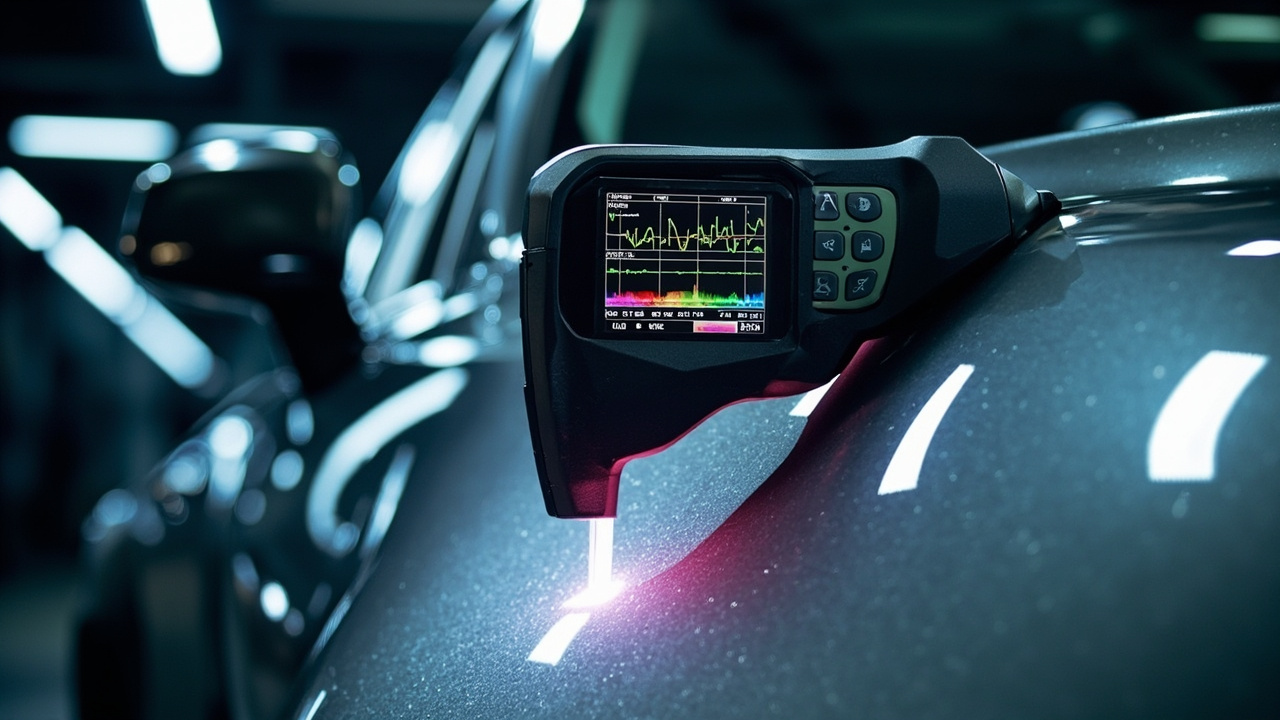
In refinish scenarios, the tool for measuring color is the spectrophotometer. It emits a standard light source (usually D65 simulated daylight or A light source) onto the vehicle surface, measures the reflectance of each wavelength in the visible light band nanometer by nanometer, outputs a complete reflection spectrum curve, and then converts it to Lab values according to CIE standards. Compared with the naked eye or simple color cards, the advantage of the spectrophotometer is that it is objective, reproducible, and unaffected by ambient light and eye fatigue: regardless of day or night, rain or shine, the same paint surface should yield a consistent spectrum curve.
It must be emphasized that the spectrophotometer measures "spectrum," and Lab is only one of its views. The spectrum curve hides information invisible to the human eye—for example, "metamerism": two colors have the same Lab and look identical under one light, but show differences under another light source. This is exactly the root cause of "looking the same in the workshop but revealing flaws in sunlight" in refinishing, and also determines that professional systems must match based on spectrum rather than a single Lab.
Geometric Optics of Spectrophotometers: 45/0, 0/45, and Integrating Sphere
A spectrophotometer does not "just shine and output numbers." Its illumination and reception geometry directly determine whether what is measured is "color" or a "mixture of gloss + texture." Refinish-specific devices mainly adopt the following geometric structures, each with applicable scenarios.
The most common refinish structure is 45/0 (45-degree annular illumination, 0-degree vertical reception) or 0/45 (vice versa). The 45-degree annular light obliquely illuminates the paint surface from all around, and the 0-degree direction vertically receives the reflected light, deliberately "avoiding" the specular reflection direction (i.e., the highlight direction), thereby suppressing the interference of surface gloss and texture on color, and capturing a "real color" closer to what the human eye sees under diffuse conditions. This structure is very effective for ordinary, relatively flat refinish areas, and is also the choice of most handheld refinish spectrophotometers.
Another is the d/8 (diffuse illumination, 8-degree reception) integrating sphere structure. The integrating sphere uses a highly reflective inner wall material to uniformly scatter light onto the sample, and then receives from the 8-degree direction, which can simultaneously give results excluding specular reflection (SCE, excluding specular, closer to visual) or including specular reflection (SCI, including specular, more reflecting material's true color). It is often used for laboratory-level color measurement and texture research, but is less flexible than 45/0 on curved surfaces and small-area refinish parts.
The core special-effect color measurement relies on multi-angle geometric structures (see later). The table below compares the characteristics and trade-offs of mainstream geometric structures.
| Geometric Structure | Illumination/Reception Method | Main Suppression/Acquisition | Typical Use | Limitations |
|---|---|---|---|---|
| 45/0 or 0/45 | 45° annular illumination, 0° vertical reception | Suppresses specular highlight, suppresses surface texture | On-site actual vehicle color measurement, main measurement of ordinary solid colors and metallic paint | Difficult to fit on strongly curved small parts, special-effect colors require multi-angle supplement |
| d/8 integrating sphere | Diffuse illumination, 8° reception (SCI/SCE switchable) | Can separate gloss and color | Laboratory formula R&D, texture analysis | Large size, high cost, poor on-site portability |
| Multi-angle (15/25/45/75/110° etc.) | Fixed illumination, multiple angles synchronized reception | Acquires color flop and sparkle | Metallic paint, pearlescent paint, iridescent paint special-effect color measurement | Expensive equipment, complex data processing |
Regardless of the structure, the equipment needs to be calibrated periodically with a standard white board (usually a ceramic or PTFE reference sample). The essence of calibration is "telling the instrument what 100% reflectance is"; otherwise, light source decay and optical window contamination will accumulate into systematic errors, ultimately manifesting as inexplicable color difference complaints.
The challenge of special effect colors: the "angle dependence" of metallic and pearlescent
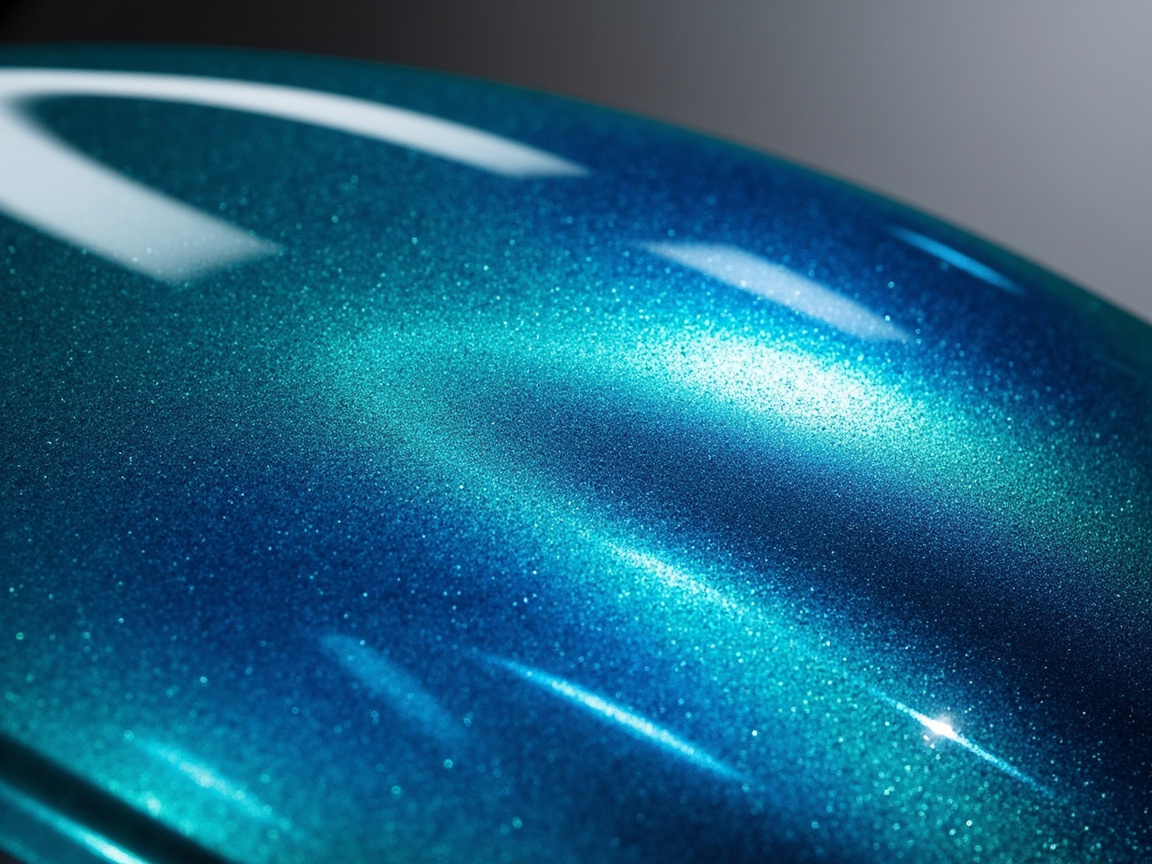
Ordinary solid paints (such as pure white, pure black, pure red) have uniformly dispersed, isotropic pigments, and their color is basically independent of observation angle. But metallic paint (containing aluminum flakes), pearlescent paint (containing mica flakes), and chameleon paint (containing interference pigments) exhibit strong angle dependence—the same painted surface shows different brightness and hue when viewed head-on, from the side, or at an angle. This is the most troublesome part in refinishing, and also a high-incidence area where "the base color is matched but it still looks fake".
The reason lies in the pigment morphology. The aluminum flakes in metallic paint are flat mirror-like small pieces, like countless micro mirrors floating in the paint film with a certain orientation; the mica flakes in pearlescent paint are coated with titanium dioxide, etc., forming a "thin-film interference" effect; chameleon paint goes further, using multi-layer interference films to create angle-dependent "iridescent" color shift. When the observation angle changes, the reflection/interference direction of these flakes toward light changes accordingly, so the human eye sees "brightness and darkness wandering with angle, hue drifting with angle".
The solution is a multi-angle spectrophotometer, which typically measures synchronously at multiple angles such as 15°, 25°, 45°, 75°, 110°, obtaining a set of "angle–reflectance" curves. Only when this set of curves matches the original vehicle can it be "flawless under different lighting and viewing angles". In other words, the matching target for special effect colors is not "one Lab point", but a "angle-dependent reflectance spectrum".
More subtly, the particle size distribution of aluminum flakes, the coating thickness of mica, and the orientation of pigments all change the flake sparkle and flop. The coarser the particles, the stronger the sparkle and the more exaggerated the angle-dependent contrast; the thicker the coating, the cooler or warmer the interference color; the more ordered the orientation, the "cleaner" the angle-dependent color shift. This means color matching is not only the matching of Lab values, but also the matching of "optical structure". This is also why high-end refinish systems emphasize "match the effect first, then match the color".
Multi-angle spectrophotometer: meaning of each angle at 15°/25°/45°/75°/110°
The angle numbering of multi-angle instruments is not arbitrary; each angle corresponds to a typical viewing angle range when the human eye observes the vehicle body. Only by understanding what each angle "sees" can one read the measurement data and make fine adjustments accordingly.
| Measurement angle | Corresponding observation scenario | Core information reflected | Significance in color mixing |
|---|---|---|---|
| 15° | Close to front view (slightly off head-on) | Brightness and hue of the brightest area of the paint surface | Determines "whether it looks good from the front", the most intuitive visual landing point |
| 25° | Slightly off-angle, near head-on | Transition color from front to side | Key anchor balancing front and side views |
| 45° | Standard side view angle (common reference) | Main hue at medium angle | Often used as the main reference angle for database matching |
| 75° | Large side view angle | Side-view brightness and hue drift | Determines "whether the side is dark or off-tone" |
| 110° | Grazing angle (nearly parallel to the paint surface) | Performance at the most extreme angle-dependent color shift | The angle where chameleon/pearlescent most easily gives itself away; the touchstone for aluminum flake orientation |
Taking Onwings Coatings' Color Cloud AI intelligent color matching platform as an example, its hardware uses a Swiss-made original five-angle colorimeter, equipped with an "automatic colorimeter calibration" function. After finding the spectrum closest to the vehicle body in the formula database, it maximizes the correction of the spectral difference between the vehicle body color and the formula, achieving "one formula per vehicle". AkzoNobel's Automatchic Vision handheld spectrophotometer also centers on multi-angle/digital measurement, paired with its MIXIT cloud database (over 2 million colors and variants), allowing users to "get it right the first time" digitally.
It is worth noting that multi-angle data must be interpreted with "curve comparison" rather than "single-point values". Professional software plots the original vehicle's reflectance at each angle as a curve, overlays it with the candidate formula curve, and requires the entire curve to fit at all angles. This process transforms the master craftsman's experience of "judging sparkle by side light" into quantifiable, reviewable data.
Optics at the pigment level: aluminum flake particle size, mica coating, and pigment orientation
To truly "match the effect", one must understand the causes of special effect colors at the pigment level. Three variables are most critical.
First, aluminum flake particle size and shape distribution. The finer the aluminum powder, the softer the paint surface and the weaker the angle-dependent contrast; the coarser the aluminum powder, the more obvious the sparkle points and the stronger the metallic feel. More importantly, the "distribution width" of particle size—a wide distribution can balance near fine sparkle and far large sparkle, while a narrow distribution has a single style. During refinishing, if the original vehicle uses coarse aluminum and the formula uses fine aluminum, even if the Lab is close, it will look "stiff and lifeless" in sunlight.
Second, mica coating thickness. The mica substrate of pearlescent paint is coated with TiO₂ or other metal oxides; the thicker the coating, the longer the interference optical path, and the pearl color tends more toward yellow-green or red-purple; the thinner the coating, the closer to the silver-white of the mica body. The confidentiality of coating processes by different OEMs is the deep reason why pearlescent colors are difficult to "copy" accurately.
Third, pigment orientation (orientation/flop). Aluminum flakes and mica flakes do not lie flat randomly in the paint film; their orientation is affected by application (spray gun air pressure, gun travel speed, flash-off conditions) and the clear coat layer. The more parallel the orientation is to the paint surface, the brighter the face and darker the flop (strong flop); the more disordered the orientation, the smaller the difference at various angles (weak flop). This is also why "same base color, different clear coat" can go wrong—the clear coat thickness and refractive index change the "floating feel" and color shift with angle of the metallic flakes.
In summary, special effect color restoration is a collaborative engineering of "pigment physics + application process + interlayer optics", far from as simple as "mixing a bucket of paint by color code". This is also the fundamental reason why leading companies build their formula databases to tens of thousands to hundreds of thousands of color codes and maintain massive variant variants.
Formula Database: The "Dictionary" of Color Restoration
After the spectrophotometer measures the target color, the next step is "what formula to use to reproduce it". This relies on the Color Formula Database. Every mainstream refinish paint company maintains a massive database: it contains tens of thousands to hundreds of thousands of OEM color codes for vehicle models, each color code corresponding to a verified pigment combination, ratio, and application parameters.
The establishment of the database is a long-term, expensive knowledge accumulation. It requires the company to obtain new vehicle model color codes in sync with the OEM, through laboratory panel spraying, baking, and aging verification, to lock in reproducible formulas, and continuously fine-tune with batches. The more complete and timely the database is updated, the higher the probability that the repair shop will "get it right in one mix". According to industry data, leading companies' cloud databases have covered over 2 million colors and variants (such as AkzoNobel's MIXIT), and some companies' formula library scales reach hundreds of thousands of vehicle model color codes.
In the Chinese market, local brands such as Yatu have established service networks covering nearly 100 countries and regions worldwide, and their formula databases need to be compatible with color code systems of different regions and different year models; Yatu has been deeply engaged in the automotive refinish coating track for over 30 years, with domestic sales and service outlets exceeding 1,000, and successfully passed the review on the Beijing Stock Exchange in September 2025, with overseas revenue maintaining double-digit growth for consecutive years. International giants, on the other hand, form moats with databases accumulated over decades. The competitive focus has upgraded from "whether there is a database" to "whether the database is accurate, new, broad in coverage, and cloud-based".
variant Formula: The "Family Differences" of the Same Color Code
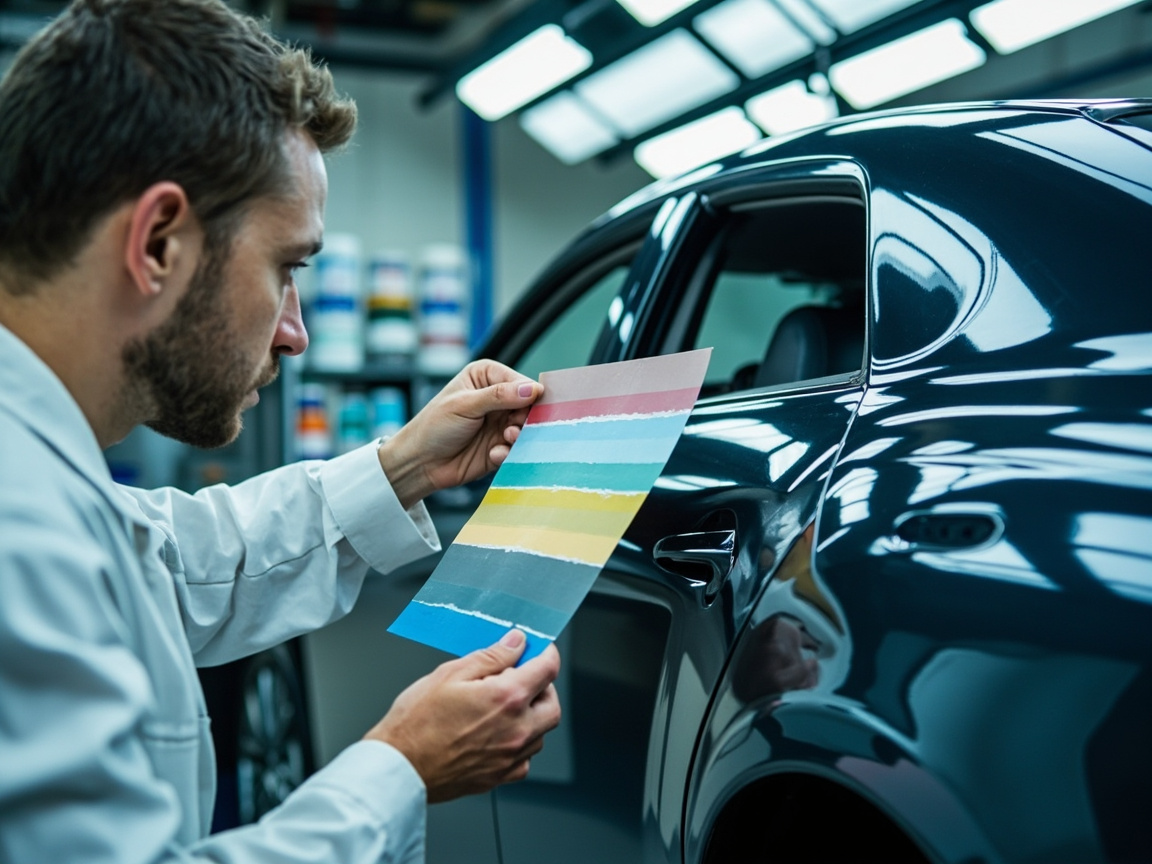
Even for the same OEM color code, due to production batches, painting lines, clear coat thickness, and even aging after vehicle service, the actual vehicle color will have subtle differences. Professional systems therefore introduce the concept of "variant": maintaining a set of fine-tuned formulas for popular color codes (such as reddish variant, darker variant, brighter variant), allowing technicians to select the closest variant based on actual vehicle measurements, and then make local fine-tuning.
This is equivalent to expanding the "standard answer" into an "answer family", greatly improving the one-time success rate. Combined with multi-point measurement of the actual vehicle by the spectrophotometer (sampling separately from hood, door, fender), the technician can judge which variant the vehicle's color leans toward—because different body panels on the assembly line may come from different spraying batches, single-point measurement is easily one-sided. The combination of multi-point measurement + variant selection achieves "personalized restoration" rather than "standardized application".
In practice, it is recommended to measure at least 3 adjacent intact areas and take the spectral median, then match the variant in the database. For old vehicles in service for more than 3 years, an aging correction coefficient (see next section) should also be applied.
Digital Color Matching Workflow and Aging Correction Coefficient
Modern digital color matching workflow is usually as follows: the technician uses a spectrophotometer to scan the intact paint surface around the damaged area, obtaining the spectrum and Lab; the software searches the formula database for the best matching color code and variant, and overlays the vehicle model's "aging correction coefficient" (considering yellowing, gloss loss, and clear coat chalking caused by sun exposure); outputs the recommended formula and dosage; after spraying a sample, measures and compares again, fine-tuning if necessary.
The "aging correction coefficient" is a key factor often overlooked. A white car exposed to the sun on the northwest plateau for 5 years has yellowed clear coat and lost gloss on the base color; directly applying a new paint formula will inevitably be cooler and darker. Professional systems perform reverse correction on the target Lab based on vehicle model, age, and regional climate, restoring "the color the new car should have", then proceed with construction, ultimately presenting a seam on the old car that coordinates with the surrounding aged paint surface.
This process transforms the uncertainty of traditional "master adjusting by eye" into a controllable process of "data-driven + experience correction". According to industry analysis, nearly 58% of repair facilities have shifted to water-based coatings, 46% adopt UV curing, and digital color matching technology has grown by 39%—digitalization has become the mainstream trend, and directly brings reduced rework rates and lower coating loss (some digital solutions report average coating usage reduction of up to 20%).
AI Intelligent Color Matching: High-Dimensional Features, Transfer Learning, and Self-Correction
The latest progress is the introduction of machine learning into formula recommendation. AI models are trained on massive (spectrum—formula—measured deviation) data, learning the complex mapping of "given a target spectrum, recommend the optimal pigment combination", especially good at handling the nonlinear optical behavior of special effect colors.
The value of AI is reflected in three levels. First, processing high-dimensional features: multi-angle spectrum (one curve per angle) + pigment physical parameters (particle size, coating, orientation) + application variables constitute a feature space far beyond human brain capacity, and AI can capture implicit patterns difficult for humans to summarize. Second, transfer learning: for rare colors or custom colors of new-force vehicle models that the database "cannot find", AI can borrow knowledge from similar color families to recommend approximate solutions, shortening the distance from "no formula" to "usable formula". Third, self-correction: each measured feedback (ΔE measured after spraying) flows back to the training set, making recommendations more accurate with use—this is the "smarter with use" that static formula libraries cannot achieve.
Some leading companies have launched AI-assisted color matching modules. Taking Donglai's Color Cloud as an example, its AI intelligent color platform "auto-corrects" after color measurement, maximizing the correction of spectral differences between the vehicle body and the formula, and supports offline access, connecting to electronic scales and automatic tinting machines, stringing "color measurement—correction—output" into a closed loop. AkzoNobel reports that after adopting its digital color solution, the correct color matching efficiency has increased by more than 3 times compared to traditional methods, and some users' average coating usage has reduced by up to 20%. For novice technicians, AI lifts the color matching success rate to close to senior level, easing the industry's talent gap pressure.
It needs to be clarified that AI does not "replace technicians", but liberates technicians from massive trial and error, allowing them to focus on experience-based decisions in critical zones. The optimal solution is "AI gives initial solution + technician does final review".
Clear Coat and Interlayer Structure: The Overlooked "Color Variable"
Many reworks are not due to wrong base color, but because the clear coat layer thickness, topcoat process, and base color flash-off time changed the final appearance. The thickness and refractive index of the clear coat affect the "floating feel" and color shift with angle of the metallic flakes; if the base color is not sufficiently flashed off before spraying clear coat, it will cause disordered pigment orientation and abnormal sparkle.
Specific mechanism: the thicker the clear coat, the deeper the metallic flakes are "buried", the lower the face brightness, and the weaker the angle-dependent contrast; if the clear coat refractive index differs from the OEM, the refraction angle of light at the base color—clear coat interface changes, altering the light intensity at various angles received by the human eye. Therefore, professional systems define "color" as the overall result of a base—intermediate—clear multi-layer system, rather than an isolated base color. This also explains why repair emphasizes "full system matching"—primer, pigmented paint, and clear coat from the same system have verified optical coordination, and mixing different brands often buries color difference risks.
In application, after base color spraying, it must be fully flashed off (especially for water-based systems), and the clear coat should be applied after the paint film is nearly touch-dry and aluminum flake orientation is stable. The clear coat itself should also be applied according to the system-recommended gun distance, air pressure, and travel speed to avoid local over-thickness. A often underestimated detail is: the clear coat in the repair area is often thinner than the OEM (OEM has multiple layers of electrophoretic paint + intermediate coat + pigmented paint + clear coat, while the repair area is much thinner), which itself causes the visual difference of "repair patch darker than surroundings", requiring compensation through base color fine-tuning.
On-Site Challenges: Variables of Light, Equipment, and People
Even with advanced tools, there are still three major variables on site. First, observation lighting: repair shops mostly use standard light boxes (D65 daylight, TL84 store light, A home light, UV ultraviolet light) for evaluation, but owners often pick up cars in natural light, and the difference between the two may expose color differences (especially metamerism). The professional approach is to cross-confirm under multiple light sources and remind owners to accept under both "natural light + garage light" environments. Second, equipment calibration: spectrophotometers need regular calibration with standard white plates; optical window contamination and battery degradation accumulate errors, so it is recommended to self-check daily at startup, calibrate with white plate weekly, and send to factory for calibration monthly. Third, technician judgment: final fine-tuning still relies on the human eye's decision in critical zones, and experience is irreplaceable—AI gives the range, humans set the endpoint.
The table below summarizes the most common color difference complaints in repair sites and their typical causes, for stores to quickly attribute.
| Common color difference complaint | Typical cause | Primary troubleshooting direction |
|---|---|---|
| Looks alike from face, darker/color-shifted from side | Aluminum flake particle size or orientation mismatch, wrong variant selected | Recheck multi-angle curve, switch variant |
| Exposed under sunlight, normal under light | Metamerism, spectrum not matched | Use spectral curve comparison instead of single Lab |
| Repaired area appears darker than surrounding | Varnish too thin, base color not compensated | Slightly brighten base color, apply varnish at system thickness |
| Metallic effect "stiff" with no sparkle | Aluminum flake size mismatch or insufficient flash-off | Check aluminum flake spec, extend flash-off |
| "Haze" at seam between old and new paint | Insufficient blending, dust spots | Expand blending zone, improve booth cleanliness |
| Color difference becomes more visible with vehicle age | Aging correction factor not applied | Retrieve model aging profile and re-adjust |
Special Challenges of New Energy Vehicles
The exterior design of new energy vehicles tends toward integration, low drag, and through-type light strips. The paint surface curvature is more complex, and the directional distribution of metallic flakes on different curved surfaces is inconsistent, increasing the difficulty of achieving "overall color match". At the same time, small but highly visible areas such as hidden door handles, around cameras, and irregular wheels impose higher requirements on local repair blending techniques—these areas often allow only minimal-area blending and are extremely sensitive to multi-angle matching accuracy.
The mixing of colored with matte, and high-gloss with satin finishes (two-tone body, matte varnish) further expands the color-matching dimension. Matte varnish itself produces almost no specular reflection; the "angle-dependent" logic is completely different, and matte paint has zero tolerance for application defects (orange peel, dust spots, sagging)—any unevenness is directly visible. Some new brands also adopt special processes such as "floating roof" and "gradient body", which require digital zone-by-zone color building during repair, far more difficult than traditional single-color vehicles.
In addition, new energy vehicles extensively use aluminum alloy, carbon fiber, and composite body parts. Differences in thermal expansion and conductivity of various substrates affect base color adhesion and orientation, indirectly influencing color appearance. This raises the new issue of "cross-substrate color consistency" for repair systems.
Commercialization of Color Services: From Consumables to Data Assets
Leading ref finish paint companies have turned color capability into a business model: while selling paint, they provide subscription-based formula databases, pay-per-use AI color-matching cloud, hardware (spectrophotometer) leasing, and technician certification training. Color has upgraded from a "one-time consumable attribute" to a "continuously serviced data asset", significantly enhancing customer stickiness.
Several typical commercial forms are worth noting: first, database subscription, where stores pay annually for the latest color codes and variant updates, saying goodbye to "mixing by old booklets"; second, AI color-matching cloud, charged per call or per seat, lowering the barrier for small and medium stores to use large models; third, hardware leasing, as spectrophotometers cost tens of thousands of yuan, the leasing model turns Capex into Opex, accelerating adoption; fourth, technician certification, where companies issue digital colorist levels, enhancing store professionalism and locking in the ecosystem. Nippon and ICRO's "color diagnosis—on-site color matching—full-process color service" launched in China is a representative of this model.
In the coating industry landscape of the Pearl River Delta, companies like Kexin New Materials (Guangdong) Co., Ltd., which focus on industrial and automotive coatings, are leveraging their OEM accumulated chemical capabilities into the repair and aftermarket. Their engineering experience in low-VOC resins and low-temperature curing systems is highly synergistic at the material level with the technical demands of water-based ref finish paint for "room-temperature film formation and low-energy drying", supporting the green upgrade of repair painting; under the trend of color servitization, the collaboration space between material companies and color data service providers is opening up.
Comparison of Color Systems Among Leading Companies
Different companies' color systems have their own focuses; understanding the differences helps stores "select system by vehicle, match color by system". The table below summarizes the color capabilities of five representative companies based on public information.
| Company | Color Platform/Hardware | Database Scale | Features | Applicable Scenarios |
|---|---|---|---|---|
| Yatu (including Sherwin) | Self-developed formula system and water-based system | Covers vehicle color codes from nearly 100 countries worldwide | Globalized national brand, high-end water-based (Sherwin), deep cooperation with new energy brands like Avatr/Leapmotor | New energy aftermarket, export support |
| Donglai (Onwings) | Color Cloud AI platform, Swiss five-angle colorimeter | Multiple brand OEM color codes | "One vehicle one formula" auto-correction, mobile + automatic dispenser closed loop | 4S stores, professional repair shops |
| Nippon + ICRO | Color diagnosis—on-site color matching—full-process service | Global vehicle model database | "Color service" model, water-based + solvent dual lines | Chain repair, high-end service |
| AkzoNobel | Colorvation (Automatchic Vision + MIXIT) | Over 2 million colors and variants | Digital efficiency increased 3x, coating consumption reduced 20% | Global chain, digital benchmark |
| PPG | Digital color measurement and matching software system | Massive OEM formulas | Strong OEM backing, mature color management tools | OEM authorized stores, accident vehicle network |
Note: The above table is a generalized comparison based on public information; specific database coverage and hardware models are subject to the latest releases of each company. When selecting a store, priority should be given to "whether the system covers the common color codes and variants of the target vehicle model" and "whether there is timely local technical support", rather than simply comparing parameters.
FAQ
Q: Why is metallic paint harder to match than solid paint? A: Metallic paint contains aluminum flakes and pearlescent paint contains mica flakes, and the color changes with viewing angle (flake effect / angle-dependent color). A multi-angle spectrophotometer is required to synchronously measure at multiple angles such as 15°/25°/45°/75°/110°, and to match the optical structure of the pigments (particle size, coating, orientation) rather than just Lab values, making it far more difficult than angle-independent solid paint.
Q: What is the role of the formula database? A: It collects tens of thousands to hundreds of thousands of OEM color codes and verified formulas for vehicle models, serving as the "dictionary" for color restoration. Leading cloud databases already exceed 2 million colors and variants. The more complete and timely the database, the higher the probability that a repair shop can match the color correctly on the first try, making it the core barrier for leading companies.
Q: What can AI do in color matching? A: AI uses machine learning to process the complex mapping between multi-angle spectra and physical pigment parameters, recommending optimal formulas, especially excelling in rare colors and special-effect colors; it can also use transfer learning to handle new colors and continuously self-correct with actual measurement feedback. It can raise the success rate of novices to near that of experienced technicians, but does not replace the critical judgment of technicians.
Q: Why does varnish also affect the final color? A: The thickness and refractive index of the varnish change the floating feel and angle-dependent color of the metallic flakes; insufficient flash-off of the basecoat leads to disordered pigment orientation. Color is the overall result of a multi-layer base-intermediate-clear system, so using a matched same-system set is emphasized, and when the clear coat in the repair area is thinner, the basecoat needs compensation.
Q: What is a variant formula? A: The same OEM color code may have subtle differences due to batches, painting lines, and aging. Professional systems maintain a set of fine-tuned formulas for popular color codes (reddish/darker/brighter, etc.), and technicians combine multi-point measurements to select the closest variant and then fine-tune, achieving "personalized restoration".
Q: What new challenges does the NEV (new energy vehicle) bring to color matching? A: Integrated styling makes the paint surface curvature complex and metallic flake orientation inconsistent; hidden door handles and irregular parts have small but highly visible areas; two-tone bodies and matte clear coats broaden the color matching dimensions; composite material substrates affect adhesion and orientation. All these require higher multi-angle matching accuracy and blending processes.
Q: How to reduce color difference rework rate? A: Use a spectrophotometer for multi-point measurement and spectral comparison rather than single-point Lab; apply aging correction coefficients by vehicle model; select the right variant; use same-system base-intermediate-clear; cross-accept under multiple light sources; and use AI color matching platforms to reduce trial and error.
Mathematics of Color Difference: From ΔE76 to ΔE2000
As mentioned earlier, ΔE is used to quantify color difference. Here we further explain how the "distance" is calculated and why the formula needs upgrading. The earliest CIELAB color difference formula is ΔE76 (Euclidean distance): ΔE = √[(ΔL)²+(Δa)²+(Δb)²]. It is simple and intuitive, but in regions where the human eye is less sensitive to blue and dark colors, it "calculates large but looks small", or distorts when lightness difference and hue difference are mixed.
For this reason, CIE successively introduced ΔE94 and ΔE2000 (CIEDE2000). ΔE2000 introduces nonlinear weights for human visual perception: weighting lightness, saturation, and hue separately, and correcting the blue region and near-neutral gray region, making the "numerical difference" closer to the "visual difference". In high-end refinishing, ΔE≤1.0 (barely distinguishable by naked eye) is often required, and ≤0.5 in strict scenarios. It is worth noting that ΔE is only a single-point indicator; for special-effect colors, even if ΔE is small at all angles, if the flop curve shape differs (flop direction reversed), the visual will still reveal it—this again shows that special-effect colors must look at the "curve" rather than the "point".
Light source is also a variable: the same pair of colors may have different ΔE under D65 and A light sources; if the difference is too large, it is "metameric failure". Professional acceptance therefore requires no color jump under multiple light sources.
Metamerism: The Invisible Killer of Repair Rework
Metamerism refers to two colors looking consistent under one light source but showing differences when the light source changes. Its root cause is "different spectral reflectance curves but same tristimulus values"—the human eye only samples three dimensions (XYZ), while the spectrum is continuous with hundreds of dimensions, and dimensionality reduction inevitably loses information.
A typical scenario in repair: a color mixed with a set of pigments (e.g., using yellow + black to simulate OEM brown) matches the original car under workshop D65 light, but shows obvious color shift when the owner drives into sunset (reddish A light). The way to avoid it is "spectral matching first": use a spectrophotometer to compare the entire reflectance curve, rather than just comparing single-point Lab; and try to use formulas of the same "pigment family" as the OEM (e.g., if OEM uses iron oxide brown, don't use yellow-black mix). The value of the database and variants lies in its accumulation of experience on "which formulas can spectrally match the OEM" rather than temporary patchwork.
Selection, Calibration and Daily Maintenance of Colorimeters
The colorimeter is the entry point of digital color matching, and its selection and maintenance directly affect everything downstream. Handheld (such as Akzo Automatchic Vision, Donglai paired Swiss five-angle meter) is suitable for on-site real vehicle measurement, lightweight and close to curved surfaces; benchtop integrating sphere meter is suitable for laboratory formula development, high precision but expensive and not portable. Repair stores usually mainly use the former, supplemented by brand cloud databases.
Calibration is a often neglected step. Each instrument needs: daily self-check on startup (light source stability); regular calibration of zero and 100% reflection with standard white plate (ceramic/PTFE standard sample); attention to optical window cleanliness (paint mist and dust contaminate the window causing reading drift); send to factory for metrology periodically per manufacturer. An empirical rule: if the same intact paint surface measures ΔE>0.3 twice in a row, suspect the device first rather than the car—clean the window, recalibrate the white plate, and then measure.
In addition, measurement technique also follows rules: the measuring head must be vertically attached to the paint surface, avoiding local defects and orange peel valleys/peaks, avoiding seams and abrupt curvature; take multiple points in each area and use the median, avoiding single-point coincidence. These "slow motions" exchange for less rework downstream.
Automatic Dispenser and Electronic Scale: The Closed Loop from Color Measurement to Output
Color measurement gives the "formula", but precise output requires "accurate dispensing". The automatic dispenser and electronic scale precisely inject each color paste in the formula by gram weight, with error controlled at 0.01 gram level, far superior to manual scooping. Donglai Color Cloud supports connecting electronic scales and automatic dispensers to achieve the "measurement-correction-dispensing" closed loop; Akzo MIXIT also supports interfacing colorimeters, electronic scales, and search platforms.
The meaning of the closed loop is "traceability": each color mixing leaves formula version, weighing record, and color measurement data, facilitating re-mixing and quality assurance. For novices, the closed loop turns "feel" into "parameters", significantly reducing the learning curve; for chain stores, the closed loop ensures high consistency of the same color code mixed at different stations and different cities—this is the underlying support for brand standardized services.
Standard Light Booth: Turning "Acceptance" into a Repeatable Action
Just as the colorimeter needs a standard white plate, human eye acceptance needs a standard light booth. Repair acceptance should be conducted under multiple light sources: D65 (6500K simulated daylight, most common baseline), TL84 (store fluorescent, common in 4S store showrooms), CWF (cool white fluorescent), A (2856K household incandescent, checking metamerism), UV (ultraviolet, checking fluorescent brightening and clear coat aging). The same repair panel should have no color difference under D65 and TL84, and confirm no obvious jump under A light source.
Operational discipline: the light booth needs preheat stabilization (fluorescent lamps have startup stabilization period); fixed observation angle (usually 45°); neutral gray background (avoid environmental color interference); overall first then local. Turning acceptance from "master says OK is OK" into "multi-light source records checkable" is a key move to reduce after-sales disputes.
Color Management, Quality Assurance, and Digital Twin
Color data is upgrading from a "color mixing tool" to "assets and evidence". In the accident vehicle repair chain, both insurance companies and car owners care about "whether the repair is correct". Multi-point color measurement records + formula version + light booth acceptance screenshots constitute defensible quality assurance evidence, reducing "color difference disputes".
More cutting-edge is the "digital twin" approach: storing each vehicle's color profile (spectral data, variant, application parameters) in the cloud, and directly retrieving the historical formula for the next repair, achieving consistent restoration across time and across stores. This aligns with the trend of "full lifecycle quality management" for new energy vehicles—color is no longer a one-time repair, but sustainable operational data. From a regional supply chain perspective, Kexin New Materials (Guangdong) Co., Ltd., leveraging Foshan's chemical supporting facilities and export channels, has become a stable force in South China's automotive paint supply; its material capabilities also provide an underlying foundation for such "data + green materials" service-oriented models.
In-depth Profile of Leading Companies' Color Capabilities
Expanding the comparison table above reveals the differentiated strategies of each company.
Yatu (including Shilewei): Centered on "globalization of national brands," it has deepened its focus on the refinish track for over 30 years, with more than 1,000 domestic outlets and business in nearly 100 countries, and passed the review for the Beijing Stock Exchange in September 2025; Shilewei's high-end water-based system has entered batch supply with new energy brands such as Avatr and Leapmotor, emphasizing "technical-grade" paint surface standards and a nationwide high-quality painting service network.
Donglai (Gao Fei, 688129): Tagged by the Color Cloud AI intelligent color matching platform, equipped with Swiss original five-angle color spectrophotometer, it focuses on "one vehicle, one formula" automatic correction, supports PC and mobile terminals, and can connect to electronic scales and automatic tinting machines, best fitting the Chinese market's measurement-correction-output closed loop.
Nippon + ICRO: With a "color diagnosis—on-site color matching—full-process color service" model, it bundles water-based products with color data services, targeting chains and high-end services, emphasizing service rather than simply selling paint.
AkzoNobel: The Colorvation platform (Automatchic Vision handheld multi-angle device + MIXIT cloud library with over 2 million colors and variants) is a digital benchmark, reporting a 3x improvement in color matching efficiency and about 20% reduction in coating consumption, with high global chain adaptability.
PPG: Relying on its strong OEM supporting background, its digital color matching and color management tools are mature and stable in authorized stores and collision repair networks, with broad color database coverage.
Note: The above is a summary based on public information; specific models and coverage are subject to the latest releases from the companies; stores should make final selections based on "target model coverage + local technical support" rather than parameter tables.
In-depth FAQ: Why Do Special Effect Colors Look "Accurate but Fake"
A common confusion in practice: the spectrophotometer shows extremely small ΔE and the variant is correctly selected, yet the owner still feels "something is off." This is usually not an instrument error, but "optical structure misalignment"—for example, the original car has coarse aluminum flakes while the formula has fine aluminum flakes, resulting in small frontal ΔE but weaker side flop; or the OEM clear coat is thick while the refinish clear coat is thin, flattening the flake contrast.
The solution is "three-dimensional alignment": ① spectral alignment (the entire reflection curve fits); ② effect alignment (multi-angle flop and color travel direction consistent); ③ interlayer alignment (clear coat thickness and refractive index close to OEM). Only with all three in place can one move from "no data color difference" to "no visual color difference." This is exactly the engineering basis for high-end systems insisting on "match effect first, then match color."
Market Data Review: Why Color Is the Core Variable of Growth
Looking at the strategic position of color through data. According to the Mahuasu Research Institute, the global automotive refinish coating market is expected to grow from $10.1 billion in 2025 to $10.74 billion in 2026 (CAGR 6.3%); China's refinish paint market in 2026 is about 18.5 billion yuan (CAGR 6.2%), with water-based penetration exceeding 78%. GEP Research estimates the global automotive paint market will reach $58.67 billion in 2026, with water-based paint and powder coating penetration in passenger vehicles rising from 52% in 2023 to 68% in 2026; China's refinish paint market is expected to exceed 50 billion yuan in 2026.
In this growth, special effect colors (metallic/pearl/iridescent) account for nearly 18%, and new energy vehicles prefer two-tone bodies, matte clear coats, and customized colors, making "color" shift from a cost item to a lever for brand differentiation and after-sales premium. Whoever can restore color quickly and accurately can secure higher order value and lower rework in the red ocean of collision repair. This is why leading companies bundle formula clouds, AI color matching, color measurement hardware, and technician certification into "color services"—color is upgrading from a technical barrier to a commercial barrier.
Visual Assessment and Grey Scale: Human Eyes Remain the Final Check
Despite highly advanced instruments and AI, human eye acceptance remains irreplaceable. The industry commonly uses the "Grey Scale" for relative rating: comparing the color difference under test with standard grey scales step by step, graded 1—5 (grade 5 is no color difference, grade 1 is extreme difference). For special effect colors, the grey scale is only auxiliary; the main judgment is still visual inspection under multiple light sources plus a "knowing in the heart" critical decision.
Beware of the mismatch of "instrument passes, human eye rejects": the instrument looks at single-point ΔE, while the human eye looks at overall appearance (including flop, color travel, clear coat texture). Therefore, the optimal process is "instrument pre-screening + human eye final review + multi-light source recheck + data archiving," all four are indispensable. For beginners, it is recommended to first compare known panels extensively under a standard light booth to train "visual calibration," then gradually take over critical fine-tuning.
Step-by-Step Breakdown of Digital Color Matching Workflow
Breaking down the "digital color matching workflow" into executable steps for store implementation:
1. Pre-treatment: Clean the area to be measured, remove wax, oil, oxidation layer, ensure the probe fits; 2. Multi-point measurement: Take 2—3 points each on hood, door, fender, record spectrum and Lab; 3. Take median/select variant: Based on data, judge which variant the vehicle leans toward; 4. Aging correction: Overlay correction coefficients by model, age, regional climate to restore "new car intended color"; 5. Formula retrieval: Software matches the closest formula in the database, AI gives initial solution; 6. Dispensing: Electronic scale/automatic tinting machine precise weighing; 7. Spray-out comparison: After spraying panel, measure color, calculate ΔE at each angle and curve difference; 8. Fine-tuning: Shift formula if necessary, repeat 6—7 until qualified; 9. Application and blend: Spray and blend according to system process; 10. Acceptance and archiving: Multi-light source acceptance, save spectrum and formula version.
This process turns "by feel" into "recordable, re-adjustable, warrantable" standard actions, and is the key to the real implementation of digital color matching.
Future Technology: Spectral Databases, New Pigments, and Quantum Dots
The next stop for color science has several clear directions. First, ultra-large-scale spectral databases: precipitating "each reflection curve + formula + application parameters + measured deviation" as training assets, making AI transfer learning and self-correction more precise. Second, new effect pigments: finer aluminum powder, more controllable mica coating, and interference-type "metal-free" pearls, bringing lower heavy metal dependence and richer color travel effects. Third, functional color display: exploration of thermochromic, photochromic, and anti-counterfeit colors on high-end and special vehicles, posing new challenges for refinish to "both match and be reversible." Fourth, miniaturization and cost reduction of color measurement hardware, making multi-angle color measurement go from "exclusive to high-end stores" to "inclusive tools."
These evolutions jointly point to a conclusion: the barrier to color restoration will continue to rise, and the composite capability of "data + algorithm + process" will determine the next round of competition. For material companies, equipment manufacturers, and repair networks, laying out color digitalization in advance is laying out the after-sales discourse power for the next decade.
Practical Advice for Purchasing Color Spectrophotometers
When purchasing color spectrophotometers, stores can evaluate against the following points rather than just looking at "how many angles" or "price":
– Geometry: Ordinary refinish priority 45/0 or 0/45; high special effect color proportion must be multi-angle (at least including mainstream angles among 15/25/45/75/110); – Database binding: Whether the instrument can access the target brand's cloud database and AI correction is more decisive for usability than the hardware itself; – Calibration and consumables: Standard white plate price, calibration cycle, whether on-site self-calibration is possible; – Connectivity and ecosystem: Whether it supports Wi-Fi/USB, can connect to electronic scales and automatic tinting machines, mobile experience; – Service and training: Whether the manufacturer provides onboard training and continuous formula updates; – Total cost of ownership: Hardware + database subscription + calibration maintenance, not just equipment quote.
A common misconception is "buying a high-end instrument means all is well." If the database is not simultaneously accessed, calibration is not done, and technicians are not trained, no matter how expensive the instrument is, it is just a decoration. The value of a color spectrophotometer can only be released within a "data ecosystem + process discipline."
Color Talent: Experience Value Amplified by Algorithms
AI lowers the threshold for color matching, but does not eliminate the need for talent; instead, it amplifies the value of "good technicians." After low-end repetitive labor (finding formulas, weighing, initial mixing) is taken over by algorithms, technicians can focus their energy on critical judgment, effect alignment, and customer communication—precisely the parts that are hardest to automate and most affect delivery quality.
Therefore, leading training no longer teaches "how to hand-mix a bucket of paint," but teaches "how to read spectra, how to select variants, how to do multi-light source acceptance, how to explain metamerism to car owners." The technician certification systems of Donglai, Akzo, Nippon, and other companies are essentially cultivating "data-savvy color engineers" rather than traditionally意义上的 "paint mixers." For stores, training 1—2 digital colorists often improves first-time success rate more than purchasing a second spectrophotometer.
Summary: Color Restoration Is a Concerto of Optics, Data, and Process
Looking back at the full text, from CIE's XYZ to multi-angle spectrophotometers, from aluminum flake size to clear coat refractive index, from formula databases to AI self-correction, the color restoration of automotive refinish paint is long no longer "the craft of old masters," but a concerto of optics, pigment chemistry, database engineering, and artificial intelligence. A short board in any link will be exposed on the vehicle body as "color difference."
For repair stores, it is recommended to treat color capability as a long-term investment in core competitiveness: equip color measurement and data ecosystem, establish standard operations and multi-light source acceptance, cultivate data-savvy technicians; for coating and material companies, it is recommended to upgrade competition from "selling paint" to system delivery of "selling color service + green materials." As new energy vehicles' two-tone bodies, matte clear coats, and integrated styling continuously increase restoration difficulty, this system capability will become the trump card to weather cycles.
It is worth emphasizing that the building of color restoration capability has no "finish line." The complexity of new car colors rises every year, pigment processes, clear coat formulas, and substrate structures continue to evolve, and today's standard answer may need fine-tuning next year. Therefore, whether stores or companies, should treat color as a "continuously operated capability" rather than a "one-time purchased device"—continuously update databases, continuously train technicians, continuously precipitate application data, in order to always stay half a step ahead in the "color difference war." This half step is exactly the most difficult-to-copy moat in the refinish paint industry.
Five Common Misconceptions in Color Restoration
Misconception 1: "Matching the color code means it can definitely be mixed accurately." Wrong. The same color code has variant differences and aging shift; multi-point measurement + variant selection + aging correction overlay is required, rather than copying the standard formula.
Misconception 2: "Same Lab means no color difference." Wrong. Lab is a single-point three-dimensional, spectrum is the full picture; metamerism will show up when changing light sources, and special effect colors need to look at color travel curves even more.
Misconception 3: "Metallic paint only adjusts the basecoat." Wrong. Clear coat thickness and refractive index directly change color travel and float feel; color is the overall result of a base-mid-clear multi-layer system.
Misconception 4: "No need to look after instrument measurement." Wrong. Instrument looks at ΔE, human eye looks at flop, texture, and overall appearance; "instrument pre-screening + human eye final review + multi-light source recheck" is mandatory.
Misconception 5: "AI can completely replace technicians." Wrong. AI excels at initial solutions and massive matching; critical judgment, effect alignment, and complaint communication still rely on experience; the optimal solution is "AI gives range, human sets endpoint."
Keeping these five misconceptions on the spray booth wall can avoid many detours. Most rework is not technically impossible, but basic actions are omitted—no multi-point measurement, no spectrum check, no device calibration, no multi-light source verification. Holding these bottom lines, then adding AI and databases, the certainty of color restoration will truly land.
The commercial value of color: from cost center to profit center
Finally, returning to the business perspective. In traditional perception, color matching is a "necessary cost"; but today, with the increasing proportion of digitalization and special effect colors, color is becoming a profit center: matching right the first time means zero rework, saving material and time; color services (database subscription, AI cloud, hardware leasing, certification) bring recurring revenue and strong stickiness; high restoration quality supports higher order value and insurance-designated partnerships.
For domestic brands, the color database and AI platform are also a breakthrough to break the foreign monopoly—when Yatu, Donglai and others perfect the "color measurement—correction—dispensing for the Chinese market", they can build a differentiated advantage in local new energy after-sales. The competition of color will ultimately evolve into a system competition of "data asset depth × process discipline × talent density". Whoever builds this capability first will hold the pricing power of the next stage of automotive refnish paint. For enterprises and stores determined to deeply cultivate the automotive aftermarket in the long term, every penny invested in color today will be returned manifold in tomorrow's rework rate, average order value, and brand reputation. The road of color is long and arduous, but action will lead to the destination.