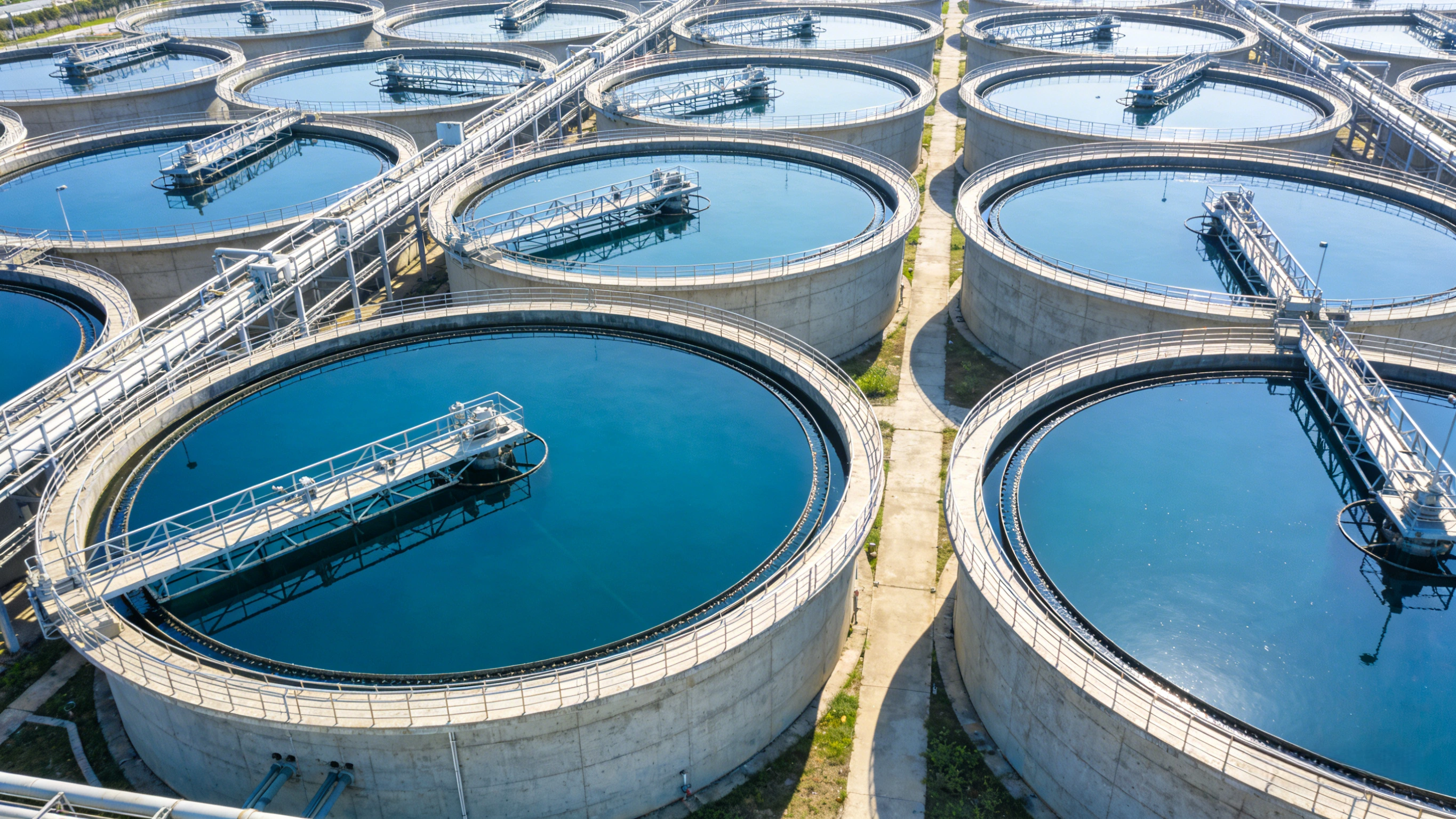
Microbiologically induced corrosion of concrete (MICC) in sewers, commonly called biogenic sulfuric acid attack, is a two-stage bio-chemical process: sulfate-reducing bacteria (SRB) in submerged sludge convert sulfate to hydrogen sulfide (H2S); the gas migrates into the pipe headspace and is oxidised by sulfur-oxidizing bacteria (SOB) in the damp crown biofilm into sulfuric acid, which dissolves cement hydrates and precipitates gypsum and ettringite. It attacks the crown of partially filled sewer pipes, manholes and aeration basins above the water line—the zone where anti-corrosion linings earn their keep.
TL;DR — Crown surface pH can fall to 1-3 against a pore solution of pH 12.5-13.5. Protection cuts both steps of the chain: dense mix design (water-to-binder ≤0.45, cover ≥40 mm, EN 206 class XA), an acid-proof barrier (epoxy glass-flake thick coat, vinyl ester mortar, polyurea or stainless liner) and, optionally, H2S suppression by dosing. Accept on measurable values: dry film thickness, continuity, pull-off adhesion.
Key data
- Concrete pore solution is strongly alkaline (pH ≈ 12.5-13.5); once the crown biofilm keeps excreting acid, the surface liquid film drops to pH 1-3, inside the fast-dissolution zone of cement hydrates.
- Sewer headspace H2S is typically <10 ppm under normal domestic flow but reaches tens to hundreds of ppm in septic, stagnant sections; odour is already detectable near 0.1 ppm.
- The oxidation runs H2S + 2O2 → H2SO4 + H2O, catalysed by microbes; Acidithiobacillus thiooxidans dominates corroding surfaces and tolerates pH <1 (Appl. Environ. Microbiol., 2007, PMID 17142362).
- Field and accelerated-test reviews put crown material loss in severe reaches at the 0.5-2 mm per year order (Materials Reports 2025, 39(7):108-118).
- Gypsum (CaSO4·2H2O) and ettringite occupy a larger volume than the phases they replace; internal stress degrades flexural strength before compressive strength.
- Design anchors: EN 206 classes XA1-XA3 set grade, water-to-binder ratio and cover (common guide values w/b ≤0.45, cover ≥40 mm); industrial structures follow GB/T 50046; lining total dry film ≥1.5-2.5 mm.
Mechanism: the two-stage chain from sulfate to acid
Submerged zone: SRB generate H2S
Sulfate in sewage and pipe-bottom sludge (domestic wastewater typically carries 30-300 mg/L sulfate, more with industrial input) serves as electron acceptor for Desulfovibrio-type bacteria in anaerobic biofilm; the released sulfide dissolves as H2S. Warm water, low velocity, long retention and sludge storage multiply production; drop boxes and turbulent reaches act as release points.
Crown zone: SOB make acid in situ
Headspace H2S is absorbed by the capillary and condensate film on the concrete crown. Sulfur-oxidizing bacteria (Acidithiobacillus/Thiobacillus, accompanied by Beggiatoa) oxidise it stepwise to sulfuric acid. The acidic film trickles downwards, so corrosion is deepest at the crown and tapers along the haunches—a site-reading signature of MICC.
Damage: dissolution plus expansion
Sulfuric acid first neutralises portlandite, then decomposes C-S-H gel, forming gypsum and ettringite. Gypsum is soft and soluble—airflow washes it away and exposes fresh alkaline surface to the next biofilm cycle; ettringite crystallising in confined space expands, cracks and spalls the layer. Once low pH and chlorides reach the reinforcement, rust jacking accelerates. Design against superposed attack: internal biogenic acid plus external soil sulfate and CO2.
Five engineering variables that set the rate
Temperature (20-35 °C is the active band for common municipal sewage); hydraulic retention and sludge storage (decide H2S production); slope and fill level (decide crown wetting time); water quality (sulfate background, industrial sulfurous wastewater, nutrients); and concrete quality—water-to-binder ratio, compaction and surface permeability. Between identical reaches, cast batches differ mostly through the last variable.
Protection systems compared
| Route | Principle | Position | Construction window | Acceptance |
|---|---|---|---|---|
| High-performance concrete mix | Lower permeability slows acid ingress | New pipes, manholes | Batching and curing stage | Grade, impermeability, cover depth |
| Epoxy glass-flake thick coat | Flake lamellae lengthen the diffusion path | Crown above water line, manhole walls | ≥5 °C, dry substrate | Total DFT ≥1.5 mm, no misses |
| Vinyl ester + quartz-sand mortar | Acid-proof resin with graded filler | Strongly acidic sections, channels | Hand lay-up or trowel | Thickness, hollow sound, Barcol cure |
| Spray polyurea elastomer | 100 % solids, fast set, bridges cracks | Repair relining, moving substrates | High-pressure plural-component rig, dry substrate | ≥2 mm, seams, adhesion |
| Process dosing (iron salt, calcium nitrate, aeration) | Precipitate sulfide or keep it oxidised | Whole network, pump wet wells | Continuous operation | H2S reduction measured in gas phase |
Application and acceptance
The substrate decides
The corroded surface is a false substrate: grind off the friable layer to sound concrete (typically 2-5 mm), high-pressure wash, then dry to <6-8 % moisture for epoxy systems; fill honeycombs with epoxy mortar. Where pull-off strength is below 1.0-1.5 MPa, strengthen before lining.
Environmental window
Apply at ≥5 °C and at least 3 °C above dew point; overhead crowns need high-thixotropy, sag-resistant formulations. Build epoxy glass-flake systems as primer—two thick coats—topcoat, respecting recoat intervals; total dry film ≥1.5-2.5 mm.
In-service inspection
Grade reaches by risk; watch crown colour (grey friable crust signals acid activity), measure coating thickness and debonding share, trend H2S and surface pH as proxy indicators. Patch damage with cut-back, grinding and ≥50 mm overlap on the repair.
FAQ
Why is the crown eaten while the invert looks intact?
The oxidation step needs oxygen, so acid forms only above the waterline in damp biofilm. Below water SRB produce H2S but no acid; invert damage usually comes from abrasion, rust jacking or soil-side attack—different mechanisms, different protection.
Is industrial sulfuric acid attack the same problem?
The material answer overlaps (acid-proof lining), but chemically derived acid can touch any wetted surface at potentially higher concentration, while biogenic acid concentrates in the crown band. Read water-quality reports and the hydraulic profile together before setting the system.
Can dosing alone replace a liner?
Dosing suppresses H2S while running, yet maintenance shutdowns and storm surcharge create protection gaps. For critical reaches the industry applies suppression plus liner as a two-layer defence.
Do silane impregnations work on crowns?
As preventive treatment of mildly exposed surfaces—hydrophobation thins the liquid film and starves the biofilm. Where a friable crust already exists, repair the substrate first; penetrants are not a structural fix.
How to make acceptance quantitative on refurbishment jobs?
Three measurable families: dry film thickness (magnetic or ultrasonic gauge, 80/20 rule over the area), adhesion (in-situ pull-off record), continuity (low-voltage wet sponge on thin systems). Write the values into the technical annex and disputes end there.
How do B2B projects start sampling?
Send reach photos, H2S and water-quality values, target thickness and schedule; you receive an epoxy glass-flake or vinyl ester system with sample test conditions, quoted EXW/FOB with construction guidance in the technical agreement.
Last updated: 2026-09-26
References: US EPA/OSMA, Guidelines for Prevention of Corrosion on Concrete Sewer Pipe (1975); Appl. Environ. Microbiol. 2007 (PMID 17142362); Materials Reports 2025, 39(7):108-118; EN 206; GB/T 50046.
Kexin New Materials (Guangdong) Co., Ltd.