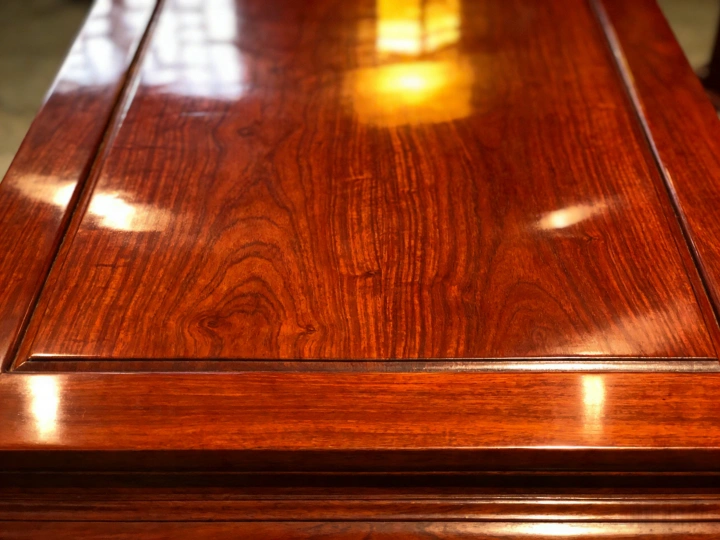
Raised grain is the roughening of a wood surface that happens when fibers, cut open by sanding, absorb water from a waterborne coating, swell sideways, and snap upright as the panel dries. It is a substrate–coating interface defect—the dominant quality problem in waterborne finishing of solid wood, veneer and fingerjoint stock—and the trigger is water, not the binder. Industry shorthand: “water popping,” “nibbing,” “fuzzing.”
TL;DR — Control operates on three levels. Substrate: condition boards to 8–12 % moisture and cap the final abrasive at P220 (stop at P180 on pine and fir). Process: for demanding species either pre-raise deliberately with water-popping (8–12 g/m² fine mist, dry, then a P320 kiss-sand) or let a sacrificial sanding sealer lift the fibers and sand them off in one pass. Equipment: on flat lines, a waterborne-UV hybrid flash cure locks fibers within seconds; otherwise 50–60 °C forced drying shortens wet contact time. Judge results by Ra change and hand-feel only after the panel is fully dry.
Key numbers
- Fiber saturation point of wood is about 28–30 % moisture content: below it, the cell wall swells and shrinks with moisture exchange—the physical precondition of raised grain (USDA Wood Handbook).
- Wood swelling is strongly anisotropic: tangential movement is roughly 1.5–2.5 × radial, and longitudinal movement is about 0.1 %; severed fibers bulge sideways and therefore stand up on the face.
- Field data on maple (eQualle, 2026): after a P220 final sand, surface roughness Ra is 1.2–1.6 µm; wetting drives it to 3.0–3.8 µm—more than double, enough to poke through a seal coat.
- The burrs are removable when dry: birch raised to Ra ≈ 3.5 µm returns to 1.0–1.3 µm after a light P320 pass at 1–1.5 kgf orbital pressure.
- Water-popping parameters: distilled-water mist of 8–12 g/m² in 2–3 fine passes; dry 30–60 min at 45–55 % RH (about 90 min in humid weather) back to pre-wet weight before sanding.
- GB 18581-2020 (limit of harmful substances in wood coatings) covers putties, sealers and topcoats; solventborne VOC limits are ≤720 / ≤670 / ≤550 g/L for nitro, PU and alkyd types. Waterborne systems sit far below—while making raised grain the price of the water.
Mechanism: from cell-wall swelling to drying snap
1. Water enters the cell wall
Sawing and sanding open the lumens of fibers and vessels. A waterborne sealer typically carries 55–70 % water; within 1–30 minutes of application, water diffuses into the first few cell layers. Hydrogen bonds in the amorphous hemicellulose/lignin matrix relax, micro-fibrils slide apart, and the wall thickens tangentially and radially while length barely changes.
2. Drying snaps the buckled fibers
As water leaves, the wall shrinks—but cell corners and thin earlywood walls fractured during the swelling cannot spring back. The fibers stay locked as upright stubs. That is why the panel feels smooth while wet and peaks in roughness only after full drying: sanding a damp panel is wasted work.
3. Species and machining set the severity
Ring-porous oak and ash tear along open vessels; diffuse-porous maple and birch produce fine, tough fuzz; pine and fir crush their earlywood if sanded too fine. Coarser residual scratch patterns leave longer free fiber lengths—higher lever arms, more dramatic raising. See also our waterborne open time and leveling and stain-blocking primer notes.
Process control: substrate, sealer, drying
Substrate preparation
Condition stock at 20 ± 2 °C / 50 ± 5 % RH to a moisture content of 8–12 % close to the destination climate. Final sand no finer than P220 (P180 on softwoods); use silicon-carbide film for the post-wet pass. On stained parts, run a wet-dry-test on scrap before committing a batch—uneven raising shows first as color blotch.
Pre-raise (water-popping) or sacrificial sealer
Water-popping detonates the problem early and sands it off once: 8–12 g/m² mist, full dry, light P320. On spray lines the usual route is a fast-flocking, low-water sanding sealer applied thick enough to embed the raised fibers (40–60 µm wet, 20–35 µm dry), then one through-sand at P320–P400 before color or topcoat. The same sealer film also blocks tannin streaking on oak and mahogany.
Locking the fibers: UV flash cure and forced drying
In waterborne-UV hybrid systems, seconds of radical pre-cure gel the film before fibers can absorb water—a decisive advantage on roll-coat flat-stock lines (doors, tabletops). Convection or IR drying in a supplier-bounded 50–60 °C window shortens wet contact; increase air movement rather than surface temperature to avoid skin-over pinholing.
Control routes compared
| Route | Practice | Effect & limits | Best fit |
|---|---|---|---|
| Water-popping | Mist 8–12 g/m², dry, P320 kiss-sand | Root-cause removal; one extra handling/dwell step | High-grade solid parts, veneers, stained work |
| Sacrificial sealer | Sealer raises fibers, then one through-sand | Line-friendly; costs one coat + abrasive | Cabinet casework, mouldings, batches |
| UV flash cure | Waterborne-UV hybrid, seconds of pre-cure | Least raising, fastest cycle; equipment investment | Roll-coat flat stock |
| High-solids, low-water formula | Pick fast-flocking sealers, keep wet film short | No line change, partial improvement only | Retrofit transition period |
| Air-dry and hope | No control, rely on topcoat to bury it | Nibs poke through topcoat; rework rate high—avoid | Non-visible faces only |
Frequently asked questions
Q1: Why does raising spike in humid summer?
High humidity slows water escape, stretching wet-contact time; absorbed volume grows roughly with time. Increase inter-station airflow, control dew point, or move the station to a UV flash cure.
Q2: The board feels smooth after drying, yet the sealed surface is gritty—why?
Raising completes during drying after water uptake, and the sealer then stands the stubs in resin. Diagnose with a wet-dry simulation on scrap (mist, dry, hand-feel) or an Ra meter: >2 µm after the simulation means treat the substrate first.
Q3: Any special rules for pine and fir?
Stop at P180—finer grits polish open softwood earlywood into ridges. Pre-raise works but keep orbital pressure under 1 kgf so stubs are cut, not pressed back in.
Q4: How thick must the sealer be to trap the fibers?
Start at 40–60 µm wet (20–35 µm dry) with a P320–P400 cut; thicker films trap air at fiber roots and pinhole unless flash-off is extended.
Q5: Does water-popping risk warp or checking?
Wet penetration is sub-millimetre and dosed at 8–12 g/m², harmless for 18 mm+ solid stock already at 8–12 % moisture; test first on thin veneers and unconditioned panels.
Q6: How do B2B buyers start a trial?
Send species, thickness, moisture records, line speed and curing setup; you receive a sealer/hybrid selection with spray parameters. Quotes run on EXW/FOB terms with commissioning covered by the technical agreement.
Last updated: 2026-09-27
References: USDA Forest Products Laboratory, Wood Handbook (fiber saturation, anisotropic swelling); eQualle sanding technology data, 2026 (Ra change after wetting, grit ladders); Sherwin-Williams Industrial Wood, Waterborne Coatings and Finishes; GB 18581-2020, Limit of harmful substances of wood coatings.
Kexin New Materials (Guangdong) Co., Ltd.