Introduction: The Anti-Corrosion Philosophy of Inorganic Zinc-Rich Coatings — "Bonding Zinc Dust to Steel with Silicate Binder"
The essence of inorganic zinc-rich coatingsUse inorganic silicate (Si-O-Si / similar to quartz glass) to "bond" >80% zinc powder particles onto the steel substrate
——forming acontinuous conductive zinc powder layer
——the zinc powder acts as a sacrificial anode——corrodes preferentially——protects the steel substrate. Its anti-corrosion mechanism is not "barrier" (like epoxy coatings that isolate water and oxygen)——but"electrochemical protection"
——zinc powder (potential -1.05V vs Cu/CuSO₄) is more "active" than steel (potential -0.65V)——in the corrosion cell zinc acts as the anode and is corroded (Zn→Zn²⁺+2e⁻)——steel acts as the cathode and is protected (Fe does not corrode)——this is "sacrificial anode cathodic protection". The Si-O-Si binder of inorganic zinc-rich coatings isinorganic
——unlike epoxy (organic resin) which degrades under UV and high temperature——therefore inorganic zinc-rich can be used long-term in high-temperature environmentsbelow 400°C
——which epoxy zinc-rich (>120°C degradation) cannot achieve.
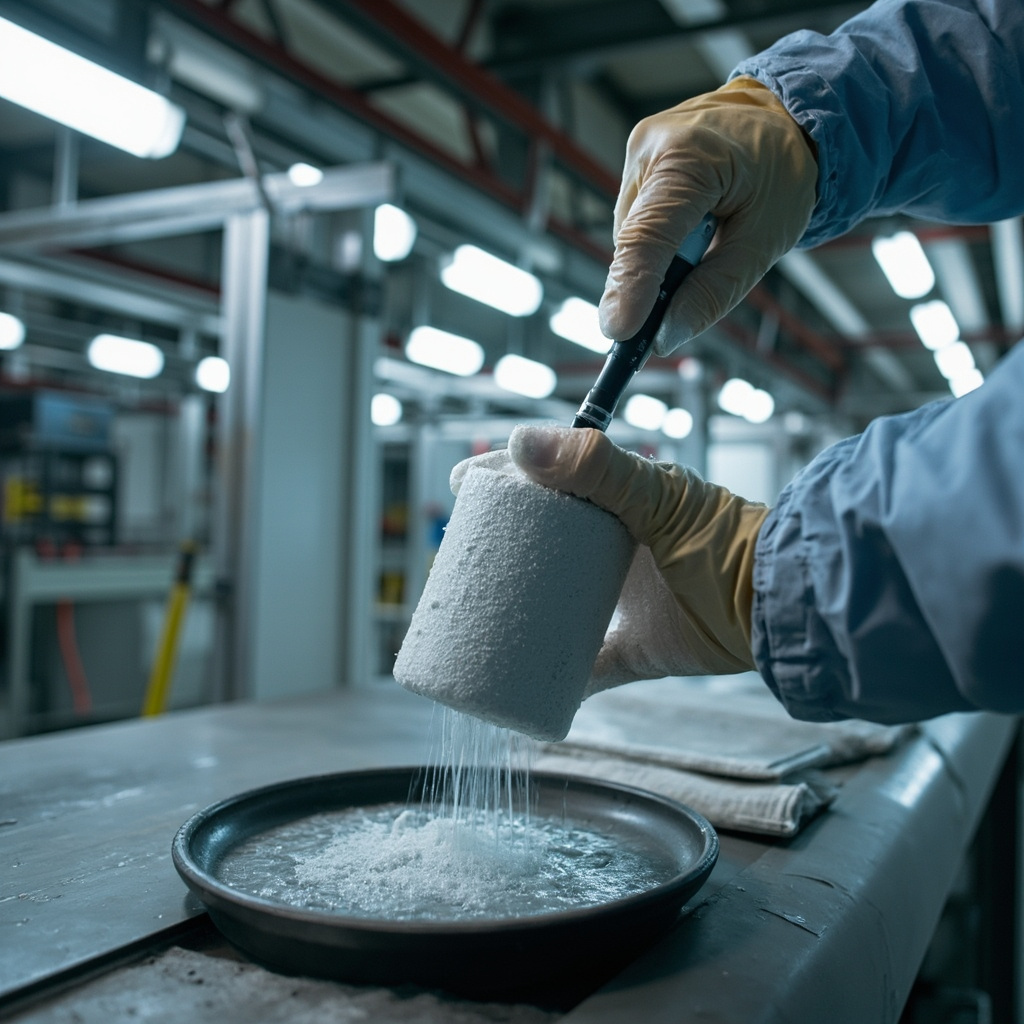
I. Curing Chemistry and Property Comparison of Three Silicate-Based Binders
| Base Material | Curing Method | Curing Byproduct | Water Resistance | VOC | Cost | Application |
|---|---|---|---|---|---|---|
| Ethyl silicate (TEOS/Si(OC₂H₅)₄) | Moisture curing——TEOS+2H₂O→SiO₂+4C₂H₅OH↑ (ethanol volatilization) | Ethanol (non-toxic) | Excellent (dense SiO₂ / quartz glass) | 300-500g/L (solvent is alcohol) | Medium (standard) | Solvent-based / heavy-duty anti-corrosion (mainstream) |
| Lithium silicate (Li₂SiO₃ / aqueous solution) | CO₂ curing——Li₂SiO₃+CO₂→SiO₂+Li₂CO₃——reversible (weak water resistance) | Li₂CO₃ (water-soluble salt / residue in coating)——reduced water resistance | Medium-Good | <50 (water-based / low VOC) | Medium-High (more expensive than TEOS) | Water-based / eco-friendly / light to medium anti-corrosion |
| Potassium silicate (K₂SiO₃ / aqueous solution) | CO₂ curing——K₂SiO₃+CO₂→SiO₂+K₂CO₃——reversible (even weaker water resistance) | K₂CO₃ (highly water-soluble)——rainwash → increased coating porosity | Medium | <50 (water-based) | Low (most economical) | Water-based / low-cost / indoor / short-term |
FAQ
Q1: Why must inorganic zinc-rich coating be applied only after sandblasting (Sa2.5) — can't simple grinding be used?
The adhesion of inorganic zinc-rich is physical + chemical dual mechanism
: (1) Roughness of steel substrate (Rz 40-70μm) — zinc powder + silicate binder mechanically locks in the rough peaks and valleys — providing physical anchoring; (2) Silanol (Si-OH) and Fe-OH on the steel surface — condensation forms Si-O-Fe covalent bonds — providing chemical bonding. Manual grinding (St3 / roughness Rz<25μm) — insufficient physical anchoring + contaminant layer on steel surface hinders Si-O-Fe bonding — inorganic zinc-rich coating peels off in sheets within weeks. Sandblasting Sa2.5 is mandatory and non-negotiable
— this is the "first iron rule" for applying inorganic zinc-rich coatings.
Q2: Why must the zinc dust content of inorganic zinc-rich coatings be >80% (by dry film weight)?
Zinc dust content <80%——zinc dust particles are "isolated" by resin in the coating, the conductive network is discontinuous——cathodic protection current (Igalv) drops sharply (1mA/m² when zinc dust >80%)——coating loses sacrificial anode function——relies only on barrier protection (and silicate's barrier effect is weaker than epoxy)——anticorrosive life is greatly shortened (>1000h vs >3000h salt spray). The "percolation threshold" of zinc dust >80% is the critical concentration for zinc dust particles to form a continuous contact + conductive network
in the coating——below this value——the coating changes from "conductive + cathodic protection" to "insulating + barrier" anticorrosion mechanism, fundamentally altered.
Q3: Synergistic effect of flake zinc powder (Flake Zn) and atomized zinc powder (Atomized Zn) in inorganic zinc-rich coatings?
Atomized zinc powder (D50 3-8μm / point contact)——good conductivity (point contact forms conductive chains)——large cathodic protection current (>1mA/m²). Flake zinc powder (aspect ratio >50:1 / thickness 1-3μm / surface contact)——excellent shielding effect (flake overlapping arrangement——water molecule permeation path extended >10 times)——but weak conductivity (large contact area but low contact pressure). Mixed system of atomized + flake (70/30)
——(1) Atomized——provides "cathodic protection"; (2) Flake——provides "shielding enhancement" anti-corrosion performance > individual use of either——salt spray life can be increased from >2000h for atomized alone to >3500h for the mixture.
Q4: What are the health hazards to welders from "zinc fume" during welding of inorganic zinc-rich coatings?
When welding inorganic zinc-rich coatings (>5000°C) — zinc evaporates under the high temperature of the arc (Zn boiling point 907°C)
— rapidly oxidizes in air to ZnO particles (<1μm/white smoke "zinc fume")
— welder inhales ZnO — after an incubation period of several hours — sudden onset of "metal fume fever" (Metal Fume Fever / flu-like — fever / chills / myalgia / headache)
— symptoms resolve spontaneously after >24-48h — but repeated exposure may develop into chronic respiratory disease
. When welding steel with zinc-rich coatings — (1) before welding — grind off the coating in the welding area (>20mm wide / bare steel)
; (2) welding with local exhaust ventilation (LEV / capture velocity >0.5m/s)
— to remove zinc fume from the welder's breathing zone; (3) after welding — re-apply coating to the welded area.
Q5: What is the difference between the "self-healing" of inorganic zinc-rich coatings and that of strontium chromate primer?
Inorganic zinc-rich "self-healing": coating scratched — zinc powder exposed — zinc acts as sacrificial anode — preferential corrosion (Zn→Zn²⁺+2e⁻) — zinc corrosion products (ZnO/Zn(OH)₂/basic zinc carbonate) precipitate + fill at the scratch
— forming a dense "zinc corrosion product barrier"
— preventing subsequent corrosive media from entering. This "self-healing" is physical filling
— relies on the self-corrosion of zinc
— therefore consumes zinc — once the zinc powder is depleted, the "self-healing" ceases. The "self-healing" of strontium chromate: CrO₄²⁻ releases from the coating to the damaged area for chemical re-passivation
— does not consume the coating itself — a more efficient "self-healing", but the carcinogenicity of Cr⁶⁺ has led to its global phase-out.
Q6: Failure mode of inorganic zinc-rich coating in "water immersion" environment?
Inorganic zinc-rich coating—long-term water immersion (e.g., ship ballast tanks/tank bottoms)—(1) Si-O-Si network in hot water/water vapor at >60°C
undergoes slow hydrolysis (Si-O-Si+H₂O→2Si-OH)—coating strength decreases; (2) Zn corrosion products (ZnO/Zn(OH)₂) in immersed environment expand in volume >3 times (ZnO+H₂O→Zn(OH)₂)
—coating "bulges" and peels off from steel substrate. Inorganic zinc-rich in water immersion environment
—needs to be paired with an epoxy sealer (>30-50μm/low-viscosity epoxy penetrates into the pores of inorganic zinc-rich—sealing water pathways) "inorganic zinc-rich primer + epoxy sealer + epoxy intermediate paint + polyurethane topcoat"
four-layer system—is the global standard for corrosion protection in marine engineering.
Q7: The "Post-cure" of lithium silicate and potassium silicate — why does it take several weeks to fully cure?
The curing of lithium silicate and potassium silicate — relies on CO₂ in the air
slowly penetrating the coating — reacting with Li₂SiO₃/K₂SiO₃ → forming SiO₂ + Li₂CO₃/K₂CO₃. The CO₂ concentration in the atmosphere is only 400ppm (0.04%)
— penetration rate is extremely slow — complete curing of the coating requires 2-4 weeks (23°C/50%RH)
. During the curing period — the coating must not be immersed in water
(water will leach out unreacted Li₂SiO₃/K₂SiO₃ — permanent weakening of the coating). To accelerate curing — (1) after >24h of application — lightly spray 5% ammonium bicarbonate (NH₄HCO₃/aqueous solution)
— NH₄HCO₃ decomposes releasing CO₂ — accelerates curing — >3 days to cure (>70% — remaining 30% continues natural curing); (2) CO₂ chamber (>50% CO₂/sealed)
— >24h for complete curing — but equipment and safety (>5% CO₂ = personnel poisoning) — only for factory prefabrication.
Q8: Inorganic zinc-rich "rough surface" (Rz>30μm) — is it "good" or "bad" for the intercoat adhesion of the subsequent epoxy intermediate coat?
The rough surface of inorganic zinc-rich (Rz 30-80μm) greatly facilitates the mechanical anchoring of the subsequent epoxy intermediate coat
— intercoat adhesion (>5MPa) is superior to that on smooth surfaces (>3MPa). However, the porosity of inorganic zinc-rich
(>5-15% / silicate coating water infiltrates the silicate coating during spraying — water vapor expands during subsequent baking — producing "bubbles"
— this is the most common intercoat defect in the inorganic zinc-rich + epoxy sealer system — the low-viscosity epoxy of the sealer must fully penetrate into the pores of the inorganic zinc-rich — displacing the air/moisture in the pores
— within 24h after application of the sealer
— do not raise temperature (>30°C) — allow sufficient time for the sealer to penetrate and cure — to avoid "bubbles".
Q9: The future of the inorganic zinc-rich coating market — can water-based (lithium silicate) replace solvent-based (ethyl silicate)?
Water-based inorganic zinc-rich (VOC2-4 weeks/weather-dependent) — solvent-based ethyl silicate (VOC>300g/L) — moisture curing — fast (>24-48h); (2) water resistance of water-based lithium silicate is weaker than solvent-based ethyl silicate — long-term (>10 years) immersion/high humidity — adhesion decay of water-based lithium silicate coating > solvent-based. Currently heavy-duty anti-corrosion (C4-C5/immersion) scenarios — solvent-based ethyl silicate is the mainstay
— water-based lithium silicate only in moderate to light anti-corrosion (C3/indoor/short-term)
— the progress of water-based replacing solvent-based in the inorganic zinc-rich field — slower than the water-borne transition of organic coatings (water-based epoxy/water-based PU) — due to inherent performance limitations of inorganic silicates.
Q10: Corrosion protection lifespan prediction of the "four-layer system" of inorganic zinc-rich + epoxy sealer + epoxy micaceous iron oxide + polysiloxane topcoat?
CX marine environment —> 50 years corrosion protection (no maintenance / theoretical — actual needs to consider maintenance) — this is the "ultimate solution" for global offshore platform corrosion protection. Contribution of each layer — (1) Inorganic zinc-rich (>80μm / provides >20 years sacrificial anode — before zinc powder is depleted); (2) Epoxy sealer (>50μm / penetrates into inorganic zinc-rich — seals water channels — extends system lifespan); (3) Epoxy micaceous iron oxide (>150μm / barrier — >30 years); (4) Polysiloxane topcoat (>80μm / weather resistance — >25 years). The "redundant design" of the four-layer system — if one layer fails (e.g., topcoat chalking) — other layers still provide corrosion protection — the system will not experience "avalanche-style failure" — this is the core principle of ultra-long-life corrosion protection design.
Related Reading
Summary
The three silicate binders of inorganic zinc-rich coatings—ethyl silicate (moisture-cured / excellent water resistance / solvent-based / mainstream), lithium silicate (CO₂-cured / water-based eco-friendly / mild-to-moderate corrosion protection), and potassium silicate (water-based / low cost)—differ significantly in curing mechanism, water resistance, and VOC. A zinc powder content above 80% is the "percolation threshold" that ensures the conductive network for cathodic protection is connected. A hybrid system of flake/spherical zinc powder (70/30) is the optimal anticorrosive formulation. Kexin New Materials provides customers with full-range inorganic zinc-rich ethyl silicate/lithium silicate coatings and support for four-tier corrosion protection system design.