Introduction: Pinholes vs. Cratering — Similar in Name, Distinct in Mechanism, Opposite in Strategy
Pinholes and Craters are the two most common surface defects in water-based paint application, but they are often confused—leading to solving the right problem with the wrong strategy. A pinhole is a micro-channel that penetrates the coating (from inside out), while a crater is a circular depression on the coating surface (from outside in).
I. Microscopic Identification Table: Pinholes vs. Craters
| Feature | Pinholes | Craters |
|---|---|---|
| Size (Diameter) | 0.05-0.5mm | 0.5-3mm |
| Shape | Regular round pinprick shape | Basin-shaped depression (center low, edges high) |
| Depth | Penetrating to substrate or primer layer | Not penetrating (surface depression only) |
| Distribution | Evenly scattered (related to the coating as a whole) | Random/local (related to contaminants) |
| Root Cause | Path of bubble escape within the coating | Low-energy surface contaminants repelling the coating |
| Solution Direction | Defoaming/deairing/reducing viscosity | Cleaning/anti-crater additives/check compressed air |
II. Overview of Technical Parameter Comparison
| Technical Indicator | Standard Requirement | Premium Level | Test Method |
|---|---|---|---|
| Adhesion | ≥3MPa | ≥5MPa | ISO 4624 Pull-off Method |
| Salt Spray Resistance | ≥500h | ≥1000h | ASTM B117 |
| Weathering Resistance (QUV) | ≥1000h gloss retention >50% | ≥3000h gloss retention >80% | ISO 16474-3 |
| VOC Content | Compliant with GB standard | 50% below limit | GB/T 23985 |
| Application Window | 5-35°C | -10~40°C (wide temperature range) | TDS Recommended Conditions |
Technical deepening: systematic optimization methods for process parameters (DOE experimental design)
The optimization of coating production processes should not rely on the "trial-and-error method" but should adopt the scientific method of DOE experimental design. Taking the dispersion process as an example—factors affecting quality (linear velocity/time/filling rate/temperature), 4 factors each at 3 levels—a full factorial requires 81 experiments—DOE uses orthogonal experiments L9 (9 times) or response surface methodology (27 times) to greatly reduce the number of experiments—while simultaneously obtaining the main effects and interactions of each factor. For example, it is found that "the interaction of linear velocity × time is significant": high linear velocity + short time and low linear velocity + long time can achieve the same dispersion effect—but the former saves over 20% energy.
In DOE analysis, interpretation of the P-value — P95% confidence). DOE ultimately outputs a set of prediction models (polynomial regression equations) — input line speed/time/temperature → predict fineness/viscosity/gloss — providing formulation engineers with a "digital formulation optimization" tool.
Industry practice: from "master craftsman's feel" to "parameter standardization"
The common challenge in the coatings industry—when experienced veteran workers retire, their "feel" (mixing resistance / fineness gauge scraping / visual inspection of wet film gloss) is taken away—new employees cannot replicate it. Transform the "feel" into quantifiable standard parameters (1) mixing resistance → viscometer reading; (2) fineness gauge scraping → fineness gauge reading (μm); (3) wet film gloss → gloss meter (GU value). The "standard parameter card" for each process is posted next to the equipment—new employees operate according to the "card" rather than "by feel". "Parameter standardization" is a key step for coating factories to move from "workshop" to "factory".
FAQ
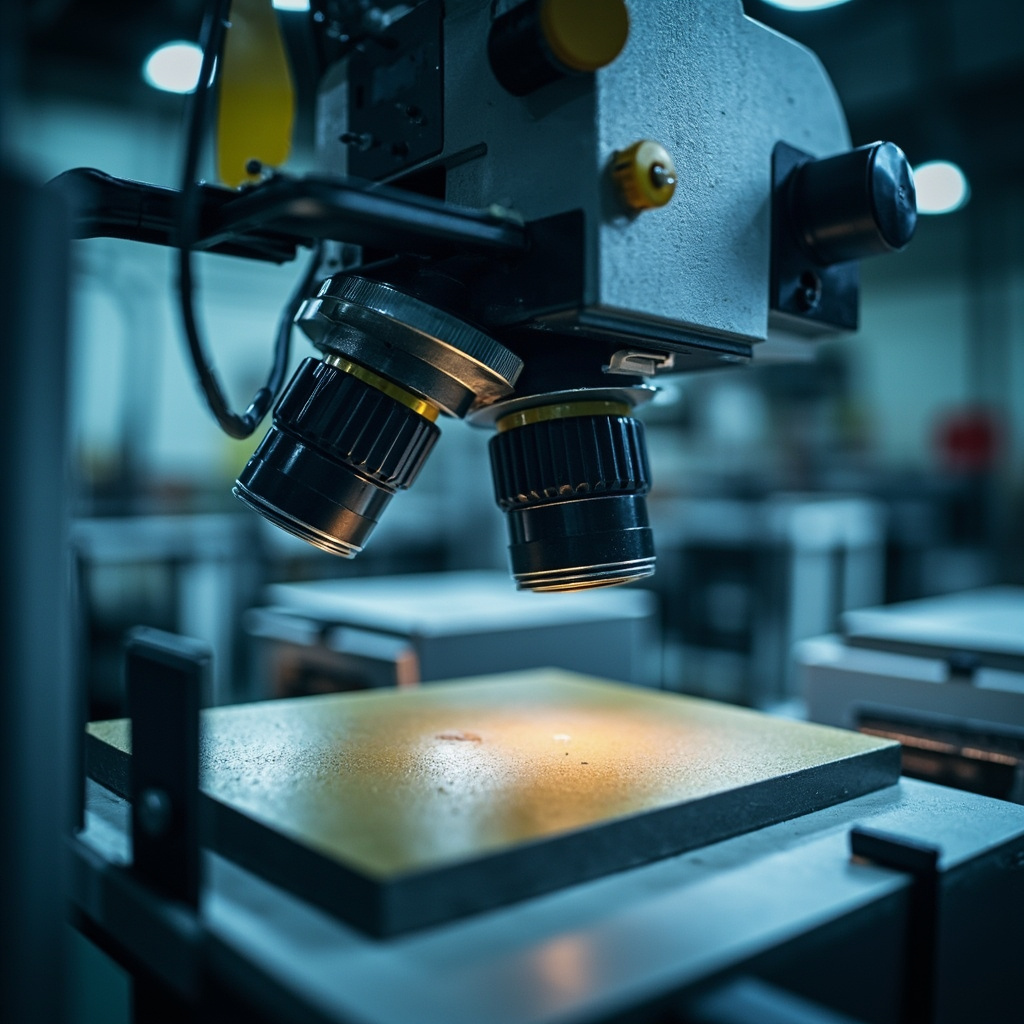
Q1: How can a portable microscope be used for on-site defect identification?A 100×-200× USB portable microscope (unit price 200-500 RMB) can be connected to a phone/tablet to observe the microscopic morphology of defects on site. Pinhole → black circular deep hole (light cannot reach the bottom); shrinkage cavity → shallow basin shape (light can see the coating at the bottom of the basin). This is the fastest on-site identification method, requiring no sampling to send to a laboratory.
Q2: What is the "small black dot" at the center of the shrinkage cavity?The black dot at the center of the shrinkage cavity is usually the contaminant itself (such as silicone oil droplets / compressor oil mist / welding spatter). Use sharp tweezers to pick out the black dot → place it on a glass slide → analyze with microscope + FTIR to identify the contaminant composition (silicone oil → Si-O-Si absorption peak / oil mist → long-chain alkyl peak).
Q3: Main manifestations of defoamer failure? A large number of micro-bubbles in the tank (foam does not disappear for a long time after stirring), dense pinholes appear in the wet film (after bubbles rise to the surface and burst, the coating does not have time to level and fill). Causes of defoamer failure: (1) Too long storage period (>12 months) causing sedimentation of active defoaming ingredients; (2) Incompatibility with other additives in the coating (especially leveling agents) leading to precipitation of the defoamer.
Q4: What are anti-cratering additives?They are usually fluorocarbon-modified acrylates or silicone-modified polyethers, low surface tension substances (surface tension <25 mN/m) that preferentially spread to cover low-surface-energy contaminants, providing a uniform spreading substrate for the coating. They are used in very small amounts (0.05%–0.2%); excess can reduce interlayer adhesion and recoatability.
Q5: How to troubleshoot pinholes caused by oil/water in compressed air?Place a clean white paper at the end of the compressed air pipe (before the spray gun) → fully open the air valve and blow for 30s → observe whether there are oil spots or water stains on the white paper. If there is oil → install/replace the oil-water separator and activated carbon filter (accuracy <0.01μm). If there is oil and water → this is the number one hidden cause of pinholes in water-based paint!
Q6: Pinholes appear densely and the defoamer doesn't work?(1)Check whether the coating viscosity is too high (bubbles rise slowly) — dilute and reduce viscosity to the recommended range; (2)Reduce wet film thickness (applying too thick a coat at once makes the internal bubble rise path too long); (3)For water-based paint, check whether there is an incompatible leveling agent (some leveling agents stabilize bubbles and make defoaming difficult); (4)In electrostatic spraying situations — check whether the grounding is good (static accumulation generates micro-arcs that form pores).
Q7: Difference in pinhole tendency between two-component (2K) and one-component (1K) coatings?The 2K system has a significantly higher pinhole tendency—because the curing agent (-NCO groups) reacts with water to produce CO₂ gas, and CO₂ bubbles create pinholes in the coating (this is one of the most troublesome issues with 2K waterborne PU). Solutions: (1) Use HDI trimer (not TDI)—slower reaction rate with water; (2) Control application environment RH<80%; (3) Add molecular sieve dehydrating agent (in the curing agent component) to absorb trace moisture.
Q8: Can a coating with pinholes/craters be partially repaired?Pinholes: Use a toothpick to dip into the same batch of coating and spot-fill each pinhole (applicable to scenarios with <10 pinholes/m²). Craters: Small craters (50/m²) must be sanded and recoated entirely — this is the lowest rework cost.
Q9: How to preventively control pinholes and craters?(1) Incoming coating inspection: Drawdown panel test to check pinhole and crater tendency (formulation-level quality control); (2) Construction environment check: Compressed air oil and moisture content test / substrate surface cleanliness (water break test) / environment RH<80%; (3) Process parameter locking: Standardize spray viscosity / film thickness / flash-off time and do not change arbitrarily.
Q10: What is the difference in the mechanism of pinhole formation between solvent-based and water-based paints?Solvent-based paint pinholes: solvent evaporation bubbles (solvent vapor) → usually <0.2mm diameter / "fine pinholes". Water-based paint pinholes: water evaporation + insufficient defoaming → usually 0.1-0.3mm diameter; CO₂ bubbles (2K PU) → 0.1-0.5mm diameter / "coarse pinholes". The incidence of pinholes in water-based paint is about 2-3 times that of solvent-based paint.

FAQ: In-Depth Technical Q&A Supplement
Q11: How do the differences in domestic and international standards for this technology affect product export?Domestic standards (GB) differ from ISO/ASTM standards in test methods and acceptance criteria. For example, salt spray testing—GB/T 1771 (equivalent to ISO 7253) has test conditions basically consistent with ASTM B117—but the rating systems (ISO 4628 vs ASTM D610/D714) differ—when providing test reports for exported products, the corresponding international standards must be indicated simultaneously, otherwise overseas customers cannot make a comparative assessment. It is recommended to list both GB and ISO/ASTM dual-standard indicators in the TDS (Technical Data Sheet) of exported products—to enhance the trust of international customers.
Q12: How to verify the long-term service performance of this technology in actual engineering?Laboratory accelerated testing (salt spray/QUV/cyclic corrosion) provides comparative data—but cannot fully replace actual outdoor exposure testing. Recommendations—(1) Set up outdoor exposure racks at both the factory location and typical customer locations (e.g., coastal C5-M/industrial C4)—conduct annual inspections of coating appearance/adhesion/film thickness changes—establish a company-owned outdoor service database; (2) Collaborate with universities/research institutes—combine enterprise data with academic research—enhance data credibility.
Q13: What should SMEs pay attention to when purchasing related raw materials/equipment?(1) The batch stability of suppliers is more important than unit price—it is recommended to require suppliers to provide COA data for >10 batches—and evaluate batch variation (CpK); (2) For equipment procurement, visit peers who have used the equipment for >2 years to understand the long-term reliability and after-sales service quality of the equipment—rather than relying only on the demonstration data from equipment suppliers; (3) For key raw materials (resin/curing agent)—maintain at least 2 qualified suppliers to guard against single-supply risk.
Q14: What is the current state and trend of digital transformation in this field?The digital transformation of the coatings industry is evolving from “point-based applications” (automation of individual equipment/processes) to ”system integration” (full-chain ERP+MES+PMS). Currently, the digitalization of small and medium-sized coatings factories has the ”highest ROI investment”: automatic batching systems + digitalization of quality control data—payback period of 1-3 years—which is the prioritized recommended direction. Future trend—AI + sensors enabling real-time optimization of process parameters—further reducing quality fluctuations between batches.
Q15: How can a newly entered coating engineer quickly master this technology?(1)Combine theory and practiceDo not only read literature without touching actual production—nor rely solely on experience without studying theory;(2)Establish a“failure case archive”Every customer complaint/production anomaly/coating failure—record the root cause and resolution process—this is the most effective learning material;(3)Learn from suppliersTechnical personnel from resin/additive/pigment suppliers are carriers of ”tacit knowledge” in this field—communicate more with them about solutions to specific problems.
Related Reading
Summary
Differentiation between pinholes (through microchannels) and craters (surface depressions) is the first step in troubleshooting waterborne coating defects. Pinholes point to defoaming/deaeration and bulk bubble management; craters point to surface contamination (oil/silicone/water) and coating wettability. A portable microscope (100×–200×) is the most practical tool for rapid on-site identification. Oil- or moisture-laden compressed air is a common hidden cause of craters (often overlooked in troubleshooting).