Introduction: Waterborne UV—combining the eco-friendliness of water with the speed of UV curing.
UV curing (instant dry/zero VOC) and waterborne coatings (safe/low odor) are the two major green technology directions in the coatings industry. Waterborne UV-curable coatings combine the two—using water as the diluent—and form films through a dual mechanism of water evaporation (physical drying) + UV-initiated crosslinking (chemical curing)—offering both the high-efficiency curing of UV (seconds-level) and the environmental safety of waterborne systems (VOC 12%).
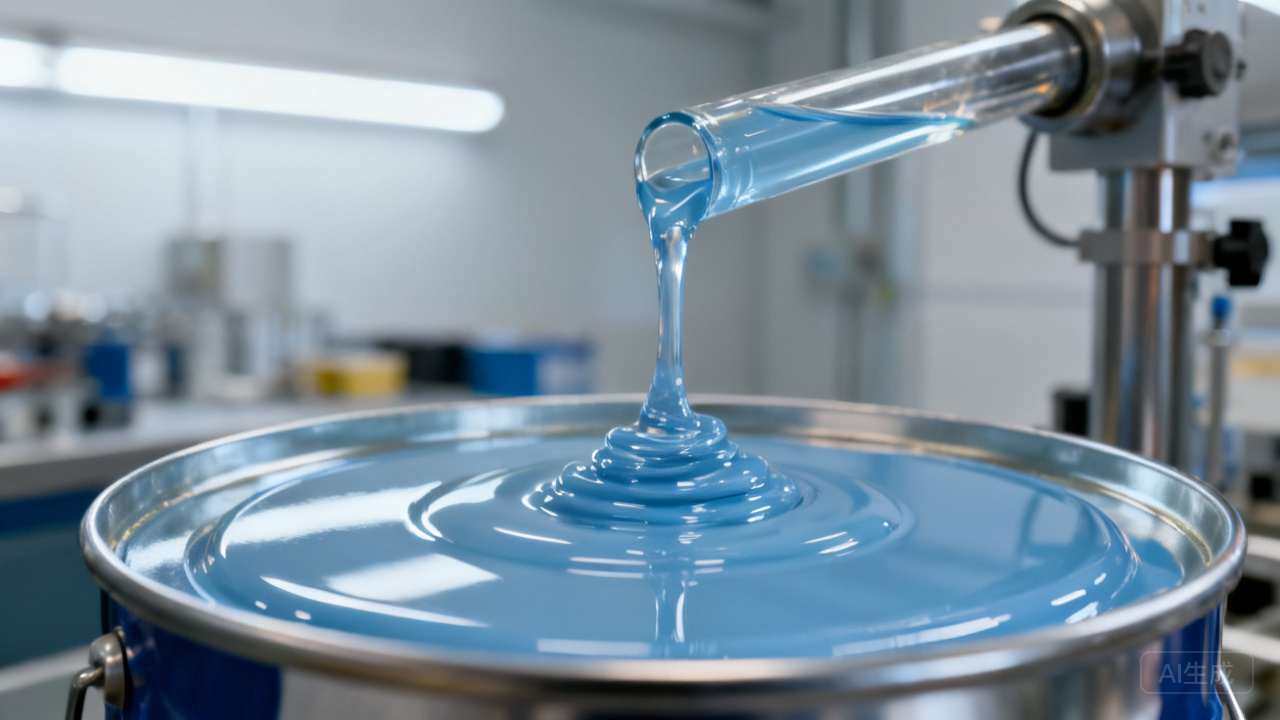
Water-based UV-curable coatings are centered on water-based UV oligomers (PUD/polyurethane acrylate dispersions) and UV photoinitiators—with water as the diluent—after application, they first undergo IR/hot-air pre-drying (removing moisture/2-5 min)—then UV irradiation (0.5-3 seconds) triggers free-radical crosslinking—forming a solid coating—a green coating system that combines environmental friendliness (VOC<50g/L), high efficiency (second-level curing), and excellent coating properties (hardness/scratch resistance/gloss).
I. Comparison of Waterborne UV vs. Conventional UV vs. Waterborne PUD
| Feature | Traditional UV (100% solids) | Waterborne UV | Waterborne PUD (one-component) |
|---|---|---|---|
| VOC (g/L) | <10 | <50 | <50 |
| Curing speed | <3 seconds | Pre-drying 2-5 min + UV <3 seconds | 20-40 min (physical drying) |
| Hardness | Extremely high (high crosslink density) | High (dual: crosslinking + physical drying) | Medium-low (no crosslinking) |
| Suitable substrates | Flat surfaces (UV light reachable) | Flat + some 3D (UV after pre-drying) | Any shape |
| Oxygen inhibition sensitivity | High (requires N2 protection) | Medium (water evaporation enriches surface with water, slowing O2) | N/A |
FAQ
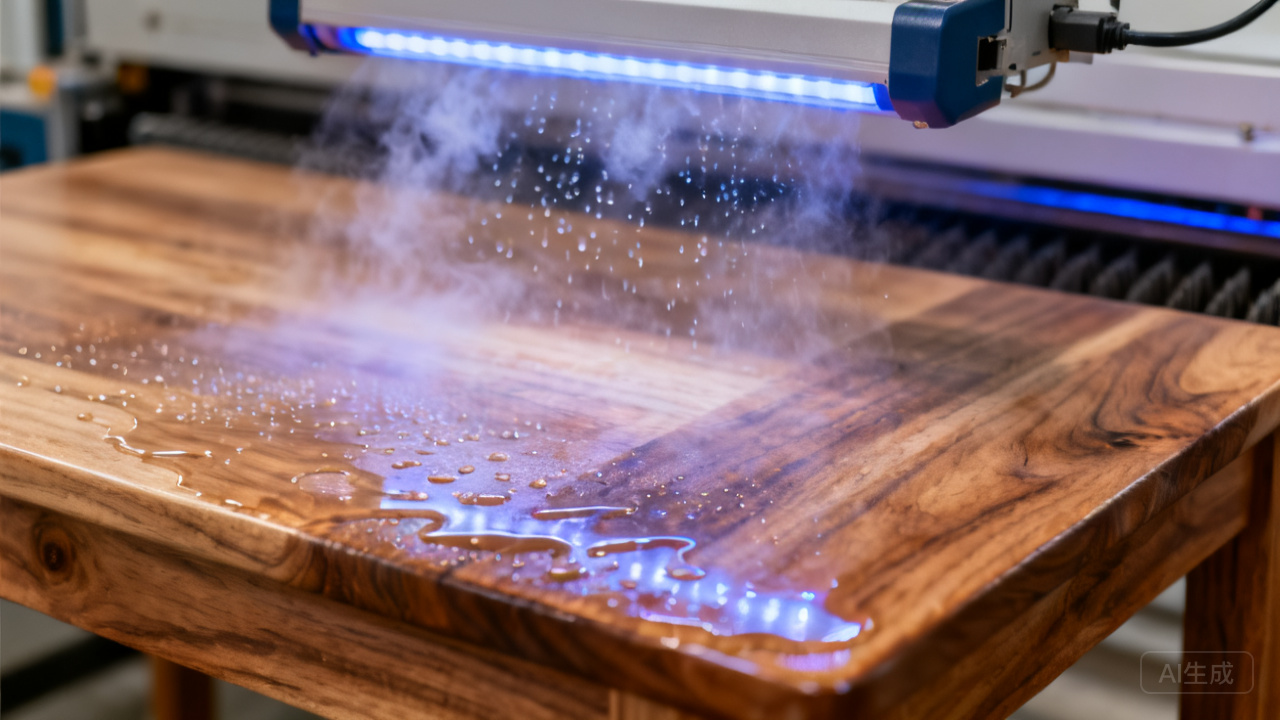
Q1: Why must water-based UV be pre-dried first and cannot be directly UV cured? Water strongly absorbs UV light—if the coating contains >5-10% water—water molecules absorb UV energy—curing efficiency drops sharply. Pre-drying (IR infrared lamp/60-80°C/2-5min) reduces the coating moisture content to <2-5%—at this point UV light can effectively penetrate the coating—photoinitiators decompose normally—crosslinking proceeds efficiently. Pre-drying is the rate-limiting step of the water-based UV process—accounting for 30-50% of total energy consumption—optimizing pre-drying parameters is a core topic.
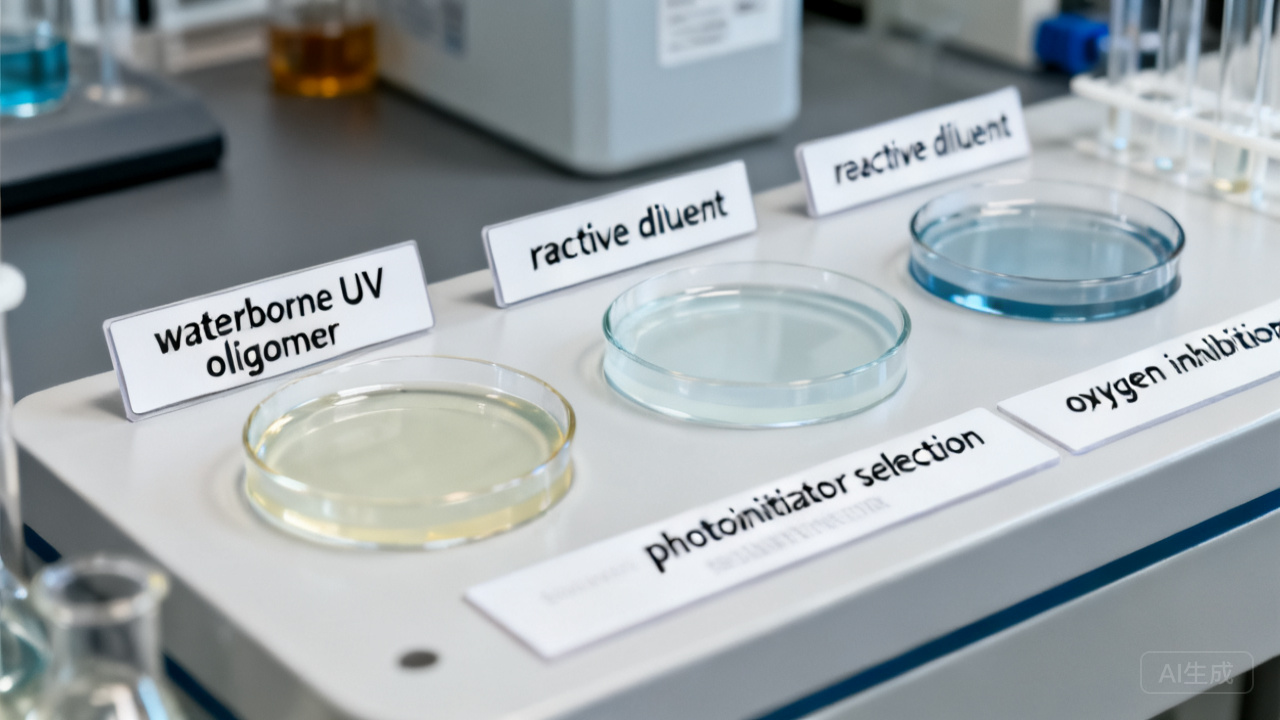
Q2: Why is oxygen inhibition of water-based UV easier to overcome than that of 100% solid-content UV?During the pre-drying process of water-based UV—water evaporates from inside the coating outward—forming a water-vapor-rich layer on the coating surface—this vapor layer dilutes the surface O2 concentration—slowing down oxygen inhibition. In addition, water-based UV usually uses a combination of cleavage-type and hydrogen-abstraction-type photoinitiators—the hydrogen-abstraction type (e.g., benzophenone BP + EDAB amine co-initiator) produces amine radicals that are insensitive to O2—which preferentially react with acrylic C=C—effectively overcoming surface oxygen inhibition. Therefore, water-based UV generally achieves good surface curing without N2 protection—which is a major advantage over 100% solid-content UV.
Q3: Pre-drying of water-based UV — what are the pros and cons of IR and hot air respectively?IR (infrared) radiation penetrates the coating — directly heats the substrate and water molecules — fast temperature rise (3-5 min) — high energy consumption. Optimal solution: IR + hot air combination — IR rapid heating — hot air maintains constant temperature — balancing speed and uniformity.
Related Reading
Summary
Water-based UV-curing coatings—dual curing mechanism (water evaporation + UV crosslinking)—combine the two major advantages of eco-friendliness (VOC < 50) and high efficiency (curing in seconds). Pre-drying is the core of the process (accounting for 30–50% of total energy consumption)—oxygen inhibition is naturally mitigated by the water vapor layer and the combination of hydrogen-abstraction-type photoinitiators. Kexin New Materials provides customers with water-based UV coating products and process optimization support—achieving both green and speed.