Introduction: The Industrialization Inflection Point of Waterborne Wood Coatings
In 2026, China's whole-house customized home furnishing market has surpassed 500 billion yuan, and the "oil-to-water" transition is accelerating from policy-driven to market-driven. The full implementation of GB 18581-2020 "Limit of Harmful Substances in Wood Coatings" has placed traditional solvent-based wood coatings (with VOC content as high as 500–700 g/L) under compliance pressure in large-scale industrial production. Water-based wood coatings can achieve VOC content as low as 50–80 g/L, but to realize stable and efficient coating results on industrial production lines, it is necessary to systematically understand the full-process technical decision-making logic from substrate and coating to drying and curing.
The selection of water-based coating solutions for whole-house customized furniture depends on three key variables: substrate type (solid wood/MDF/veneer), production line tempo (pieces/minute), and final surface effect (open/closed/high gloss).For solid wood open effect, water-based single-component acrylic + roller coating is recommended; for MDF high-gloss closed effect, water-based UV primer + water-based UV topcoat + LED curing is recommended.
I. Substrate and Primer Compatibility Decision-Making
1.1 Technical Characteristics of Different Substrates and Challenges for Waterborne Coatings
| Substrate Type | Moisture Content Requirement | Wood Fiber Raising / Grain Raising Tendency | Oil / Tannin Migration | Recommended Primer System |
|---|---|---|---|---|
| Solid wood (Oak / Cherry / Black Walnut) | 8%-12% | Moderate (greater tendency for woods with deep pores) | Severe tannin in Black Walnut | Water-based acrylic sealing primer + tannin blocker |
| Solid wood (Pine / Fir) | 8%-12% | Low | Resin migration requires degreasing treatment | Water-based cationic sealing primer (anti-resin) |
| MDF (Medium Density Fiberboard) | 6%-10% | Severe — water-based paint penetration causes fiber swelling | Low | Water-based UV sealing primer (pre-cured to block penetration) |
| Veneer / MDF with veneer | 6%-10% | Slight | Depends on veneer species | Water-based one-component acrylic primer |
| Plywood / Multi-layer board | 8%-14% | Moderate at delaminated edges | Alkaline substances from phenolic adhesive may migrate | Water-based two-component epoxy sealing primer |
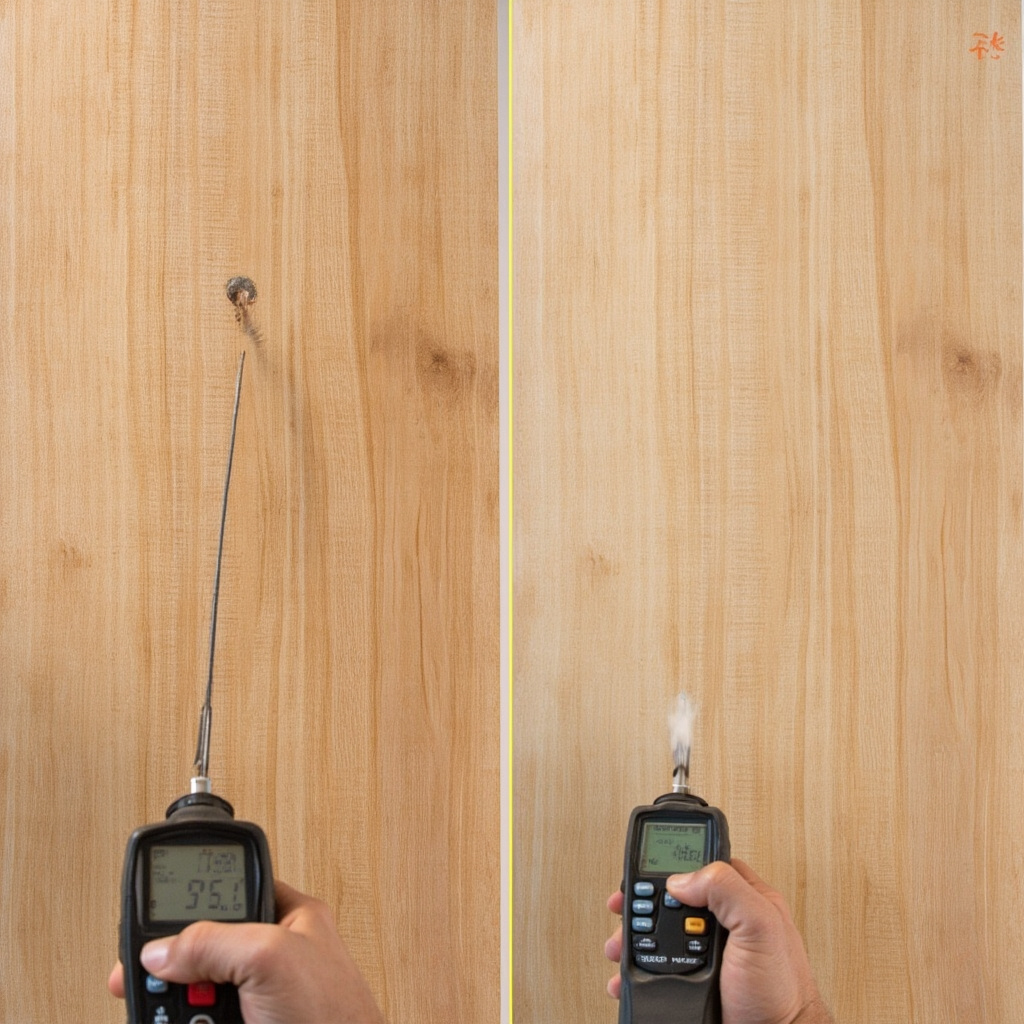
1.2 Root Causes and Solutions for the "Raised Grain" Problem on MDF
The occurrence of "grain raising" (surface roughness caused by wood fiber swelling from water absorption) of water-based paint on MDF is the biggest technical pain point in large-scale industrial coating. The root cause is that the surface tension of water (72.8 mN/m) is much higher than that of solvents (about 25-30 mN/m), and water more easily penetrates into the MDF fiber gaps.
Tier 3 Solution:
- Primary prevention: Use high-density MDF boards with low moisture content (6%-8%) (density ≥ 750 kg/m³)
- Secondary blocking:Use water-based UV sealing primer, application rate 15-25 g/m², form a dense sealing layer after UV-LED pre-curing
- Third-stage repair:After the first coat of primer has cured, use 320#-400# sandpaper to lightly sand once to remove the raised wood fibers
II. Process Decision Tree for Coating Methods
| Coating Method | Paint Utilization Rate | Film Thickness Control Precision | Applicable Line Takt | Surface Effect | Applicable Coatings |
|---|---|---|---|---|---|
| Roller Coating | ≥ 95% | ± 2 μm (precision engraved roller) | 8-15 m/min | Flat parts — Excellent (good uniformity) | Water-based UV primer/filler/topcoat |
| Reciprocating Automatic Spraying | 60%-75% | ± 5 μm | 3-5 pcs/min (depending on part size) | Irregular parts — Excellent (good profiling) | Water-based 1K/2K primer and topcoat |
| Vacuum Coating (Vacumat) | ≥ 98% | ± 3 μm | 2-4 pcs/min | Lines/profiles — Superior (360° wrapping) | Water-based 1K primer |
| Curtain Coating | ≥ 95% | ± 5 μm | 15-25 m/min | Large flat panels — Excellent | Water-based UV topcoat |
| Electrostatic Spraying | 80%-90% | ± 5 μm | 2-4 pcs/min | Metal/conductive substrates — Excellent | Coating resistivity needs adjustment |
2.1 Key Parameters for Waterborne Coating Spraying
- Coating viscosity: Zahn cup No. 4 20-35 seconds (adjust according to spray equipment type)
- Spray pressure:0.2-0.4 MPa (HVLP spray gun) / 8-15 MPa (airless spray)
- Nozzle bore: 1.2-1.8 mm (gravity-feed/pressure-feed spray gun)
- Special requirements for water-based paint: The spray gun and pipeline materials must be stainless steel (304/316L) to avoid long-term corrosion of carbon steel parts by water-based paint
III. Selection of Drying and Curing Technologies
3.1 Core Challenges in Waterborne Coating Drying
The latent heat of vaporization of water is 2260 kJ/kg, which is 4–6 times that of solvents (about 350–500 kJ/kg). This means waterborne coatings require far more drying energy and time than solvent-based coatings under the same conditions. Industrial production lines must complete drying within limited space and time, so the design of the drying system is critical to the success of a waterborne coating line.
3.2 Comparison of Drying/Curing Methods
| Drying Method | Thermal Efficiency | Heating Rate | Applicable Coating Types | Equipment Investment | Energy Cost (RMB/m²) |
|---|---|---|---|---|---|
| Hot Air Circulation Drying | 30%-40% | Slow (gradual) | Water-based 1K/2K | Low | 0.5-1.0 |
| IR (Infrared) Drying | 60%-75% | Fast (surface priority) | Water-based primer pre-drying | Medium | 0.3-0.7 |
| IR + Hot Air Combination | 50%-65% | Fast (inside-out balanced) | Water-based primer + topcoat | Medium-High | 0.5-0.9 |
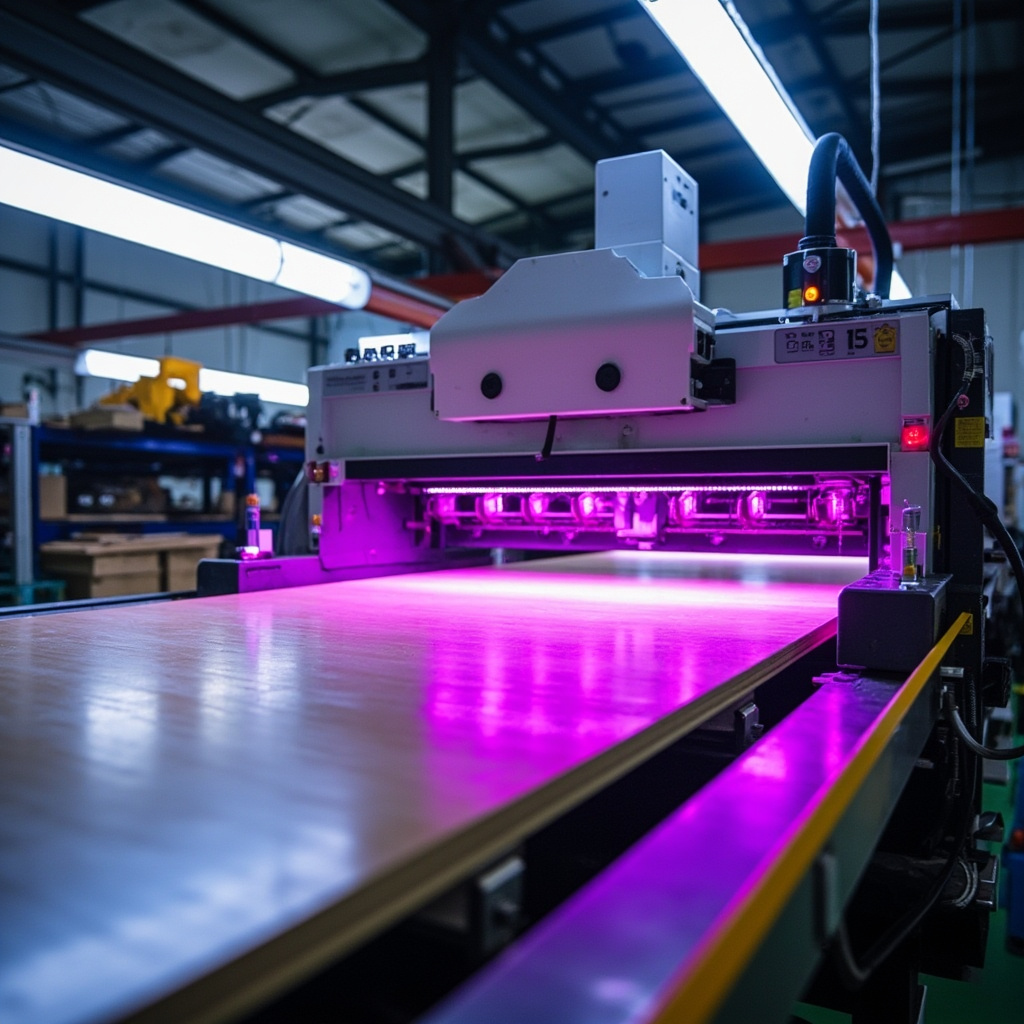
| UV-LED Curing | 85%-95% | Extremely fast (seconds level) | Water-based UV coatings | High | 0.2-0.4 |
| Microwave Drying | 70%-85% | Extremely fast (from inside out) | Water-based paint (thin parts only) | High | 0.3-0.6 |
3.3 Measures for coping with low-temperature and high-humidity environments in winter
Winter (temperature 5–15°C, relative humidity 70%–90%) is the most challenging period for waterborne coating application. Mitigation measures include:
- Paint preheating: Store the paint in a constant-temperature warehouse at 25-30°C for at least 24h, and the paint temperature before application should be ≥ 20°C
- Substrate preheating: IR preheat the board surface to 30-35°C (note that MDF must not be overheated to cause deformation)
- Ventilation and moisture removal: Increase ventilation in the drying room by 30%-50% to accelerate the expulsion of water vapor
- Slow-drying solvent addition: If necessary, add 3%-5% propylene glycol butyl ether (PnB) or dipropylene glycol methyl ether (DPM) to extend the open time
IV. Surface Effect and Coating System Compatibility
4.1 Open Pore Finish
The open-grain effect preserves the natural texture and pores of the wood, making it suitable for the high-end positioning of solid wood furniture. The key points for achieving a water-based open-grain effect are: use a low-solid-content, low-viscosity water-based primer (solid content 25%–30%), control the application rate at 60–80 g/m², and leave the surface unfilled (no pore filling).
4.2 Closed Pore / Piano Finish Effect
The sealing effect requires completely filling the wood pores with a mirror-smooth surface, typically used for high-gloss piano lacquer finishes on MDF or high-grade solid wood. Process: water-based UV filler for pore filling (2–3 coats) + water-based UV primer (2 coats) + water-based UV topcoat (1–2 coats), with full UV-LED curing throughout, finished by 1500#–3000# wet sanding and polishing.
4.3 Yellowing Resistance Requirements
The yellowing resistance of white or light-colored wood coatings is one of the core quality indicators for customized home furnishings. Compared with traditional NC and PU systems, water-based acrylic systems offer better yellowing resistance, but aliphatic isocyanate curing agents (rather than aromatic ones) and weather-resistant titanium dioxide should be prioritized in the formulation.
V. Key Points for Industrial Production Line Planning
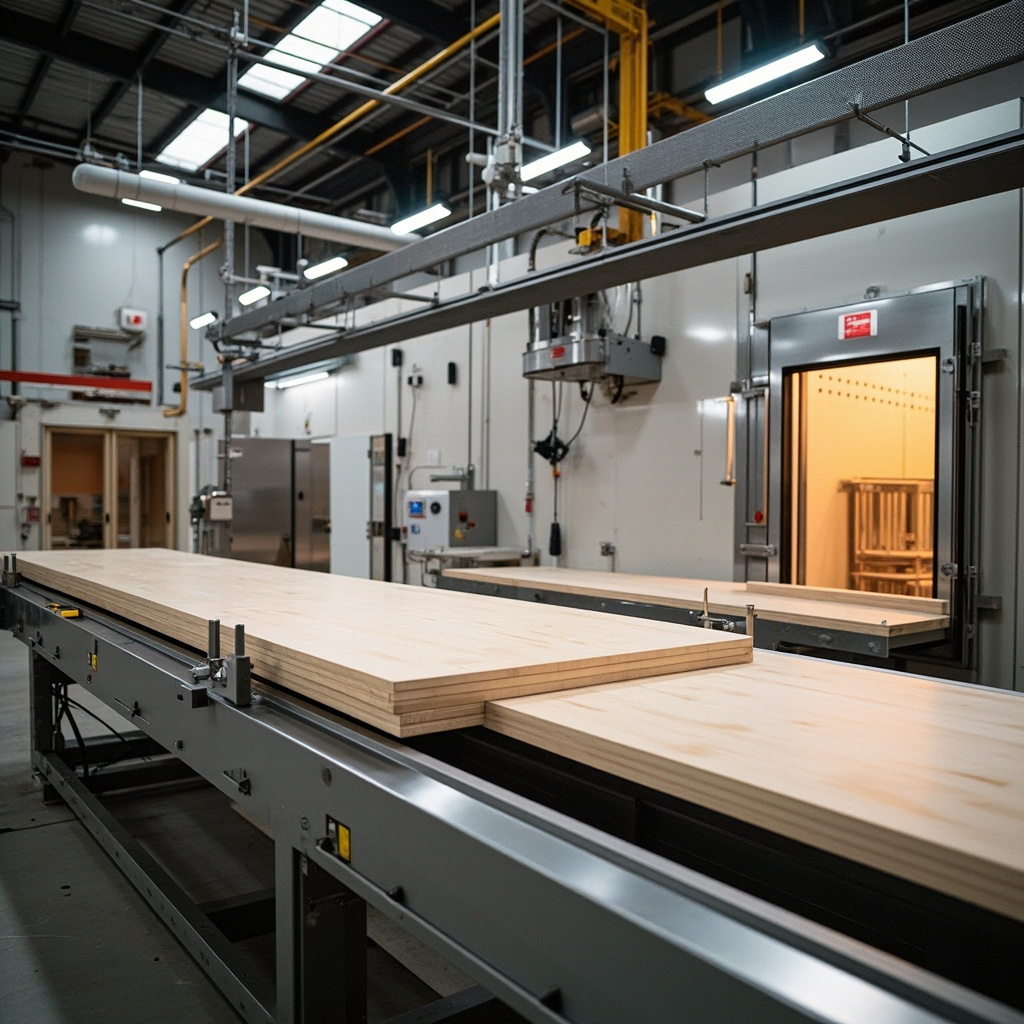
- Production line speed matching: The product of coating section speed × drying section time determines the length of the drying line; water-based paint drying lines are usually 40%-60% longer than solvent-based ones.
- Space utilization: Adopt U-shaped or double-layer layout to reduce footprint
- Cleanliness control:The painting area must maintain positive pressure (≥ 10 Pa), and the air filtration grade must be ≥ F7 (EN 779)
- Wastewater treatment: The COD in water-based paint cleaning wastewater can reach 5000-10000 mg/L, requiring supporting wastewater treatment facilities.
- VOC emissions: Although water-based paint has low VOC, film-forming aids (such as Texanol, DPnB) still volatilize during the drying process, requiring activated carbon adsorption or RTO treatment
FAQ: Industrial Application of Waterborne Wood Coatings
Q1: What is the root cause and solution for the "grain raising" phenomenon of water-based paint on MDF?
The root cause is that water molecules in the water-based paint penetrate into the MDF fiber gaps, causing the fibers to absorb water and swell (thickness swelling rate can reach 10%-20%). The most effective solution is to use a water-based UV sealing primer, which forms a dense sealing layer within 3-5 seconds after UV-LED pre-curing, preventing moisture penetration from subsequent coatings. Combined with high-density MDF boards with low moisture content (6%-8%), grain raising can be reduced to an invisible level to the naked eye.
Q2: What are the performance differences between water-based UV and 100% UV solid content wood coatings?
Water-based UV coatings contain 20%-40% water as a diluent medium and require pre-drying to remove water before UV curing (the dewatering step is critical). 100% UV coatings contain no water or solvent, and 100% of the liquid components participate in the photocuring reaction. The advantages of water-based UV are: lower viscosity for easy roller coating, smaller shrinkage, better interlayer adhesion, and lower VOC. The advantages of 100% UV: faster curing speed (no dewatering step required), and higher hardness possible (greater crosslink density).
Q3: How to ensure the drying speed of water-based wood coatings in low-temperature and high-humidity environments in winter?
(1) Preheat the coating to 20-25°C to reduce viscosity; (2) Preheat the substrate with IR to 30-35°C; (3) Use combined IR + hot air drying in the drying room, where IR rapidly raises the surface temperature and hot air carries away the evaporated water vapor; (4) Automatically adjust the ventilation volume based on the absolute humidity difference (PLC linked with humidity sensor); (5) For extreme conditions, consider switching to a water-based UV system (UV-LED curing is unaffected by ambient temperature and humidity).
Q4: What are the formulation differences between the "open effect" and "closed effect" of water-based wood coatings?
Open effect formulation features: low solids content (25%-30%), low viscosity (Coating-4 cup 15-20s), transparent system with minimal fillers; the design intent is to let the coating penetrate into the wood vessels without blocking the pores. Closed effect formulation features: high solids content (35%-50%), medium-high viscosity (Coating-4 cup 25-40s), contains ultrafine fillers (e.g., 0.1-0.5 μm precipitated barium sulfate or transparent powder) for filling the pores.
Q5: What are the 7 troubleshooting points for the "orange peel" texture appearing when applying water-based paint by roller?
Troubleshooting process: (1) Coating leveling property — check the leveling agent addition amount and coating thixotropy index; (2) Roller coating pressure — both too high or too low can cause it; (3) Engraved roller pattern depth — should match the coating amount; (4) Coating viscosity — too high leads to insufficient leveling; (5) Line speed — too fast leads to insufficient leveling time; (6) Initial drying temperature — too high causes the surface skin to form too quickly; (7) Substrate flatness — uneven MDF density causes different coating penetration rates.
Q6: Can water-based wood paint be directly recoated over old solvent-based coatings?
Not recommended. The adhesion between water-based paint and old solvent-based coatings (such as NC, PU) is generally poor, because: (1) the surface energy of solvent-based coatings is low (about 30-40 mN/m), making it difficult for water-based paint to spread; (2) residual silicone oil/wax additives in the old coating severely reduce interlayer adhesion. Solution: sand the old coating surface (320# sandpaper) → apply water-based adhesion-promoting primer (containing special functional silane) → then apply water-based topcoat.
Q7: Causes and preventive measures for "pinholes" in water-based paint?
Pinholes in water-based paint are mainly caused by two reasons: (1) Too rapid evaporation of moisture in the coating causes the paint film surface to seal quickly, and internal water vapor breaks through the surface leaving pinholes — Solution: Adjust the drying curve, with the initial stage temperature ≤ 35°C for slow flash drying; (2) Air in the pores of the substrate escapes during the coating curing process — Solution: Preheat the substrate (40-50°C) to pre-expand the air in the pores before painting, or use a defoaming agent.
Q8: What is the typical pot life of two-component waterborne polyurethane wood coatings? How can it be extended?
The pot life of waterborne two-component polyurethane is typically 2-4 hours (25°C), significantly longer than the 1-2 hours of solvent-based systems. This is because in the waterborne system, the isocyanate is encapsulated within hydrophobic polyol latex particles, and side reactions with the aqueous phase (generating CO₂ and urea) are effectively suppressed. Measures to extend pot life: (1) Use HDI trimer instead of IPDI-type curing agent — stronger hydrophobicity; (2) Lower the system temperature to 18-22°C; (3) Reduce the content of amine neutralizers in the system.
Q9: What should I do if "knife jump marks" (horizontal streaks) appear during water-based paint roller coating?
Knife jump marks are caused by vibration or uneven pressure between the engraved roller and the applicator roller in the roller coater. (1) Check the concentricity of the engraved roller and applicator roller (runout ≤ 0.02mm); (2) Adjust the uniformity of inter-roller pressure; (3) Reduce the roller coating speed to 5-8 m/min and observe whether it improves; (4) Increase the coating viscosity (Zahn cup #4, 30-40s) to enhance the continuity of the liquid film layer; (5) Check whether the engraved roller pattern is unevenly worn.
Q10: How do the VOC test methods and limit standards for water-based wood coatings correspond?
Test in accordance with GB/T 23985-2009 "Paints and varnishes - Determination of volatile organic compound (VOC) content - Difference method". GB 18581-2020 "Limit of harmful substances in wood coatings" stipulates: water-based wood coatings (clear coat) VOC ≤ 250 g/L, water-based wood coatings (pigmented coating) VOC ≤ 200 g/L. Note: The classification and limits of "water-based UV coatings" in this standard are still controversial; the latest standard updates should be monitored during industrial application.
Q11: When a furniture factory switches from solvent-based to water-based paint, where is the main investment in production line retrofitting?
Main investment directions: (1) Drying system — this is the largest investment item, requiring the addition or upgrade to IR + hot air combined drying or UV-LED curing systems, with a budget of approximately 300,000–1,000,000 RMB per line; (2) Spray booth retrofit — water-based paint spray booths require stainless steel material (though paint mist corrosiveness is low, long-term effects still exist) and efficient water curtain/dry filtration; (3) Wastewater treatment — cleaning wastewater requires flocculation + biological treatment systems; (4) Constant-temperature paint storage room — water-based paint is sensitive to storage temperature (5–35°C) and requires a constant-temperature warehouse; (5) Pipeline retrofit — carbon steel pipelines replaced with stainless steel or PP pipes.
Related Reading
Summary
"Oil-to-water" is not a simple paint replacement, but a systems engineering involving substrate selection, coating process, drying and curing, production line layout, and quality standards. Kexin New Materials provides custom home furnishing enterprises with full-process services from coating selection, production line planning to construction training, helping furniture factories complete the water-based transformation smoothly and efficiently.