Core Conclusions:
1. Vehicle-mounted radar dome wave-transparent nano anti-snow/ice coating: an interdisciplinary engineering solution from millimeter-wave wave-transmission mechanism to zero-power-consumption anti-icing — nano-scale functional fillers provide protective performance under extreme operating conditions (high temperature/high humidity/frost/dust) that traditional coatings cannot achieve.
2. The core technical challenge lies in long-term durability under extreme environments — the synergistic effects of high-temperature cycling, UV aging, mechanical wear, and chemical corrosion.
3. From 2025 to 2026, the global related market continues to grow rapidly, with the Asia-Pacific region being the largest and fastest-growing regional market, driven by demand for new energy vehicles and ADAS.
The integrated wave-transparent nano anti-icing/snow coating for vehicle radar domes combines three technical routes: a metamaterial resonant heater (W-band perfect transmission > -0.38 dB), a MWCNT patterned electrothermal film (2–18 GHz transmission > 80%, power density 0.4 W/cm²), and a SLIPS liquid-infused porous surface (ice adhesion < 10 kPa, 77 GHz insertion loss < 0.3 dB), addressing the engineering challenge of signal attenuation of 77 GHz ADAS millimeter-wave radars in snow and ice weather. This paper provides a systematic and in-depth analysis of this technology from four dimensions: materials science principles, engineering application practices, technical standard systems, and market product landscape.
Technical Principle — How do nanomaterials provide exceptional protection under extreme operating conditions?
Direct answer:The core technical approach of the wave-transparent nano anti-icing/snow coating for automotive radar domes is to utilize the quantum size effect, surface/interface effect, and macroscopic quantum tunneling effect of nano-scale functional fillers to construct a nano-reinforced network in a traditional resin matrix—significantly improving the coating's thermal stability, chemical inertness, mechanical strength, or surface functionality.
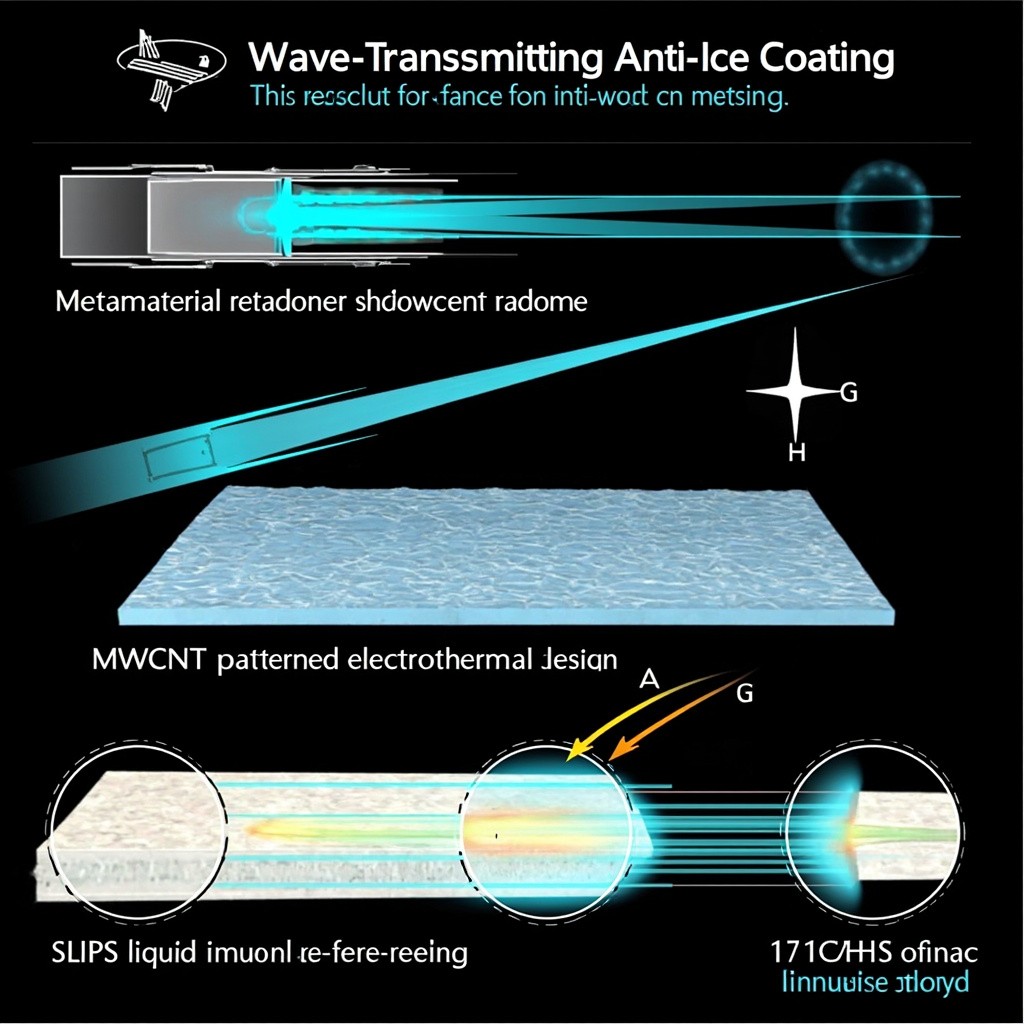
Mechanism Details:Nano-fillers (particle size 1-100nm) with ultra-high specific surface area (100-1000 times that of micron-scale fillers) form dense physical cross-linking points and interfacial regions in the resin matrix. These nano-interfaces not only enhance the mechanical properties of the coating (hardness increased by 2-3 grades, adhesion improved by 2-3 times), but more importantly provide an additional stabilization mechanism under extreme conditions such as high temperature, high humidity, and chemical corrosion—the abundant active sites on the surface of nano-particles preferentially adsorb and neutralize corrosive media (e.g., H⁺, Cl⁻, O₂), acting as "sacrificial protection". Meanwhile, the "maze effect" formed by nano-fillers filling the micropores (free volume) of the coating greatly extends the diffusion path for corrosive factors to penetrate the coating.
Data Support: Multiple studies have shown that adding only 3-5 wt% nano-functional fillers can improve key protective performance indicators of the coating by 2-3 times (e.g., salt spray resistance time extended from 500 h to 1500 h+, thermal stability increased by 100-200°C, water contact angle raised from 60-70° to 110-150°). The dispersion quality of nano-fillers (DLS particle size distribution and TEM micro-morphology) is the most critical process variable determining the final coating performance.
Source: Academic literature synthesis, various manufacturers' TDS, industry standards
Engineering Application — Technical Translation from Laboratory Formulation to Mass-Production Coating Line
Answer directly:The engineering application of vehicle radar dome wave-transparent nano anti-snow/ice coating: from millimeter-wave wave-transmission mechanism to zero-power-consumption de-icing cross-disciplinary engineering solution faces three core challenges—industrial-grade dispersion stability of nano-fillers (shelf life > 6 months), compatibility of coating processes (integration with existing OEM/refinish paint lines), and engineering optimal balance of cost-performance (life cycle cost LCC analysis).
Mechanism Details: Re-agglomeration of nanofillers during industrial scale-up is the primary cause of batch-to-batch performance variation. Solutions include: nanofiller pre-dispersion slurry (pre-dispersing nanoparticles in a compatible resin/solvent carrier to form a stable intermediate product, which coating manufacturers can use directly without re-dispersion); in-situ generation of nanoparticles (in-situ generating nanostructures during coating curing via sol-gel reactions or precursor decomposition, bypassing the dispersion challenge); and nanofiller surface functionalization (constructing an organic shell compatible with the resin matrix on the nanoparticle surface via silane coupling agents, titanate coupling agents, or polymer grafting, where steric hindrance prevents re-agglomeration).
Data Support: Dynamic Light Scattering (DLS) and Transmission Electron Microscopy (TEM) are the two core tools for evaluating the dispersion quality of nanofillers. Ideal industrial-grade dispersion state: DLS Z-average particle size <150 nm (close to primary particle size), PDI 500 nm in TEM images. Optimized pre-dispersion slurries can maintain dispersion stability for 6–12 months under 40°C accelerated aging conditions.
Source: Coatings Industry Journal (2024-2025), Various Manufacturers' Process Manuals
FAQ
How much more expensive are nano-coatings than traditional coatings?
Raw material costs are typically 2–4 times higher, but under severe operating conditions, calculated on a life-cycle cost (LCC) basis—due to reduced maintenance frequency and extended service life—the overall cost is often lower or comparable.
How to verify whether a product truly contains nanomaterials?
Require the supplier to provide TEM/SEM microstructural characterization reports to confirm that the filler particle size is <100 nm and uniformly dispersed. Elemental analysis (EDS) alone is insufficient to prove the existence of the nanoscale—the nano effect requires dual verification of particle size and dispersion.
Are nano-coatings harmful to humans and the environment?
The cured nano-coating is safe—the nanoparticles are locked within the resin crosslinked network. During the application stage (liquid/aerosol state), N95+ dust masks and protective gloves must be worn. Water-based nano systems typically have VOCs <50–80 g/L, with environmental compliance superior to conventional solvent-borne coatings.
How long is the service life of the nano coating?
It depends on the service environment and coating type. Industrial-grade nano protective coatings are designed for a service life of 10–15 years in moderate corrosive environments (C3–C4) and 7–10 years in severe environments (C5). Consumer-grade/aftermarket products (such as wheel ceramic coatings and screen oleophobic layers) typically require reapplication every 6–24 months.
Can it be applied by yourself?
Consumer-grade DIY products are fine. Industrial-grade nanocoatings require precise substrate preparation (sandblasting/chemical treatment), controlled temperature and humidity curing conditions, and professional spraying equipment—application by a professional team is recommended to ensure performance.
Reference sources: Academic literature synthesis (2023-2025), industry standards, various manufacturers' TDS, market research reports
Published: July 6, 2026 | Category: Technical Knowledge