
Hot dish marks (cup rings, also called glass marks or burn rings) are a class of surface failure in furniture finishes: after the film contacts a hot cup base, a hot plate, or another heated object, thermal softening of the coating, condensation of water vapor at the coating–wood interface, or the thermal response of the wood surface itself leaves a visible ring-shaped or patch-shaped mark in the contact area. Under current Chinese practice this corresponds to the dry heat assessment of GB/T 4893.3-2020 and the wet heat assessment of GB/T 4893.2-2020; under European practice to the dry heat assessment of BS EN 12722:2009 A1:2013 and the wet heat assessment of BS EN 12721:2009 A1:2013, with results reported on a 1–5 rating scale (5 = no visible change).
This is a common occurrence in B2B delivery: during arrival sampling of dining and office tables, a check panel carries a white ring pressed out by a 70 °C heat block; a hot cup of tea leaves a ring on a showroom negotiation table that never self-heals within three months; an export order is accepted against EN 12722 and the rating lands at grade 3 (distinct change visible from several viewing angles), holding the whole batch. For coatings plants and furniture factories the hard part is not whether the finish "burns or does not burn", but decomposing the white ring into three causal chains — coating softening, interfacial condensation, and wood thermal response — and then deciding reversibility, the rework boundary, and the formulation countermeasure. This article sets out reproducible test criteria and quantified figures.
Bottom line up front: six verifiable points
- Separate the causes into layers: blushing (whitening caused by light scattering, mostly redistributed interfacial condensate), softening impressions (the coating pressed down with a raised edge), and discoloration (thermal oxidation or a wood-side color change) are three distinct defects; a 24 h–48 h rest period separates them, and the rest time GB/T 4893.3-2020 requires is exactly 16 h–24 h.
- Dry heat and wet heat are two test lines: GB/T 4893.3-2020 allows dry heat points of 55 °C, 70 °C, 85 °C, 100 °C, 120 °C, 140 °C, 160 °C, 180 °C, and 200 °C; GB/T 4893.2-2020 takes only 55 °C, 70 °C, 85 °C, and 100 °C, and requires spraying (2±0.2) mL of deionized water onto a white polyamide fiber cloth.
- Conditioning and the grading environment are part of the criteria: preconditioning at (23±2) °C and (50±5)% RH for no less than 48 h; grading under diffuse light with (1200±400) lx on the test area, an observation distance of 0.25 m–1.0 m, and touch judgment permitted; heat block base roughness Ra (2±1) μm and temperature control of ±1 °C.
- Systems differ structurally: on the same 70 °C/20 min dry heat basis, the common order is UV cure and waterborne UV ≥ two-component polyurethane ≥ waterborne self-crosslinking acrylic ≥ acid cure ≥ nitrocellulose (NC, thermoplastic with no crosslinking); the gap comes mainly from crosslink density and effective glass transition temperature (Tg).
- Thicker films and extra coats do not mean more heat resistance: published work within the manufacturer-recommended 80 g/m²–150 g/m² over 2–3 coats (100 g/m²–110 g/m²) observes only limited differences; a trend appears only beyond the recommended range, and thickness contributes far less to heat resistance than the degree of cure.
- The wood side is a variable, not a backdrop: the fiber saturation point sits around 25%–30%; taking thermal conductivity 0.12 W/(m·K), density 600 kg/m³, and specific heat 1,700 J/(kg·K), a 20 min contact drives heat roughly 12 mm deep (√(α·t) basis), the same order as common 18 mm–25 mm panel thickness, so board thickness and moisture gradients change how the white ring forms and recovers.
The three causal chains behind cup marks: coating softening, interfacial condensation, and wood thermal response
Treating the "white ring" as a single phenomenon is where every misjudgment begins. In engineering terms it should be decomposed into three independent causal chains, each with its own reversibility and remedy, and each tied to different formulation variables.
1) Coating side: glass transition and crosslink density set the softening window
The base of a hot cup typically sits at 45 °C–70 °C, while plate and pot bottoms can exceed 100 °C. Once the contact temperature enters the coating's effective glass transition range, the modulus drops one to two orders of magnitude within minutes: the film stops behaving as a rigid layer and becomes a creep-capable viscoelastic body, and the cup's weight on its annular contact edge presses the deformation into a groove. The test for whether this is the primary cause is direct — after 24 h of rest, is the mark still there, can you feel an edge to the touch, has gloss dropped along with it?
Crosslink density caps that window. Thermoplastic nitrocellulose lacquer has no crosslink points: a wide softening window and slow recovery. UV-cured systems crosslink densely and can push the effective softening temperature into the 80 °C–120 °C band. Two-component polyurethane sits between the two and depends on the isocyanate ratio and the cure time. It is also why two panels of one waterborne topcoat, delivered after an overnight cure versus after 4 h, can differ by a full heat-resistance grade — before the crosslinked network develops, no thickness compensation helps. Blushing during application and early water-resistance problems follow another independent causal chain, covered in waterborne wood topcoats: coalescence and crosslinking countermeasures for blushing and early water resistance.
2) Interface side: the optical origin of blushing and its reversibility
Blushing is light scattering in its purest form. When a fine water phase appears beneath the coating or within its microregions (condensate, displaced adsorbed water, or water not fully released), the refractive index steps from a continuous 1.5 to a two-phase system of "resin 1.5 / air or water 1.0–1.33", short-wavelength visible light scatters preferentially, and the eye reads a white patch. It has three verifiable signatures: it fades briefly under a damp wipe; it strengthens under grazing light at 15°–30° incidence; and it dies away within 24 h–48 h as moisture rediffuses to equilibrium.
Heat-driven vapor migration is the engine of this chain. Heat brought in by the cup drives the local wood-surface moisture content down; the vapor diffuses outward and recondenses at the cooler coating or interface. If the coating's water vapor transmission rate is low and micro-voids exist at the interface (open grain, vessel direction, intercoat gaps left by insufficient sanding), the condensate stays locked at the interface and the ring persists for days. That GB/T 4893.2-2020 forces (2±0.2) mL of water to be sprayed under the white polyamide cloth is precisely to isolate and stress this interfacial chain.
3) Wood side: moisture gradient, thermal diffusion depth, and recovery speed
Wood is hygroscopic, and its fiber saturation point sits near 25%–30%. Below it, moisture changes directly alter cell-wall stiffness and dimensions; above it, free water migrates through the lumens while heat capacity and conductivity rise together. Densities of the solid woods and panels common on tabletops span 400 kg/m³–800 kg/m³, giving thermal diffusivities α of roughly 0.8×10⁻⁷ m²/s to 2.0×10⁻⁷ m²/s; on √(α·t), a 20 min contact carries the thermal disturbance to about 10 mm–15 mm deep. Two panel thicknesses (18 mm vs 25 mm) therefore give the interface significantly different temperature histories, which explains why the same formulation grades inconsistently on different substrates.
The second wood-side route is heat-induced discoloration and extract migration: pale maple and birch respond to heat differently from dark precious hardwoods, and some extracts migrate to the surface at high temperature, leaving irreversible brown marks. Those marks do not fade with rest and show no groove to the touch, so they are easily misread as "insufficient coating heat resistance". Yellowing of white systems under combined heat and light has its own dedicated criteria, in white coating yellowing resistance: matching hardener and additive selection.
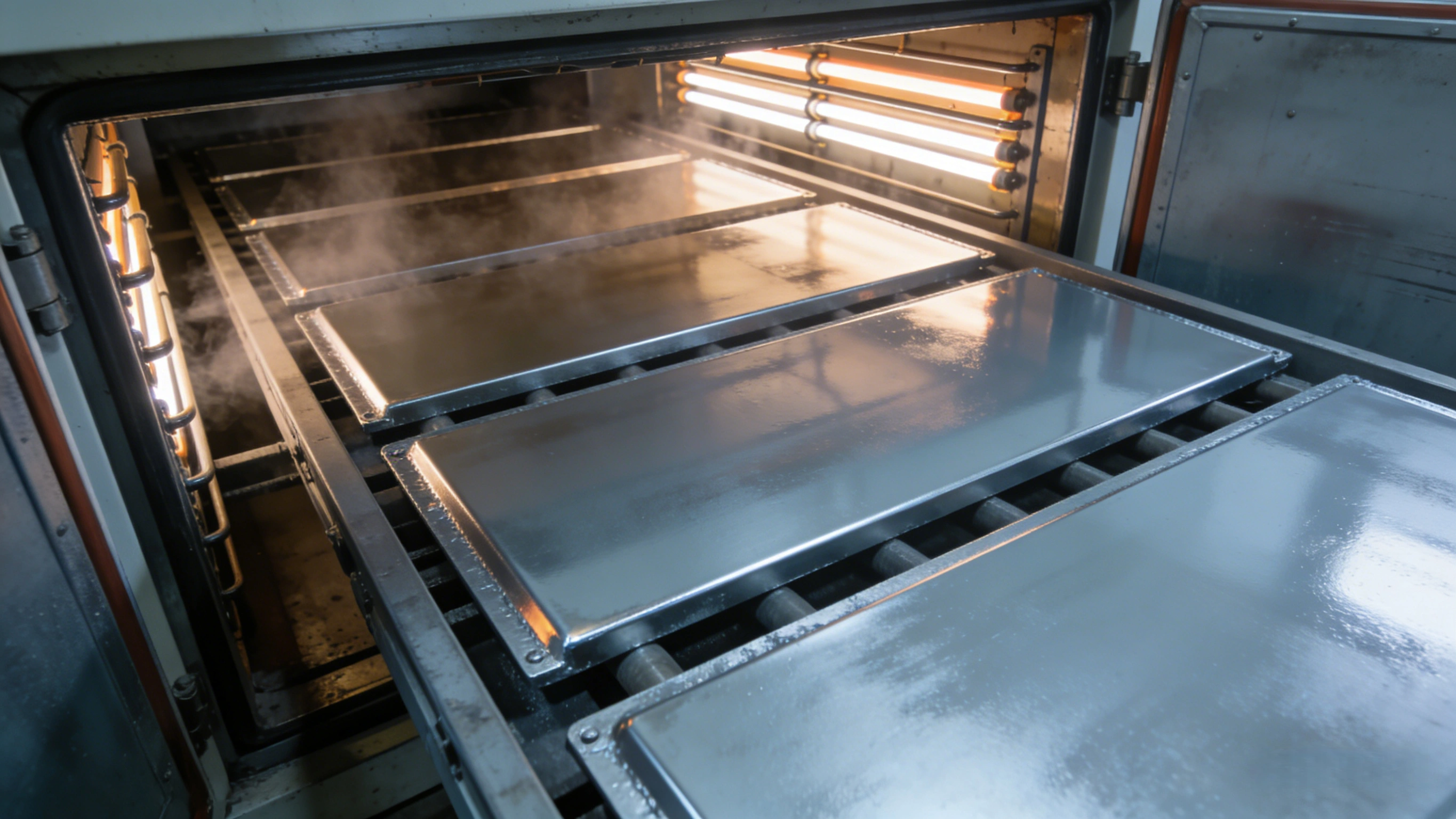
How it is measured: the GB/T 4893 series and the EN 1272x criteria
Dry heat and wet heat are independent test lines; mixing them yields meaningless conclusions. The current Chinese and European methods share the same design (heat block, contact time, grading after rest) but differ in temperature points and judgment details; export orders must follow the method version named in the contract.
| Test item | Method and current version | Key test parameters | Relation to cup marks |
|---|---|---|---|
| Dry heat resistance | GB/T 4893.3-2020 (superseding the 2005 edition) | Nine points from 55 °C to 200 °C; the heat block is withdrawn 10 °C above the set value and, once stable within ±1 °C, held for 20 min; preconditioning at (23±2) °C and (50±5)% RH for at least 48 h; grading after a 16 h–24 h rest | Primary criterion for indentation and gloss loss from dry hot cups and plates |
| Wet heat resistance | GB/T 4893.2-2020 | Four points: 55 °C, 70 °C, 85 °C, and 100 °C; white polyamide fiber cloth sprayed with (2±0.2) mL of deionized water; AlMgSi heat block (alloys 6060 and 64430 in GB/T 3190) with base roughness Ra (2±1) μm; 20 min contact | Hot cup with a water film on its base, pressing out interfacial-condensation blushing |
| Cold liquid resistance | GB/T 4893.1; BS EN 12720:2009 A1:2013 | Association-standard figures include 10% sodium carbonate solution and 10% acetic acid solution for 24 h each; the European coffee test grades at 1 h on the 1–5 scale | Separates discoloration-type staining from structural damage; shares the rating family with cup marks |
| Adhesion | GB/T 4893.4 (cross-cut method); ISO 2409-2020 | Grading after the cross-cut; published work generally accepts grades 0–1 as the line | Precondition criterion for rework and intercoat recoating |
| Thermal shock (hot/cold cycling) | GB/T 4893.7 | Association-standard figures: 1 h at (40±2) °C with (95±3)% RH, then 1 h at (-20±2) °C, for 3 cycles | Cracking, gloss loss, and delamination from thermal-shock stress |
| Abrasion and impact | GB/T 4893.8; GB/T 4893.9 | Association-standard figures: 60-revolution abrasion and 50 mm impact height | Reflects the remaining surface margin after recovery treatment (polishing, repair) |
Grading observation conditions are often neglected, yet they are a frequent reason two laboratories split a verdict on the same set of panels: illuminance (1200±400) lx, observation distance 0.25 m–1.0 m, multiple viewing angles with combined-angle lighting, and confirmation by touch permitted; leave no less than 15 mm between adjacent test areas and no less than 50 mm between tests run simultaneously. The European 1–5 wording for surface assessment reads: grade 5 no visible change; grade 4 slight change visible only in reflected light; grade 3 moderate change visible from several angles; grade 2 distinct discoloration or gloss loss accompanied by slight structural change; grade 1 severe change.
Temperature points mapped to use scenarios
Choosing a temperature point is not about choosing the harshest, but the real ceiling of the delivery scenario. Household dining tables see dry heat topping out at 70 °C–100 °C, and with coasters the contact surface usually stays below 50 °C; commercial restaurants and tea houses put vessels above 100 °C straight onto the table; kitchen worktops and islands add hot pans and grease. A three-tier internal line is suggested: 70 °C as the factory gate, 100 °C as the commercial gate, and higher points only as extra verification for special scenarios — with the method version, temperature point, contact time, and accepted grade written into the technical agreement so acceptance never drifts.

Key data: eight quantified criteria with their units
- Dry heat temperature span: 55 °C–200 °C across nine steps (GB/T 4893.3-2020).
- Wet heat points: 55 °C, 70 °C, 85 °C, and 100 °C, with (2±0.2) mL of humidification water (GB/T 4893.2-2020).
- Contact time fixed at 20 min; the heat block is withdrawn no less than 10 °C above the set value and placed under ±1 °C control.
- Preconditioning at (23±2) °C and (50±5)% RH for no less than 48 h; post-test rest 16 h–24 h.
- Grading illuminance (1200±400) lx, observation distance 0.25 m–1.0 m, recommended correlated color temperature (6500±50) K and color rendering index Ra above 92.
- Heat block base roughness Ra (2±1) μm; test areas at least 15 mm apart, simultaneous tests at least 50 mm apart.
- Recommended application range 80 g/m²–150 g/m² over 2–3 coats (100 g/m²–110 g/m² is the process point adopted by published studies).
- Wood-side references: fiber saturation point near 25%–30%; at a conductivity of 0.12 W/(m·K), the 20 min heat penetration depth is about 12 mm (√(α·t) basis).
System comparison: UV, waterborne UV, 2K PU, waterborne self-crosslinking acrylic, and NC
The table below places the five mainstream clear wood finish systems in one coordinate frame. Mind the basis: the "white sample grade 5 share" comes from CATAS public statistics on the EN 12720 coffee test at 1 h — a cold-liquid figure, not dry heat — shown only to illustrate the relative sensitivity between systems; it cannot replace measured GB/T 4893.3 results. Same-batch statistics on the transparent-coat substrate side show birch and beech reaching grade 2 in 12.9% and 12.5% of cases and oak in 3.2%, while pine, ash, and walnut recorded no failures in that sample set — substrate choice changes the apparent heat resistance of the same system.
| Resin system | Crosslinking and softening window | Blushing tendency (wet heat basis) | White samples at grade 5 (published statistics) | Rework and repair friendliness |
|---|---|---|---|---|
| UV-cured varnish | High crosslink density; effective softening temperature designable to 80 °C–120 °C | Low, provided the cure energy is adequate | 67.9% at grade 5; 7.5% falls to grade 3 | Low; requires sanding and recoating |
| Waterborne UV | Medium-high crosslink density, with the waterborne application window | Low–medium | 95.7% at grade 5; 4.3% falls to grade 4 | Medium |
| Two-component polyurethane (2K PU) | Depends on the NCO/OH ratio and the cure time | Medium; rises sharply when under-cured | 100% at grade 5 (cold-liquid basis) | Medium–high; wide recoat window |
| Waterborne self-crosslinking acrylic | Decided jointly by coalescent level and late crosslinking; wide window | High; early water and heat resistance are limited together | 47.1% at grade 5; 23.5% falls to grade 2 | High |
| Nitrocellulose (NC, thermoplastic) | Uncrosslinked; wide softening window and slow recovery | High | Acrylic-type white samples fall to grade 3 in 44.5% of cases (like-for-like thermoplastic reference) | High; reworkable with the same system by solvent flash |
Thickness, coat count, and build: is a thicker film more heat resistant?
The short answer is "limited effect". Published coat-number work on 1K waterborne polyurethane clear varnish (maple substrate, 2, 3, and 4 coats; the manufacturer recommends 2–3 coats at 80 g/m²–150 g/m²) finds that coat count yields no monotonic improvement in cold-liquid and adhesion results; at 4 coats some media even regress. In the same accelerated weathering batch the coating's own color difference stayed at ΔE below 2 units while the maple beneath reached about ΔE 10 units: within the recommended range, the factors that dominate color and surface change are the substrate and the cure, not the film thickness. Bomba et al. in BioResources, studying tolerance to household liquids, reach a matching conclusion: within the manufacturer's recommended build range, thickness variation has no significant effect.
Thickness re-enters as a variable beyond two bounds. First, when the film is too thin (open grain left unfilled, local areas under the system design thickness), the heat-and-water interface path is exposed directly and blushing risk rises. Second, when the film is thick but under-cured, a dense skin seals over trapped solvent or water, and internal pressure on reheating lifts blisters. The correct order is cure first, system compatibility second, thickness last. Field control of film thickness and wet-to-dry conversion is covered in sanding grit progression and intercoat abrasion control in wood finishing; how intercoat bonding of the system constrains the rework window in wood wax oil: penetrating film formation and a sand-free recoat window.
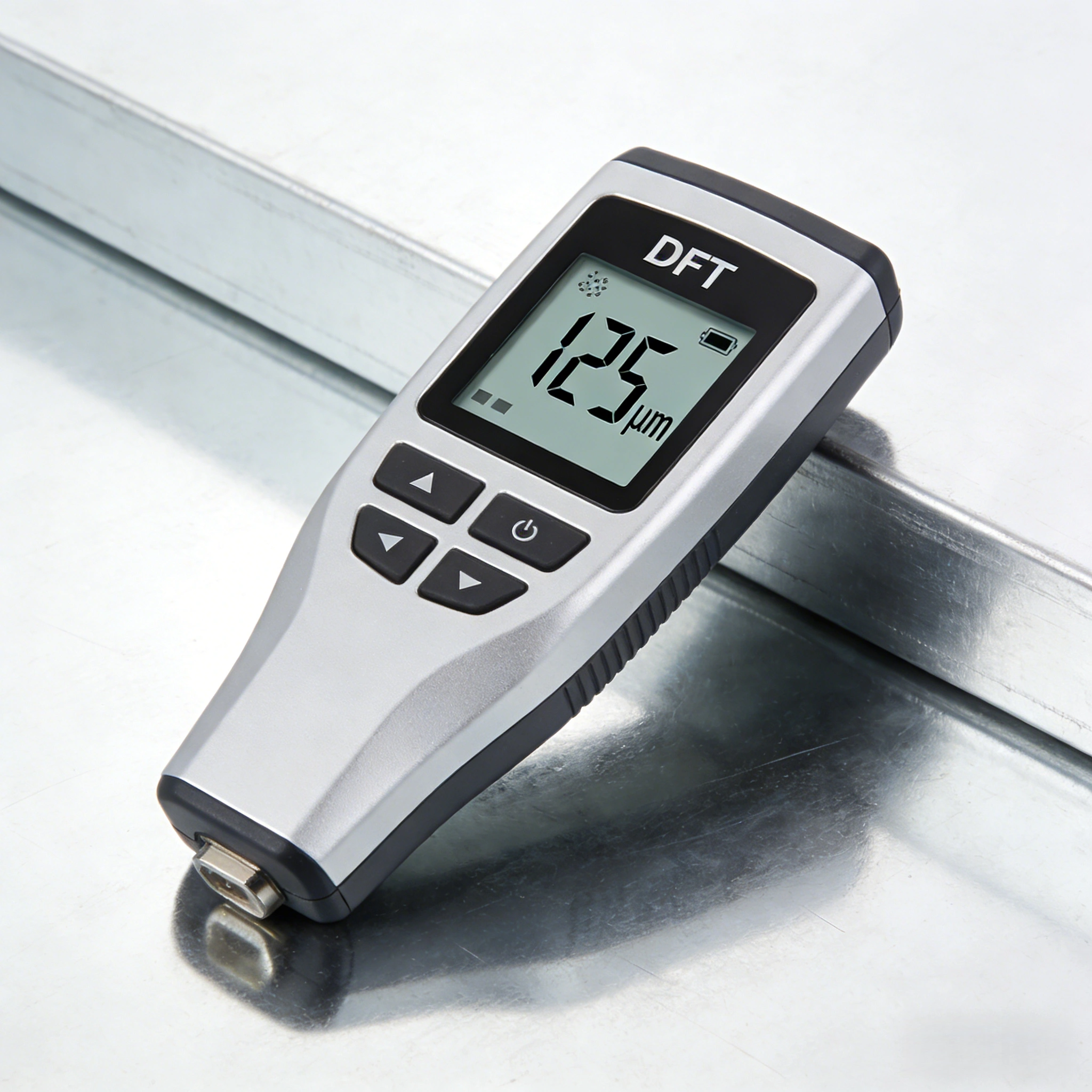
Recovery measures and their limits: how far can hot air, polishing, or ironing go?
Treatment should escalate in the order non-contact, light contact, then rework, with decision gates: before any measure is applied broadly, test it on a small hidden area of the same product, rest for 24 h, reassess, and only then generalize. The table below gives the scope and failure boundary of the common measures.
| Mark type | Field criterion | Self-recovery in 24 h–48 h | Allowed treatment and stop condition |
|---|---|---|---|
| Blushing white ring (light scattering) | Visible in grazing light, no groove to the touch; fades briefly under a damp wipe | Common; fades as moisture re-equilibrates | Rest in a dry environment; gentle 60 °C–80 °C warming to aid diffusion; if ineffective, move to polishing |
| Localized gloss loss | 60° gloss difference on the order of 5 GU | Partial | Light polish with a fine polishing compound; if gloss still sits below the system baseline, rework |
| Indentation and depression | Annular edge felt by touch, film material displaced through the thickness | Rare; thermoplastic systems occasionally rebound | Thin touch-up with the same system; if the groove exceeds one coat thickness, sand and recoat |
| Discoloration (yellow, brown) | Visibly discernible color difference, ΔE on the order of 1.5 units | Essentially none | First decide whether the discolored layer is the coating or the wood; wood-side discoloration only allows tinted local rework |
| Blistering and cracking | Structural change, matching European grade 1–2 | None | Strip back to a sound interface and recoat; filling over the defect is not allowed |
The risk of the ironing "home remedy" should be stated plainly: covering with a damp cloth and repeatedly applying heat deliberately superimposes a wet heat test on an already damaged coating. It may help interfacial-condensation blushing, but against softening impressions and blisters it only widens the damage. Likewise, a heat gun with uncontrolled temperature and distance easily turns one cup mark into an intercoat delamination. The mechanism by which thermal stress and coefficient-of-thermal-expansion matching affect coating integrity is covered in thermal shock resistance and CTE matching criteria for nanocoatings.
Formulation and process countermeasures: from resin selection to the cure window
There are four actionable directions on the formulation side. First, the crosslinking system: raise crosslink density through post-cure without sacrificing open time or flow — maturation management in 2K PU, the temperature–time activation window of waterborne self-crosslinking systems, or a small charge of polyfunctional crosslinker in waterborne resins; this improves blushing and softening at the same time. Second, balance resin glass transition (Tg) against the coalescent: too much coalescent drags down the effective softening temperature in service, and residual volatiles form micro-pores under heat, so a verifiable compromise is needed between low-temperature film formation and heat resistance. Third, pore filling and sealing: open-grained wood (oak, ash) channels vapor along the vessels, and getting the coat schedule and pore-filling practice right often improves interfacial condensation more than switching resin. Fourth, UV energy accounting: aged lamps, fouled reflectors, and rising line speed yield surfaces that pass while intercoat cure falls short; use MEK double rubs, or a hardness–solvent recovery pair, as the routine cure criterion instead of fresh-apply appearance.
The key process control is a reproducible thermal history: the heat-resistance rating of one formulation is more sensitive to cure temperature and time than to film thickness, so measured board temperature curves from the oven (not setpoints), per-batch loading density, and duct air velocity belong in the records. This shares its logic with the drying window criteria: overbaking embrittles the film and builds intercoat stress, while underbaking drags heat and chemical resistance down together. The test logic on the contamination and chemical media side is in stain and chemical resistance testing of furniture coatings and its formulation logic.
Delivery and acceptance: contract, sampling, and complaint judgment
For B2B delivery, write hot dish mark requirements into the technical agreement rather than leaving them as verbal promises. The agreement should carry: method standard and version (GB/T 4893.3-2020 or BS EN 12722:2009 A1:2013), temperature point and contact time, preconditioning and rest conditions, the minimum accepted grade (for example, grade 4 or above acceptable), and for disputes a retest by a third-party laboratory to the agreed method. Sampling frequency should work along two dimensions — batch and substrate combination — because the same formulation can differ more between birch and pine than between batches.
Complaint handling follows a recommended four-step flow: confirm the contact conditions (vessel temperature, water film present or not, duration, whether load was applied); classify the mark along the three causal chains (blushing, softening, discoloration, or structural damage); reassess after 24 h–48 h of rest to establish reversibility; then set the remedy and the liability boundary. Note that everything here is in an industrial supply and batch-delivery context: supply and quotation terms cover EXW and FOB only. End-use advice (coasters, insulation pads, maintenance intervals) should be treated as part of the use-and-care instructions, stated separately from coating performance acceptance, so maintenance conditions never blur into acceptance criteria.
Frequently asked questions (FAQ)
Q1 A hot cup left only a white ring with no dent — does that fail the coating?
Not a conclusion to draw on the spot. A white ring with no groove to the touch is mostly light scattering from interfacial condensation, which usually fades within 24 h–48 h as moisture re-equilibrates. Only if retesting to the wet heat basis of GB/T 4893.2-2020 or BS EN 12721 still grades at 3 or below, or the ring recurs and no longer fades, should the coating be judged short on wet heat resistance and system compatibility. Before any verdict, record the contact temperature, duration, whether the cup base carried water, and the panel's prior rest conditions.
Q2 What exactly separates the dry heat and wet heat tests, and which should be run?
Dry heat (GB/T 4893.3-2020) presses a dry heat block directly onto the coating and examines thermal softening, gloss loss, and heat-induced discoloration. Wet heat (GB/T 4893.2-2020) sprays (2±0.2) mL of deionized water onto the white polyamide cloth before the heat block is applied and examines blushing, blistering, and interface change under vapor and heat together. If customer complaints come from hot coffee cups, tea, or wet-bottomed glasses, run wet heat as the main line with dry heat as corroboration; if they come from plates or pots in dry high-temperature contact, prioritize dry heat and add points at 100 °C and above.
Q3 Why does a panel from one batch of waterborne varnish, delivered the next day, outperform one delivered the same day?
Because crosslinking and evaporation are still running. Waterborne systems depend on coalescent evaporation and water release; early on, the film interior holds residue and its effective softening temperature is low. With age, the polymer particles fuse further and the self-crosslinking reaction continues, so heat resistance typically improves markedly between day 3 and day 7. In engineering terms, submitted panels must state their preparation age, and the technical agreement should fix panel conditioning (for example, (23±2) °C and (50±5)% RH) and test age — otherwise one formulation can produce two grades.
Q4 Can adding one more topcoat fix insufficient heat resistance?
Within the recommended build range, a single extra coat buys little: published coat-count studies see only non-monotonic change between 2 and 3 coats, and some metrics regress at 4. When the root cause is under-cure, missing pore filling, or open interfacial channels, extra coats only push the problem later — with a denser skin, trapped water and solvent blister sooner under heat. Verify the degree of cure first, complete the sealing and pore filling, then discuss thickness, and confirm with the cross-cut adhesion test (GB/T 4893.4 or ISO 2409-2020) that the intercoat can carry rework.
Q5 A customer brings in a heat-damaged table — what can and cannot be done on site?
On site you may clean the piece, rest it in a dry environment, trial gentle warming (60 °C–80 °C) and light polishing on a small hidden area, and keep photographs and gloss readings before and after. You may not bake at high temperature, heat a damp cloth over a wide area, or fill over impressions and blisters: those measures alter the coating's thermal history and interfacial moisture state, turning reversible blushing into irreversible structural damage. The judgment and treatment boundaries are in Table 3, and every measure should first be validated on panels from the same product batch.
Q6 Can export-to-Europe and domestic acceptance clauses share one test report?
Not necessarily. The Chinese method (GB/T 4893 series) and the European methods (EN 12720/12721/12722) differ in media, temperature points, rest duration, and grade wording; although the ratings share the 1–5 scale, the test conditions are not directly interchangeable. The prudent course is to state the required values under both bases in the technical agreement, designate one as the controlling method with the other as reference; for white or light opaque finishes, also track discoloration from cold-liquid media (coffee, acetic acid, sodium carbonate solution), so heat is not measured while the media are ignored.
Q7 Do panel thickness and moisture content really affect cup-mark results?
They do, and the effect can outweigh fine formulation tuning. On the √(α·t) estimate, a 20 min contact pushes the thermal disturbance to about 12 mm deep (conductivity 0.12 W/(m·K), density 600 kg/m³, specific heat 1,700 J/(kg·K)), the same order as the common 18 mm–25 mm panel thickness: the thinner the board, the faster it sheds heat through the back, and the more the interface temperature history differs. On moisture, the fiber saturation point sits near 25%–30%; before shipment the wood should be within the equilibrium moisture content range of the destination and conditioned at (23±2) °C and (50±5)% RH for no less than 48 h. On under-conditioned panels, the same coating reports more blushing and more blistering.
References and statement of basis
- GB/T 4893.2-2020 (determination of wet heat resistance) and GB/T 4893.3-2020 (determination of dry heat resistance) from the series on the physico-chemical properties of furniture surface coatings: issued 2020-07-21, effective 2021-02-01; temperature points, humidification volume, preconditioning, and grading conditions quoted from the standards' published text.
- BS EN 12720:2009 A1:2013 (cold liquids), BS EN 12721:2009 A1:2013 (wet heat), BS EN 12722:2009 A1:2013 (dry heat), and ISO 2409-2020 (cross-cut adhesion): standard designations and scope.
- CATAS (Sara Moruzzi, "Do coated surfaces pass the coffee test?"): statistics from 2,445 coffee tests at 1 h to EN 12720 — a 92.0% overall pass rate, of which 84.1% at grade 5 and 7.9% at grade 4; plus the white-sample grade 5 shares stratified by coating type.
- Proceedings of the 2024 hardwood conference of the University of West Hungary (Sopron): coat-number trial on 1K waterborne polyurethane clear varnish recommending 2–3 coats at 80 g/m²–150 g/m², with coating color difference ΔE below 2 units against about 10 units for the maple substrate; and Bomba et al. (BioResources 12: 5867-5877, doi 10.15376/biores.12.3.5867-5877) on the non-significance of film thickness within the recommended build range.
- USDA Forest Products Laboratory, Wood Handbook, Chapter 4 on wood–moisture relations and physical properties (order of magnitude for the fiber saturation point, thermal conductivity, specific heat, and thermal diffusivity); the heat penetration depth cited in this article is our own estimate from published figures, not a clause value.
Statement of basis: parameters marked "association-standard figures" (10% sodium carbonate and 10% acetic acid for 24 h each; thermal shock at (40±2) °C / (-20±2) °C for 3 cycles; 60-revolution abrasion and 50 mm impact height) come from published association standards citing the GB/T 4893 series, not from the clause text of the individual parts. The grade 5 shares by system derive from cold-liquid statistics and are not dry heat results; they indicate system sensitivity only. Columns marked "workshop experience figures" are reproducible observation ranges, and specific projects follow the contractual method and measured data. This article is professional technical exchange; supply and quotation conditions cover EXW and FOB only and constitute no performance commitment for any specific application. Measured data follow third-party laboratory and on-site validation results.
Last updated: 2026-11-20 | Kexin New Materials (Guangdong) Co., Ltd. | B2B technical basis; trade terms EXW / FOB only