Among the many coating products, alkyd enamel remains a enduring choice for industrial and outdoor painting due to its excellent overall performance and wide range of applications. This article explores in depth the composition, properties, application key points, and market position of alkyd enamel in the modern coatings industry.
What is alkyd enamel?

Alkyd enamel is a colored paint formulated with alkyd resin as the main film-forming substance, together with pigments, additives, and organic solvents (such as mineral spirits and solvent naphtha No. 200). In its name, "alkyd" refers to the resin type, while "enamel" describes the hard, glossy coating film after drying, which resembles the luster of a porcelain glaze. Based on gloss level, it is classified into three types: glossy, semi-gloss, and flat.
Key Features: Advantages and Limitations
The reason alkyd enamel has long been favored lies in its unique performance balance:
Advantages:
- Excellent overall performance: Achieves a rare balance among adhesion, gloss, hardness, flexibility, and weather resistance that is hard to find in traditional paints.
- Easy construction: Suitable for brushing, spraying, roller coating and other methods, with good leveling and simple operation.
- High cost-performance ratio: Raw materials are widely sourced, production costs are low, and it is economical and practical.
- Strong permeability: Good wettability and adhesion to substrates such as wood and metal.
- Better gloss and color retention: Compared with ordinary oil-based paints, it has superior weather resistance and color durability.
Disadvantages:
- Slow drying speed: Surface drying takes 2-6 hours, and full curing may take over 24 hours, making it prone to dust contamination during construction.
- Insufficient environmental friendliness: Contains a high level of volatile organic compounds (VOC), with a noticeable odor during application, requiring enhanced ventilation.
- Poor chemical resistance: Not resistant to corrosion by strong acids, strong alkalis, and solvents.
- Limited water resistance: Not suitable for long-term immersion environments.
- Storage stability issues: Thickening or skinning may occur during long-term storage.
Primary application areas
Alkyd enamel has been widely used in outdoor and industrial applications over the past decades:
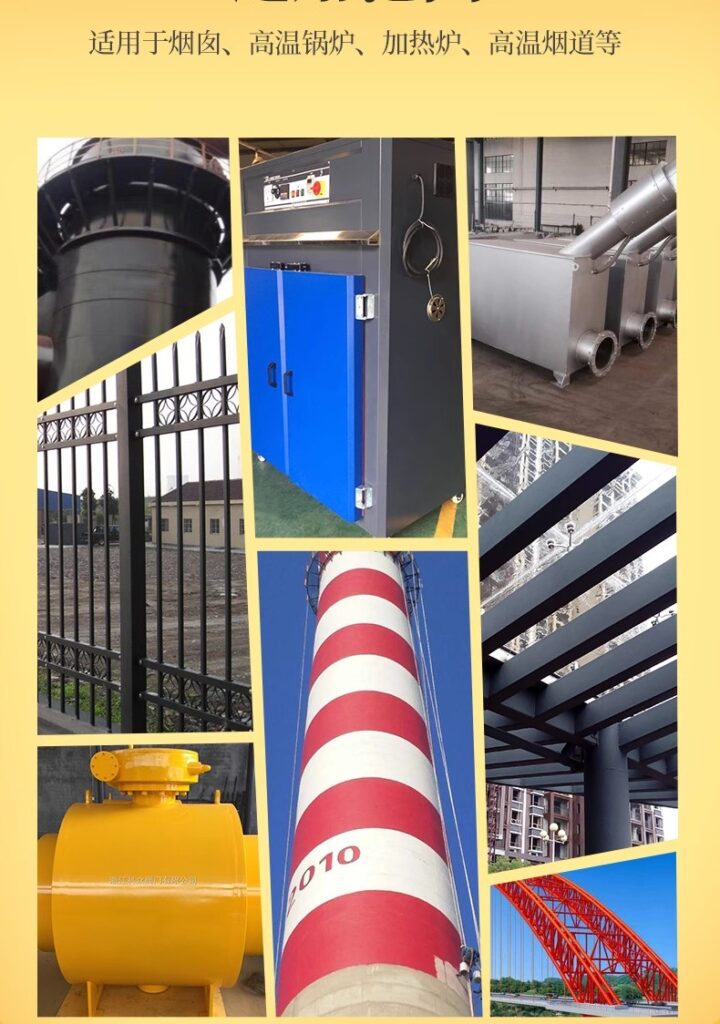
- Steel structure protection: anti-rust topcoat for metal structures such as workshops, bridges, towers, guardrails, and pipelines.
- Architectural door and window coating: protection and decoration of traditional steel windows and iron doors.
- Machinery and equipment: surface coating for agricultural machinery, construction machinery, machine tools, etc.
- Outdoor wood products: suitable for wooden structures requiring weather resistance, but must be used with a compatible primer.
- Shipbuilding industry: used for ship superstructures and interior bulkheads.
Key construction points
To ensure the coating effect, the following points should be noted during application:
- Surface treatment: The substrate must be clean, dry, free of oil and rust. For metal surfaces, it is recommended to remove rust first and apply anti-rust primer.
- Stir thoroughly: Mix completely before use to ensure even pigment distribution.
- Thinner selection: Use dedicated alkyd thinner or mineral spirits to adjust viscosity; avoid strong solvents such as banana oil (amyl acetate) and acetone.
- Recoating interval: Usually 2 or more coats are required, with an interval of no less than 24 hours between each coat to ensure the base layer is fully dried.
- Environmental Requirements: Construction should be carried out at a temperature of 5-35°C, humidity below 80%, and in a well-ventilated environment, avoiding work in adverse weather conditions.
- Tool Cleaning: Immediately clean tools with thinner after construction to prevent residue from curing.
Comparison with Common Coatings
| Feature | Alkyd Enamel | Acrylic Paint | Polyurethane Paint | Nitrocellulose Lacquer |
|---|---|---|---|---|
| Drying Speed | Slow | Relatively Fast | Moderate | Very Fast |
| Gloss and Fullness | Good | Better | Excellent | Good |
| Hardness | Moderate | Moderate | High | Moderate |
| Weather Resistance | Good | Excellent | Excellent | Average |
| Environmental Friendliness | Poor (High VOC) | Good (Water-based) | Moderate (Solvent-based) | Poor (High VOC) |
| Price | Economical | Moderate | Relatively High | Moderate |
Development Trends and Market Position
With increasingly stringent environmental regulations, the application of traditional solvent-based alkyd enamel in interior decoration and high-end fields is gradually being replaced by eco-friendly products such as water-based alkyd paint, water-based acrylic paint, and polyurethane paint. However, in areas such as heavy-duty anti-corrosion, outdoor engineering, and cost-sensitive applications, alkyd enamel still holds a significant market position by virtue of its mature technology, reliable performance, and low cost. The rise of water-based alkyd resin coatings has also injected new vitality into this classic product.

Summary
Alkyd enamel, as a classic general-purpose industrial anticorrosive and decorative topcoat, continues to deliver value through its good overall properties, ease of application, and cost-effectiveness. For outdoor fences, garage doors, agricultural implements, and other projects with low environmental requirements but a need for weather resistance and rust prevention, it remains an economical and practical choice. However, for scenarios such as household interior decoration, children's furniture, or applications with higher demands for drying speed and environmental friendliness, it is recommended to prioritize modern products such as water-based acrylic paint, water-based wood coating, or two-component polyurethane paint.