
Discussions on nano coating safety often fall into two extremes: on one side, vendors use "nano = harmless high-tech" as a selling point, while on the other, the public treats "nano = unknown deadly poison" as a source of panic. A truly responsible stance is neither blind reassurance nor baseless fear, but returning to the MSDS (Material Safety Data Sheet) and the science of occupational exposure itself—acknowledging that nano particles do carry special risks distinct from conventional powders, while using actionable engineering controls and personal protection to suppress risks to an acceptable level.
This article is aimed at spray painters using nano coatings, laboratory R&D personnel, workshop EHS managers, and procurement compliance staff. Based on the nano safety entries in the batch research archive (TDS_MSDS_RESEARCH.md) and the core requirements of the automotive isocyanate MSDS, it systematically explains "where the risks lie, how to protect, and where compliance gets stuck." All key conclusions are marked with sources for direct inclusion into SOPs and safety training materials. The safety baseline is not a cost, but a prerequisite.
As a functional coating supplier, Kexin New Materials (kexinMaterials) provides a complete MSDS with its nano composite coatings and clearly states the boundary of "inert after curing, protection needed before curing" during technical disclosure. The protection level table in this article is exactly the baseline framework we recommend clients incorporate into their work instructions.
I. First, Define "Nano" Precisely: Size Itself Is the Source of Risk
According to the research archive (§V.1), nano coating is defined as a system with at least one phase sized 1–100 nm, with common nanoparticles including TiO₂, SiO₂, ZnO, Ag, Cu, CaCO₃, etc. These particles possess special properties due to small-size effects and high specific surface area (surface effect), but precisely these two characteristics form the physical basis of their occupational health risks:
- Inhalability: Particles of 1–100 nm are extremely light and easily form dust/aerosols that can remain suspended in air for long periods. Human respiratory cilia and mucus mainly intercept larger particles, but intercept nano-scale particles inefficiently; they can follow breathing deep into alveoli and even enter the bloodstream (crossing the alveolar-capillary barrier).
- High biological activity: The larger the specific surface area, the stronger the chemical reaction and surface interaction per unit mass. After entering the lungs, the highly active surface may induce inflammation and fibrosis (e.g., pneumoconiosis-like pathology). The research archive (§V.7) explicitly lists this as the core potential risk of nanoparticles: "nano particles can be inhaled into the lungs, potential inflammation/fibrosis."
It must be emphasized: the magnitude of risk depends on the "exposure form." The same nano material, encapsulated in a cured paint film versus floating in the air as dust, differs vastly in hazard. This is exactly the basis for the later boundary line of "inert after curing vs protection needed before curing." For common misconceptions about on-site coating safety awareness, first refer to water-based paint application safety myths to establish the basic judgment that "risk depends on form, not name."

II. Core Risks of Nano Particles: Inhalation into Lungs and Inflammation/Fibrosis
2.1 Inhalation Is the Main Exposure Route
The research archive (§V.7) clearly states the triggering condition for nano safety risks: NIOSH particulate respirator protection is required during operation. That is, risks concentrate in the "operation" stage—operations that introduce nano particles into the air such as opening bags, weighing, dispersing, spraying, and sanding uncured layers.
Why "inhalation" rather than mainly "skin contact"? Because the main entry portal for nano dust and atomized slurry is the respiratory tract. Skin as a barrier offers some blockage to intact nano particles, but mucous membranes (mouth, nose, eyes) and broken skin remain secondary entries, so eye-face and hand protection must not be omitted either; it is just that respiratory protection ranks first in priority.
2.2 Inflammation and Fibrosis: Not Immediate Poisoning, but Chronic Accumulation
The archive describes the consequence as "potential inflammation/fibrosis," which matches the typical feature of occupational lung disease: not collapsing upon one breath, but cumulative damage after long-term, repeated, low-dose exposure. Nano particles in alveoli are phagocytosed by macrophages but hard to clear, continuously stimulating and causing chronic inflammation, which may progress to pulmonary fibrosis over time (tissue hardening, decreased gas exchange function). This chronic, irreversible nature is logically同源 with automotive isocyanate "irreversible after sensitization" (archive §III.4)—both demand "protection beforehand" rather than "treat after incident."
2.3 Toxicity Differences Among Various Nano Materials
Avoid "one-size-fits-all panic." The nano particles listed in the archive have different uses: TiO₂, SiO₂ mostly for reinforcement and hydrophobicity; ZnO, Ag for antibacterial; Ag/ZnO antibacterial mechanism is destroying microbial membranes/enzymes (§V.4). Different materials vary in biopersistence, solubility, and toxicity—for example, soluble ones metabolize faster, while insoluble and persistent ones (e.g., certain insoluble oxides) are more likely to remain long-term. But before specific product toxicology data is available, uniformly treating as "potential harmful dust requiring protection" is the safest engineering stance, which is exactly the conservative principle of MSDS.
III. Boundary Line: Usually Inert After Liquid Curing, Dangerous Only Before Curing
The research archive (§V.7) gives the most critical boundary for nano safety: liquid formula is usually inert after curing; but spraying dust/uncured slurry requires protection. This line must be memorized by every operator.
3.1 Why "Usually Inert" After Curing
After nano coating forms a film, nano particles are firmly wrapped and fixed in the resin network within a three-dimensional crosslinked structure, losing the freedom to suspend in air and enter the respiratory tract; meanwhile many resin systems have high chemical inertness after curing and no longer release active particles on the surface. Therefore:
- Daily cleaning, touching, and light use of fully cured nano coating surfaces usually require no special respiratory protection;
- The archive mentions YC-8703 hydrophobic self-cleaning nano composite ceramic coating as "non-combustible, flame-retardant, food-grade (SGS + US FDA tested)" (§V.2), a representative of low-risk inert coating after curing;
- Electronic-use ECS 1300AG also notes "inert and eco-friendly after curing" (§VI.3).
3.2 Why Dangerous Before Curing
Danger concentrates in three types of "uncured/releasable" forms:
- Dry powder and nano powder raw materials: directly generate inhalable dust when opening bags, transferring, weighing;
- Uncured slurry/dispersion: forms droplets containing nano particles when spraying; mixing, pouring, and cleaning spray guns also release them;
- Sanding/processing incompletely cured paint film: turns already fixed nano particles back into inhalable dust.
The archive (§V.7) especially emphasizes "avoid releasing nano powder into the environment"—this is both occupational protection (not leaking to other workshop areas) and environmental responsibility (the long-term fate of nano powder entering drainage or atmosphere is not fully clear). Therefore operations should be conducted under fume hood/local exhaust, and spills collected per harmful dust procedures, not washed into sewers.
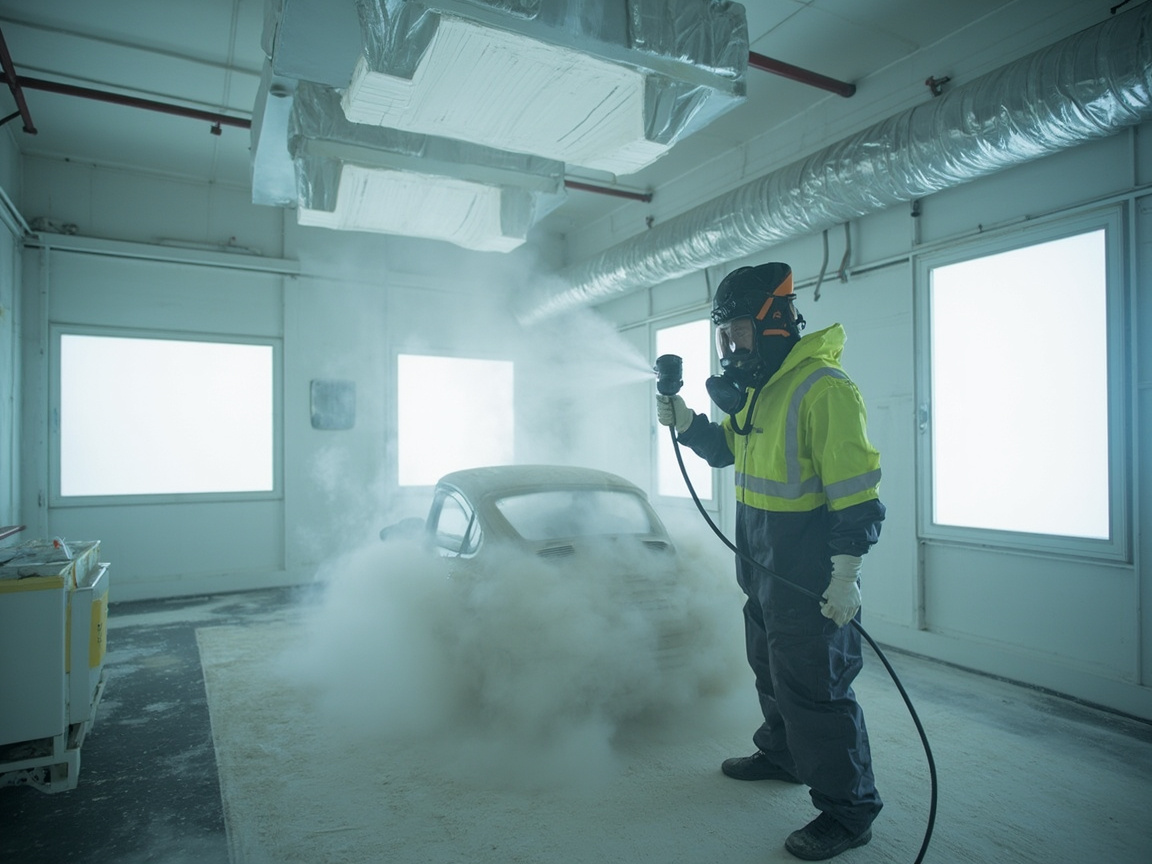
IV. Protection Level Table: Graduated Configuration from Powder Handling to Spraying
Combining the nano safety entries of the research archive with the PPE approach of the automotive isocyanate MSDS (§III.4) yields a gradable protection reference table. The core logic is: the more "inhalable" the exposure form and the higher the concentration, the higher the protection level selected.
| Risk Scenario | Main Hazard | Protection Level | Configuration Requirement (per archive) |
|---|---|---|---|
| Nano dry powder/powder operation (bag opening, weighing, dispersing) | Inhalable dust into lungs, inflammation/fibrosis | High | NIOSH particulate respirator (N95 minimum, prefer P100), goggles, nitrile/powder-proof gloves, fume hood/local exhaust, sealed transfer |
| Uncured nano slurry spraying | Atomized particle inhalation + solvent exposure | High | Respiratory protection (particulate P100; if containing solvent/isocyanate, per §III.4 use OV/P100 or APR/PAPR), full-face shield for eyes, coverall, spray booth local exhaust |
| Isocyanate-containing 2K nano system (related automotive approach) | Sensitization (irreversible) + atomized inhalation | Highest | Half-mask APR + OV/P100 cartridge (minimum); recommend full-face APR or PAPR (OV/HEPA); nitrile gloves ≥8 mil (latex ineffective); cartridge replace at 8h or upon odor detection |
| Sanding/welding incompletely cured paint film | Re-release nano dust + pyrolysis fumes | High | Prohibit work before confirming full cure; if must process, use high-level respiratory protection + local extraction + goggles |
| Fully cured paint film (daily contact) | Usually inert, low risk | Basic | Routine industrial hygiene (ventilation, regular gloves), no special respiratory protection needed |
Principle for using this table: First determine which row the "current form" belongs to, then follow that row's configuration, adopting the higher level when in doubt. For example, "nano ceramic coating spraying" contains both nano slurry and is often paired with 2K curing agent, so it should be classified under the highest level of "contains isocyanate 2K", rather than being under-configured merely as "dust".
V. Respiratory Protection: NIOSH Particulate Standards and Filter Discipline
5.1 Why Emphasize NIOSH
The research archive (§V.7) explicitly states "wear NIOSH particulate respiratory protection during operation". NIOSH (National Institute for Occupational Safety and Health) has grades for particulate respirators: N series protects against non-oil particles (N95 filters ≥95%, N99, N100 ≥99.97%), P series also protects against oil particles (P95/P100). For nano dust, prefer P100 (or N100), as it has the highest filtration efficiency and the P series is also effective against possible oily carriers (such as slurry droplets containing resin/solvent).
Note: Ordinary gauze masks and uncertified simple masks cannot block nano particles—their filtration pore size is far larger than 100 nm, and their fit is poor. Certified respirators must be used with a fit test to ensure no air leakage at the edges.
5.2 Connection with Automotive Isocyanate PPE
When the nano coating uses a 2K polyurethane system (curing agent contains isocyanate), the risks are compounded: both nano particle inhalation and isocyanate sensitization. In this case, directly apply the stricter requirements of archive §III.4:
- Minimum baseline: half-face APR + OV/P100 filter (OV for organic vapor, P100 for particles, both indispensable);
- Recommended upgrade: full-face APR or PAPR (OV/HEPA), suitable for long-duration/high-concentration;
- Filter replaced every 8 hours of spraying or upon smelling odor (whichever comes first), strictly no overdue use;
- Nitrile gloves ≥8 mil, latex ineffective; prohibit sanding/welding of incompletely cured coating film.
Therefore, "nano coating safety" and "automotive coating isocyanate safety" are consistent in terms of PPE—when encountering a 2K system, execute according to the stricter isocyanate standard. For the configuration framework of spray booths, exhaust ventilation, and personal protective equipment, you may further read Water-based Coating Application Tools and Equipment, where the general principles for local exhaust and respiratory protection also apply.
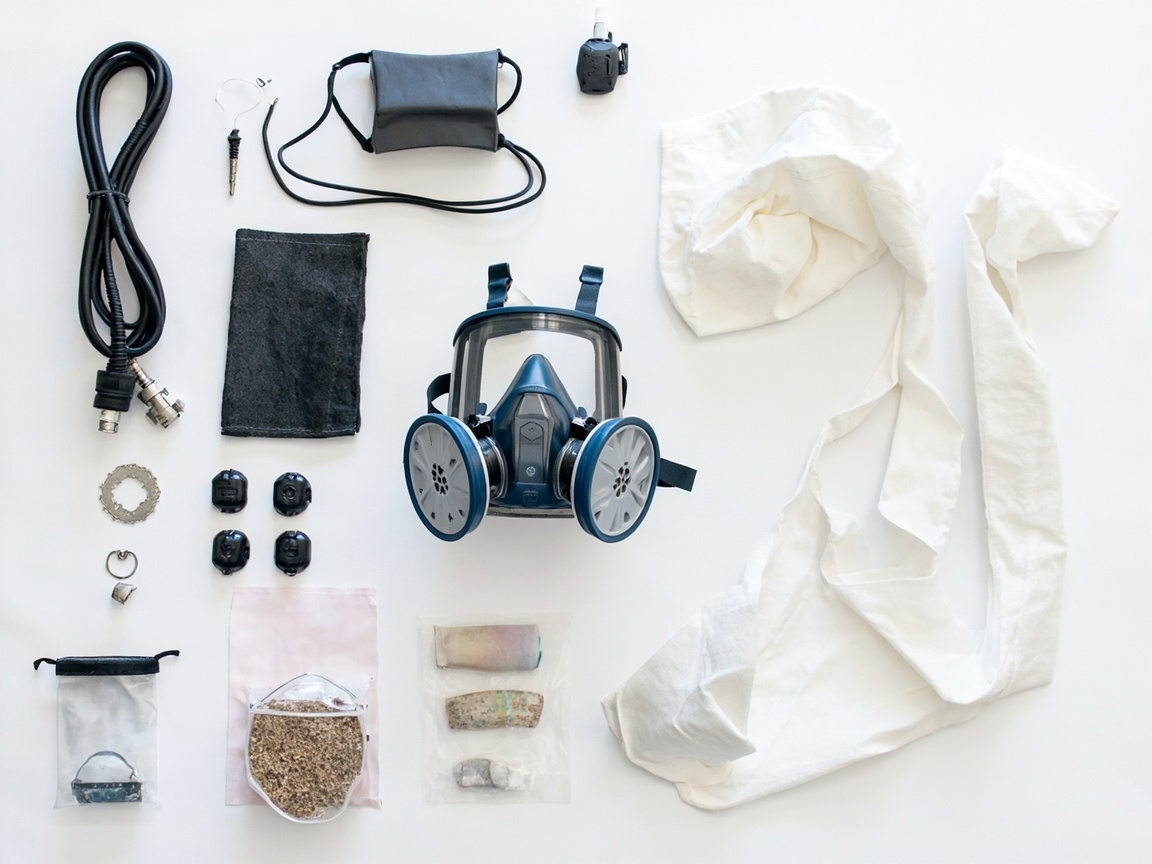
VI. Engineering Controls: Ventilation Cannot Replace Respiratory Protection
Just like the isocyanate scenario (archive §III.4: "spray booth ventilation alone cannot reduce below PEL, respiratory protection still required"), the control of nano dust must also be a dual layer of "engineering control + PPE":
- Local Exhaust Ventilation (LEV) priority: capture at the point of dust/mist generation (weighing table fume hood, spray gun nozzle) nearby, superior to general dilution ventilation;
- Ventilation reduces overall load, protects others, extends filter life, but cannot alone reduce breathing zone concentration to zero or below safe threshold—especially nano dust can remain suspended for long periods and easily re-suspend;
- Therefore the correct hierarchy is "ventilation + respiratory protection overlay", any omission of "no mask needed if there is ventilation" is a misreading of the MSDS.
For laboratories and workshops with frequent nano powder contact, it is recommended to conduct air sampling monitoring: wear personal samplers in the breathing zone to verify whether engineering controls and PPE truly suppress exposure to acceptable levels, turning safety from "experience" into "data".
VII. Environmental Release and Waste: Don't Take the Risk Out of the Workshop
The research archive (§V.7) separately lists "avoid releasing nano powder to the environment", which needs to be implemented in waste and spill management:
- Spill handling: nano powder leakage should be collected by wet method or inert adsorbent material, avoid dry sweeping that raises dust; dispose according to hazardous dust/chemical process;
- Waste liquid and waste: cleaning waste liquid and waste slurry containing uncured nano particles must not be directly discharged into the sewer, should be collected and treated as hazardous waste;
- Packaging and transfer: nano powder raw materials sealed, labeled with MSDS, transport to prevent bag breakage;
- Personnel removal: protective clothing and gloves removed in designated area, avoid taking nano dust out of the control zone.
This part is both EHS compliance and corporate social responsibility—research on the environmental fate of nano materials is still ongoing, cautious disposal is the most prudent position at present.
VIII. Compliance and Standards Status: No Single Mandatory Standard, but Referenceable Frameworks Exist
According to the research archive (§VI.6), currently there is no single global mandatory standard for "nano coating", mostly referencing existing coating/material standards (ISO 12944, GB/T series, etc.). For safety compliance, actionable levers include:
- MSDS itself: supplier must provide, and operators can access on site (archive §III.4 also emphasizes MSDS on wall for isocyanate products);
- General hazardous substance national standards: industrial coating VOC governed by GB 30981-2020, automotive coating by GB 24409-2020 (archive general table); although not specifically nano standards, they are the compliance base for coatings;
- Industry common PPE and ventilation norms: such as NIOSH respirator certification, OSHA exposure limit thinking;
- Third-party testing: when purchasing, require hard data on particle size, Zeta, film thickness, contact angle, salt spray, etc. (§VI.6), which also indirectly verifies "nano attributes are real, not conceptual packaging".
Treating "safety compliance" as a selection dimension, alongside "performance, cost, application", is the practice of mature procurement. For related comprehensive judgment framework, refer to Water-based vs. Solvent-based Coating Selection Guide, incorporating the MSDS protection requirements of this article into supplier evaluation.
IX. Kexin New Materials' Safe Delivery and Compliance Recommendations
Implementing the above points into management actions, Kexin New Materials (kexinMaterials) provides five baseline recommendations for workshops and laboratories to adopt directly:
- MSDS on wall, training documented: each nano product MSDS accessible on site, complete "inhalation risk, pre/post-cure boundary, PPE, ventilation" training and sign before onboarding;
- Protection by form grading: dry powder/P100, uncured slurry/respiratory protection + local exhaust, 2K system per OV/P100 or PAPR highest level; nitrile gloves ≥8 mil, latex ineffective;
- Ventilation and respiratory protection double insurance: local exhaust operates as usual, but entering dust/mist generation zone must wear respiratory protection, not omitted on grounds of having ventilation;
- No sanding/welding before cure: based on product MSDS cure time, before reaching standard prohibit sanding, welding, cutting, to avoid re-releasing nano dust and pyrolysis fumes;
- Zero environmental release: spill wet method/adsorption collection, waste liquid and waste managed as hazardous waste, prohibit discharge into sewer.
Kexin New Materials (kexinMaterials)'s position is: the safety of nano coating does not rely on "feeling reassured because it sounds high-tech", nor on "turning pale at the mention of nano", but on MSDS written clearly, PPE properly equipped, ventilation solidly done, boundaries clearly drawn. When a safety document can answer "what form is dangerous, what to wear, how to ventilate, where waste goes", only then does nano coating truly deserve to be "responsibly used".
IX-1. Emergency Response: Three Things at the Nano Powder Exposure Scene
Even with proper protection, accidents (powder bag rupture, large slurry spill, PPE failure) may still occur. The site must have emergency procedures ready and drilled, core three things:
- Inhalation: immediately move person to fresh air, loosen restrictive clothing, keep quiet and warm; if cough, chest tightness, breathing difficulty occurs, seek medical attention immediately and clearly inform of "nano particle/chemical exposure history", do not let them "tough it out". Lung effects of nano dust are mostly cumulative, acute exposure may not show symptoms immediately, but must inform contact background for diagnosis.
- Skin and eye contact: remove contaminated clothing, rinse skin with plenty of soapy water; eye contact hold eyelids open and rinse with running water or saline for at least 15 minutes, seek medical attention immediately. Note do not wipe with organic solvent (would carry nano particles or chemicals deeper).
- Leak/spill: cut off ignition source, enhance ventilation, collect nano powder with wet method or inert adsorbent material (strictly no dry sweeping raising dust), waste managed as hazardous chemical; cleanup personnel also must wear P100 respiratory protection and gloves, prohibit "casually mopping" with mop to spread dust.
Emergency supplies (eyewash, emergency shower, adsorbent cotton, spare filters) should be fixed-point, usable, regularly inspected, not "locked in a cabinet". The value of drills is to make response muscle memory—in a real incident, panic is more fatal than dust.
IX-2. Occupational Health Surveillance and Training Audit
Nano hazards are progressive and potentially irreversible (same origin as irreversible isocyanate sensitization, archive §3.4), so "after-the-fact remediation" is almost ineffective; the focus must be placed on pre-employment screening and periodic monitoring:
- Pre-employment baseline: Pulmonary function tests, questionnaire on allergy history and respiratory disease history. Those with atopic constitutions such as asthma and allergic rhinitis have relatively higher risk to inhaled sensitizers, and should be carefully evaluated for suitability to engage in high-frequency nano-powder operations.
- Periodic medical surveillance: During employment, recheck pulmonary function and respiratory symptoms per occupational health management requirements, and establish personal health records; in case of recurrent cough, chest tightness, wheezing, eye/nose irritation, immediately remove from exposure and seek medical care.
- Training traceability: New employees must complete pre-employment training on "inhalation risk, pre-/post-curing boundary, PPE wearing, ventilation limitations, prohibited operations" and sign; MSDS must be accessible on site.
- Auditable records: Filter/glove replacement records, exposure and abnormal exposure logs, spill handling records, forming an evidence chain. Compliance audits look not at slogans, but at these traceable records.
Writing health surveillance and training into the EHS system is more substantive than any "safety slogan".
It is worth emphasizing that health records should have continuity: when an employee is transferred or leaves, their nano exposure history and all past pulmonary function data should be archived, which is both responsible to the individual and provides objective evidence in case of disputes. For SMEs, even without a dedicated EHS function, the above four items (baseline, periodic, training, records) should be outsourced to a qualified occupational health institution, rather than omitted on the grounds of "small scale"—nano dust does not reduce its activity because the enterprise is small, and the compliance baseline is the same for operations of any size.
Part 9.3, Comparison with Conventional Coating Safety: What Is Special about Nano
Viewing nano coating safety within the broader context of "coating safety" makes its specificity clearer, and avoids two extremes:
- Adds an "inhalable dust" dimension vs. conventional solvent-based paint: The main hazards of conventional alkyd/epoxy paint are organic solvents (flammable, vapor irritation) and isocyanate sensitization; nano coating additionally layers on the risk of "nano particles reaching deep into alveoli", so even with very low VOC or even water-based, one cannot let down guard—low VOC does not equal low nano risk.
- Adds a "highly active surface" dimension vs. conventional filled paint: Conventional micron-scale fillers are essentially inert once encapsulated; nano particles, due to high specific surface area and potential bioactivity, may react more actively in the body even with the same material, which is why archive §5.7 separately lists "inflammation/fibrosis".
- Same as conventional paint in the "inert after curing" logic: Regardless of nano or not, liquid application state is dangerous and cured state is safe is a universal rule; the difference is only that nano extends the protection requirement of the "application state" from "solvent prevention" to "particle prevention".
Therefore, the most stable management posture is: treat nano coating as a dual risk of "dust + chemical", adding the NIOSH particulate protection link on top of conventional coating PPE; for 2K systems, further叠加 the highest level of isocyanate protection. Neither exaggerate panic nor omit dimensions—this is exactly where MSDS and safety management show professionalism.
One more reminder: nano safety is not "buy all equipment and done", but "dynamic management". New processes (e.g., added spray drying, electrostatic spraying), new raw materials (e.g., switching to higher specific surface area powder), new employees (untrained) all change the risk profile, and Job Hazard Analysis (JHA) re-assessment should be done periodically, upgrading ventilation or PPE when necessary. Treating "safe today" as evidence of "always safe" is the most dangerous illusion; true professionalism is keeping protection levels always ahead of risk changes, holding the baseline with systems rather than luck.
Ten, Frequently Asked Questions
Q: Is nano coating more toxic than ordinary paint?
A: It cannot be generalized. Risk depends on exposure form: per research archive (§5.7), nano particles can be inhaled into lungs, with potential inflammation/fibrosis, but liquid formulations are usually inert after curing. Danger mainly lies in dry powder, uncured slurry, and sanding uncured layers. The solvent/isocyanate hazards of ordinary paint are also significant. The key is not "nano or not", but "inhalable or not, uncured or not".
Q: Is daily contact with already-applied nano coating furniture safe?
A: Usually safe. Per archive §5.7, inert after curing; e.g., YC-8703 is non-combustible/flame-retardant and food-grade after curing (§5.2), ECS 1300AG is inert after curing (§6.3). Daily touching and cleaning require no special respiratory protection. But cutting or sanding already-cured nano coating will still generate dust, and should be handled with high-level protection.
Q: Can ordinary cotton gauze masks block nano dust?
A: No. Nano particles are far smaller than cotton gauze mask pores and fit poorly. Archive (§5.7) requires wearing NIOSH particulate respiratory protection, preferably P100/N100 certified respirators with fit testing. Simple masks cannot block nano particles.
Q: When spraying nano coating in a spray booth with extraction, can I skip the mask?
A: No. Same as isocyanate scenarios (archive §3.4: ventilation alone cannot reduce below PEL, respiratory protection still needed), nano dust can remain suspended for long periods and easily re-suspend; ventilation reduces load but does not remove the respiratory protection obligation. "Ventilation + respiratory protection" must be combined.
Q: How to protect when using isocyanate-containing 2K nano coating?
A: Risks are叠加; execute per stricter standard (archive §3.4): minimum half-mask APR + OV/P100 filter; recommended full-face APR or PAPR (OV/HEPA); nitrile gloves ≥8 mil, latex ineffective; filter replaced every 8h or upon odor; prohibit sanding/welding incompletely cured film.
Q: How to clean up spilled nano powder?
A: Avoid dry sweeping that raises dust. Use wet method or inert adsorbent material to collect, dispose per hazardous dust/chemical process, operators wear P100 respiratory protection and gloves; waste managed as hazardous waste, not flushed into sewer (archive §5.7: avoid releasing nano powder to environment).
Q: Why emphasize "avoid releasing nano powder to environment"?
A: The long-term fate and ecological impact of nano powder entering atmosphere or water are not fully understood (archive §6.6 also notes existing standards mostly reference prior coating/material standards). Prudent disposal and closed-loop management are the most稳妥 current engineering and environmental stance, protecting populations outside the workshop and fulfilling corporate responsibility.
Q: Is there a dedicated mandatory national standard for nano coating safety?
A: Per research archive (§6.6), there is currently no single global mandatory "nano coating" standard, mostly referencing existing standards such as ISO 12944, GB/T series. The compliance leverage is MSDS, NIOSH/OSHA-oriented PPE and ventilation specs, and coating hazardous substance national standards such as GB 30981-2020/GB 24409-2020.
Q: Weighing a small amount of nano powder in lab, do I need full protection?
A: Corresponding level of protection is needed. As long as in the "handling" step (opening bag, weighing, dispersing) inhalable dust is generated (archive §5.7), it should be done in a fume hood, wearing P100 respiratory protection and goggles, using sealed containers for transfer. Small amount does not mean no risk; nano hazard is cumulative.
Q: How can enterprises make nano coating safety auditable?
A: Four things documented: MSDS accessible on site; training signatures; PPE configuration and filter/glove replacement logs; spill and abnormal exposure records. Write "form-based graded protection" into SOP, and periodically conduct air sampling verification, turning compliance from slogans into an evidence chain.
Eleven, Further Reading
- Water-based Paint Application Safety Myths (same cluster: on-site coating safety cognition correction, complementary to nano risk boundaries in this article)
- Water-based Paint Application Tools and Equipment (same cluster: spray booth, local exhaust, and personal protective equipment configuration framework)
- Water-based vs. Solvent-based Coating Selection Guide (related: treating safety compliance as a selection dimension alongside performance and cost)