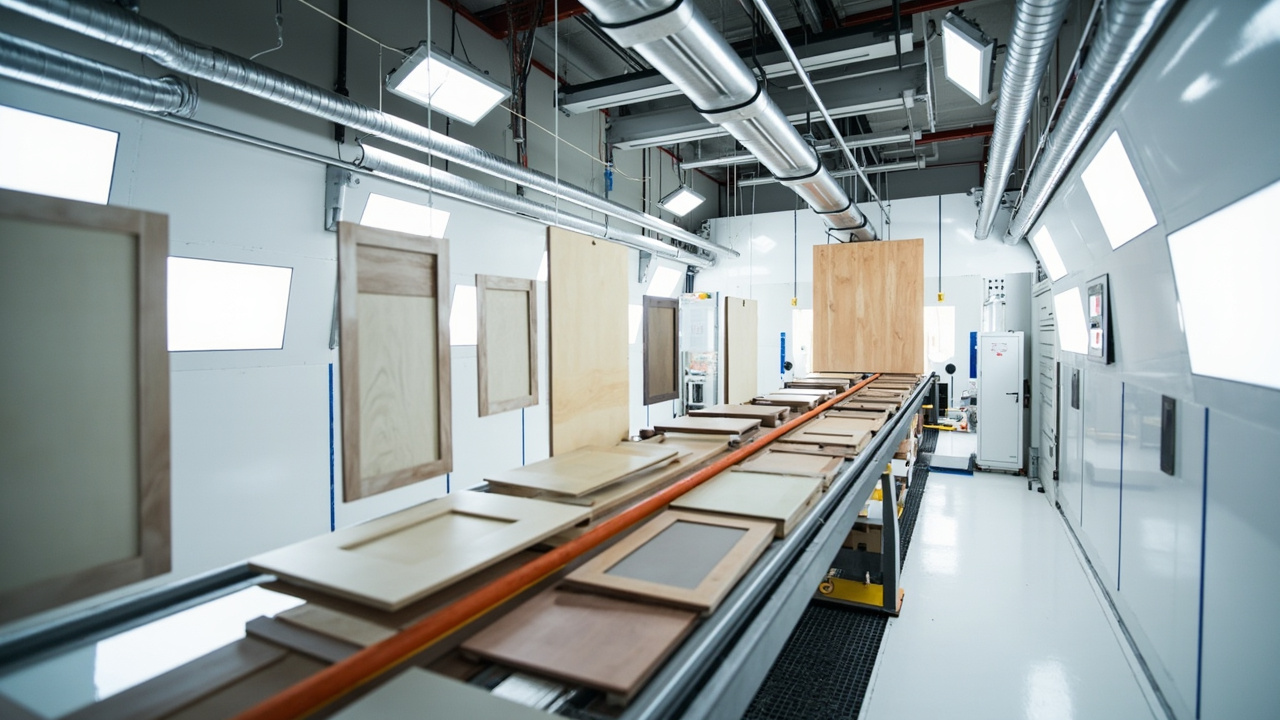
Water-based paint has moved from "whether it can be used" to "how to use it stably and well in factories," with a real production line lying in between. For factories producing wooden doors, kitchen cabinets, and custom furniture, switching from oil to water is not as simple as replacing paint buckets with water-based coating buckets, but rather a systematic transformation involving the line, drying, environment, process, and cost. Many factories achieve good results during the sampling stage, but once on the mass production line, issues such as sagging, blushing, inability to keep up with the cycle time, and surging rework rates emerge. The essence is underestimating the requirements of the water-based system for "process control." From a factory perspective, this article breaks down the implementation paths of water-based coating on the production lines of three types of products—wooden doors, kitchen cabinets, and custom furniture—focusing on the three metrics that bosses and plant managers care about most: drying cycle time, yield, and comprehensive cost.
As a coating supplier that has long served furniture and woodworking enterprises, Kexin New Materials (kexinMaterials) has accumulated a large number of OEM implementation cases in water-based wood coating systems and production line support. The methodology in this article also comes from these frontline experiences. If you are planning or evaluating water-based transformation, you can first compare your own product families against our wood coating product system, and then discuss technical solutions with specific cycle time and yield targets.
I. Calculate the Account First: Why Furniture Factories Should Adopt Water-Based Lines
The primary driving force for any transformation in a factory is never "environmental sentiment," but rather "failure to transform will lead to lost orders, penalties, and production restrictions." For wooden door, kitchen cabinet, and custom furniture factories, the practical pressures driving water-based adoption mainly come from three sources:
First, regulations. The limits on harmful substances in wood coatings, various local rectifications on VOC emissions, and environmental inspections requiring exhaust gas collection in spraying workshops all make traditional high-VOC solvent-based lines face rising compliance costs or even the risk of production restrictions. Second, customers. Real estate fine decoration, chain customization, and export orders often write "water-based," "low odor," and "low VOC" into bidding and factory audit clauses; without a water-based solution, you are directly eliminated. Third, workers and the site. The irritating odor of solvent-based paint leads to difficulty in recruitment and high occupational health risks, while water-based lines are significantly more friendly in terms of workshop environment and employment.
But the flip side of opportunity is risk: water-based line transformation requires large investment and yield fluctuations during the ramp-up period. If you only stare at the unit material price, it is easy to draw the wrong conclusion that "water-based is more expensive." Later, a complete cost model will be used to correct this deviation.
II. The Core of Line Transformation: Not Changing the Paint, but Changing the Entire Logic of "Conveying + Atomization + Drying"
Solvent-based paint relies on rapid volatilization of strong solvents and is tolerant of the environment; water-based coating relies on water evaporation for film formation and is more sensitive to temperature, humidity, convection, and film thickness. Therefore, when adopting water-based lines, what really needs to be changed is "how to let the water stably go away and let the paint film grow evenly."
2.1 Selection of Spraying Methods
Three common routes:
- Air spraying (traditional spray gun modification): Low equipment cost, directly reuses the original spray booth, but the atomized particles are coarse and paint mist dispersion is large. Water-based coating is sensitive to viscosity, and orange peel and sagging often coexist. Suitable for the transition period of small batches and low cycle time.
- Airless-assisted spraying (air + airless): Fine atomization, high transfer efficiency, and easier control of film thickness. It is the mainstream choice for wooden doors and flat panels, and can significantly reduce sagging and orange peel.
- Electrostatic spraying: Coating utilization can reach over 80%, especially suitable for relatively regular kitchen cabinet door panels and wooden doors, but the conductivity of water-based coating requires special resistance adjustment and electrostatic-specific formulations, with the highest equipment and process thresholds.
Key points for selection: First determine the spraying method based on the three elements of "workpiece shape complexity + cycle time + budget," then reverse-require the coating formulation to match (e.g., electrostatic lines must be paired with low-resistance water-based coating). Many factories put the cart before the horse: they buy the paint first and then find it cannot be sprayed, with all rework on the equipment.
2.2 Paint Supply and Circulation and Constant-Temperature Paint Feeding
Water-based coating has a narrow temperature and viscosity window, and it is best to equip a constant-temperature paint supply and circulation system: original paint tank → mixing tank (constant temperature, slow stirring to prevent settling) → insulated pipeline → spray gun. The core function is to lock the variable of "viscosity" that most affects atomization and sagging. Without constant-temperature paint feeding, the viscosity difference between summer and winter is significant, and the same gun sprays two effects, causing yield fluctuations.
III. Drying Cycle Time: The Lifeline of Capacity
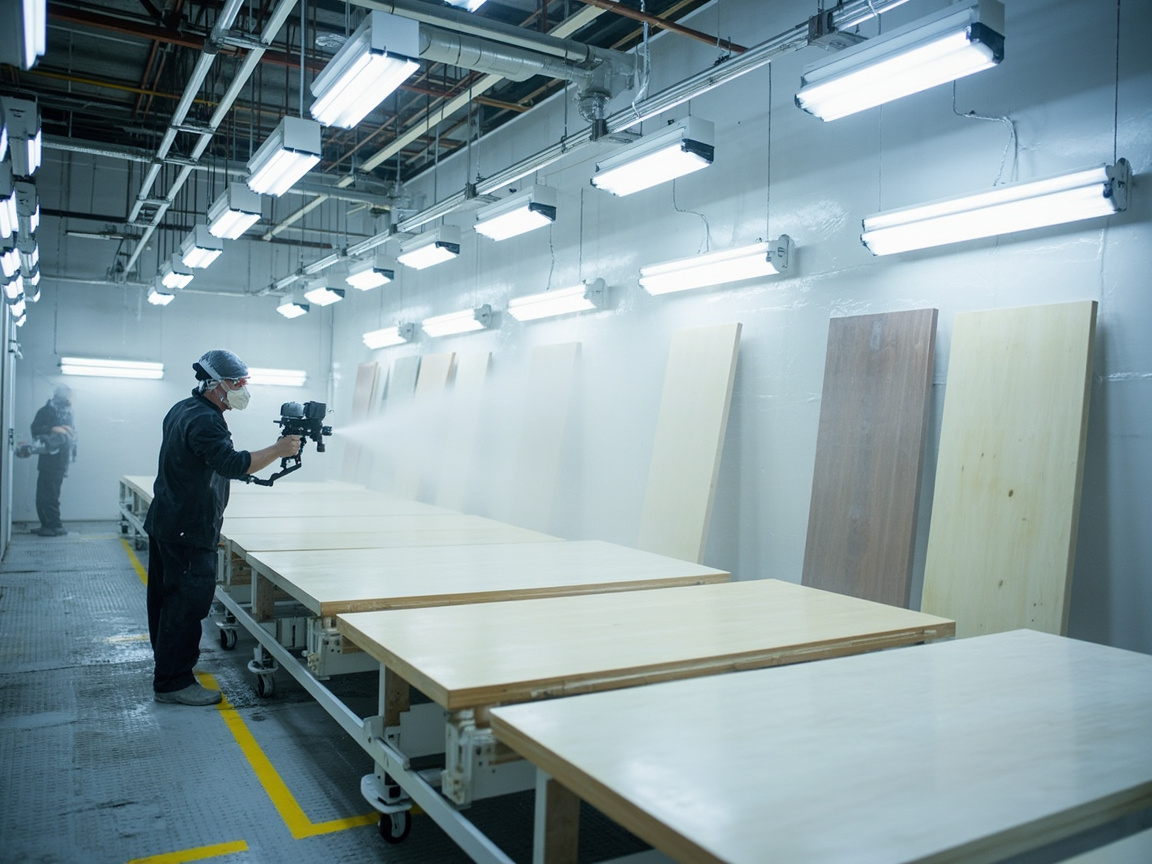
The biggest "perceived slowness" of water-based coating is in drying. Designing the drying cycle time well establishes the capacity of the entire line.
3.1 Two Stages of Drying
Water-based coating drying is divided into "water evaporation (surface dry)" and "film hard dry/crosslinking (depends on the system)." Surface dry being fast does not mean it can dry thoroughly. Many lines appear surface dry and move to the next process, but after stacking, they become damp, show press marks, and stick. Cycle time design must be based on the hard dry time of "stackable/packable," not surface dry time.
3.2 Combination of Infrared and Hot Air
Simple natural air drying on a mass production line equals suicidal scheduling. Factories commonly use combinations:
- Infrared (IR) radiation: Directly heats the workpiece, fast heating, high efficiency for thin-board wooden doors, suitable for surface dry setting, but beware of local overheating causing surface skinning and internal under-drying.
- Hot air convection: Removes moisture from the film surface, solving "surface dry inside damp," more effective for thick films and groove parts.
- Infrared + hot air gradient: First IR for fast setting, then hot air for slow dehydration—a mature combination that can compress single-pass drying from natural hours to ten to dozens of minutes, directly determining daily capacity.
Cycle time algorithm example: If single-pass effective drying requires 25 minutes (IR + hot air), and the spraying cycle time is 3 minutes/piece, then the drying section needs about 9 parallel stations (including buffer), based on which the drying oven length and conveyor speed are determined. This is the engineering logic of "cycle time reverse-deriving equipment."
3.3 Multi-Pass and Sanding Cycle Time
Water-based wood coating usually requires 2–3 passes (primer + topcoat or primer + intermediate coat + topcoat), with surface dry + light sanding needed between each pass. Treat "drying + sanding" as one cycle to calculate total cycle time, which is much longer than just looking at spraying. Custom furniture, due to small pieces and many batches, is more suitable for "small cycle multiple lines"; wooden doors, due to large pieces and flat surfaces, are suitable for "long line continuous."
IV. Constant Temperature and Humidity Environment: The Underestimated Invisible Capacity
The environmental window of water-based coating is narrower than that of solvent-based. When the temperature is below 10°C and relative humidity is above 75%–80%, water evaporation slows sharply, and even "film molding hair" (early damp blushing) occurs. Therefore, workshop environment transformation is a hard investment:
- Constant-temperature and humidity spray booth and drying area: Control spraying and drying within the window of temperature 20–30°C and humidity 50%–70%.
- Dehumidification unit: Essential in plum rain and high-humidity summer areas, otherwise the entire line directly stops during the returning spring humidity days.
- Isolation and cleanliness: Dust settling is more obvious before water-based coating surface dry; positive-pressure cleanliness in the spray booth is more critical than for solvent-based.
Many factories spend all their budget on spray guns and ignore humidity control, resulting in capacity halved for one-third of the year (wet season). Environmental control is not icing on the cake, but the "bottom-line insurance" of capacity.
V. Yield and Rework: The Real Cost Black Hole of Water-Based Lines
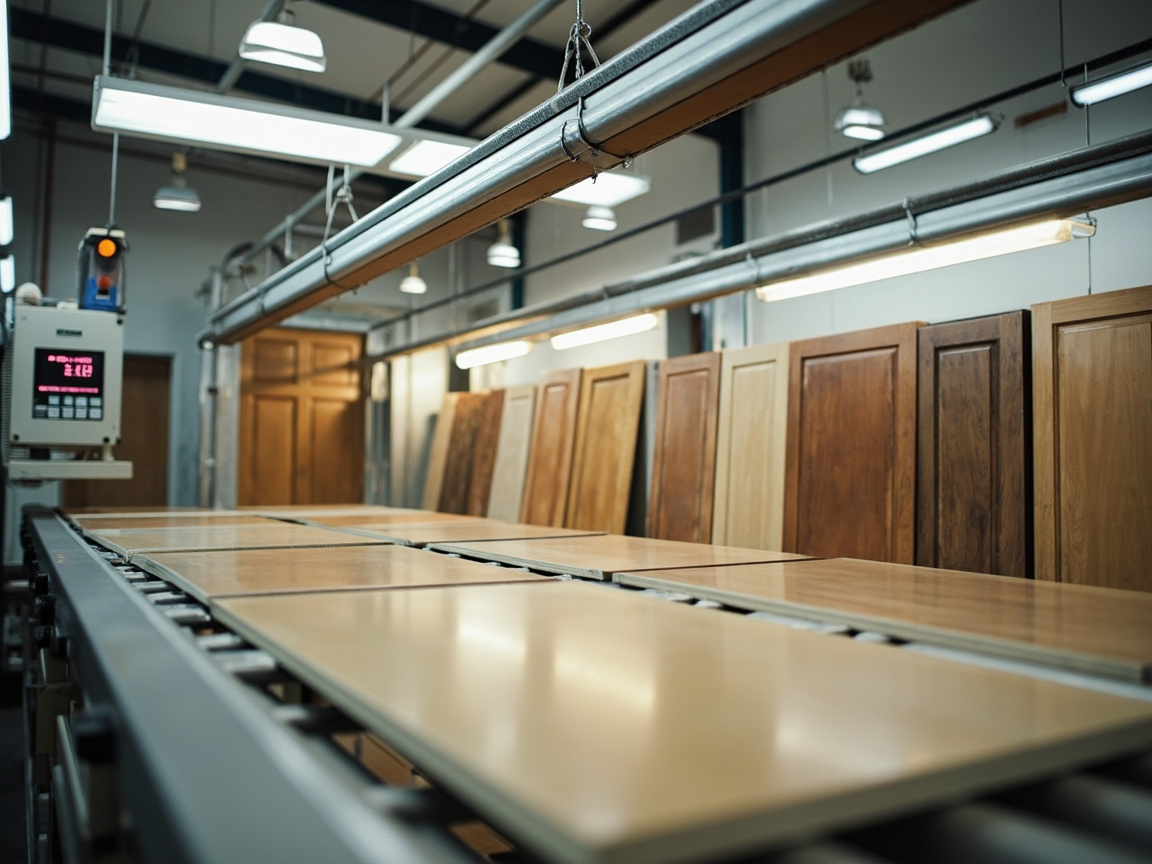
What factories fear most is not expensive materials, but "making a hundred pieces and returning twenty." Common defects and countermeasures of the water-based system:
| Defect | Typical Manifestation | Main Cause | Countermeasure |
|---|---|---|---|
| Sagging | Tear marks and accumulation at thick vertical areas | Low viscosity / large film thickness / insufficient leveling | Increase viscosity, control film thickness, adjust leveling agent |
| Orange peel | Orange peel surface, uneven | Poor atomization / too fast surface dry / improper viscosity | Switch to airless-assisted spraying, adjust volatilization gradient |
| Blushing / damp | Paint film turns white and loses transparency | High humidity low temperature moisture retention | Raise temperature dehumidify, extend drying |
| Wood grain swelling | Wood grain conduits bulge | Water causes wood to swell grain | Seal bottom first, control water, treat swelling grain |
| Cratering | Local bare-bottom pits | Oil stain / silicone pollution / surface tension | Deoil, control pollution source, add leveling |
| Particles | Sandy feel on surface | Dust, paint sludge, sanding dust | Clean spray booth, filter, light sand dedust |
| Poor adhesion | Interlayer or substrate peeling | Insufficient sanding / poor sealing / wrong matching | Standardize sanding, match sealing primer |
Yield improvement does not rely on "spraying one more pass," but on writing the control of the above variables into the SOP: use a viscosity cup for shift inspection of viscosity, environmental temperature and humidity linked alarms, incoming workpiece moisture content detection, and adhesion and gray scale board tests for each batch. Turning "human control" into "parameter control" is the only way for yield to stably ramp up.
VI. Wooden Doors, Kitchen Cabinets, Custom Furniture: Differences Among Three Types of Production Lines
| Dimension | Wooden Door Factory | Kitchen Cabinet Factory | Custom Furniture Factory |
|---|---|---|---|
| Workpiece characteristics | Large pieces, flat surfaces, medium batch | Regular door panels, suitable for electrostatic | Small pieces, many batches, many irregular shapes |
| Spraying method | Mainly air-assisted airless/roller coating | Electrostatic/air-assisted airless | Air-assisted airless + manual touch-up |
| Drying focus | Long line IR + hot air | Fast-dry oven after electrostatic | Multiple lines small circulation |
| Takt pressure | Medium | High (scale production) | High (fragmented lead time) |
| Yield pain points | Raised grain, sagging | Orange peel, particles | Irregular-shape sagging, color difference |
| Water-based difficulty | Medium | Low (regular) | High (non-standard) |
Conclusion: Kitchen cabinets, with regular workpieces, are the easiest to convert to water-based; custom furniture, being non-standard, is the most demanding on process; wood doors fall in between but have prominent raised-grain issues. The retrofit plan cannot "use one drawing for three factories"; it must be designed separately by workpiece family.
VII. Wood Moisture Content and Wood Pretreatment: The Overlooked Front-end Gate
Before water-based paint is implemented, the wood itself is a variable. Excessive wood moisture content causes cracking, raised grain, and reduced adhesion due to internal-external moisture pressure difference after spraying; too low moisture content easily leads to uneven paint absorption. Factories should make "workpiece moisture content" a mandatory incoming inspection item, recommended to be controlled at 8%–12%, and perform the following pretreatment:
- Conditioning balance: Let raw workpieces equilibrate in the workshop environment for over 48 hours to eliminate internal-external moisture difference.
- Raised-grain pretreatment: For hardwoods with obvious vessels such as oak and ash, first spray a thin mist of water or low-solid-content sealer; after raised grain appears, lightly sand with 320–400 grit, then apply formal primer, which can greatly reduce finished-product raised grain.
- Sealer matching: Water-based systems must use matching sealer to control uneven paint absorption and tannin bleed (especially tannic acid contamination of pine and oak).
- Pore filling and putty: Wood species with deep vessels should be pore-filled first so the topcoat can be flat, reducing film-thickness imbalance and sagging caused by touch-up.
If this step is not done well, no matter how good the spray gun is later, yield cannot be saved. Many factories blame the "raised grain" on the paint, but the root cause is in the wood pretreatment process.
VIII. Viscosity and Rheology: The Neglected "Invisible Parameter"
The application viscosity of water-based paint directly determines atomization particle size, leveling, and sag resistance, and is a more day-to-day variable than "which brand of paint to choose." Key points:
- Quantify with viscosity cup: Measure viscosity with a No. 4 cup before each shift starts, record and lock the target range (e.g., 25–35 s for air-assisted airless spraying), forbid "thinning with water by feel."
- Control water-thinning ratio: Water-based paint generally allows 5%–15% deionized water; excess destroys emulsion stability and causes cratering and loss of gloss; hard water (calcium and magnesium ions) also causes flocculation, so pure water must be used.
- Temperature-linked viscosity: Viscosity drops significantly for every 1℃ rise; this is where constant-temperature paint supply matters. In winter, heating instead of adding water to reduce viscosity equals accumulating risk for the next process.
- Rheology additives: Use associative thickeners to develop pseudoplasticity of "high-shear low-viscosity, low-shear high-viscosity"; good atomization during spraying and sag resistance after gun stop is a key formulation lever for yield.
Treating viscosity as a process parameter rather than the free play of the paint mixer is the watershed for a smoothly running water-based line.
IX. Engineering Parameters of Drying Oven and Workshop Layout
After takt is determined, it must be translated into equipment dimensions. A practical estimation chain:
- Target daily capacity ÷ effective working hours = required spraying takt (pieces/minute).
- Single-pass effective drying time × safety factor = drying section occupied station duration.
- Drying duration ÷ takt = number of workpieces to run in parallel in drying section.
- Workpiece spacing × parallel count = conveyor length, based on which drying oven size and IR/hot-air arrangement are determined.
In layout, it is recommended to form a U-shape or straight closed loop of "spraying—surface dry—force dry—cooling—sanding—next pass" to reduce handling and collision; set buffer cache between force-dry section and spray booth to absorb takt fluctuation. In southern high-humidity regions, the dehumidification unit capacity must be designed for the worst month, not the average, otherwise capacity is discounted for a fraction of the year.
X. Yield Digitalization: Managing the Production Line with KPIs
The difficulty of water-based lines lies in many variables; the solution is to turn each variable into a recordable KPI:
- Paint consumption per piece: Monitor coating efficiency and waste; electrostatic line should be significantly lower than air spray.
- Rework rate (by defect category): How much sagging, orange peel, raised grain each account for, to locate improvement focus.
- Viscosity stability: Fluctuation range of each shift check, reflecting whether the paint supply system is reliable.
- Environment out-of-bounds duration: Cumulative minutes of temperature/humidity exceeding window, correlated with yield fluctuation.
- Qualified drying takt: Measured stackable time vs design takt, to identify false surface dry.
Make these into a daily dashboard, review weekly during ramp-up, and in three months rework rate can be pressed from double digits to single digits. Digitalization is not formalism; it is the only path to turn "master's experience" into "factory-wide replicable standard."
XI. Regional Climate Differences: Southern Return-flow Humidity vs Northern Winter
The same water-based line has different pain points by region:
- Southern high-humidity region: Return-flow humidity and plum rain are the number-one killers; dehumidification unit capacity and operation strategy decide life or death, and the drying section must have redundancy.
- Northern winter: Low temperature is the main contradiction; workshop heating + drying section heating must be in place, otherwise water barely evaporates; meanwhile the north is dry, dust particle issues are more prominent, and spray booth cleanliness must be increased.
- Western/plateau: Low pressure affects convective heat transfer efficiency; drying oven design must be corrected by local pressure.
The retrofit plan must take "local climate extremes" as input, not copy others' drawings. Many factories copy southern peers' configuration to the north, resulting in winter shutdown, for this reason.
XII. Scheduling Connection between Water-based and Solvent-based Lines (Transition Period)
Most factories will not cut off solvent-based lines at once, but coexist long-term. Transition-period scheduling points:
- Split by product family: Regular, batch, odor-sensitive orders go water-based first; irregular, urgent, non-standard go solvent-based, gradually shifting.
- Physical isolation of spray booths: Water and oil in same workshop must prevent solvent vapor from oil contaminating water-based line (causing cratering); best to have independent spray booth and drying area.
- Dual-line personnel training: Avoid cross-line misuse, especially in paint mixing and cleaning (water-based equipment forbids residual solvent-based solvent).
- Customer communication: Clarify which products are water-based, with corresponding test reports and eco declarations, turning compliance assets into order-winning pitch.
With transition-period management in place, delivery is secured while oil is steadily reduced, avoiding the awkwardness of "fully online but unable to take orders."
XIII. Comprehensive Cost Accounting: Don't Just Calculate Material Unit Price
A common misconception is to take "water-based paint unit price ÷ paint unit price" as the conclusion, judging water-based as more expensive. Factories should calculate the total cost per qualified piece (TCO):
- Material cost: Water-based paint unit price may be higher, but solid content, hiding power, and coating efficiency (high utilization under electrostatic) dilute it; compare by "paint consumption per piece" not "price per kg."
- Energy cost: Drying oven, dehumidification, constant temperature are new electricity fees, but solvent-based line also has exhaust treatment electricity; compare net.
- Labor and rework: After SOP of water-based line, rework rate drops, implicitly saving much labor and scrap.
- Line depreciation: Spray booth, drying oven, constant temp/humidity, paint supply system investment amortized per piece.
- Compliance and orders: The order-taking ability and exemption from production limits brought by water-based are hard-to-account but real benefits.
Most factories after running smoothly will find: material per piece slightly up, but rework rate from double digits to single digits, order premium and production-limit exemption covering retrofit depreciation, comprehensive cost actually controllable or even down. The key is "running smoothly"—this is exactly the value of process matching.
XIV. Implementation Roadmap: Phased Ramp-up
Not recommended to "cut all at once" full-line water; a steadier path is:
- Sampling and product-family screening: First select regular, large-batch product families (e.g., flat cabinet door panels) for water-based pilot.
- Small-line validation: Build a constant-temp/humidity small line, run through viscosity, drying, yield SOP, precipitate process cards.
- Key equipment completion: Based on takt, add air-assisted airless/electrostatic, IR+hot air, dehumidification and paint supply.
- Mass-production ramp-up: After yield stable, expand to wood doors, custom non-standard pieces, gradually replace solvent-based line.
- SystemCuring: Write "primer—intermediate coat—topcoat" matching, process cards, check tables into enterprise standard, reduce dependence on people.
For enterprises weighing both efficiency and eco-friendliness, flat pieces can also simultaneously evaluate UV curing wood coatingIn application on batch lines, use irradiation instant curing to bypass the beat bottleneck of "slow water evaporation"; for topcoat layers with high requirements for hardness and wear resistance, you can still refer to the polyurethane wood coating (PU wood coating) matching approach for clear coat.
15. Collaboration with Kexin New Materials
Kexin New Materials (kexinMaterials) provides not just paint but a package of "formulation + process card + ramp-up on-site support" in the above implementation paths: offering sealing and grain-raising treatment solutions for the wood door grain-raising problem, low-resistance water-based formulations for cabinet electrostatic lines, and multi-scenario systems with adjustable viscosity for custom non-standard parts. Its value lies not in the performance parameters of a single can of paint, but in aligning the four things of "line body—environment—process—coating" so that the factory stabilizes yield and beat with a replicable SOP.
It is recommended that the factory, before starting the transformation, organize "workpiece family list, target beat, existing spray booth and drying conditions, local temperature and humidity extremes, order compliance requirements" into a requirements table, and conduct a joint process review with the supplier, rather than buying paint first and then figuring out a way. This is also the implementation method verified by Kexin New Materials in multiple furniture OEM projects, which turns water-based conversion from "trial and error" into "calculated".
16. Common Selection and Ramp-up Misconceptions
Misconception 1: Water-based paint is just expensive and doesn't pay off. The mistake is only comparing material unit price. Including rework, order intake, production limits, and net energy cost into TCO, many projects are cost-effective.
Misconception 2: Buying the best spray gun solves everything. The spray gun is only one link; constant temperature of paint supply and circulation, drying beat, and constant humidity environment equally determine success or failure.
Misconception 3: Natural air drying is sufficient. Natural air drying on a mass production line means capacity collapse; a combination of IR + hot air + dehumidification is mandatory.
Misconception 4: One set of parameters for all workpieces. The workpiece families of wood doors, cabinets, and custom furniture differ greatly and must be processed with family-specific processes.
Misconception 5: Yield relies on the master's feel. The water-based system has many variables and must be parameterized and SOP-ized, otherwise changing personnel causes failure.
Misconception 6: Wood pretreatment is optional. Moisture content and grain-raising pretreatment directly determine adhesion and surface smoothness; skipping this step cannot be saved by even the best paint.
17. Quantitative Checklist for Renovation Acceptance
Whether the water-based line renovation is successful should be accepted with a set of deliverable quantitative indicators, rather than "looks okay". It is recommended to write the following checklist into the acceptance form: qualified paint consumption per piece, measured stackable time in drying section, monthly average rework rate (by defect category), cumulative duration of environmental out-of-bounds, total cost per qualified piece (TCO) compared to baseline. Only when these numbers meet the standard is the renovation considered running smoothly; otherwise, one should trace back which parameter of the line body, environment, or process card is out of control. Turning acceptance from "feel" into "data" is the last barrier for water-based conversion from trial production to stable mass production, and can also provide a replicable baseline template for subsequent line expansion.
FAQ
1. For furniture factories adopting water-based lines, where is the biggest capacity bottleneck?
In the drying beat. Water-based coating forms film by water evaporation; natural air drying is extremely slow and sensitive to humidity. Mass production must rely on infrared + hot air combination and constant temperature and humidity environment to stably remove water, otherwise the entire line beat is locked by the drying section.
2. Among wood doors, cabinets, and custom furniture, which is most suitable to adopt water-based first?
Cabinet door panels are regular, can be electrostatic, and easy to batch, most suitable for water-based pilot; custom furniture has many non-standard parts and is the hardest; wood doors are in between but have prominent grain-raising issues. It is recommended to start from regular parts and then expand to non-standard parts.
3. The unit price of water-based paint is higher than paint, how should the factory calculate fairly?
Calculate by total cost per qualified piece (TCO): include paint consumption per piece, net energy cost, rework rate reduction, line depreciation, order intake and production-limit-free benefits, rather than just comparing price per kg of paint. After running smoothly, the comprehensive cost is often controllable or even lower.
4. Without a constant temperature and humidity workshop, is it okay to only produce in dry seasons?
Very risky. High humidity and low temperature will cause water-based coating to regain moisture and turn white, and drying stalls; capacity may be halved in humid season. In the long run, dehumidification and constant temperature must be equipped to lock the environmental window, so capacity has a floor.
5. What should be noted for electrostatic spraying of water-based coating?
The conductivity of water-based coating needs special resistance adjustment to match electrostatic equipment; a low-resistance water-based formulation and electrostatic-specific process must be paired, otherwise transfer efficiency is low and breakdown occurs easily. Equipment and coating must be selected synchronously.
6. If the yield of the water-based line cannot go up, what to check first?
Check in order: whether viscosity is checked per shift, whether environmental temperature and humidity are out of bounds, whether workpiece moisture content is qualified, spray booth cleanliness, and whether primer sealing and matching are correct. Most problems come from "parameter out of control" rather than the coating itself.
7. How to schedule beat for multi-coat painting?
Treat "drying + sanding" as a cycle to calculate total beat, rather than just looking at spraying. Water-based usually requires 2–3 coats, each needing surface dry + light sanding between coats; custom furniture suits small-cycle multi-line, wood doors suit long-line continuous.
8. Must the renovation go fully water-based on the entire line?
Not necessarily. More stable is phased: first validate with regular-part small line, precipitate process card, then supplement key equipment, ramp up mass production, and finally expand to non-standard parts. A一刀切 (one-size-fits-all) approach easily causes excessive loss during ramp-up.
9. How to solve the grain-raising problem?
Water is the main cause of grain raising. The countermeasure is to first do sealing to reduce water penetration, do grain-raising pretreatment (first lightly spray water mist, wait for swelling then light sand), control construction water amount and film thickness, and select a water-based primer with good sealing in primer matching.
10. How to choose between water-based and UV curing?
For flat, batch, regular parts, prioritize UV curing: irradiation instant film formation, extremely high efficiency, low VOC; for irregular, non-standard, small-batch parts, water-based spraying is still suitable. Combination is also possible: water-based for base and irregular parts, UV for flat topcoat.
Further Reading
- Formulation Science and Application Implementation of Water-based Wood Coatings: A full explanation of wood water-based conversion from resin system to application implementation, supplementing the technical base of "line body—coating" alignment in this article.
- UV Curing Wood Coatings — Efficiency, Environmental Friendliness and Process Boundaries: An efficient alternative for flat-part mass production, suitable for factories wanting to bypass the water-based drying beat bottleneck.
- Green Transition of Industrial Coatings: Policy, Market and Implementation Paths: Places furniture factory water-based conversion into a larger green transition framework to understand the long-term logic of order intake and compliance.
- Application of Nano Coating on Wood and Plastic Surfaces
- Nano Antibacterial Coating: Ag, ZnO Particles and Antibacterial Mechanism