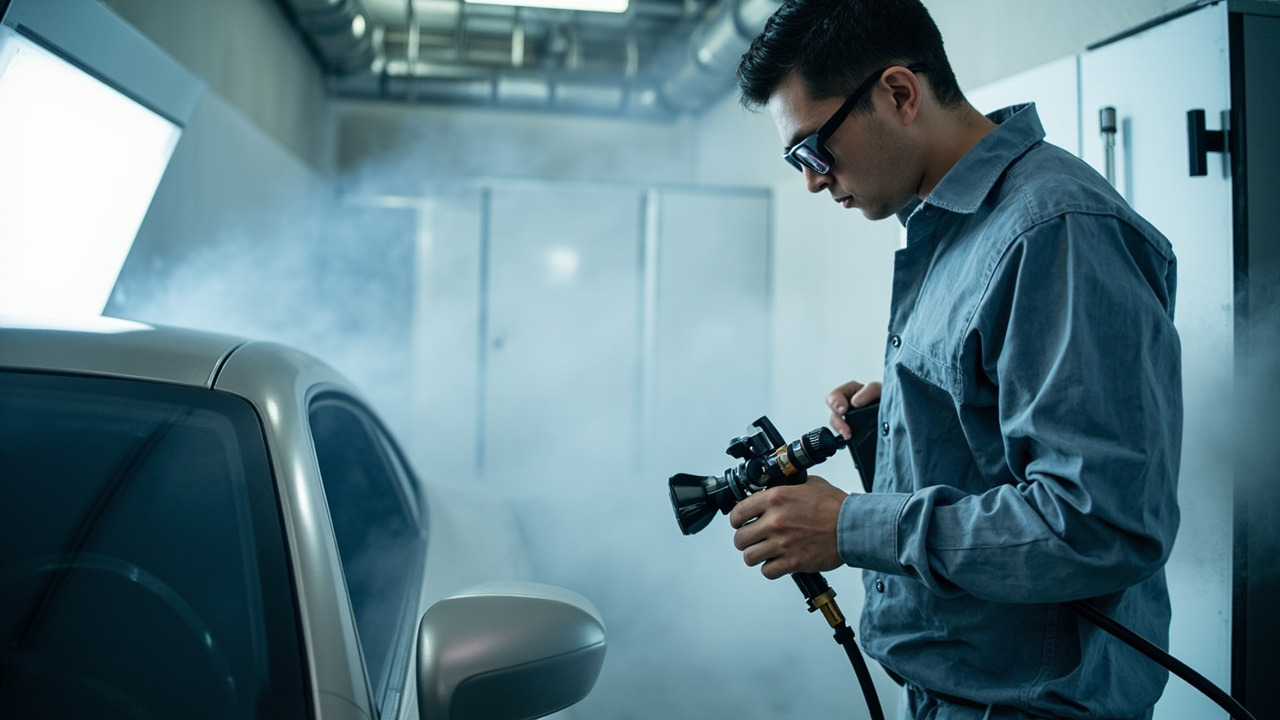
The final effect of automotive coating is 30% paint and 70% spraying. Even the best 2K clear coat or basecoat, when applied with a spray gun whose parameters are not properly adjusted, will end up with orange peel, sagging, particles, or uneven film thickness. Many refinishers attribute quality problems to "bad paint", yet overlook the real leverage—application equipment and spray gun parameters: nozzle orifice, inlet air pressure, HVLP transfer efficiency, DIN4 viscosity, and the long-neglected temperature, humidity, and equipment cleaning.
As a technical supplier of automotive coatings and painting equipment, Kexin New Materials (kexinMaterials) delivers matching spray gun parameters and process cards along with the coatings. This article follows the main thread of "equipment—parameters—environment" to thoroughly explain equipment selection and key parameters for automotive paint spraying. All values are cited from real TDS and general application specifications in the research archive.
I. Overview of Spray Equipment: From Spray Gun to Compressed Air System
A complete set of automotive paint spray equipment includes at least four parts:
- Spray Gun: Atomizes the coating and deposits it directionally onto the workpiece surface; it is the core of parameter control.
- Compressed Air System: Air compressor + air receiver + refrigerated dryer + oil-water separator + pressure regulator, providing clean, dry, and stable-pressure air source.
- Viscosity and Film Thickness Measurement Tools: DIN 4 viscosity cup, wet film gauge, dry film thickness gauge.
- Auxiliary and Protection: Spray booth, ventilation, supplied-air respirator, cleaning equipment.
Automotive refinishing mainly uses air spray (including HVLP), while high-volume OEM lines use electrostatic rotary bells or robots. This article focuses on the most commonly used air spray equipment for refinishing and small-to-medium batches—especially HVLP spray gun parameter settings. For application配套 of industrial protective paint, refer to How to Select Water-Based Industrial Coatings: Resin Systems and Applicable Conditions.
II. Core Spray Gun Parameter Comparison Table
The table below summarizes the spray gun and spraying parameters given in the automotive 2K clear coat TDS from the research archive, supplemented with general application specifications. All values retain units and sources.
| Parameter | AkzoNobel 288 HS | Axalta LV9714 | GM/BASF Reference | Engineering Meaning |
|---|---|---|---|---|
| Nozzle orifice | 1.2–1.4 mm | HVLP 1.3–1.4 mm | 1.2–1.4 mm (clear coat general) | Clear coat has high viscosity; too small orifice clogs easily, too large sags easily |
| Inlet air pressure | 1.7–2.2 bar | — | 1.7–2.2 bar ≈ 25–32 PSI | Supply air pressure, determines atomization power |
| HVLP cap-end pressure | ≤ 0.7 bar (≈10 PSI) | 6–8 PSI | ≤ 0.7 bar is HVLP defined upper limit | Low cap-end pressure is key to high transfer efficiency |
| Spray viscosity (DIN 4 @20℃) | 13–16 s | Not listed separately | 13–21 s (incl. BASF 18–21 s) | Uncontrolled viscosity directly determines orange peel/sagging |
| Common spray pressure (gauge) | — | — | 13–26 PSI | Practical pressure window, follow TDS |
| Spray method | Air spray/HVLP | HVLP | HVLP preferred | High-solid systems suit HVLP |
This table is the "baseline" for equipment selection. Each column is expanded below.
It must be emphasized that the pressures in the table involve two measurement points: those marked "bar" are mostly inlet (supply) pressure, while those marked "PSI" with values around 10 are cap-end pressure—they are not at the same location and must not be mixed. When reading the table, first confirm whether your pressure gauge is connected at the gun tail or the air cap, then refer to the corresponding column; otherwise "adjusting pressure by the table" will actually be wrong. Many on-site disputes ("adjusted per TDS but still orange peel") root from measurement point misalignment, not from paint or gun issues.
III. HVLP Principle: Why Cap-End Pressure ≤0.7 bar
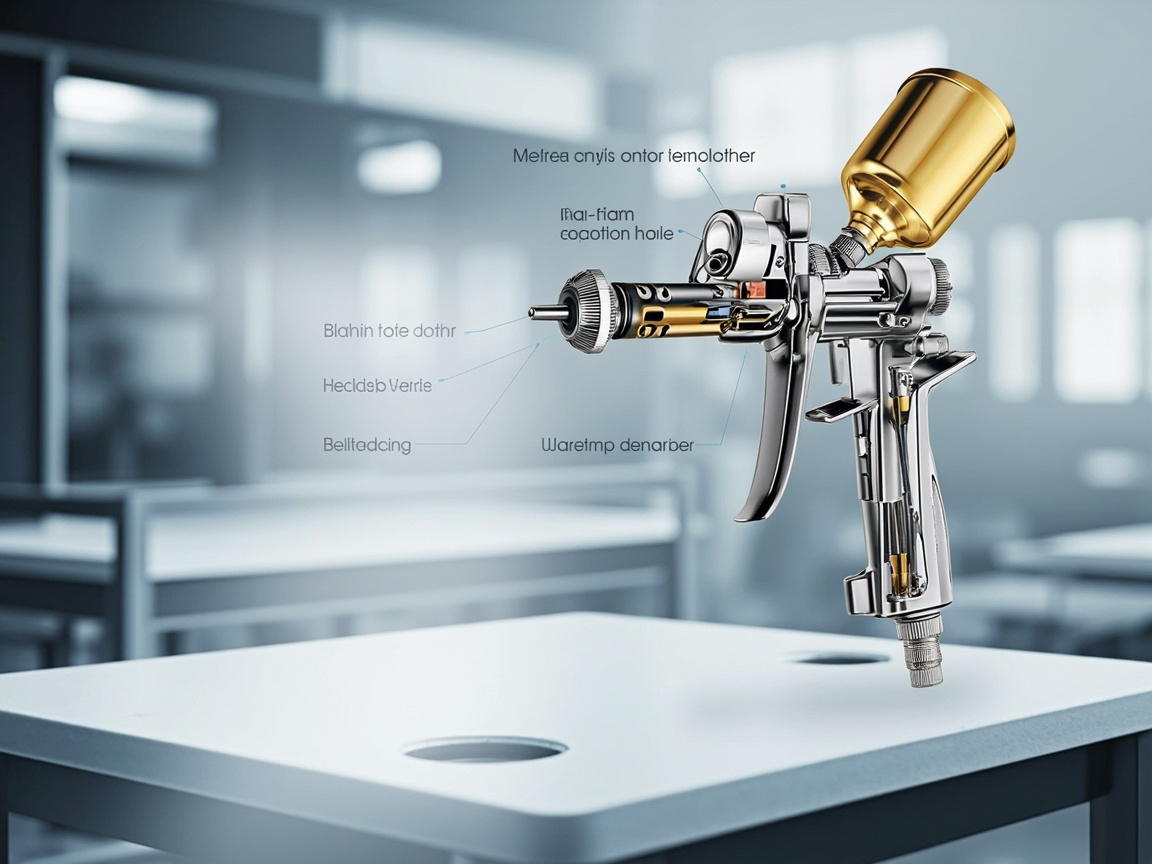
III. HVLP Principle: Why Cap-End Pressure ≤0.7 bar
HVLP is the abbreviation for High Volume Low Pressure. Its core definition is: the pressure at the air cap does not exceed 0.7 bar (about 10 PSI), relying on "high volume, low pressure" compressed air to atomize the coating and gently transport it to the workpiece.
Traditional spray guns can have cap-end pressure of 2–3 bar or higher; the coating is "slammed" onto the workpiece by high-pressure airflow, with large amounts of overspray rebounding and drifting, and coating transfer efficiency (TE, paint-on rate) only 30%–50%. After HVLP reduces cap-end pressure to ≤0.7 bar:
- Low overspray velocity, less rebound, transfer efficiency increased to 65%–85%;
- Same film thickness with less paint, saves paint, reduces cost;
- Less drifting overspray, spray booth pollution and VOC emissions drop in sync, more compliant;
- Coating surface smoother, lighter orange peel.
The research archive clearly records: AkzoNobel 288 HS requires "inlet air pressure 1.7–2.2 bar (HVLP cap-end ≤0.7 bar)"; Axalta LV9714 notes "HVLP 1.3–1.4 mm, cap-end 6–8 PSI". Note the difference—1.7–2.2 bar is inlet (supply) pressure, at the regulator/gun tail; ≤0.7 bar (6–8 PSI) is cap-end (at air cap) pressure, at the atomization point. The value of HVLP lies entirely in "low cap-end", not low inlet. Many technicians adjust inlet pressure as cap-end pressure, resulting in no change in the physical essence of atomization—neither saving paint nor reducing emissions.
Supplement: Common spray pressure (gauge) in the 13–26 PSI range is also a pragmatic application window, but must correspond to the specific TDS measurement point; across brands and coatings, follow that product's TDS notation, and never confuse "inlet PSI" with "cap-end PSI".
IV. Nozzle Orifice: How to Choose 1.2–1.4 mm
Clear coat has higher viscosity than basecoat, so nozzle orifice is generally smaller. The research archive gives:
- AkzoNobel 288 HS: 1.2–1.4 mm;
- Axalta LV9714: HVLP 1.3–1.4 mm.
Logic for choosing orifice:
- 1.2 mm: Suits thinner, high-solid or fine spray; fine atomization but low paint output, good for small parts, patches;
- 1.3–1.4 mm: Mainstream for clear coat, balancing output and atomization; most 2K high-gloss clear coats fall in this range;
- Larger orifice (≥1.6 mm) for intermediate coat, primer and other thicker, higher-output coatings; not suitable for clear coat (easy sagging).
Also consider the spray gun's "atomization hole/fluid hole" ratio and fan adjustment. Same orifice, different gun models, atomization shape varies greatly; it is recommended to fix one validated gun model and needle-nozzle combo to avoid frequent changes causing film thickness fluctuation.
V. Inlet Pressure and PSI Conversion: Don't Confuse Inlet with Cap-End
As emphasized earlier, inlet pressure (gun tail/regulator) and cap-end pressure (air cap) are two concepts. Conversion: 1 bar ≈ 14.5 PSI.
- AkzoNobel 288 HS inlet 1.7–2.2 bar ≈ 24.6–31.9 PSI;
- HVLP cap-end ≤ 0.7 bar ≈ 10 PSI (Axalta measured 6–8 PSI).
Practical suggestions:
- Install precision regulator + oil-water separator between compressor outlet and gun; connect pressure gauge at gun tail to read inlet pressure in real time;
- Use HVLP dedicated air cap, confirm cap-end pressure not exceeding 0.7 bar (verify with cap-end pressure gauge);
- Too low pressure → poor atomization, coarse particles, poor leveling; too high pressure → more overspray, large rebound, loses HVLP meaning, and may erode wet film;
- Before each start, use "spray panel test" to calibrate: spray on a scrap panel at set pressure, observe atomization fan and leveling, then proceed to workpiece.
For environmental coordination of coating drying and curing, read further at Drying and Curing Principles of Water-Based Paint, and its temperature–reaction logic also applies to solvent-based 2K systems.
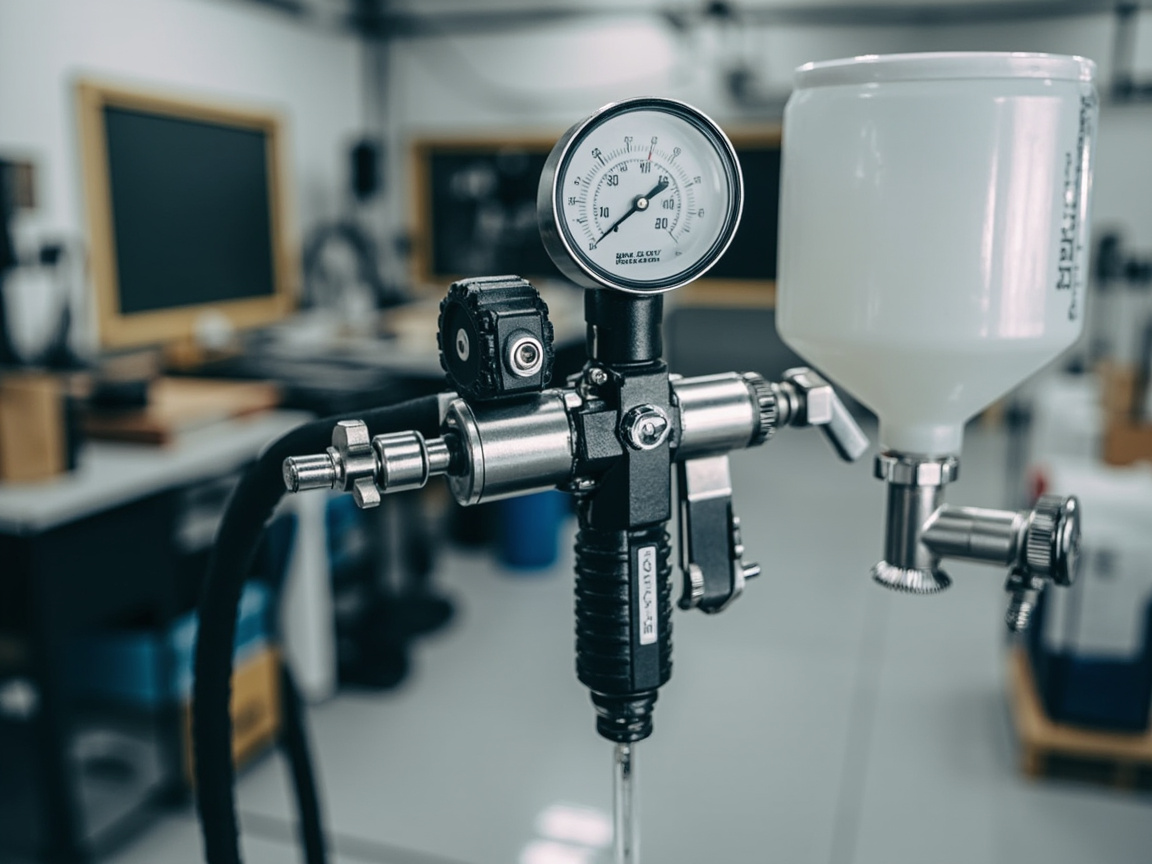
VI. DIN4 Viscosity: 13–21s Is the Golden Window for Varnish
Viscosity determines atomization and leveling; automotive varnish is commonly measured with a DIN 4 cup (20℃) for outflow time. Varnish viscosities given in the research archive:
- AkzoNobel 288 HS: 13–16 s;
- BASF 923-666: 18–21 s.
Combined, 2K varnish spray viscosity mainly falls in the 13–21 s (DIN 4 @20℃) range. Why it must be controlled within this window:
- < 13 s too thin: sagging, insufficient film thickness, easy to show substrate, uneven gloss;
- > 21 s too thick: coarse atomized particles, heavy orange peel, difficult to release bubbles, poor leveling.
Viscosity measurement iron rules:
- Same cup type: DIN 4, Ford #4, and Zahn cup outflow times are not directly comparable; the same standard must be used;
- Same temperature: for every 1℃ rise, outflow time shortens significantly; TDS always marks @20℃, site must control temperature or convert;
- Same technique: cup must be level, filled, and hole-plugged release timing consistent.
Thinner addition directly affects viscosity—AkzoNobel 288 HS with 10% 810 thinner falls to 13–16 s; BASF 923-666 high solids (50–55%) needs no thinner and is already 18–21 s. This shows "how much thinner to add" is not free play, but to push viscosity into the TDS window.
VII. Spray Gun Type Selection: Gravity, Siphon, Pressure-Feed
By feed method, automotive refinish spray guns are divided into three types:
- Gravity (top cup): paint cup on gun, feeds by gravity, stable output, saves paint on cleaning, best for refinish and small/medium parts, mainstream for HVLP conversion;
- Siphon (bottom cup): paint cup below gun, draws paint by airflow negative pressure, sensitive to viscosity, high air consumption, still used in traditional refinish;
- Pressure-feed (independent paint tank/pump): feeds paint by external pressure, suitable for high-volume, continuous spraying (OEM lines, intermediate coat), high output.
Varnish refinish prefers gravity HVLP, reason: cap-end low pressure + gravity feed, highest transfer efficiency, most economical cleaning, most stable film thickness. Pressure-feed is left for intermediate coat/primer high-output conditions.
VIII. Coating Equipment Cleaning: An Underestimated Quality and Compliance Step
Spray gun cleaning is not "just rinse it clean", but a key process affecting next spray quality and VOC emissions. Discipline as follows:
- Clean immediately: disassemble gun soon after stopping, residual 2K paint crosslinking in gun clogs nozzle and needle valve, causing deformed atomization next time;
- Stepwise solvent wash: flush cup, channels, air cap with matching thinner/cleaner; use dedicated needle for air cap holes (do not use steel wire to poke hard, destroys geometry);
- Cap-end blow-through: low-pressure air to blow clean air cap holes, ensure atomization holes symmetric;
- Waste liquid collection: cleaning solvent is hazardous waste, must be collected in sealed container, disposed as hazardous waste, prohibited from pouring into sewer (VOC and heavy metal pollution);
- Daily maintenance: check seal O-rings, needle valve wear, replace regularly, prevent air leak causing unstable pressure.
Solvent volatilization during cleaning is a hidden source of spray booth VOC. Using HVLP + standard cleaning can lower both overspray and waste liquid, substantially helping pass GB 24409-2020 vehicle coating VOC review.
IX. Temperature, Humidity and Dew Point: Overlooked Invisible Parameters
Paint atomization is only the beginning; whether the film cures intact depends heavily on environment. The industrial coating application spec in the research archive gives general boundaries: temperature 5–35℃, relative humidity ≤ 80%, substrate temperature above dew point by 3℃. Although automotive refinish is high-solids, boundary principles are consistent:
- Too low temperature (< 15℃): 2K crosslinking extremely slow or non-curing, varnish soft, poor leveling;
- Too high temperature (> 30℃): surface dry too fast, orange peel, bubbles, and violent solvent evaporation, high VOC peak;
- Too high humidity (> 70%–80%): —NCO reacts with water first, producing amine by-products, bubbles, gloss loss, this is "moisture-cure blushing";
- Dew point trap: substrate temperature must be above dew point by 3℃ or more, otherwise condensation on workpiece surface, film will definitely be mottled and peel.
Spray booth should be equipped with thermo-hygrometer and dew point calculation table, confirm three items meet standard before start. For high-moisture plastic parts, old paint surfaces, pre-bake dehumidification is needed. Temperature and humidity are "free parameters"—cost nothing to adjust, yet decide success or failure.
X. Safety and Ventilation: Isocyanate Protection Cannot Be Omitted
Automotive 2K varnish hardener contains HDI isocyanate; booth concentration during spraying can exceed OSHA PEL (HDI PEL = 0.02 ppm) by 50–100 times. The MSDS section of the research archive gives hard requirements:
- Respirator: half-mask APR + OV/P100 cartridge (minimum); recommended full-face APR or PAPR (OV/HEPA);
- Gloves: nitrile gloves ≥ 8 mil, latex ineffective;
- Goggles: full-face mask also protects eyes;
- Ventilation: booth ventilation alone cannot lower concentration below PEL, respiratory protection still needed;
- Prohibitions: no sanding/welding of uncured film; replace cartridge when smell detected or every 8 h.
At equipment level, booth must have effective intake/exhaust and paint mist filtration; supplied-air respirator source must be from clean zone not booth return air. Safety equipment is not optional accessory, but "application equipment" equally important as spray gun.
XI. Turning Parameters into Process Card: Kexin's Supporting Approach
Kexin New Materials (kexinMaterials) when delivering automotive paint, habitually writes "equipment parameters" into a replicable process card, rather than letting technicians adjust by experience. A typical varnish spray process card includes:
- Spray gun model and tip: HVLP, 1.3 mm (varnish);
- Inlet pressure: 1.8–2.0 bar; cap-end: ≤0.7 bar (verified);
- Viscosity: DIN 4 @20℃, 14–18 s (per product TDS);
- Fan and output: medium-speed overlap spray, 1.5–2 wet coats;
- Film thickness: DFT 40–60 µm (thickness gauge spot check);
- Environment: 18–25℃, RH ≤ 70%, substrate above dew point 3℃;
- Drying: 60℃ bake 30 min or ambient leveling then corresponding cure;
- Cleaning: clean immediately after stop, waste liquid recovered.
Bundling "paint + process card + equipment parameters", refinish shops can turn "master's feel" into "rookie can stably produce results" standard operation, this is exactly the value of system suppliers versus "only sell paint". For lines doing oil-to-water or low VOC upgrade, this support is especially critical.
XII. Common Equipment Mismatches and Troubleshooting
| Phenomenon | Most Likely Cause | Countermeasure |
|---|---|---|
| Heavy orange peel | Viscosity too high / pressure too low / tip too small | Adjust viscosity to TDS window, raise cap-end compliant pressure |
| Sagging | Viscosity too low / film too thick / output too high | Reduce thinner, control DFT 40–60 µm |
| Coarse particles | Insufficient atomization pressure / paint unfiltered / dirty gun | Raise atomization, add filter, thoroughly clean gun |
| Large overspray, waste paint | Non-HVLP / cap-end pressure exceeded | Switch to HVLP, control cap-end ≤0.7 bar |
| Blushing gloss loss | High humidity / insufficient dew point / NCO meets water | Lower humidity, keep dew point 3℃, control environment |
| Gun clog | 2K paint crosslinked in gun / cleaning not timely | Clean immediately after stop, needle clear holes |
| Uneven film | Uneven gun speed / crooked fan | Fix gun distance and speed, calibrate fan |
XIII. Spray Technique: Gun Distance, Speed and Overlap Rate
Equipment tuned, technique decides uniformity. Three elements:
- Gun distance: varnish usually 15–20 cm (about one and a half forearm), too close causes sagging and paint buildup, too far causes dry spray roughness;
- Gun speed:Move at a constant speed, about 30–50 cm/s; too fast results in a thin film, too slow causes sagging;
- Overlap rate: adjacent passes overlap by 50% (i.e., each pass covers half of the previous one) to ensure uniform film thickness without lap marks;
- Angle: the gun body should always be perpendicular to the workpiece surface; an oblique angle causes thin film on one side and a skewed fan pattern.
The rhythm of gun movement is solidified into muscle memory through "spray panel practice". With the same gun and the same set of parameters, different technicians can produce DFT differences of more than 10 µm, indicating that technique is the second largest variable besides equipment.
14. Compressed Air Quality: Oil-Water Separation and Cleanliness
The medium for spray gun atomization is compressed air, not the paint itself—therefore, the cleanliness of the air source directly determines the cleanliness of the paint surface. Three common types of contaminants in compressed air:
- Water: condensate causes blushing of the paint film and reduced adhesion; a refrigerated dryer must be installed to lower the pressure dew point below the process requirement;
- Oil: compressor oil mist causes craters and fish eyes; a high-efficiency oil separator (≤ 0.01 mg/m³ level) is required;
- Particles: pipeline rust debris and dust cause particles; precision filtration + regular drainage is required.
It is recommended to install a three-stage setup of "pressure regulator + oil-water separator + particle filter" before the gun, connect a pressure gauge at the gun tail, drain weekly and replace filters regularly. Many "inexplicable particles and craters" are rooted in the air source rather than the paint.
15. Electrostatic Spraying and Rotary Bell: From an OEM Perspective
Refinishing mainly uses HVLP air spray guns, but OEM mass production lines generally use electrostatic rotary bell / rotary disc—the coating is centrifugally atomized at the high-speed rotating bell edge and charged with static electricity, the grounded workpiece attracts it, transfer efficiency can reach over 90%, and the paint mist is directional with extremely uniform film thickness. Its parameter logic differs from that of air spray guns: focus on rotation speed (rpm), shaping air, electrostatic voltage (kV), flow rate (cc/min), rather than simply air pressure.
For refinishing shops, understanding OEM processes helps to understand "why the original factory paint surface is so uniform"—that is an equipment-level difference, not magic of the paint. To approach OEM texture in refinishing, HVLP + standardized technique is already the most cost-effective solution; blindly pursuing rotary bell-level equipment is uneconomical for small repairs.
16. Transfer Efficiency and Cost Accounting
The economic value of HVLP can be quantified by transfer efficiency (paint-on rate):
- Traditional spray gun: 30%–50%, over half of the paint mist becomes waste overspray;
- HVLP: 65%–85%;
- Electrostatic rotary bell: 90%+.
Taking one liter of mixed clear coat (covering about 7–12 m² at approx. 50–60 µm DFT) as an example, increasing transfer efficiency from 40% to 80% directly halves the paint used for the same workpiece; the saved paint cost can cover the price difference of an HVLP gun within a few months. Coupled with the reduction of waste liquid leading to lower hazardous waste disposal costs and VOC compliance benefits, HVLP is a rare choice that is "both money-saving and compliant".
17. Spray Gun Selection Decision Checklist
Turn the preceding text into a checkable list, and verify item by item before procurement:
- Coating type (clear coat/basecoat/intermediate coat) → determines nozzle size (clear coat 1.3–1.4 mm);
- Whether HVLP → confirm cap-end ≤0.7 bar, not just low inlet air;
- Feed method → choose gravity-fed for refinishing, pressure-fed for mass production intermediate coat;
- Air source capability → can the compressor displacement support HVLP high flow;
- Viscosity window → can DIN 4 @20℃ stably stay at 13–21 s;
- Environment → are temperature/humidity/dew point controllable within specifications;
- Cleaning and waste liquid → is there a hazardous waste recycling channel;
- Budget → include the paint savings from transfer efficiency into the total account.
Selecting based on this checklist is more reliable than "buying the most expensive gun from advertisements".
18. Spray Booth Design and Air Exchange Rate
No matter how good the spray gun is, it also relies on the spray booth as the "big equipment". A qualified automotive spray booth must at least meet:
- Slight positive pressure: clean air is supplied downward from top filtration and exhausted from the floor trench to avoid backflow of external dust;
- Air exchange rate: usually more than 10–20 times per hour, ensuring overspray paint mist and solvent vapor are promptly removed, with concentration below the lower explosive limit and occupational exposure limit;
- Controllable temperature and humidity: equipped with air conditioning and dehumidification to stabilize the environment at 18–25℃, RH ≤ 70%, and maintain substrate 3℃ above dew point;
- Paint mist filtration: floor filter / paper box filter captures overspray, replace regularly to prevent clogging causing negative pressure and dust on paint surface;
- Lighting: shadowless lighting above 500–1000 lux, to facilitate discovery of orange peel, sagging, particles.
The spray booth is an "invisible construction parameter". Many refinishing shops spend heavily on guns but ignore booth air exchange and dehumidification, resulting in paint surface cleanliness and curing stability never improving—equipment investment must be balanced, not just focused on the spray gun.
19. From Experience to Data: Clarifying the Cost
Calculating the account of HVLP and standardized process to the end is a win-win for society and the factory. Taking a refinishing shop that sprays 200 panels per month as an example (illustrative caliber, not precise quotation):
- Traditional gun transfer efficiency 40%, each panel consumes about 0.4 L of mixed clear coat;
- After switching to HVLP, efficiency 80%, same coverage only 0.2 L per panel;
- Save 40 L of paint per month, based on mixed clear coat unit price, equipment price difference is recouped within months;
- Hazardous waste cleaning solvent is halved simultaneously, disposal cost and compliance risk both drop;
- VOC overspray reduced, easier to pass GB 24409-2020 review, avoiding production restriction losses.
This shows that construction equipment is not a "cost center" but a "profit and compliance lever". When selecting, evaluate equipment, paint, process, and waste liquid as a package to get the true total cost of ownership (TCO), rather than just looking at the gun's price tag.
20. Daily Inspection and Quick Troubleshooting of Spray Guns
Equipment stability relies on daily inspection, not repair after breakdown. It is recommended to do a five-minute inspection before each shift:
- Air source: is the pressure regulator pressure within the TDS range, is the oil-water separator accumulated with water, is the filter dirty;
- Gun body: is there worn nozzle/needle valve leaking paint, are the air cap holes unobstructed and symmetrical;
- Cup and hose: paint cup seal, hose no blockage no leak;
- Atomization test: spray a pass on a waste panel, see if the fan is symmetrical, any skewed spray;
- Protection: is the respirator filter within validity, any glove breakage.
Common fault quick check:
| Fault | Possible cause | Quick action |
|---|---|---|
| Slanted fan | Half-clogged air cap hole | Clear hole with needle, blow through at low pressure |
| Intermittent paint output | Needle valve stuck / cup vent clogged | Clean needle valve, clear cup cap vent hole |
| Sudden coarse atomization | Inlet pressure drop / cup clog | Check pressure regulator and air source displacement |
| Gun body air leak | Seal ring aged | Replace O-ring |
| Paint drip / tear | Paint accumulated at gun tip | Wipe gun tip, reduce paint output |
| Thick center thin edges in spray pattern | Center hole and corner hole imbalance | Calibrate air cap, check air pressure |
Post the inspection and quick-check table on the spray booth wall, even newcomers can troubleshoot by the diagram, reducing dependence on "old masters". This is also the minimal cost investment to shift construction from experience-driven to data-driven.
21. Recording and Traceability of Construction Parameters
Quality is "recorded". The spraying of each panel should leave a minimal data set: date, temperature/humidity, dew point, spray gun model and nozzle size, inlet/cap-end pressure, DIN4 viscosity, mixing ratio, film thickness DFT, drying method and duration. These data have two values: one is to trace back and locate whether the problem is paint, equipment or environment when issues arise; the other is to draw "parameter—defect" correlations after accumulation, in turn optimizing the process card.
For refinishing and OEM plants certified to IATF 16949, ISO 9001 and other systems, such traceability is a mandatory audit item. Even without certification requirements, establishing a "spray log" can help newcomers quickly align with the stable range of veterans, turning personal experience into organizational assets. The recording tool can be an electronic sheet or spray booth board, the key is persistence, traceability, and reviewability. When data accumulates to a certain sample size, you may even find in reverse: some "old master exclusive feel" can actually be translated into specific pressure, viscosity and gun distance numbers—this is the sign of construction moving from art to engineering. For refinishing shops managing multiple guns and multiple teams, parameter traceability can also horizontally compare the stability of different teams, locking quality fluctuations to specific links rather than vaguely blaming "the paint is wrong today".
FAQ
1. What is an HVLP spray gun, and what is its core difference from traditional spray guns?
HVLP stands for High Volume Low Pressure; the core definition is that the pressure at the air cap (atomization point) does not exceed 0.7 bar (about 10 PSI). Traditional spray guns can have cap-end pressure of 2–3 bar, with paint mist rebounding at high speed and transfer efficiency only 30%–50%; HVLP uses large flow and low pressure to gently transport the paint mist, raising transfer efficiency to 65%–85%, saving more paint, more compliant, and lighter orange peel.
2. What is the relationship between inlet pressure 1.7–2.2 bar and cap-end ≤0.7 bar?
1.7–2.2 bar (≈25–32 PSI) is the inlet / supply pressure, occurring at the pressure regulator and gun tail; ≤0.7 bar (≈10 PSI, Axalta measured 6–8 PSI) is the cap-end pressure, occurring at the air cap atomization point. The value of HVLP lies entirely in "low cap-end", not low inlet. Many technicians adjust inlet as cap-end, the physical essence unchanged, neither saving paint nor reducing emissions.
3. What nozzle size is appropriate for automotive clear coat spray gun?
According to the TDS, AkzoNobel 288 HS uses 1.2–1.4 mm, Axalta LV9714 uses HVLP 1.3–1.4 mm. Varnish has high viscosity, mainstream falls at 1.3–1.4 mm; 1.2 mm is suitable for thin paint/small parts, ≥1.6 mm is prone to sagging and not suitable for varnish. Intermediate coat/primer use larger nozzle sizes.4. Why control DIN4 viscosity at 13–21 seconds?
According to the TDS, AkzoNobel 288 HS is 13–16 s, BASF 923-666 is 18–21 s, varnish spray viscosity is mainly 13–21 s (DIN 4 @20℃). Too thin (21 s) causes coarse atomization, heavy orange peel, and poor leveling. Viscosity must be measured with the same cup type, same temperature (20℃), and same technique to be comparable.
5. What is spray pressure 13–26 PSI, and does it conflict with 1.7–2.2 bar?
13–26 PSI is a commonly cited practical spray gauge pressure window, corresponding to approximately 0.9–1.8 bar supply air range. It is not the same measurement basis as 1.7–2.2 bar (≈25–32 PSI)—the latter is the inlet pressure upper limit marked in the varnish TDS. Pressure for different coatings and different measurement points cannot be directly applied; always follow the product's TDS markings, and distinguish "inlet PSI" from "cap-end PSI".
6. How much does spray booth temperature and humidity affect automotive coating?
The impact determines success or failure. The general application specification is temperature 5–35℃, relative humidity ≤80%, substrate at least 3℃ above dew point. Too low temperature—2K won't cure, too high—orange peel; too high humidity—NCO reacts with water causing blushing and gloss loss; substrate below dew point condenses water causing coating detachment. The spray booth must be equipped with a thermo-hygrometer and dew point meter, confirm all three meet standards before starting work.
7. Why is spray gun cleaning important, and how to handle waste liquid?
Residual 2K paint in the gun will crosslink and clog the nozzle and needle valve, causing defective atomization next time; untimely cleaning equals slow gun ruin. Clean with matching solvent, use dedicated needle for air cap holes, waste liquid is hazardous waste and must be collected sealed and disposed as hazardous waste, prohibited from pouring into drains. Proper cleaning also reduces VOC emissions.
8. Do you still need respiratory protection with HVLP?
Yes. Even though HVLP has less overspray, 2K varnish hardener contains HDI isocyanate, booth concentration can still exceed OSHA PEL (0.02 ppm) by 50–100 times. Research records require half-mask APR + OV/P100 cartridges (minimum), recommend full-face mask or PAPR, nitrile gloves ≥8 mil, booth ventilation cannot replace respiratory protection.
9. How to choose gravity, siphon, and pressure-feed spray guns?
Varnish refinishing prefers gravity HVLP (cup on top, stable paint output, easy cleaning, stable film thickness); siphon is sensitive to viscosity, high air consumption, still used traditionally; pressure-feed relies on external pressure to supply paint, suitable for intermediate coat/primer high-output continuous spraying. Don't use pressure-feed for varnish, both film thickness and waste are hard to control.
10. If film thickness is uneven and orange peel recurs, should you check equipment or paint first?
Check equipment and parameters first. Orange peel mostly from high viscosity/low pressure/small nozzle; uneven film mostly from inconsistent gun speed or crooked fan; sagging mostly from excess thinner/excess film thickness. Use a process card to fix nozzle, pressure, viscosity, gun distance and speed, then use thickness gauge to quantify DFT, most defects can be solved at equipment end rather than changing paint.
Further Reading
- Key Points of Water-Based Paint Application Tools and Equipment: Extend the spray gun, pressure, and cleaning logic in this article to water-based systems, understand the consistent equipment requirements of different coatings.
- How to Select Waterborne Industrial Coatings: Resin Systems and Applicable Conditions: Return from equipment parameters to coating selection, establish an integrated "coating—equipment—process" decision framework.
- Formulation Science of Waterborne Wood Coatings: Laterally understand the underlying relationship between coating film formation and application environment (temperature/humidity, viscosity), expand认知 of the essence of spray parameters.