Core Conclusions:
1. Wind turbine blade tip linear velocity 80-100 m/s — raindrop impact equivalent pressure >100 MPa (exceeding the yield strength of most metals). Nano-polyurethane topcoat achieves synergistic toughening via graphene/CNT/SiO₂/Al₂O₃ nanofillers — reducing blade leading-edge material erosion rate by 60-85%, and improving lift-to-drag ratio by 62% (Results in Engineering 2025).
2. TiO₂ pigment/binder ratio (P/B=0.6) is the optimal formulation parameter for rain erosion resistance (Tribology International 2025) — when P/B>0.8, TiO₂ agglomeration causes coating microcracks that accelerate rain erosion; when P/B<0.4, insufficient UV shielding leads to PU photo-oxidative degradation.
3. Nano-hybrid PU (CNT/rGO+SiO₂+Al₂O₃) reduces erosion depth by 75-85% and integrates photothermal de-icing function (CNT/rGO photothermal conversion efficiency increased by 10% — coating surface temperature rises 3-5°C under solar radiation to suppress icing). Leading-edge protection is the highest-cost single item in wind power O&M, accounting for about 15-20%.
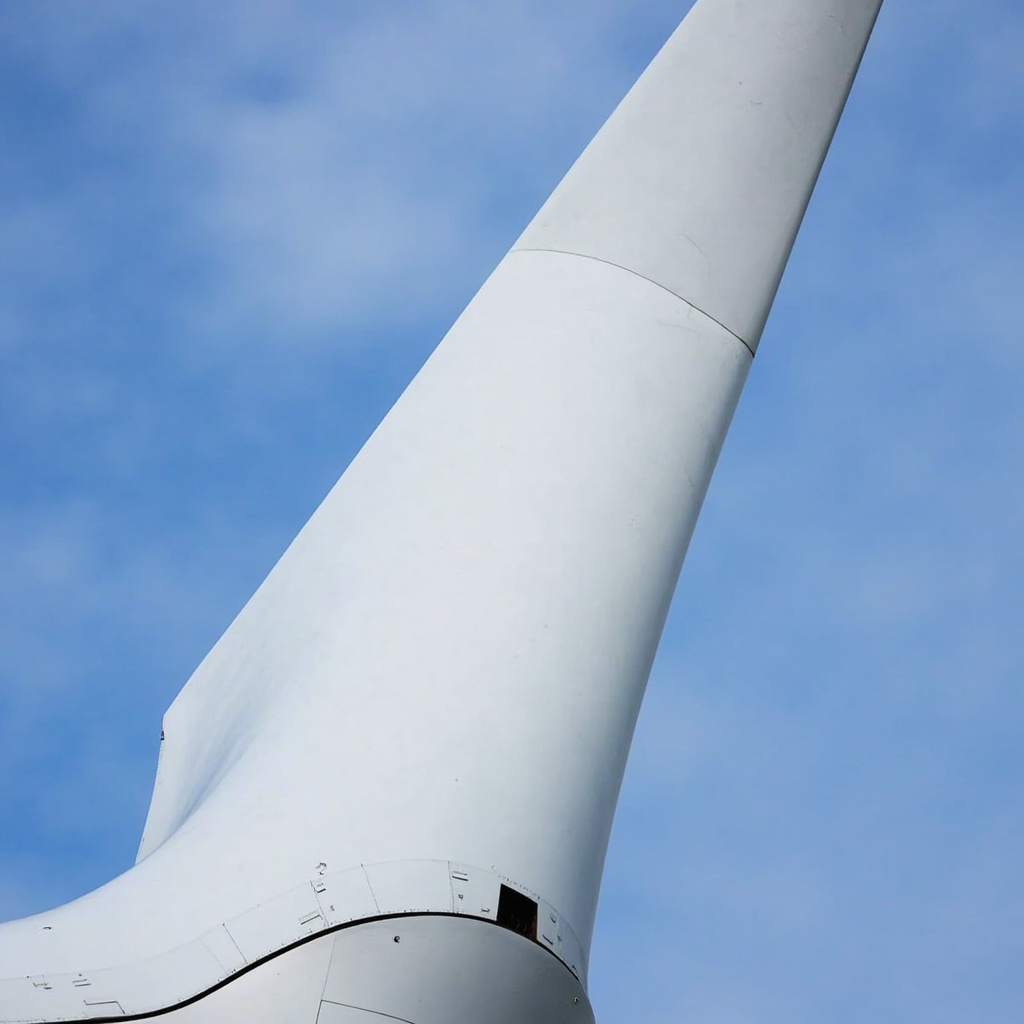
A 5MW offshore wind turbine, whose blade tip linear velocity at rated wind speed can reach 80-100m/s (approx. 290-360km/h—close to an F1 car's top speed). At such speeds, the "Water Hammer Pressure" generated by raindrops of 1-2mm diameter impacting the blade leading edge can exceed 100MPa—this already surpasses the yield strength of most metallic materials. The polyurethane protective coating on the blade leading edge endures hundreds of millions of raindrop and sand/dust particle impacts every year—this is one of the most extreme "Micro-Particle Erosion" conditions in nature. Anti-sand-dust erosion nano-polyurethane topcoat for wind turbine blades is the single protective material with the highest proportion of wind turbine O&M costs—the annual leading-edge maintenance cost per turbine can reach tens of thousands of yuan, and the global wind blade coating market will be about USD 1.2 billion in 2025 (CAGR 9.5%).
Rain erosion mechanics—why can "soft water droplets" "pierce hard coatings"?
Direct answer: Raindrop impact on the coating is not "static pressure" — it is "water hammer effect". When a spherical raindrop strikes the coating surface at 80-100 m/s in an instant (about 1-5 microseconds), the bottom of the raindrop is compressed to form a high-pressure water film — peak pressure P = ρ·c·v (ρ is water density 1000 kg/m³, c is sound speed in water about 1500 m/s, v is impact velocity) — at v = 90 m/s, P ≈ 135 MPa. This pressure pulse penetrates the coating in the form of a stress wave (PU sound speed about 2000 m/s) — reflects at the coating-substrate (fiberglass/carbon fiber composite) interface to form a tensile wave — when the tensile stress exceeds the coating's cohesive strength or adhesion — microcracks initiate. Hundreds of millions of cycles (fatigue loading) — microcracks propagate and intersect — the coating spalls in the form of tiny fragments — the blade leading edge shows a "serrated" erosion morphology.
Mechanism Details—Toughening and Erosion Resistance Mechanism of Nanofillers.Pure PU coating's rain erosion resistance is limited by its viscoelasticity—under high-speed impact (strain rate >10⁴ s⁻¹), PU transitions from viscoelastic to brittle (glassy state)—impact energy cannot be dissipated through molecular chain segment motion—and is released concentrated in the form of cracks. The introduction of nanofillers changes this failure mode through four mechanisms: (1) Crack deflection by graphene/CNT—two-dimensional (graphene) and one-dimensional (CNT) nanofillers form a "nano rebar network" in the coating—forcing impact cracks to propagate tortuously along the nanofiller/PU interface—effective fracture path length increases 3-5 times—fracture toughness (KIC) improves by 40-80%; (2) Stress dispersion by SiO₂/Al₂O₃—spherical nanoparticles (0D) act as "microscopic stress dispersion points" in the PU matrix—uniformly transferring concentrated impact stress to the surrounding matrix—avoiding local stress exceeding fracture strength; (3) Energy dissipation via nanofiller/PU interfacial slip—during impact, nanoscale slip occurs at the interface between nanofillers and PU matrix—frictional dissipation converts impact kinetic energy into heat—reducing energy available for crack propagation; (4) UV protection by TiO₂—anatase/rutile nano-TiO₂ absorbs UV (<390 nm)—blocking the photo-oxidative degradation chain reaction of PU—maintaining PU molecular weight and viscoelasticity—indirectly enhancing long-term rain erosion resistance.
Data Support:Two independent studies in 2025 quantified the nano-toughening effect. Results in Engineering (Alajmi & Ramulu): Graphene IA-700 + PU multilayer alternating coating — material erosion rate reduced by 60%, lift-to-drag ratio (post-erosion) increased by 62% — erosion most severe at 0° impact angle (normal impact), least severe at 10° impact angle. Tribology International (Sun, Cao, Duan et al.): At TiO₂ P/B = 0.6 — coating surface forms a "honeycomb" microstructure — prolongs the "incubation period" of rain erosion damage — time to visible damage in jet erosion test for P/B = 0.6 coating is about 3 times longer than P/B = 0.2. Polymer Korea (Choi & Hwang, KITECH): CNT/rGO + SiO₂ (0.1wt%) + Al₂O₃ (0.05wt%) hybrid PU — tensile elongation increased by 25-35%, adhesion increased by 80-100%, erosion depth reduced by 75-85%, photothermal de-icing efficiency improved by 10% (CNT/rGO photothermal conversion).
Source:Results in Engineering(2025), Tribology International(Vol.211, Nov 2025), Polymer Korea(2025), Elsevier
Engineering systems for leading-edge protection of blades—a comparison of diverse solutions from coatings to tapes
Direct answer: There are currently three mainstream technical routes for wind turbine blade leading-edge protection: (1) Nano-modified PU coating (spray/roller application — film thickness 200-500μm — most economical, requires maintenance recoating every 3-5 years — accounts for about 60% of the market); (2) Leading-edge protection tape (LEP Tape — polyurethane/fluoropolymer tape — thickness 300-600μm — high initial cost but better durability — replaced every 5-8 years — accounts for about 25% of the market); (3) In-mold integrated protective shell (Shell — the wear-resistant shell is integrally molded during blade manufacturing — highest initial cost — no subsequent maintenance required — accounts for about 15% of the market, mainly used in offshore wind power). The comprehensive cost (25-year LCC) of the three from low to high is: Nano PU coating < LEP Tape ≈ integrated Shell — because the single maintenance cost for offshore wind power (renting O&M vessels + high-altitude work + downtime power generation loss) can be as high as 10-20 times the coating material cost.
Source:Aura CDT/Loughborough University(2025), Kingston University Thesis(Dashtkar & Zweiri, 2024)
FAQ
How long does the leading-edge coating on the blade last?
Onshore wind power: 3–5 years; offshore wind power: 2–4 years (salt spray + higher wind speeds + more difficult maintenance). Nano-modified PU coatings extend the maintenance interval by approximately 30–50% compared with conventional PU.
Q: Why is the leading edge of the blade eroded much more severely than the trailing edge?
Linear velocity difference—the linear velocity at the blade tip (r=50 m, r/R=1.0) is twice that at r=25 m (r/R=0.5); impact kinetic energy ∝ v²; thus tip erosion intensity is 4 times that at mid-span. Meanwhile, the tip has a smaller angle of attack (thinner airfoil)—water droplets strike more nearly normal to the surface (0° impact angle causes the most severe erosion).
Reference sources:Results in Engineering(2025), Tribology International(2025), Polymer Korea(2025)
Deep Rewrite: July 6, 2026