In the production process of plastic products, coating selection and application are critical steps that determine the product's appearance, texture, and service life. Especially in electronic devices, appliance housings, automotive interiors, and consumer product exterior parts, plastic spraying has long ceased to be merely a "coloring" operation, but has become an important means of enhancing product quality perception and added value.
However, when selecting plastic coatings, many manufacturing enterprises often focus only on color and price, while neglecting the overall compatibility of substrate matching, performance requirements, and application processes. As a result, problems such as blistering, peeling, scratching, and blushing appear on product surfaces, which may mildly affect appearance or, in severe cases, lead to the scrapping of entire batches.
To maintain high-quality and stable output in a highly competitive market, one must master the three technical principles of scientific paint selection: substrate compatibility, performance matching, and process verification. These three elements together constitute the technical core of "plastic coating system selection."

I. Substrate Compatibility: Ensuring Reliable Adhesion from the Source
The substrate is the prerequisite for whether the coating can bond firmly. Different plastic materials exhibit vast differences in surface energy, which directly affects the coating's adhesion performance.
For example:
- ABS, PC, PVC and other strongly polar materials can directly use ordinary plastic paint systems, with stable adhesion performance.
- PP, PE are low-polarity plastics; if not subjected to corona treatment, flame treatment, or specialized primer spraying, they are highly prone to paint peeling and flaking.
- For workpieces of uncertain material, it is necessary to perform the cross-cut adhesion test and alcohol wipe test to ensure system compatibility before mass production.
Correct substrate identification is the starting point for successful coating selection. Any "experience-based judgment" that neglects this step will incur costs in production.
II. Performance Matching: Defining the Formulation System by Application Requirements
Different product application scenarios correspond to different performance requirements, and no single system can be used to cover all of them.
- Household items, appliance housings: For those pursuing appearance and tactile feel, a one-component acrylic system can be used, offering high application efficiency.
- Industrial equipment, electronic tools: Require abrasion resistance and scratch resistance, and a two-component PU system must be adopted.
- Outdoor exposed products: It is recommended to use UV-curable coatings, which have excellent weather resistance and UV resistance.
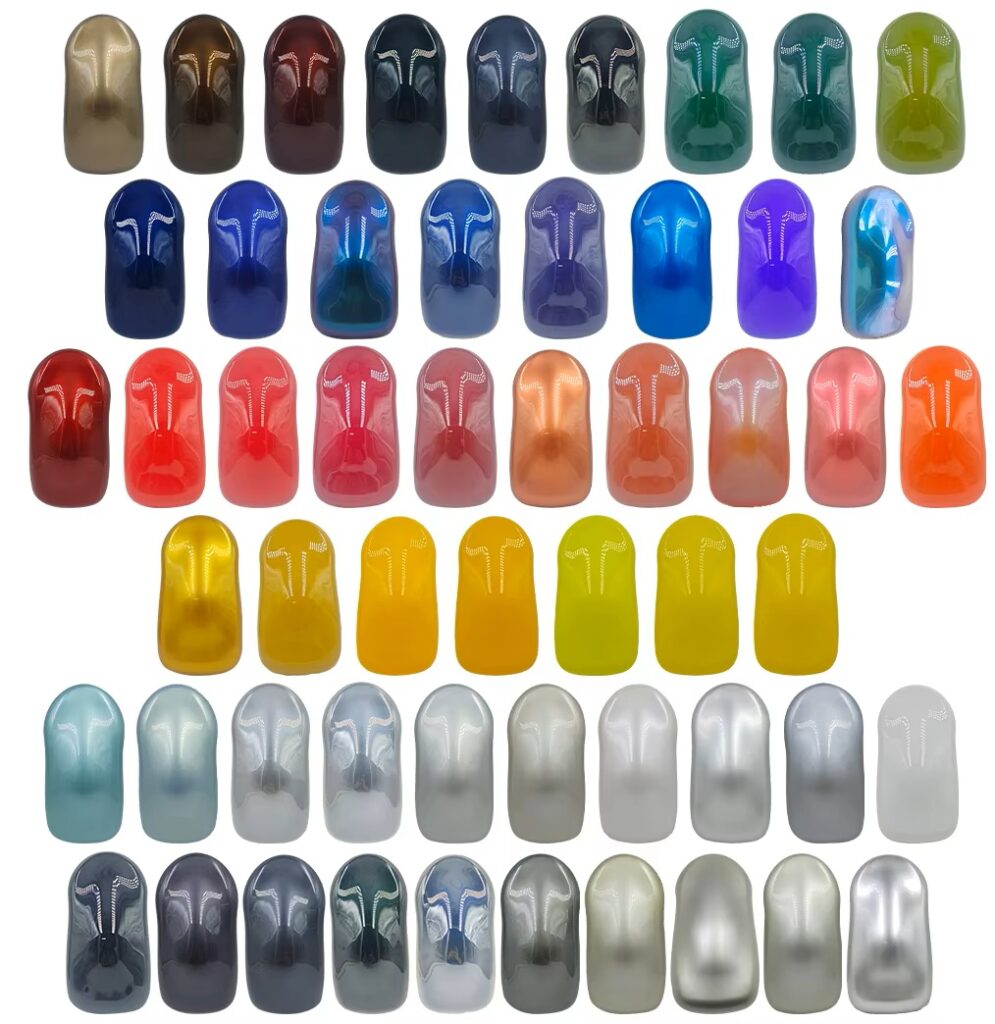
- High-end appearance parts: such as metallic pearlescent, rubber paint, matte effects, etc., require independent spraying lines and exclusive formulations.
The core logic of performance selection is: reverse-derive formulation choices based on the product's usage environment and lifespan requirements.
III. Process Validation: The Key from "Theoretically Feasible" to "Stable Mass Production"
Even the highest-quality formulation may fail in mass production if it lacks scientific process validation. The process control steps for plastic spraying mainly include the following:
- Surface pretreatment: Before spraying, degreasing, dust removal, and static elimination must be performed to ensure the substrate is clean and free of residues.
- Spraying environment: It is recommended to use a constant-temperature, constant-humidity, low-dust environment to prevent particle adhesion or bubble formation.
- Film thickness control: The spray gun distance, spray speed, and pressure parameters must be stable to avoid orange peel and sagging.
- Curing process: Select appropriate temperature and time ranges based on system differences (e.g., acrylic, PU, UV, etc.) to ensure the paint film is fully crosslinked and cured.
Many quality issues are not formula defects, but rather process parameters that have not been standardized. During the mass production phase, traceable process documents and quality control records should be established to ensure stability through data.

IV. Verification Testing: The Final Line of Defense for Quality Assurance
Before entering formal production, at least the following three types of tests should be performed to verify that the system is complete and reliable:
- Adhesion (Cross-cut Test): To verify the bonding strength between the paint film and the substrate.
- Alcohol resistance and abrasion testing: Simulating daily friction and chemical contact.
- Color Difference and Gloss Detection: Use standard light sources to compare with reference samples to control batch consistency.
These validations are not an additional cost, but the most effective insurance against later rework and brand damage.
V. Conclusion: Scientific coating selection is an integral part of the quality system.
The scientific selection of plastic coatings is a systematic collaboration among technology, materials, and management. It concerns not only appearance but also directly determines the product's service life and value.

The correct logic is:
Identify the substrate → Match the performance → Verify the process → Control the process → Form a standardized system.
Master this method, and you can achieve the leap from experience-based production to science-based manufacturing, enabling every plastic product to possess stable quality, excellent durability, and a high-end visual texture.