——Approaches to Achieving Metallic Appearance on Irregular Plastic Structures
Complex curved surfaces and irregular structures impose higher requirements on electroplating paints. This paper systematically analyzes the coating challenges of electroplating paints on complex plastic structures, and how to achieve stable and uniform metallic visual effects.
I. Technical Requirements for Electroplating and Painting of Complex Curved Surfaces
Compared with planar structures, complex curved surfaces and irregular shapes generate more variables during coating, such as curvature variations, shadow zones, and edge/corner areas, all of which directly affect the film-forming quality and visual consistency of electrocoated paint.
Under high-reflective metallic effect requirements, these differences will be further amplified.
II. Major Challenges in Coating Uniformity
On complex structures, electrocoating paint needs to address the following issues:
- Non-uniform coating thickness distribution
- curved surface reflectance variation
- Reduced metallic appearance in edge and corner areas
If not properly controlled, uneven brightness or broken metallic effects may occur.

III. Influence of Substrate Structure on Metallic Effect
Substrates with complex curved surfaces often exhibit the following issues during the injection molding or forming stage:
- microscopic stress differences
- Insufficient local flatness
- Inconsistent surface texture
These factors will all affect the continuity of the subsequent reflective layer, thereby influencing the overall metallic visual effect.
IV. The Role of Primer Coating on Complex Surfaces
In complex curved-surface painting, the primer coating not only provides adhesion functionality but also needs to:
- Correct micro-defects on curved surfaces
- provide a uniform optical foundation
- Reduce visual fluctuation of the reflective layer
A high-quality base layer is the prerequisite for achieving stable metallic effects in complex structures.
V. Imaging Performance of the Reflective Layer in Curved Structures
The mirror effect presented by the reflective layer on curved surfaces is closely related to curvature variation. By reasonably controlling the performance of the reflective layer, it is possible to achieve on complex curved surfaces:
- continuous metallic appearance
- Soft and natural reflection transition
- Enhanced visual hierarchy
VI. Influence of Transparent Protective Layer on Curved Metallic Effect
The transparent protective layer on complex curved surfaces must not only possess good leveling properties, but also ensure:
- Uniform gloss on curved surfaces
- Edge area protection is intact.
- Appearance stability under long-term use
Otherwise, sagging or visual distortion is likely to occur.
VII. Importance of Process Control in Complex Coating Applications
Coating of complex curved surfaces demands higher process stability. Proper process control helps ensure consistent metallic effects across different areas and improves overall appearance quality.
VIII. Application Value and Design Significance
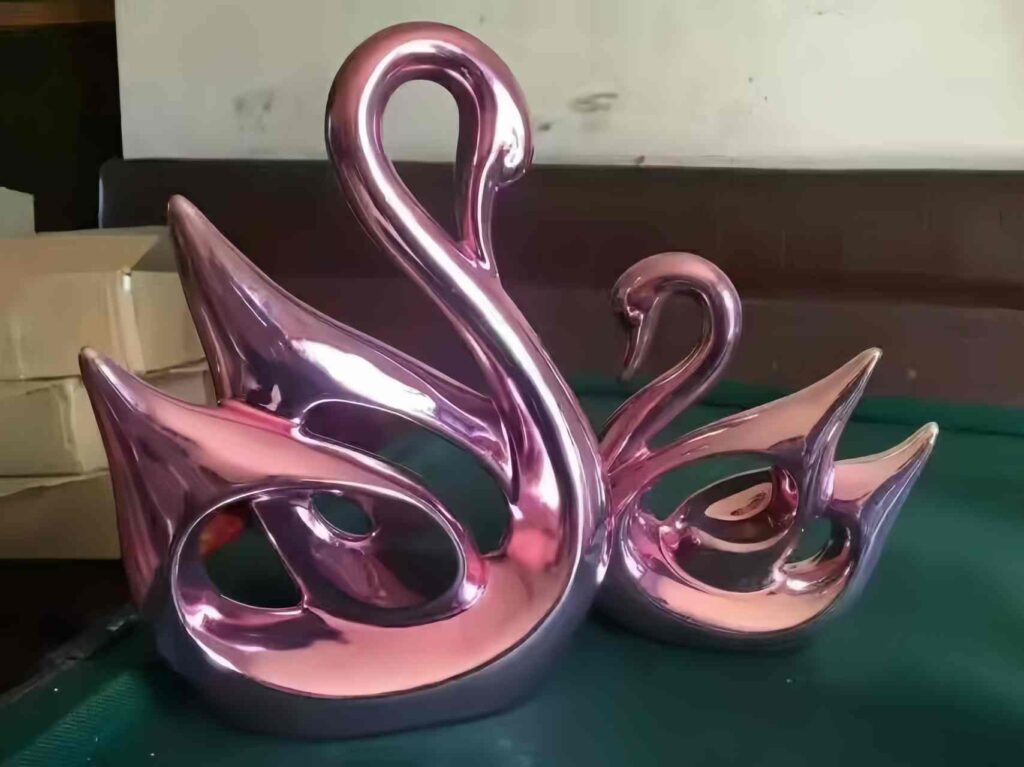
Through mature plating and painting systems, complex plastic structures can also achieve high-quality metallic appearances, providing greater design freedom and differentiated competitive advantages for product design.



IX. Conclusion
The application of electroplating paint on complex curved surfaces and irregular structures demonstrates the integrated capability of technology and craftsmanship. Through systematic control of each stage in the coating process, stable and uniform metallic visual effects can be achieved on complex structures.
The following content will further explore the performance of mirror coatings in complex structures.