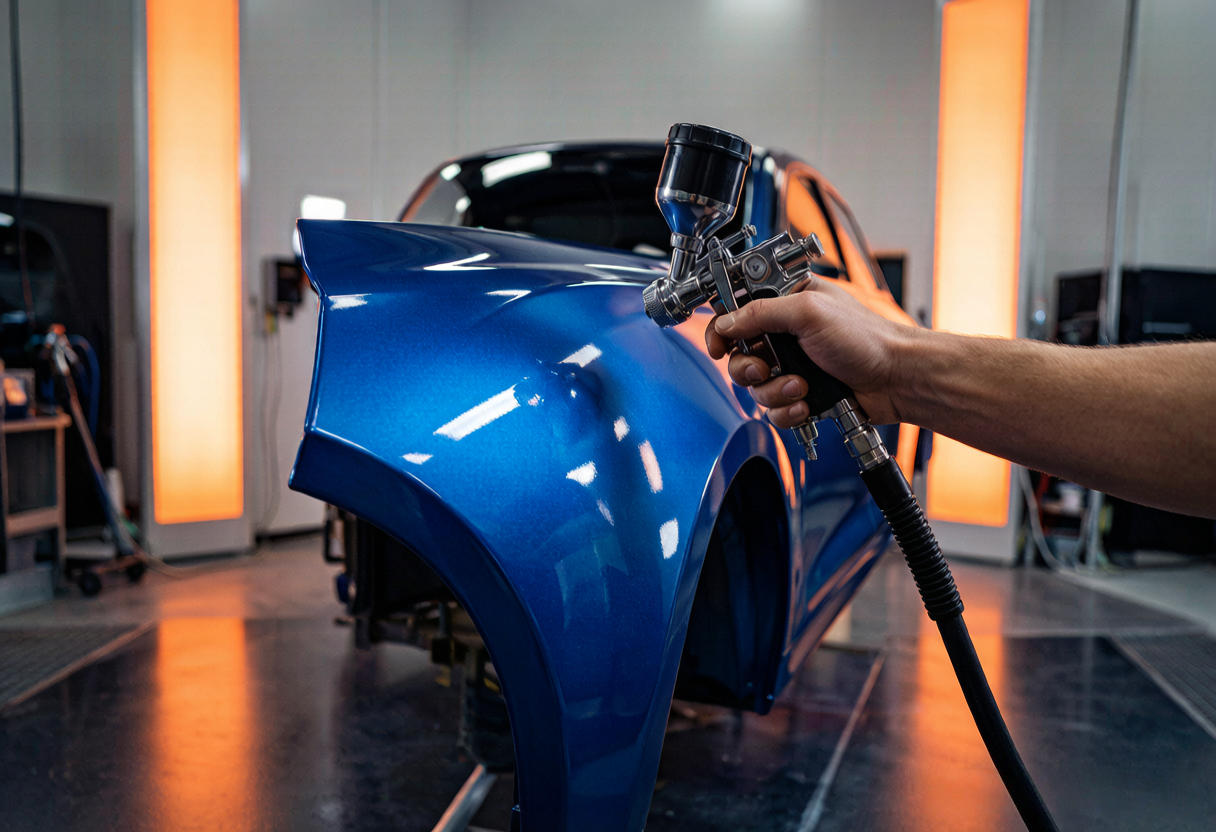
In the field of automotive refinish paint color mixing, 1K and 2K are two of the most fundamental and important concepts. Whether for 4S shops, repair workshops, or parts suppliers, accurately understanding the differences between the two directly determines color-mixing efficiency, film performance, and final delivery quality. This article systematically analyzes the differences between 1K and 2K colorants from four dimensions—composition, performance characteristics, application process, and suitable scenarios—and provides selection recommendations.
I. What is 1K tinting paste?
1K colorant, namely single-component (One Component) colorant, is a colorant product that can be used without adding a hardener. Its film-forming substances are mainly acrylic resin, polyurethane-modified resin, etc., and the paint film is formed through physical drying (solvent evaporation).
Characteristics of 1K color masterbatch
- Drying method: Physical drying, can be done by air drying at room temperature or low-temperature baking.
- Construction convenience: Ready to use upon opening, no mixing required, saving color matching time
- Environmental friendliness: Relatively low VOC content, in line with environmental trends
- Hiding power: Medium hiding power, requiring multiple coats of spraying to achieve the effect
- Chemical resistance: General chemical resistance, not suitable for highly corrosive environments
- Hardness and Durability: Low hardness, limited long-term weather resistance
To learn about PSSTE's full range of automotive paint products, please visit the Automotive Paint Series and Automotive Refinish Paint product pages.
II. What is a 2K tinting paste?
2K colorant, i.e. Two Component colorant, consists of a colorant base and a hardener, which are mixed in proportion before use. The film-forming substances are hydroxyacrylic resin + isocyanate hardener, which form a high-performance paint film through a chemical reaction (cross-linking reaction).
Characteristics of 2K colorants
- Drying method: Chemical curing, can be at room temperature or by baking
- Coating film properties: high hardness, strong weather resistance, excellent chemical resistance
- Hiding power: Strong hiding power, achievable with one or two coats of spray.
- Glossiness: High gloss, can reach above 95GU
- Durability: Outstanding resistance to aging and yellowing, with a long service life
- Construction Requirements: The mixture must be prepared strictly in proportion, and the construction window is limited.
III. Comparison of Core Differences
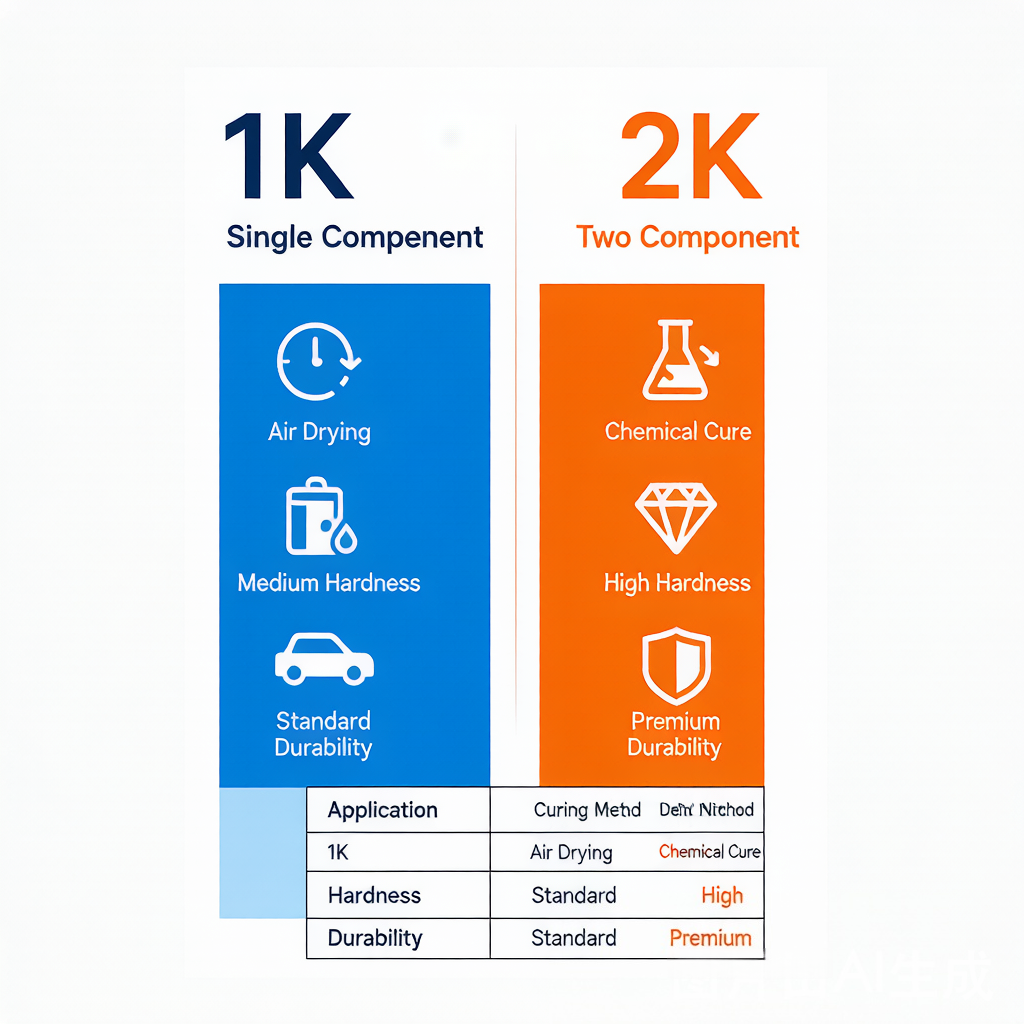
The core differences between 1K colorants and 2K colorants are as follows:
- Component: 1K is single-component, no hardener required; 2K is two-component, requires hardener
- Drying mechanism: 1K is physical drying (solvent evaporation), 2K is chemical curing (cross-linking reaction)
- Hardness: 1K medium (HB-H), 2K high (2H-3H)
- Weather resistance: 1K generally 2-3 years, 2K excellent 5-10 years
- Gloss: 1K medium, 2K high gloss (95GU+)
- Construction convenience: 1K is ready to use out of the can, 2K requires mixing and has a pot life window.
- Applicable Scenarios: 1K is suitable for quick repairs and temporary coatings, 2K is suitable for high-end restoration and long-term protection
IV. How to Choose? Scenario-Based Recommendations
Scenarios for selecting 1K
- Quick minor touch-up: Localized spraying for small areas with low requirements
- Temporary coating: for display vehicles and short-term use vehicles
- High environmental requirements: Water-based 1K paint is more in line with environmental trends
- Limited construction conditions: No professional paint booth required; air-drying at room temperature is sufficient.
- Cost Control: Limited budget, requiring cost-effectiveness
Scenarios for selecting 2K
- Full vehicle painting: Large area, high requirements
- High-end vehicle repair: 4S shops, luxury brand repair
- Long-term weather resistance: vehicles for outdoor use and long-term use
- High gloss requirement: mirror-like effect required
- Chemical resistance requirement: Frequently exposed to acids and alkalis, frequent car washing
Advanced solution: 1K + 2K combination
In actual repair work, many technicians use the combination of "1K basecoat + 2K clearcoat":
- Base coat layer: Spray with 1K colorant for color mixing (convenient for color adjustment, moderate cost)
- Clear coat layer: Apply 2K clear coat for finishing (to enhance hardness, gloss, and weather resistance)
This approach balances tinting convenience and final coating performance, and is currently the most mainstream application process for automotive refinish paints.
V. Key Points for Construction
1K Application Precautions
- Use a "wet spray" technique during application, applying each coat thinly to avoid sagging.
- The interval between coats should not be too long (to prevent delamination).
- After drying, it needs to be sanded before applying the next coat.
- It is recommended to apply 2K clearcoat after spraying the 1K basecoat for enhanced protection.
2K Application Precautions
- Mix strictly according to the main agent:curing agent ratio (typically 4:1 or 2:1).
- After mixing, there is a working window (typically 4–6 hours); it must not be used beyond this time.
- Sufficient curing time is required after spraying (24 hours at room temperature, baking can accelerate the process).
- The amount of curing agent affects hardness and drying speed, and must not be adjusted arbitrarily.
- It is recommended to use a dedicated thinner to ensure leveling and drying speed.
Conclusion
1K masterbatch and 2K masterbatch each have their pros and cons; the key to choosing lies in clarifying the application scenario: choose 1K for quick convenience and eco-friendliness, choose 2K for durability and high performance, and the best solution is a "1K base color + 2K clear coat" combination. Kexin New Materials specializes in automotive paint R&D and manufacturing, providing a complete 1K/2K masterbatch system and color-matching system support. Welcome to inquire and learn more.
For further technical guidance, please feel free to contact us at any time.
Further reading:Automotive Refinish Paint Color Matching Tips: Metallic Flakes and Pearl Powder · Spray Gun Nozzle Size Selection: 1.3mm vs 1.5mm