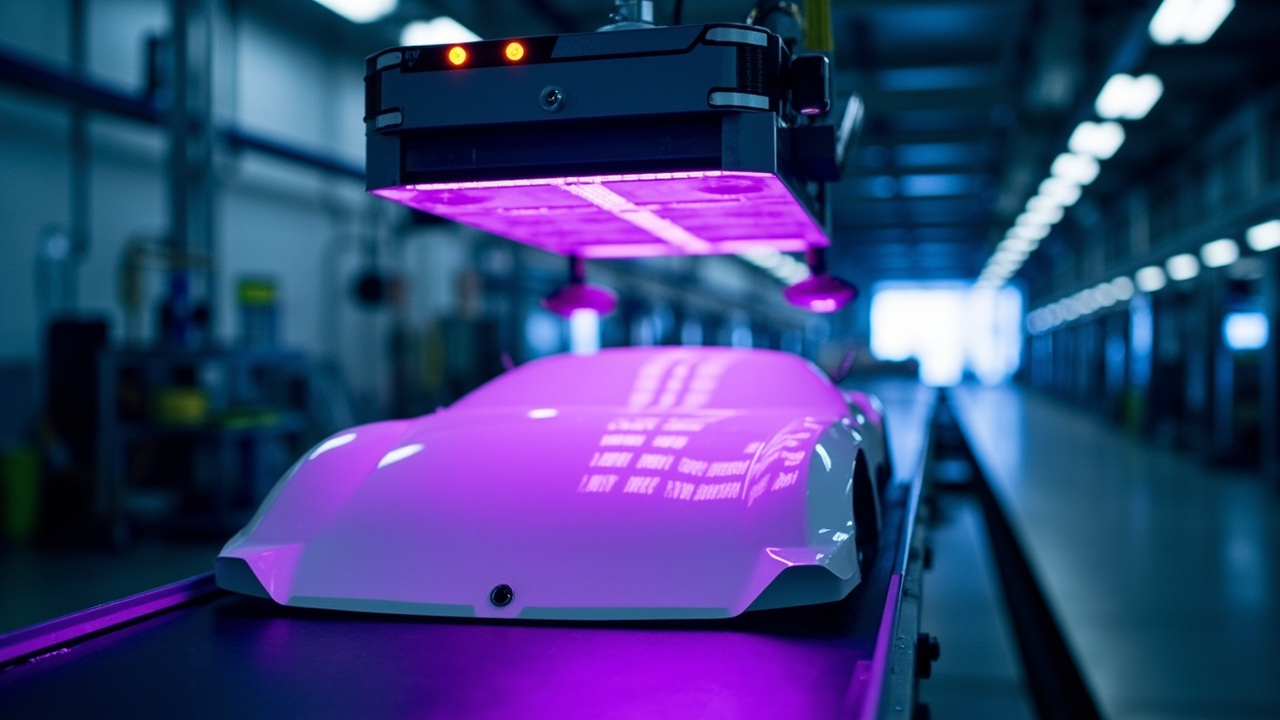
In traditional automotive painting, 2K clearcoat cures by days at ambient or tens of minutes at 60 °C, and OEM clearcoat by 160–180 °C baking. These “thermal cure” paths are energy-hungry and their takt is limited by oven length. UV curing uses photons to trigger polymerization instantly, compressing “minutes/days” of curing into seconds.
As a technical supplier of automotive and industrial protective coatings, kexinMaterials has layout in radiation curing and low-VOC systems. This article explains the photochemistry, equipment (especially LED UV), typical processes (3C1B UV) and standards/safety, to help engineers judge “should my line go UV”.
1. Photochemical Nature of UV Curing
UV curing is a form of radiation curing: UV photons excite a photoinitiator to generate free radicals or cations that instantly polymerize and crosslink the resin. Two families:
- Free-radical (most common): acrylate resin (multifunctional urethane acrylate / epoxy acrylate) + radical photoinitiator (e.g., Irgacure types). On UV exposure the initiator fragments to radicals that add across acrylate double bonds. Fast and broad raw-material base, but oxygen inhibition (surface needs oxygen exclusion or wax/amine) and slightly higher shrinkage.
- Cationic: epoxy / vinyl-ether resin + cationic photoinitiator (e.g., iodonium salt). UV generates strong acid that opens rings. No oxygen inhibition, low shrinkage, good adhesion and “dark cure” (reacts after lamp off), but costlier and moisture-sensitive.
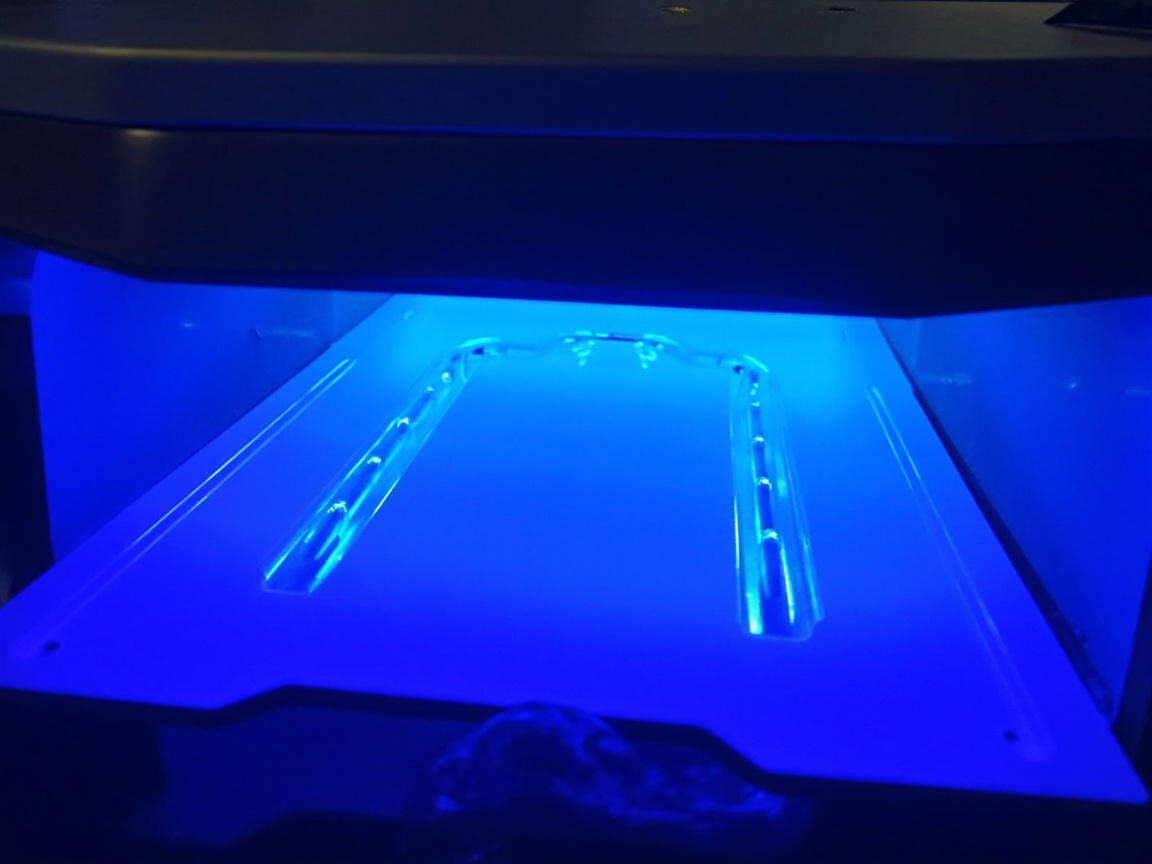
Automotive UV clearcoats are mostly radical urethane-acrylate systems balancing appearance and weathering; some high-end use cationic or hybrid for adhesion and chemical resistance. UV’s “seconds” come from photochemistry, not heat transfer: photons directly activate the reaction without heating the whole panel — and UV cure is nearly unaffected by ambient temperature/humidity.
2. UV Spectrum: UVA/UVB/UVC and LED
UV by wavelength: UVA 315–400 nm, UVB 280–315 nm, UVC 200–280 nm. UV curing commonly uses UVA (peaks 365/385/395/405 nm) — good penetration, relatively lower skin hazard (still must protect). Traditional mercury lamps peak near 365 nm with UVB/UVC and much heat/IR. LED UV gives a single narrow peak (365/385/395 nm), no mercury, cold source, instant on/off, low energy, long life, and is replacing mercury lamps for environmental and energy reasons.
Caution: even LED UVA carries enough photon energy to damage eyes and skin, and UV on air generates ozone (especially with short wavelengths). UV zones must be enclosed, exhausted and equipped with UV-protective masks and aprons; never look directly at the lamp.
3. UV Coating Formulation Skeleton
UV coatings (100% solid or high-solid) consist of four parts:
- Oligomer: decides main properties — urethane acrylate (flexible, weatherable), epoxy acrylate (hard, abrasion-resistant), polyester acrylate (general). Auto clearcoat mostly urethane acrylate for gloss/weathering.
- Reactive diluent (monomer): acrylate double bonds adjust viscosity and take part in crosslinking (TMPTA, TPGDA, HDDA). Some monomers are skin-irritating; assess safety.
- Photoinitiator: radical (Irgacure 184/1173/819) or cationic (iodonium) — sets absorption wavelength and cure speed.
- Additives & effect pigments: leveling, defoaming, adhesion; but effect pigments (aluminum, mica-titanium) reflect/absorb UV and limit cure depth — a key difficulty for UV color coats.
UV coatings are nearly solvent-free, VOC far below 2K solvent types — the root of their environmental advantage. But 100% solid means “no solvent evaporation leveling”; leveling depends entirely on formulation and spraying, making application stricter.
4. Takt Advantage: Seconds vs Minutes/Days
UV turns “cure waiting” from a bottleneck into “pass-through”, sharply shortening takt, reducing WIP and eliminating long oven footprint and energy. Especially economical for high-volume plastic/small-part lines (bumpers, wheels). But count total cost: one-time UV equipment and maintenance (lamp decay monitoring, cooling) must offset saved oven, energy and footprint.
5. Typical Process: 3C1B and UV
- UV clearcoat (most mature): primer/base still traditional (or waterborne), final clearcoat UV-cured — no high-temp bake, protects plastic parts from deformation.
- UV primer/base + UV clear (3C1B UV): full radiation curing, extreme takt compression; challenge is UV penetration through effect color coats and flop control.
- Bumper/wheel dedicated lines: plastic parts intolerant of high temperature → UV is the first choice.
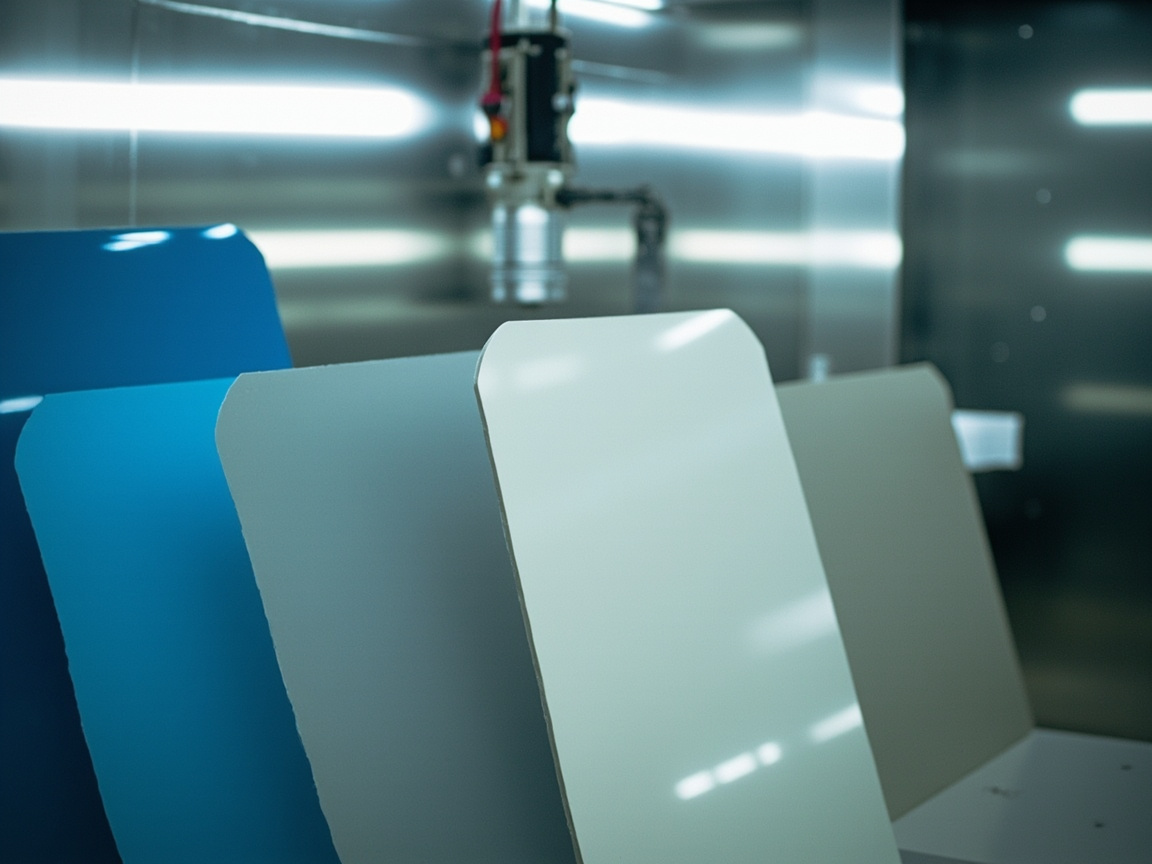
Key: before UV, “IR/hot-air pre-leveling” lets the wet film settle (no solvent leveling), then into UV. UV dose (mJ/cm²) must fully penetrate film thickness; under-dose leaves surface tacky and under-cured, over-dose yellows and embrittles. Dose management is the core KPI — monitor online, not just periodic sampling.
6. Process Window and Clean Environment
- Cleanliness: no solvent leveling means any particle landing on the wet film is permanently trapped — spray-booth cleanliness must exceed 2K.
- Pre-leveling time: window between spray and UV; too short → orange peel, too long → dust.
- Oxygen inhibition: radical types need oxygen exclusion (nitrogen curtain) or surface wax/amine, else surface stays tacky.
- Substrate temperature: 20–30 °C recommended for viscosity and leveling.
7. Dual-Cure Explained
To balance “seconds to set” with “shadow/thick-film cure”, dual-cure couples UV with another mechanism: UV + thermal (UV sets fast, thermal fills shadow/thick film), UV + moisture/air (cationic dark-cure), UV + latent reaction. Dual-cure is pragmatic for parts with cavities and bracket backs — the cost is more complex, costlier formulation and still a thermal stage, slightly reducing takt advantage.
8. UV vs 2K and Standards
UV and 2K are positioned differently: UV seconds by photons, ~0 VOC, ideal for takt and plastics; 2K by chemical crosslink for repair and high-temp OEM. They combine (UV clear + 2K base). Standards: ISO 10640 (crosslink by DMA/Tg), ISO 16474 / GB/T 1865 (xenon/UV aging), GB 24409-2020 (vehicle coatings, very friendly to near-0-solvent UV), GB/T 9286 / GB/T 6739 (adhesion/hardness).
Note: UV coating weathering must be real xenon/fluorescent-UV aging, not just initial hardness — some acrylates yellow or chalk outdoors; choose oligomer/initiator for weathering.
9. Decision: Should I Go UV?
- Parts regular, rotatable, few shadows? → UV advantage large.
- Plastic / intolerant of high temperature? → UV first choice.
- Takt is the bottleneck? → UV seconds release capacity.
- Can you afford UV equipment and maintenance? → TCO vs bake oven.
- High effect-color-coat ratio? → verify UV penetration and flop.
Typically: bumpers, wheels, lamps, trim → UV first; full-line clearcoat → partial UV; complex cavities and thick color coats → caution. Pilot small parts first, validate with dose monitoring and aging data before scaling.
FAQ
Q: Why is UV curing so fast?
A: UV photons directly excite the photoinitiator to generate active species that instantly polymerize resin double bonds — photochemical, not thermal — so seconds to set, no long bake or days at ambient.
Q: LED UV vs traditional mercury lamp?
A: LED UV has a single peak (365/385/395 nm), no mercury, cold source, instant on/off, low energy, long life; mercury lamps carry UVB/UVC and much heat, need warm-up, and create mercury waste. The industry is shifting to LED.
Q: Why is UV coating VOC so low?
A: UV coatings are mostly 100% solid (or near-0 solvent); film forms by photopolymerization, not solvent evaporation, so VOC is far below solvent 2K and very friendly to GB 24409-2020.
Q: What is the UV “shadow area” problem?
A: Shaded or back-side areas receive no light, so no crosslinking. Mitigate by optical path design, rotating parts, or “UV + thermal dual-cure” to fill shadows.
Q: What is difficult about UV color coats?
A: Effect pigments (aluminum, mica-titanium) reflect/absorb UV, leaving thick/color-coat layers under-energized and under-cured; flop is also film-thickness sensitive. Control thickness, choose initiator or use dual-cure.