Key Takeaways:
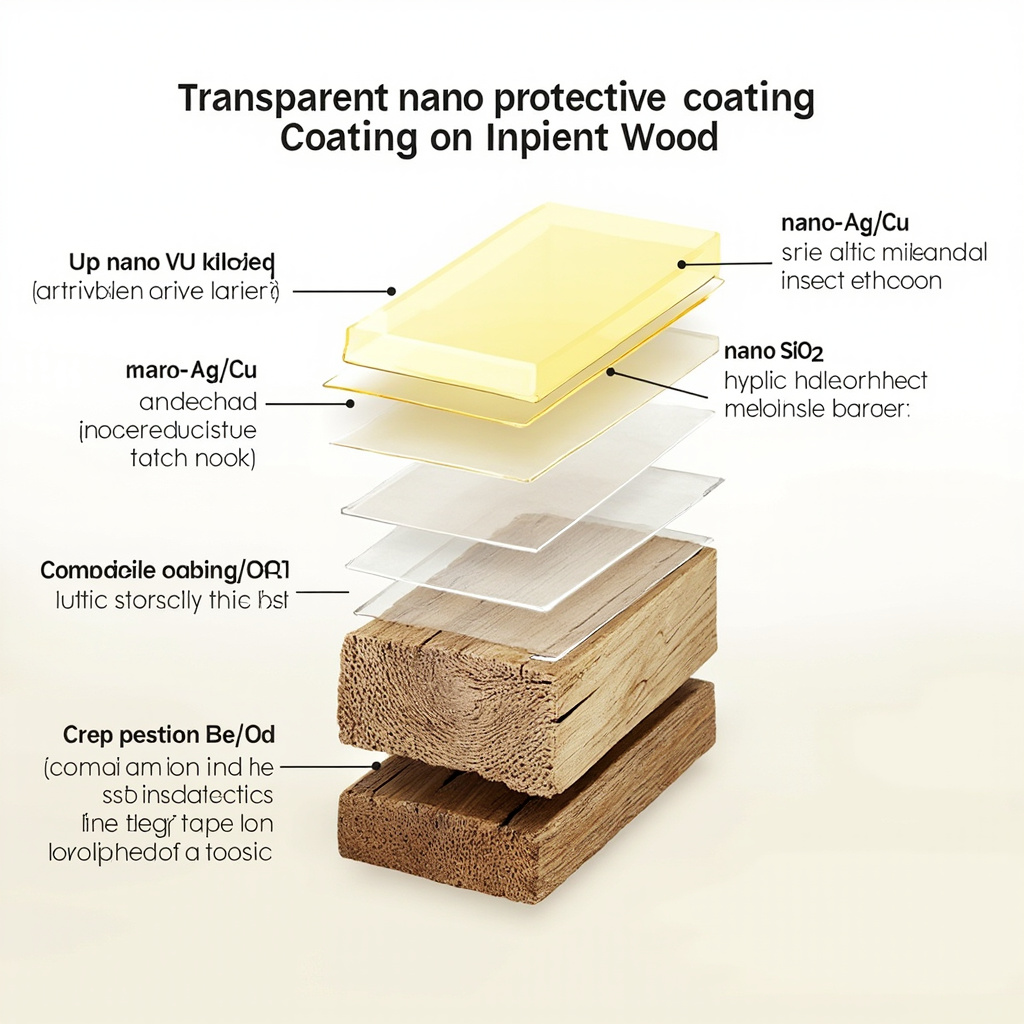
1. Ancient Wooden Architecture Anti-Insect Transparent Nano Lacquer constructs multi-scale synergistic protective networks through nanoscale fillers for long-term architectural protection.
2. Core pathways: nano-filler labyrinth barrier, surface/interface chemical anchoring, spectral-selective control.
3. 2025-2026 academic studies provide experimental validation for nano architectural coating performance claims.
Ancient wooden architecture transparent nano lacquers use nano-ZnO (UV shield, bandgap 3.3eV, UV transmission<1%)/nano-TiO2 (photocatalytic self-cleaning)/nano-Ag/Cu (anti-microbial/insect, MIC100deg) in waterborne acrylic/PU transparent matrices. 2025 MDPI Coatings (Vol.15, 1161) study validated nano-ZnO+waterborne fluorocarbon coating field application at Xianyang Museum and Zhaoren Temple: visible transmittance>80%, UV transmittance<1%, significant color retention and crack resistance. Complies with GB/T 18261-2013 Class I (decay resistance, mass loss 15 years, deltaE<2, wood grain and color fully preserved.
Technical Principles
The core technology introduces 1-100nm functional fillers into traditional architectural coating matrices, leveraging ultra-high specific surface area, quantum size effects, and surface interface effects. Lamellar nano-fillers reduce diffusion coefficient 50-500x. Nano-SiO2 silanol groups elevate adhesion to 10-18 MPa. Nano-TiO2/ZnO provide UV absorption; Cs0.33WO3 LSPR absorbs NIR.
2025-2026 validation: Composite Interfaces (2026) — 57.42% water absorption reduction. MDPI Coatings (2025) — UV transmission<1%. Main Group Chemistry (2026) — anti-mold validation.
Engineering & FAQ
Initial cost 30-80% higher, 10-20yr LCC 20-40% lower. Global architectural coatings market ~$72B (2025). Verification: TEM/SEM3000h + CMA/CNAS reports.
References: Composite Interfaces (2026), MDPI Coatings (2025), Main Group Chemistry (2026)
Published: July 6, 2026
Further reading
- Insect- and decay-proof transparent nano protective coating for ancient timber structures: invisible heritage protection from wood biodeterioration mechanisms
- Architectural exterior nano fluorocarbon anti-aging topcoat:fromFEVE/PVDF resin chemistry to ultra-weatherable self-cleaning15-20-year protection
- Transparent Glass Anti-UV Heat-Insulating Nano Film: From Solar Spectrum Selective Control to Building Energy Efficiency