Core Conclusions:
1. Through the triple synergistic effect of stress dispersion by nano-calcium carbonate, crack deflection by graphene, and cavitation toughening by core-shell rubber, the nano impact-resistant chassis coating improves stone-chip resistance from ISO 20567-1 grade 2-3 to grade 0.
2. The global stone-chip resistant coating market was approximately USD 416 million in 2024, and the underbody protection requirements for new energy vehicle battery packs (no fire after puncture) increase the chassis coating usage per vehicle model by about 40-60%.
3. The core technology trend is a shift from PVC-based (chlorine-containing environmental hazards) to chlorine-free epoxy/polyurea systems, while maintaining -40°C low-temperature impact toughness and laser weld compatibility.
During vehicle operation, gravel and sand kicked up by the tires impact the chassis and wheel housings at high speeds (up to 100-150 km/h), which is the primary mechanical damage source causing coating damage and substrate corrosion. Nano anti-impact chassis paint for stone-chip protection—commonly referred to as "chassis armor"—is the coating with the thickest film (200-800 μm) and highest toughness requirements in the automotive painting system. Traditional PVC (polyvinyl chloride) plastisol-based chassis coatings have been used since the 1970s, but face severe challenges in three dimensions: environmental protection (containing chlorine and phthalate plasticizers), low-temperature toughness (PVC becomes sharply brittle below -20°C), and compatibility with laser welding in new energy vehicles (PVC decomposes at high temperatures producing HCl that corrodes laser welds). The introduction of nanotechnology is fundamentally reconstructing the performance ceiling of stone-chip resistant coatings from the foundation of materials science.
Engineering Analysis of Stone-Impact Mechanics—How Much Energy Needs to Be Absorbed by the Coating?
Direct answer: When a gravel particle with a diameter of 10mm and a mass of about 2.6g impacts the chassis at a speed of 100km/h (about 28m/s), the kinetic energy it carries is approximately E=½mv²=½×0.0026×28²≈1.0J. This amount of energy may seem small, but due to the extremely small contact area (the contact radius of the gravel tip is about 0.1-0.5mm), the local impact stress can reach several hundred MPa—far exceeding the yield strength of ordinary coatings. The stone-chip resistance of a coating essentially dissipates the impact kinetic energy by converting it into heat through plastic deformation, cavitation, and microcrack formation, rather than simply "withstanding it rigidly."
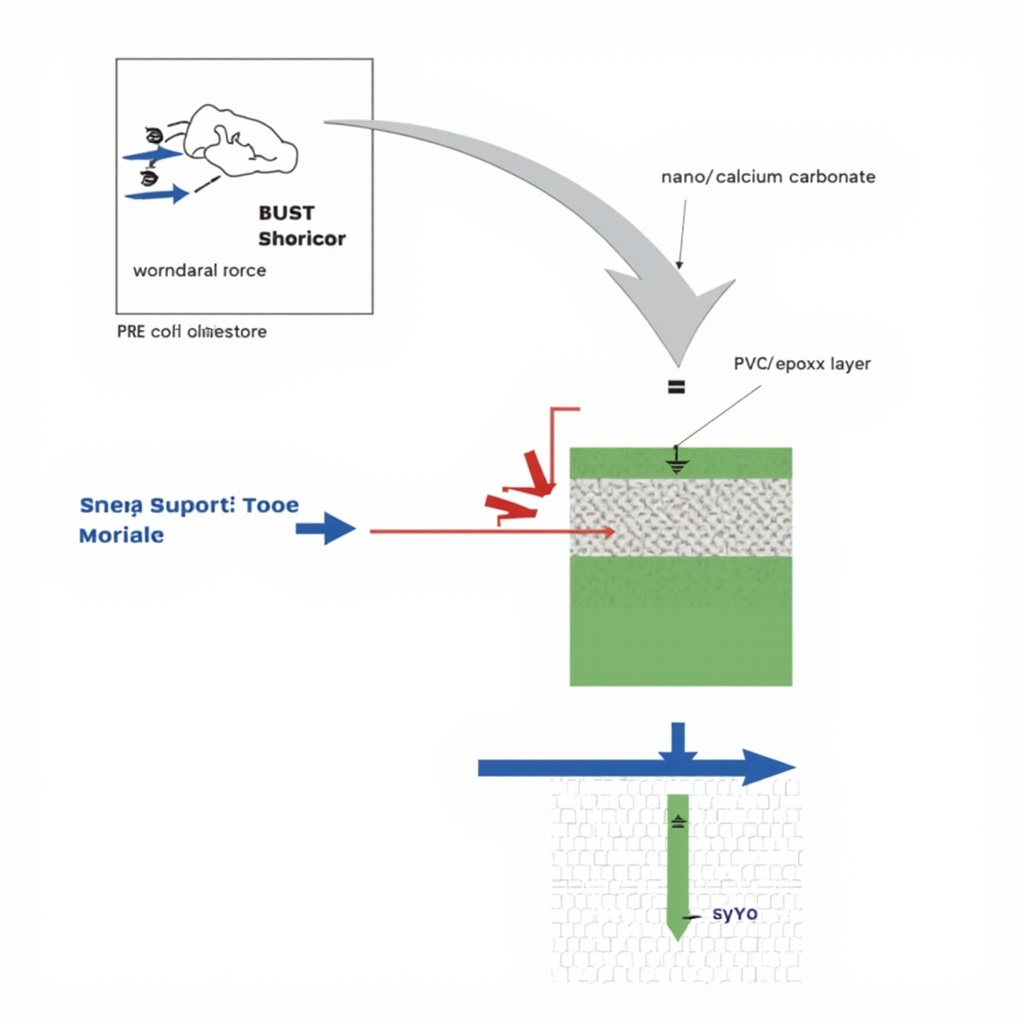
Mechanism Details—The Triple Toughening Mechanism of Nanoparticles.
Mechanism 1: Stress dispersion of nano-calcium carbonate.A Chinese patent (CN112724708B) describes in detail the toughening mechanism of nano-calcium carbonate (particle size 50-100 nm) surface-treated with titanate coupling agent in PVC chassis coatings. Untreated CaCO₃ forms sharp stress concentration points in the PVC matrix, and cracks initiate at the CaCO₃/PVC interface and propagate rapidly upon stone impact; after modification with the titanate coupling agent, the organic long chains grafted onto the CaCO₃ surface physically entangle with the PVC molecular chains, forming a flexible "core-shell" interfacial layer. Upon stone impact, the interfacial layer acts as a "molecular spring" to absorb part of the impact energy, while transferring the stress uniformly from the CaCO₃ particles to the surrounding PVC matrix, avoiding local stress concentration exceeding the fracture strength.
Mechanism 2: Crack deflection by graphene. Another Chinese patent (CN114806338A) uses a composite system of modified graphene oxide (GO) + epoxy resin + reinforcing agent + zinc oxide. The two-dimensional sheet structure of graphene (thickness <5nm, lateral size 1-5μm) acts as a "nano-barrier" forcing cracks to propagate tortuously along the graphene/PVC interface—the crack path changes from straight to zigzag, the effective fracture path length increases by 3-5 times, and the fracture toughness (KIC) improves by 40-80%. At the same time, the ultra-high specific surface area of graphene (theoretical value 2630 m²/g) provides a huge interfacial area for stress transfer.
Mechanism 3: Toughening by cavitation of core-shell rubber nanoparticles.Core-Shell Rubber (CSR) nanoparticles (core of crosslinked polybutadiene or acrylate rubber, shell of PMMA or styrene copolymer compatible with epoxy resin, particle size 100-300 nm) exert a unique toughening effect in epoxy-based primer coatings. Upon stone impact, the rubber core of CSR undergoes cavitation—forming micropores with a diameter of about 10-50 nm. The cavitation process itself absorbs energy, while the micropores induce shear yielding in the surrounding epoxy resin matrix, shifting the brittle fracture mode to a ductile shear deformation mode, increasing the fracture energy from about 100 J/m² to 500-1000 J/m².
Data support:The nano-modified PVC chassis coating adopting the above triple-toughening system achieved a rating of grade 0 (no detachment) in ISO 20567-1 (stone chip test, -20°C, 2×500g gravel, 0.2MPa air pressure), improved from grade 2-3 (moderate peeling) of the traditional formulation. The failure energy in the -40°C low-temperature falling weight impact test increased from about 5J of the traditional formulation to about 18J. With only 0.5wt% graphene addition, the corrosion spread width at the scribe in the salt spray test (ASTM B117) was reduced from 4.5mm to 1.2mm.
Source:CN112724708B, CN114806338A, ISO 20567-1, ASTM B117, Daubert Chemical Technical Data
From PVC to Chlorine-Free Systems: Restructuring of Technical Routes Driven by Environmental Regulations
Answer directly:PVC chassis coatings face triple environmental pressure: (1) The EU ELV Directive (End-of-Life Vehicles Directive 2000/53/EC) restricts the use of chlorine-containing plastics in vehicles; (2) Phthalate plasticizers (DEHP/DINP/DIDP) are listed in the REACH SVHC candidate list; (3) PVC releases HCl and dioxins when vehicles are incinerated at end-of-life. Three alternative technology routes are developing in parallel.
Technical Route 1: Solvent-free Epoxy System.Represented by patent EP 0551063A1, the formulation uses liquid epoxy resin + solid latent curing agent (dicyandiamide/imidazole class) + nano-toughening filler, which is cured at 100-150°C to form a high cross-link density coating. Advantages: zero VOC, excellent adhesion (pull-off method >15MPa), no HCl generated during laser welding. Challenges: low-temperature toughness needs to be compensated by nano core-shell rubber particles, and raw material cost is about 2-3 times that of the PVC system.
Technical Route 2: Styrene-diene block copolymer hot-melt system.Patent EP 0546635B1 proposes a 100% recyclable hot-melt chassis coating solution—applied by melting and coating at <160°C, forming a rubber-elastic stone-chip resistant layer after cooling. The advantage lies in being completely solvent-free and recyclable, but its heat resistance (softening point approximately 80°C) limits its application in chassis areas near the exhaust system.
Technical Route 3: Water-based SBR/acrylic hybrid system. US Patent US7163978 blends synthetic rubber (SBR) latex with acrylic latex to prepare water-based stone-chip resistant coatings. SBR provides rubber elasticity and low-temperature toughness (Tg approximately -50°C), while acrylic provides adhesion and weather resistance. This system has VOC 0°C requires application in environments >5°C) are the main engineering limitations.
Data support: In the global anti-stone-impact coating market, PVC systems still account for approximately 65% of the share, but this is expected to drop below 50% by 2030. Solvent-free epoxy systems have the highest annual growth rate (CAGR 9.2%), mainly driven by ELV compliance demands from European OEMs. Chinese new energy vehicle companies (BYD, NIO) have already mass-applied water-based/solvent-free chassis coatings on their latest platform models.
Source:EP 0551063A1, EP 0546635B1, US7163978, Research and Markets 2025, EU ELV Directive
Frequently Asked Questions
Are undercoating and chassis paint the same thing?
In a broad sense, yes. Undercoating typically refers to thick-film PVC/epoxy anti-stone-chip coatings (film thickness 300-800 μm) added in the aftermarket, while chassis paint usually refers to the anti-stone-chip coating (film thickness 200-500 μm) sprayed on the OEM production line after the body electrophoretic primer. Nano-modified formulations are applied in both.
Is the application of nano chassis paint the same as that of traditional chassis paint?
The process flow is the same (spraying → bake curing → cooling), but the dispersion quality of the nano-formulation is more sensitive to application parameters—the settling rate of nano-fillers in the pipeline is 1/5 to 1/10 that of micro-fillers, requiring more frequent pipeline circulation agitation to prevent batch-to-batch performance fluctuations caused by settling.
How is the stone-chip resistance of chassis paint tested?
The core standard is ISO 20567-1, which uses a pneumatic gravel impingement tester to project standard gravel onto coated test panels at -20°C, followed by tape peel assessment of coating damage area, rated from grade 0 (no detachment) to grade 5 (large-area detachment). Supplementary tests include falling weight impact (ASTM D2794) and cross-cut salt spray (ASTM B117 + ASTM D1654).
Why do new energy vehicles require stronger underbody protection?
The battery pack of an electric vehicle is typically mounted beneath the chassis. GB 38031-2025 "Safety Requirements for Power Batteries of Electric Vehicles" stipulates that the battery pack shall not catch fire or explode after bottom penetration (150 mm diameter spherical head, 150 kN force). The composite protection scheme of chassis coating plus underbody shield has become standard configuration, and the stone-impact absorption layer of the chassis coating is a critical element.
Will nano chassis coating interfere with laser welding?
Traditional PVC-containing formulations generate HCl gas during laser welding, causing weld porosity and reduced strength. Chlorine-free nano-epoxy/polyurea formulations completely avoid this risk and have become the preferred chassis coating solution for laser-welded body structures.
Reference sources:CN112724708B, CN114806338A, EP 0551063A1, EP 0546635B1, US7163978, ISO 20567-1, ASTM B117, GB 38031-2025, Research and Markets 2025
Publish Date: July 6, 2026 | Category: Technical Knowledge