Core Conclusions:
1. Nano hydrophilic anti-fog coatings construct a superhydrophilic interface with surface energy >72 mN/m (contact angle <5°), causing water vapor to spread into a uniform transparent water film instead of scattering fog droplets—TiO2 photocatalytic-induced superhydrophilicity or nanocellulose hydrogel water-absorption swelling are the two mainstream technical routes.
2. The global superhydrophilic anti-fog coating market is approximately $773 million in 2025 and is projected to reach $1.13 billion by 2032. Automotive rearview mirrors and in-vehicle cameras are the fastest-growing application scenarios.
3. Durability is the core bottleneck for industrialization—the latest hyaluronic acid hydrogel coating achieves 120h water immersion + 300 wear cycles + 10-second self-healing, and cellulose/ZnO coatings achieve 240+ days of anti-fog storage stability.
In rainy and foggy weather while driving, tiny water droplets (diameter <50μm) condensed on the mirror surface severely interfere with the driver's vision through Mie scattering—this is one of the most direct factors leading to the increased rate of traffic accidents in rainy days. Traditional heated rearview mirror defogging solutions (approx. 50-150W per mirror) take several minutes to take effect and continuously consume electrical energy. Anti-fog Automotive Rearview Mirror Nano Hydrophilic Coating provides a passive solution that requires no external energy—through the underlying design of material surface chemistry, water vapor is fundamentally prevented from condensing into scattering fog droplets.
Physicochemical principles of superhydrophilic anti-fogging — why does water "disappear" on the coating surface?
Direct answer: The fundamental physical principle of anti-fog is to eliminate the Mie scattering of light by discrete water droplets. When the surface water contact angle is <5° (superhydrophilic state), condensed water vapor spreads on the surface into a continuous water film of uniform thickness (<1μm) rather than discrete hemispherical fog droplets—the thickness of the water film is much smaller than the visible light wavelength (380-780nm), and light passes through the water film with almost no scattering, which is perceived by the human eye as "completely transparent and fog-free".
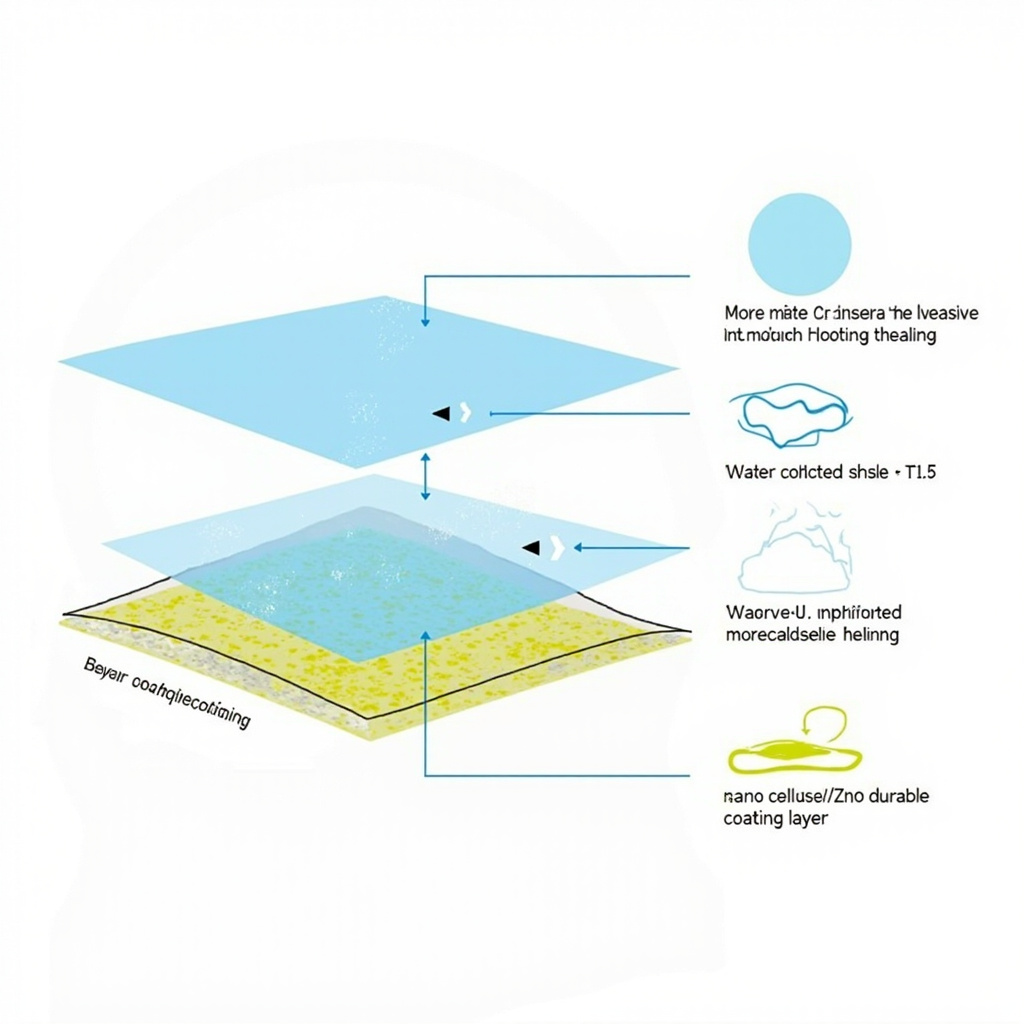
Mechanism Details—Two Superhydrophilic Technical Routes.Route 1: TiO2 photocatalytic-induced superhydrophilicity. Anatase nano-TiO2 (particle size 5-20nm) under ultraviolet light (wavelength 72mN/m (surface tension of water) → water droplets completely spread on the surface (contact angle → 0°). Key feature: The superhydrophilic state requires UV "activation", and gradually reverts to a hydrophobic state over several hours to days in darkness—TiO2 needs periodic light exposure to maintain its function.
Route 2: Nanocellulose/hydrogel water absorption and swelling. Two studies published in Progress in Organic Coatings in 2025 represent the latest breakthrough in anti-fog durability: (1) Hyaluronic acid (HA)-glycerol-FeCl₃-ZnO nanoparticle hydrogel coating — a "biomimetic" design mimicking the human tear film, with no anti-fog performance decay after 120 h water immersion, contact angle still <5° after 300 cycles of sandpaper abrasion, and scratches self-healing within 10 s (reorganization of dynamic Fe³⁺-HA ionic crosslinks). (2) Sodium carboxymethyl cellulose (CMC) + ZnO nanoparticles + FeCl₃ + glycerol system — no anti-fog decay after 240+ days of storage at room temperature, and retains function after 100 h xenon lamp aging plus 80 h water immersion.
Data support:IOTA ST5 (launched by Anhui IOTA Silicone Oil in 2025) is a superhydrophobic nano-coating specifically designed for automotive rearview mirrors (not a hydrophilic route) — achieving a contact angle of >150° through fluorocarbon silane chemical modification, causing raindrops to roll off under gravity or wind rather than spreading. This differs from the application scenarios of hydrophilic anti-fog routes: the hydrophilic route is suitable for "fog" (micro-condensed water droplets, static state), while the hydrophobic route is suitable for "rainwater" (large water droplets, with gravity/wind driving force). The optimal solution for rearview mirrors may be a zoned design — hydrophobic on the upper mirror surface (repels rainwater) + hydrophilic on the lower part (prevents fog).
Source:Progress in Organic Coatings (Vol.198/206, 2025), ScienceDirect (2025), IOTA ST5 Technical Data, QYResearch 2026
Durability—the "Achilles' heel" of anti-fog coatings
Direct answer: The failure modes of anti-fog coatings mainly include: water immersion causing leaching of hydrophilic components (loss of plasticizers/glycerol/surfactants), mechanical abrasion (wiping/wiper scraping) physically removing the coating, and UV aging degrading organic components. Breakthroughs in 2025 have focused on solving durability issues through three pathways: chemical cross-linking (covalently anchoring hydrophilic groups), inorganic-organic hybridization (nanoparticle reinforcement), and self-healing functionality (dynamic bond reorganization).
Latest data on HPMC/HEC (hydroxypropyl methyl cellulose/hydroxyethyl cellulose) anti-fog coatings (Progress in Organic Coatings, Vol. 198, 2025): one-step green preparation (pure water solvent, no organic solvents/fluorine-containing compounds), transmittance >90%, capable of withstanding 3000 fabric rubbing cycles, and no anti-fog performance decay after 1 year of storage at -20°C—this represents one of the highest durability data reported to date for cellulose-based anti-fog coatings.
Source:Progress in Organic Coatings (2025), Pellucere Technologies (2025)
FAQ
Are hydrophilic anti-fog and hydrophobic water-repellent the same thing?
Exactly the opposite. Hydrophilic (contact angle 150°) makes water roll off—suitable for rain (large droplets). The optimal solution for rearview mirrors is a zoned or dual-layer design.
Will a TiO2 anti-fog coating fail in a tunnel (without UV)?
Yes. The superhydrophilicity of TiO2 requires UV "activation"—in the dark for several hours, surface –OH is gradually covered by contaminants and the hydrophilicity decays. Solutions: TiO2+SiO2 composite (using the intrinsic hydrophilicity of SiO2 as a "backup" in the absence of UV) or cellulose/hydrogel route (not dependent on UV activation).
How long does a single application last?
Consumer-grade spray products: 3–6 months. Professional-grade coatings: 1–2 years. OEM-grade CVD/sputtered TiO2 coatings (some high-end models): 5–10 years but cost an order of magnitude higher.
Will an anti-fog coating affect the specular reflectance of a mirror?
High-quality products have a visible light transmittance >90%; when the anti-fog function is activated (water film formed), the transmittance is even higher than in the dry state (the water film fills surface micro-defects and reduces diffuse reflection). Inferior products may exhibit rainbow streaks or increased haze.
Reference sources:Progress in Organic Coatings (2025, Vol.198/206), ScienceDirect (2025), QYResearch 2026, Pellucere Technologies, IOTA ST5
Date: July 6, 2026 | Category: Technical Knowledge