Key Takeaways:
1. Far-infrared nano insulation coatings rely on dual mechanisms — cesium tungsten bronze LSPR absorption and ATO free-electron reflection — achieving >90% IR rejection while maintaining >70% visible light transmission.
2. The critical technological advantage is selective IR blocking without sacrificing visible transparency — unachievable with traditional insulation materials (carbon black, metalized films).
3. Coatings deliver maximum thermal benefit during vehicle “heat soak” phase (post-parking heat accumulation) rather than steady-state driving — a quantitative finding with direct engineering implications for vehicle thermal management strategy design.
Vehicles parked under summer sun can reach interior temperatures exceeding 70°C within 30 minutes — impacting occupant comfort and directly increasing AC energy consumption (approximately 5-10% of total vehicle energy use). Far-infrared nano insulation coatings for vehicles achieve efficient thermal management by precisely controlling transmission and reflection of the infrared portion of the solar spectrum (780-2500nm, ~53% of solar radiation energy) without compromising visible light transmission. The core technology relies on nanoscale metal oxide semiconductor materials — small enough (<100nm) to be transparent to visible light, yet sufficiently "active" to strongly absorb or reflect infrared radiation.
Infrared Physics Engineering — How Do Nanoparticles Selectively Block Heat?
Direct Answer: Solar radiation energy distribution: UV (300-380nm) ~5%, visible (380-780nm) ~42%, IR (780-2500nm) ~53%. Traditional insulation materials (dyed films, metalized films) cannot differentiate between visible and infrared light — either blocking both (dyed films sacrificing transparency) or reflecting both (metalized films interfering with GPS/ETC signals). Nanoscale metal oxide semiconductors, particularly cesium tungsten bronze (Cs₀.₃₃WO₃) and ATO (antimony-doped tin oxide), achieve differentiated visible/IR response through two distinct physical mechanisms.
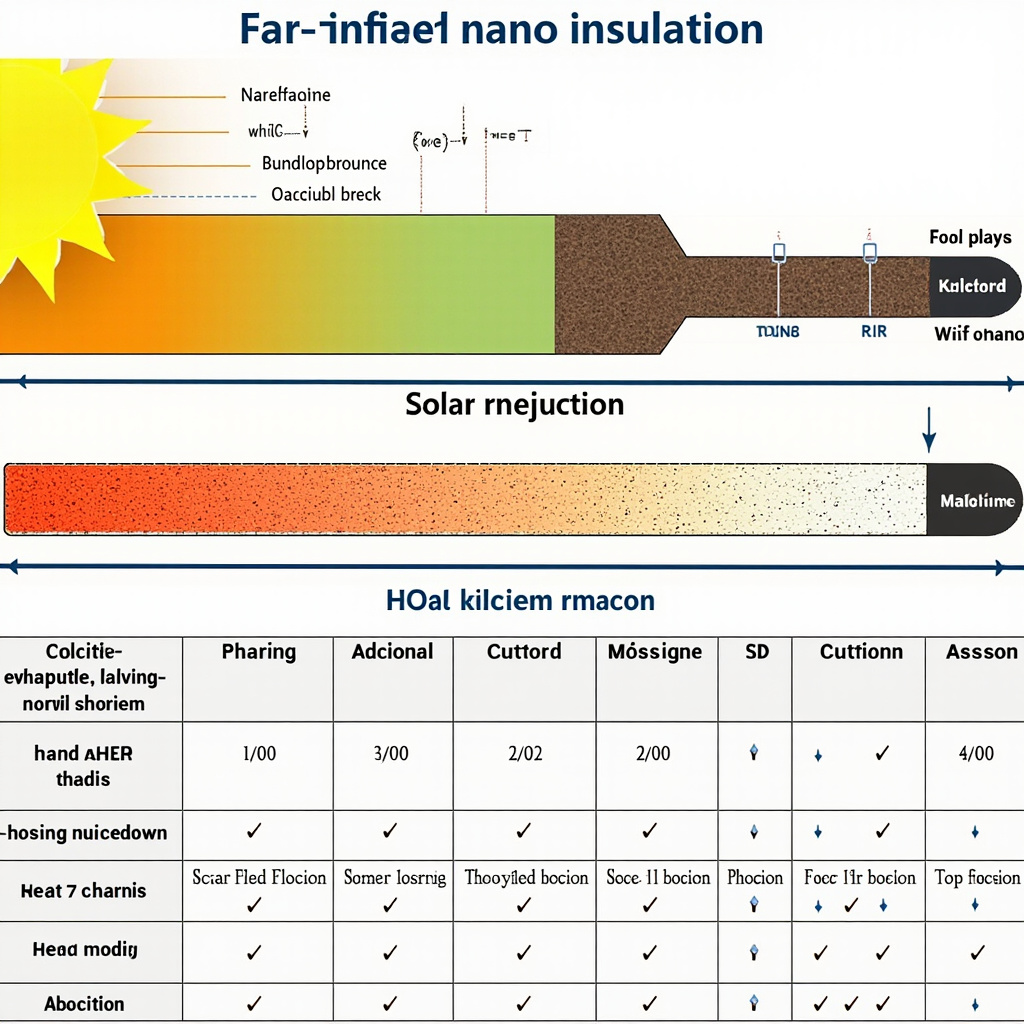
Mechanism 1 — Cs₀.₃₃WO₃ Localized Surface Plasmon Resonance (LSPR) Absorption: Cs₀.₃₃WO₃ possesses a unique hexagonal tungsten bronze crystal structure where Cs⁺ ions are embedded within hexagonal channels of the WO₆ octahedral framework. This structure generates LSPR effects in the near-infrared band (800-1200nm) — incident IR photons resonantly couple with collective oscillations of free electrons on nanoparticle surfaces, with IR energy efficiently absorbed and converted to heat (subsequently dissipated outside the vehicle through convection and radiation). The LSPR peak of Cs₀.₃₃WO₃ nanoparticles is located at approximately 950nm, precisely at the strongest band of solar IR radiation.
Mechanism 2 — ATO Free-Electron Reflection: Antimony-doped tin oxide (ATO, Sb:SnO₂) introduces free carriers (electrons) into the SnO₂ lattice through Sb⁵⁺ substitution for Sn⁴⁺, forming an energy band structure similar to transparent conductive oxides (TCOs). When free electron concentration reaches ~10²⁰-10²¹ cm⁻³, the plasma frequency falls into the IR band — electromagnetic waves below this frequency (i.e., IR) are collectively reflected by free electrons, while those above (i.e., visible light) transmit through. The unique advantage is non-metallic — no electromagnetic signal shielding unlike metalized films.
Data Support: Commercial Cs₀.₃₃WO₃ nanodispersions (20-30wt% solids) achieve 92-97% IR rejection at 950nm while maintaining 70-75% visible light transmission. ATO nano-coatings achieve >90% IR rejection at 1400nm with ~80% visible transmission. Sumitomo Metal Mining’s CWO® series and Merck’s LAZERFLAIR® series represent global benchmarks for Cs₀.₃₃WO₃ nanodispersions. Chinese Cs₀.₃₃WO₃ nanopowder synthesis and dispersion technology has achieved significant progress by 2025, with domestic product performance approaching imported product levels.
Sources: CTIA Wiki, Journal of Materials Chemistry C (2023), Sumitomo Metal Mining Technical Data, Merck LAZERFLAIR® Specifications
Vehicle Thermal Management Engineering — From Heat Soak to System-Level Optimization
Direct Answer: A 2025 study published in Infrared Physics & Technology quantitatively analyzed insulation coating effectiveness under different vehicle operating conditions: coatings deliver maximum benefit during the post-parking “heat soak” phase (thermal spike after engine shutdown) — reducing peak cabin temperature by 10-12°C with ~40% reduction in temperature rise rate. During steady-state driving, forced convection cooling dominates heat transfer, making coating benefits relatively limited (3-5°C reduction). Under direct solar exposure, coating insulation gains show diminishing returns beyond 5μm thickness — providing direct engineering guidance for coating thickness optimization.
Data Support: Comparative field testing shows: under 35°C ambient temperature and 800W/m² solar irradiance, vehicles with nano insulation coating (Cs₀.₃₃WO₃+ATO composite system) reached 48°C cabin temperature after 60 minutes parking, versus 59°C for uncoated vehicles — an 11°C difference. AC cooling time from startup to 26°C: coated ~4.5 min vs. uncoated ~7 min. Based on 2 short trips/day and 3kW AC power, annual electricity savings of ~150-200 kWh (equivalent to ~800-1000 km additional EV range per year).
Sources: Infrared Physics & Technology (2025), StarShield Technical Data, Gasgoo
FAQ
Q: Nano insulation coating vs. traditional window tint film — differences?
Traditional film is physical lamination (PET + dye/metal layer); nano coating is chemical cross-linking cure. Coating advantages: (1) no edge peeling or bubbling; (2) no GPS/ETC/5G signal interference (non-metallic reflection mechanism); (3) applicable to curved glass and sunroofs. Disadvantages: coating durability (3-5 years) typically shorter than premium films (5-10 years).
Q: Does cesium tungsten bronze coating have color?
Cs₀.₃₃WO₃ nano-coatings exhibit a very faint blue tint at thin layers (<5μm) — this is the weak tailing effect of LSPR absorption at the visible spectrum edge (~600-700nm, red/orange light). For high-transparency applications, reducing Cs₀.₃₃WO₃ concentration and increasing ATO ratio balances insulation performance with color neutrality.
Q: How much fuel/electricity can nano insulation coatings save?
Field data shows annual savings of ~20-30L fuel for ICE vehicles (reduced AC load) and ~800-1000 km additional range for EVs. In hot southern regions (>2000 hours annual sunshine), savings are 30-50% higher.
Q: How effective is insulation coating on panoramic sunroofs?
Sunroofs represent the weakest point in vehicle thermal insulation — panoramic sunroofs can reach 1-2m² with >80% IR transmittance. Nano insulation coating or Cs₀.₃₃WO₃ PVB interlayer film can reduce sunroof IR transmittance to <15%, lowering the roof inner surface temperature by 15-20°C.
References: Infrared Physics & Technology (2025), Journal of Materials Chemistry C (2023), CTIA Wiki, Sumitomo Metal Mining, Merck LAZERFLAIR®, StarShield Technical Data, Gasgoo
Published: July 6, 2026 | Category: Technical Knowledge