Key Takeaways:
1. Superhydrophobic nano glass coatings create 5-60nm roughness + fluorocarbon chemistry, achieving 150°+ water contact angle with sub-10° sliding angle.
2. Rain droplets roll off automatically above 60km/h without wipers. Global self-cleaning glass market projected to reach $698M by 2034.
3. The critical challenge is durability against wiper abrasion — next-gen laser-etched textures with microscale armor protection are breaking through this bottleneck.
When driving in rain, the water film on the windshield is the primary factor compromising visibility. Traditional wipers mechanically scrape away water but introduce noise, wear, and intermittent visibility loss. Superhydrophobic nano glass coatings offer a fundamentally different approach — making the glass surface itself “water-hating,” so raindrops cannot spread into a film but instead roll off under gravity or wind force.
The Science of Superhydrophobicity — Why Water Droplets “Dance” on Coated Glass
Direct Answer: The core principle is biomimetic “lotus leaf effect” — constructing nanoscale rough structures (5-60nm peaks and valleys) on the glass surface, trapping air in cavities to form an “air cushion,” reducing actual solid-liquid contact area to less than 10% of apparent area, pushing contact angles beyond 150°.
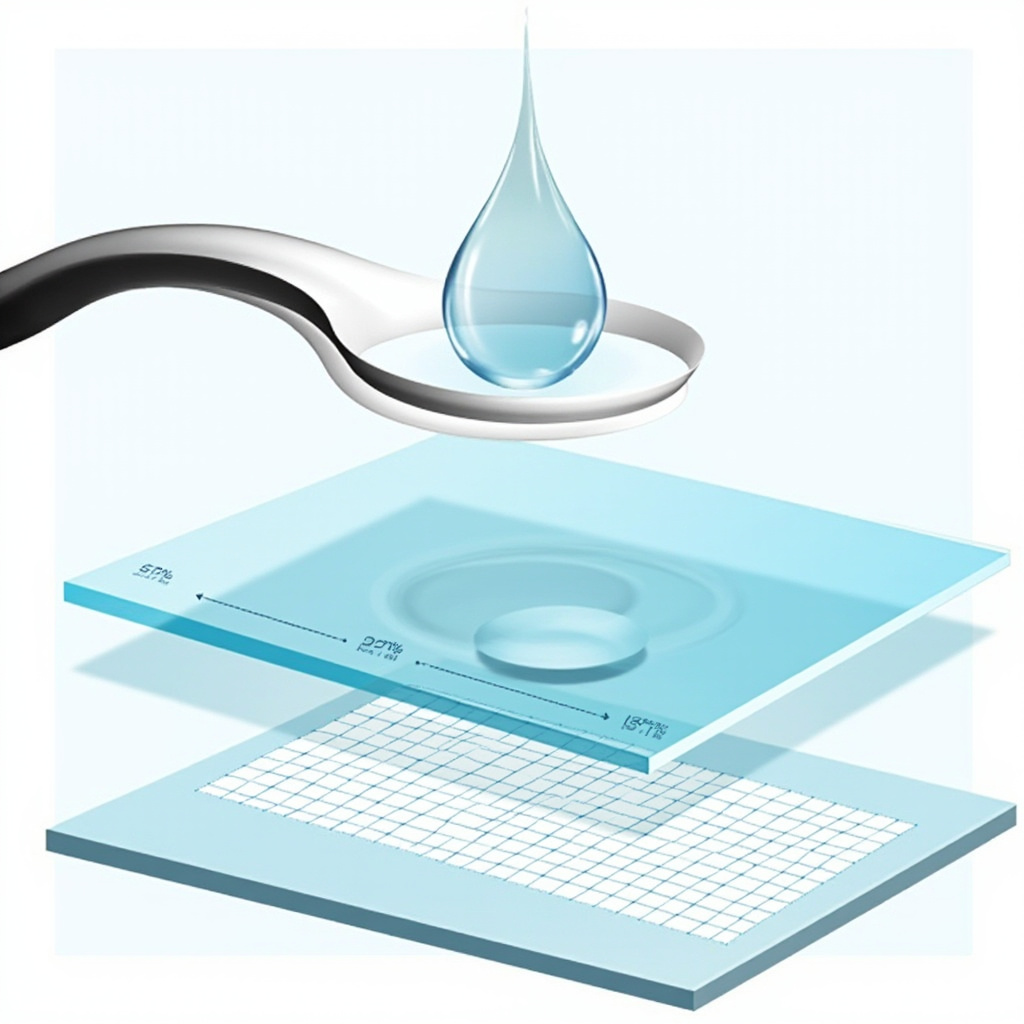
Mechanism: In nature, the lotus leaf’s superhydrophobicity stems from dual-scale roughness: microscale papillae (~10μm) overlaid with nanoscale wax crystals (~100nm). Nano glass coatings replicate this strategy through sol-gel deposition of nano-SiO₂ or polysilazane particles, creating lotus-like nanoscale topography. Subsequent fluorocarbon silane (e.g., perfluorodecyltrichlorosilane) or PDMS treatment reduces surface energy from ~72 mN/m (bare glass) to below 20 mN/m.
The sliding angle is a more practical metric than contact angle. Premium superhydrophobic coatings achieve sliding angles below 10° — meaning water droplets begin rolling on a mere 10° incline. On automotive windshields (typically inclined 30-45°), rainwater slides off even when the vehicle is stationary.
Data Support: Tsinghua University researchers (2018, Journal of Materials Chemistry) used femtosecond laser etching on silica glass to create micropit arrays with self-organized nanorods, achieving 161° contact angle, <2° sliding angle, >92% transparency, and surviving 168-hour water immersion plus 500°C thermal testing. Chinese Academy of Sciences teams further developed microscale “armor” protective frames allowing nanostructures to withstand sandpaper abrasion and high-pressure water jets.
Sources: Journal of Materials Chemistry (2018), Physics World (2024), CAS Nanomaterials Laboratory
Product Categories and Performance Comparison
Direct Answer: Market products fall into three categories: consumer-grade sprays (3-6 month durability), professional-grade application compounds (1-2 year durability), and OEM-grade CVD/laser-etched solutions (permanent, premium vehicle options only).
Consumer products like Rain-X and Sinograce PF-304 are typically alcohol-based quick-dry formulations with ~100-110° contact angles. Their advantage is DIY accessibility; their weakness is rapid performance degradation with each car wash or wiper pass. Professional products like Gtechniq G1/G5 and CarPro FlyBy Forte use two-component chemical curing systems, achieving 115-120° contact angles with 1-2 year or 20,000km durability. The most advanced OEM solutions — such as Oak Ridge National Laboratory’s “Moses Effect” coating — use phase-separated glass powder to create permanent nanoscale roughness, maintaining a micro-air layer even when fully submerged.
Data Support: Nasiol FCC third-party testing shows water contact angle maintained at ~95° after 5,000 wet scrub cycles (from initial 102°). IOTA ST5 (Anhui Iota Silicone) demonstrates contact angles stable above 115° under 50-100°C curing conditions.
Sources: Sinograce Chemical Technical Data, Nasiol FCC Specifications, Oak Ridge National Laboratory 2024
FAQ
Q: Does the coating affect windshield wipers?
Quality coatings do not damage wipers, but inferior silicone-oil products may cause wiper chatter. Choose fluorocarbon/polysilazane-based products specifically designed for automotive glass.
Q: How long does one application last?
Consumer-grade: 3-6 months. Professional-grade: 1-2 years. Durability depends on wiper usage frequency, washing methods, and environmental exposure (UV, acid rain accelerate degradation).
Q: Can I apply it myself?
Consumer spray products: yes (deep clean→degrease→apply→cure→buff residue). Professional products: recommended to use authorized installers for optimal results.
Q: Does it affect nighttime visibility?
High-quality products have >92% light transmittance with minimal visual impact. Inferior products may cause haze, rainbow effects, or glare — posing nighttime driving hazards.
Q: Can it be used on all windows?
The windshield (constant wiper abrasion) shows the shortest durability. Side windows and mirrors (no wiper contact) deliver the longest-lasting performance and represent the highest-value application.
References: Journal of Materials Chemistry (2018), Physics World (2024), Oak Ridge National Laboratory, Sinograce Chemical, Nasiol Technical Data, CAS Nanomaterials Research
Published: July 5, 2026 | Category: Technical Knowledge