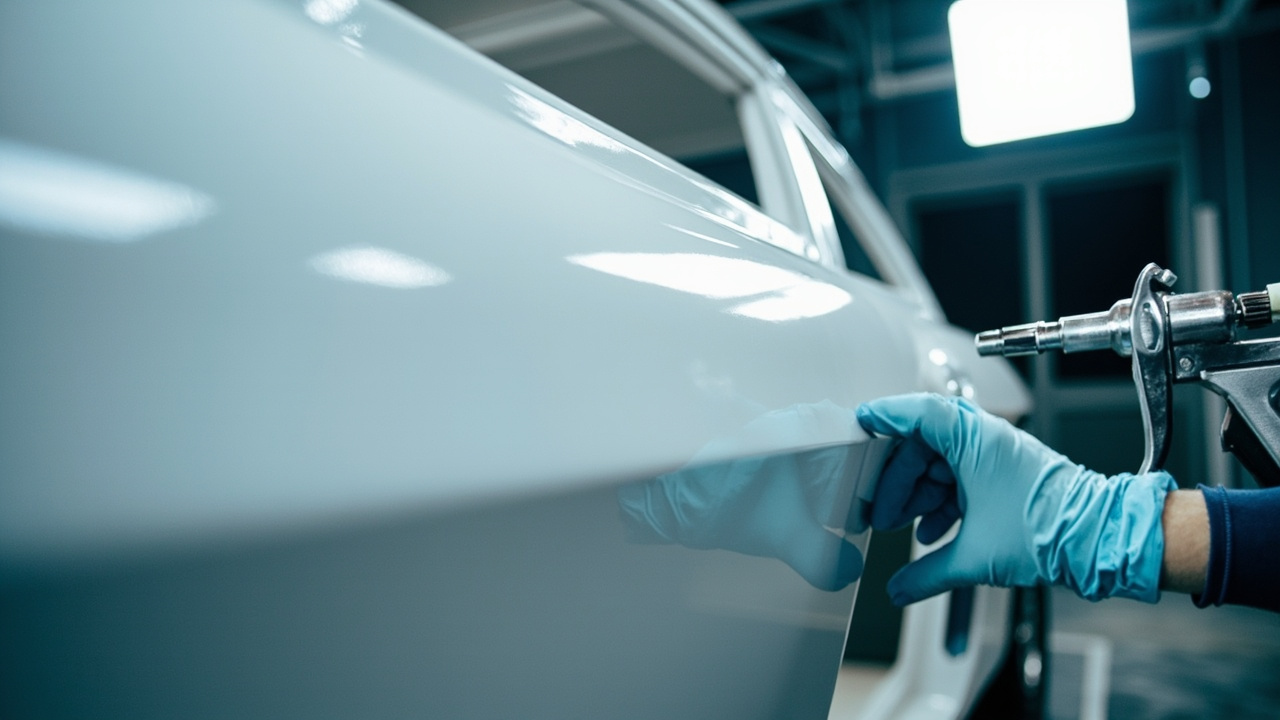
2K polyurethane clear coat (two-component polyurethane clear coat) is the most critical "protective layer" in modern automotive refinish and OEM topcoat systems. It does not directly provide color, yet it determines the vehicle's gloss, weather resistance, scratch resistance, and chemical corrosion resistance. Many car owners and technicians only care about "whether it's shiny and dries fast," but overlook the real factors behind performance: the crosslinking mechanism of HDI curing agent, precise mixing ratio, controlled dry film thickness (DFT), and the unavoidable VOC compliance red line.
As a technical supplier of automotive coating and industrial protective coating, Kexin New Materials (kexinMaterials) has accumulated extensive frontline data on the formulation and application support of two-component polyurethane systems. This article also combines real parameters from publicly available TDS (Technical Data Sheets) of AkzoNobel, Axalta, and BASF to break down the key technical indicators of 2K polyurethane clear coat, helping you upgrade "experience" to "citable data" in selection and application.
I. What is 2K Polyurethane Clear Coat: From 1K to 2K
Clearcoat is the outermost transparent protective layer in the coating system. By film-forming method, clearcoats are divided into one-component (1K, film formed by solvent evaporation or oxidative drying) and two-component (2K, film formed by chemical crosslinking). The reason 2K polyurethane clear coat leads comprehensively in performance lies in its "2K"—that is, the base paint (containing hydroxyl resin) and curing agent (containing polyisocyanate) must be mixed in proportion before use, and after mixing a chemical reaction generates a dense polyurethane network.
Taking the most common acrylic polyurethane clear coat in automotive refinish as an example, its base resin is acrylic polyurethane resin, and the curing agent base is polyisocyanate. According to the TDS description of AkzoNobel Lesonal 2K Clearcoat 288 HS, the system is a "two-component acrylic polyurethane clear coat, high solids (HS)," with the base explicitly stated as "acrylic polyurethane resin (clearcoat) + polyisocyanate (curing agent)." BASF Glasurit 923-666 is likewise defined as "2K acrylic polyurethane, high solids (HS)." This shows that the film-forming substances of mainstream 2K clearcoats are highly consistent: acrylic-modified hydroxyl resin + aliphatic/cycloaliphatic polyisocyanate.
Why polyurethane rather than other systems? Because the reaction between —NCO (isocyanate group) and —OH (hydroxyl group) can generate urea/urethane bonds at room or medium-low temperature, forming a 3D crosslinked network that delivers hardness, abrasion resistance, and chemical resistance far beyond 1K systems. This is also the fundamental reason it can simultaneously handle "high decoration (high gloss)" and "heavy protection (weathering and chemical resistance)."
1.1 HDI Curing Agent: The Role of Aliphatic Isocyanate
In automotive clearcoats, the curing agent mostly uses HDI (hexamethylene diisocyanate) type polyisocyanate or its trimer and adduct. According to the automotive paint section of the research archive: "Automotive 2K curing agent contains HDI (hexamethylene diisocyanate) type polyisocyanate." The key to choosing HDI over TDI (toluene diisocyanate) is the yellowing resistance of aliphatic HDI—aromatic TDI tends to yellow under long-term UV exposure, while the aliphatic structure of HDI offers excellent gloss and color retention, which is the fundamental requirement for clearcoats needing long-term outdoor weathering.
But HDI also brings safety issues: isocyanates are sensitizing to the respiratory tract, and sensitization is irreversible. The MSDS section of the research archive clearly states that isocyanate concentration in the spray booth during spraying can exceed the OSHA PEL (HDI PEL = 0.02 ppm) by 50–100 times, so respirators and nitrile gloves must be worn during application. We will revisit this in the VOC and safety section later.
II. Comparison Table of Core Parameters from Three Real TDS
To evaluate a 2K clearcoat, don't just look at advertising claims—pull out the hard indicators in the TDS. The table below summarizes publicly available real data of three mainstream 2K clearcoats from the research archive, with all values directly cited from the corresponding manufacturers' TDS and units preserved.
| Technical Indicator | AkzoNobel 288 HS | Axalta LV9714 | BASF 923-666 |
|---|---|---|---|
| System Type | 2K acrylic polyurethane (high solids HS) | 2K fast-dry clearcoat (2.1 lb/gal VOC) | 2K acrylic polyurethane (high solids HS) |
| Base : Curing Agent Mixing Ratio | 2 : 1 (volume), plus +10% thinner | 4 : 1 (volume) | 2 : 1 (volume, no thinner needed) |
| VOC (mixed material) | 538 g/L | 230 g/L (≈2.1 lb/gal) | ≤ 419 g/L |
| Volume Solids | High solids (HS, exact value not disclosed) | 32.93% (volume) / 35.34% (mass) | 50–55% (ready-to-use mixture) |
| Recommended DFT | 50–60 µm | Single coat approx. 25 µm (≈1.0 mil), 2 coats recommended | 40–60 µm (1.5–2 wet coats) |
| Spray Viscosity (DIN 4 @20℃) | 13–16 s | Not listed separately (HVLP 1.3–1.4 mm) | 18–21 s |
| Pot Life | Depends on curing agent type (typically several hours) | 1 h (@25℃) | 2 h (@20℃) |
| Drying (ambient) | 728B tack-free 15 min / handleable 2 h | Polishable 45–60 min / full 7 d | 20℃ air 10 h handleable |
| Forced Drying | 60℃ bake greatly shortens time | Mainly ambient | 60℃ bake 30 min or 20℃ 10 h |
| Pencil Hardness | Typical high gloss | Not listed separately | > 2H |
| Theoretical Coverage | 7 m²/L (mixed material) | Depends on DFT | 10–12 m²/L (@50µm) |
This table is the "skeleton" of the whole article. Next, we break down the engineering meaning behind each column and how it affects your final result.
III. Crosslinking Mechanism of HDI Curing Agent: Why 2K is Harder than 1K
To understand the performance source of 2K clearcoat, the film-forming mechanism must be explained thoroughly. After the two components are mixed, the —NCO groups in the curing agent undergo nucleophilic addition with the —OH groups in the resin:
—NCO + —OH → —NH—COO— (urethane bond / polyurethane bond)
When a trifunctional HDI trimer is present in the system, the reaction extends from linear to a 3D crosslinked network. The higher the crosslink density, the denser the film, manifested as:
- High hardness: BASF 923-666 TDS specifies pencil hardness > 2H;
- Good chemical resistance: resistant to acid, gasoline, UV (per ISO 2812 test), suitable for hood, fuel cap, and other parts easily exposed to oil;
- Abrasion and scratch resistance: dense network resists external mechanical damage;
- Gloss and color retention: aliphatic HDI resists UV yellowing, no yellowing under long-term outdoor exposure.
In contrast, one-component clearcoats (such as 1K acrylic or nitrocellulose) form film by solvent evaporation without chemical crosslinking; molecular chains are only physically entangled, so hardness and chemical resistance are naturally lower than 2K. This is why high-end refinish and OEM clearcoats almost invariably use 2K polyurethane.
Note that the crosslinking reaction is extremely sensitive to ratio, temperature, humidity, and activation time. Wrong mixing ratio leaves unreacted —NCO or —OH in the film, causing softening, gloss loss, and sharp drop in chemical resistance; too humid an environment causes —NCO to preferentially react with water, foaming and generating amine by-products; too low temperature makes the reaction very slow or even non-curing. So "mixing ratio is much stricter than casually stirring coffee."
IV. Mixing Ratio and Proportion Discipline: 2:1, 4:1, 2:1 Cannot Rely on Feel
The three TDS have different mixing ratios, but the common point is precise volumetric measurement must be used, never by feel:
- AkzoNobel 288 HS: clearcoat : 728 curing agent = 2 : 1 (volume), with an additional 10% 810 thinner (volume). Note that this "10%" is added by volume relative to the base, not casually mixed; excessive thinning reduces solids, lowers film thickness, and prolongs drying.
- Axalta LV9714: LV9714 : curing agent (LV9355/56) = 4 : 1 (volume). The ratio is leaner (higher base proportion), corresponding to its fast-dry positioning.
- BASF 923-666: varnish : 929-666 hardener = 2 : 1 (by volume), and no thinner required—this is a characteristic of high-solid systems, as the application viscosity of the base paint is already adapted for spraying.
Engineering implications of mixing discipline:
- Insufficient hardener→ inadequate crosslinking → soft, tacky film, poor chemical resistance, easy gloss loss;
- Excess hardener→ more residual —NCO → brittle film, prone to cracking, releases more free monomers, greater irritation;
- Uncontrolled thinner→ insufficient film thickness, sagging, orange peel, uneven gloss.
Practical advice: use a graduated mixing cup (cylinder) to measure by volume ratio, pour the base paint first, then add hardener, finally add thinner (if needed), stir in one direction at constant speed for 2–3 minutes, let stand to defoam (induction) before use. This shares the same principle with water-based systems regarding equipment and mixing requirements. For the selection logic of industrial coatings, refer to How to Select Waterborne Industrial Coatings: Resin Systems and Applicable Conditions.
V. Dry Film Thickness DFT: 50–60µm, Thicker Is Not Always Better
DFT (Dry Film Thickness) is the most easily overlooked yet most critical parameter in 2K varnish application. Recommended DFT from the three TDS:
- AkzoNobel 288 HS: 50–60 µm;
- BASF 923-666: 40–60 µm (1.5–2 passes of wet spraying);
- Axalta LV9714: approx. 25 µm (≈1.0 mil) per pass, 2 passes recommended.
Why control varnish in this range? Too thin ( 70–80 µm) means high internal stress, easy sagging, orange peel, and outer layer cures fast while inner layer reacts slowly, leading to "surface dry but inner not dry" and later shrinkage cracking. Varnish DFT is usually estimated by "wet film thickness × volume solids" (WFT = DFT ÷ volume solids). For example, BASF 923-666 has 50–55% volume solids; to achieve 50 µm DFT, wet film needs about 90–100 µm, corresponding to two wet passes.
Measure DFT with magnetic/eddy-current gauge (magnetic and eddy-current principles for steel/aluminum substrates respectively); measure wet film immediately after application, spot-check dry film after curing. The common industry defects "varnish cracking, fish eyes, pinholes" are, in nine out of ten cases, related to uncontrolled DFT or uneven film thickness.
VI. Spray Viscosity and DIN 4: The Difference Between 13–16s and 18–21s
Viscosity determines atomization and leveling. Automotive varnishes commonly use DIN 4 cup (20℃) to measure flow-out time:
- AkzoNobel 288 HS: spray viscosity 13–16 s (DIN 4 @20℃);
- BASF 923-666: spray viscosity 18–21 s (DIN 4 @20℃).
The difference comes from solids and formulation: the high-solid BASF (50–55%) base paint is thicker and needs longer flow-out time; while 288 HS with 10% thinner is more dilute, 13–16 s gives good atomization. Consequences of deviating from recommended range:
- Too thin → sagging, insufficient film thickness, less orange peel but easy show-through;
- Too thick → poor atomization, coarse particles, heavy orange peel, difficult bubble release.
Viscosity must be measured with same type of viscosity cup, same temperature to be comparable. For every 1℃ rise, flow-out time shortens noticeably, so TDS all specify @20℃. If no DIN 4 cup on site, at least use Ford Cup #4 for conversion, but keep recording consistent. For environmental control of coating drying and curing, read further at Drying and Curing Principles of Water-based Paint.
VII. Drying and Curing: Ambient, 60℃ Baking and Infrared
The "dry" of 2K varnish has two meanings—surface dry/handle dry and full crosslink curing. The three TDS provide different paths:
- AkzoNobel 288 HS (@20℃): 728B hardener touch dry 15 min, handleable 2 h; 728C about 5 h; 728CC about 7 h 35 min. 60℃ baking greatly shortens. Infrared: half power 4 min / full power 6 min (panel temp ≤100℃).
- Axalta LV9714 (@25℃): tack-free 5–10 min, dust-free 10–15 min, polishable 45–60 min, re-polish 2–4 h, full cure 7 d. Pot life 1 h.
- BASF 923-666: 60℃ bake 30 min or 20℃ air 10 h; pot life 2 h (@20℃).
Key interpretation:
- "Handleable/polishable" ≠ "fully cured". Axalta can be polished in 45–60 min, but full cure still takes 7 days; premature polishing may damage the not-fully-crosslinked film.
- Baking is an efficiency lever. 60℃ baking for 288 HS and 923-666 compresses lead time from "hours/days" to "minutes/half-hour", suitable for batch flow in refinish shops. But panel temperature must be controlled (infrared ≤100℃) to prevent varnish thermal degradation or substrate deformation.
- Pot Life is a dead line. Chemical reaction starts after mixing; beyond 1–2 h (depending on hardener) viscosity spikes, even gels and scraps. Must "estimate usage, mix accordingly".
VIII. VOC Comparison: 538, 230, ≤419 g/L and Regulatory Red Lines
VOC (volatile organic compounds) is an unavoidable eco indicator for 2K varnish. VOC from the three TDS (all theoretical mixed values):
- AkzoNobel 288 HS: 538 g/L;
- Axalta LV9714: 230 g/L (i.e., 2.1 lb/gal, low VOC fast-dry type);
- BASF 923-666: ≤ 419 g/L (compliant with EU/China).
Putting numbers in the regulatory coordinate makes the weight clear. Automotive coatings are bound by GB 24409-2020 "Limit of Harmful Substances in Vehicle Coatings", setting VOC upper limits for varnish; solvent-based coatings also refer to EU 2004/42/EC, CARB/SCAQMD Rule 1113, etc. Among the three, Axalta 230 g/L is significantly lower, positioned as "2.1 VOC" low-emission; while 288 HS's 538 g/L is typical high-solid solvent-based value, compliant but higher emission.
From a tech trend, two paths to lower VOC: ① raise volume solids (less solvent, more film former, e.g., BASF 50–55% solids); ② waterborne or high-solid + low-toxic thinner. As a system supplier, Kexin New Materials (kexinMaterials) always treats GB 24409-2020 limits as a hard boundary in formulation design when pushing high-solid and low-VOC two-component systems, not an afterthought—this is also key for refinish shops to pass eco audits and avoid production limits.
Clarify a misconception: high VOC ≠ high performance. VOC is only a solvent content indicator; what truly determines performance is resin and crosslink density. Low VOC products (e.g., Axalta 230 g/L) can fully achieve fast dry, polishable, weather-resistant. Selection should review "VOC compliance" and "performance达标" side by side, not use VOC level to hijack performance judgment.
IX. Pencil Hardness and Chemical Resistance: What >2H Means
BASF 923-666 TDS states pencil hardness > 2H, and declares resistance to acid, gasoline, UV (ISO 2812). Pencil hardness (GB/T 6739 / ISO 15184) uses a set of standard pencils to scratch the film; higher means stronger scratch resistance. Above 2H means daily car wash, sand, minor scrapes leave no marks—exactly one core value of varnish.
But note: hardness and flexibility often trade off. Varnish too hard is brittle, too soft is easily scratched. 2K polyurethane balances both via crosslink density, better than 1K varnish. Interlayer adhesion with substrate and intermediate coat (GB/T 9286 cross-cut, 0 best) also decides final durability; talking varnish hardness in isolation is meaningless.
X. Application Process Recommendations: Turn Parameters into Stable Quality
To turn the above parameters into an executable process, recommendations are as follows (typical case of high-solid 2K varnish):
- Substrate and environment: temperature 15–25℃, relative humidity ≤ 70%, substrate temp at least 3℃ above dew point; clean spray booth, positive pressure, good ventilation.
- Mixing: measure by TDS volume ratio (e.g., 2:1 or 4:1) with cup, add specified thinner (if any), stir in one direction 2–3 min, stand to defoam.
- Viscosity: DIN 4 @20℃ adjust to TDS range (e.g., 13–16 s or 18–21 s).
- Spraying: spray gun 1.2–1.4 mm (see another article of this batch for detailsAutomotive paint application equipment and spray gun parameters), HVLP cap-end pressure ≤ 0.7 bar (≈10 PSI); apply in 1.5–2 wet coats, controlling DFT at 40–60 µm.
- Drying: After flash-off at room temperature, bake at 60℃ for 30 min (or corresponding infrared process); avoid heavy polishing, water contact, or film application before fully cured.
- Inspection: Measure DFT, gloss (60° high gloss ≥ 85 GU, per GB/T 9754), cross-cut adhesion, and appearance (no orange peel, sagging, or particles).
Kexin New Materials (kexinMaterials) delivers with a "paint + process card" approach: not only providing formulation parameters, but also the process boundaries for corresponding spray guns, viscosity, film thickness, and baking windows, enabling refinishers to transform the "master craftsman's feel" into "reproducible data" and reduce batch variation. For production lines undergoing water-based conversion or low-VOC upgrades, such support is especially critical.
XI. Common Selection Misconceptions
Misconception 1: Lower VOC means worse performance. Wrong. Axalta's 230 g/L has proven that low VOC can also be fast-drying and weather-resistant; performance depends on the resin, not the amount of solvent.
Misconception 2: More hardener makes it harder. Wrong. Excess hardener causes brittleness, cracking, and increased free monomers; strict ratio compliance is the prerequisite.
Misconception 3: Polishable = cured. Wrong. Axalta can be polished in 45–60 min, but full cure takes 7 days; premature re-polishing is risky.
Misconception 4: Thicker clear coat means more protection. Wrong. DFT > 70–80 µm creates high internal stress and is prone to cracking; 40–60 µm is the optimal engineering range.
Misconception 5: Hardeners from different brands of clear coat can be mixed. Wrong. The —NCO and —OH reaction is sensitive to equivalent weight, activity, and solvent system; cross-brand mixing easily causes loss of gloss and non-curing.
Misconception 6: Only look at brightness, not DFT. Wrong. Brightness is superficial; DFT is the real guarantee for weather and scratch resistance, and must be quantified with a thickness gauge.
Misconception 7: Room temperature is always sufficient. Wrong. 60℃ baking significantly shortens turnaround and improves crosslinking completeness; batch refinishing should prioritize baking.
XII. Supporting System: Primer, Intermediate Coat, and Pigmented Paint above the Clear Coat
The clear coat does not exist in isolation. In a complete automotive coating system, the 2K clear coat is only the outermost "clear protection"; beneath it are the basecoat (providing color and flop effect), intermediate coat (filling, stone-chip resistance), and electrophoretic/primer (anti-corrosion and adhesion). The research archive's automotive paint system section gives the OEM four-process: "pretreatment → cathodic electrodeposition (CED) → intermediate coat → basecoat → clear coat (baking)"; the refinish system is "1K basecoat + 2K clear coat" or "2K solid color paint".
Understanding this is important: the performance ceiling of the clear coat is constrained by the underlying system. If the basecoat is not fully dry before applying clear coat, solvent mutual solubility causes lifting and wrinkling; if the intermediate coat is rough and poorly adhered, even the hardest clear coat will delaminate with it. Therefore, evaluating a 2K clear coat should not only test its own hardness and gloss, but also its adhesion (GB/T 9286 cross-cut 0/1 grade is excellent) and interlayer compatibility within the complete "primer–intermediate–color–clear" system. For heavy anti-corrosion scenarios (e.g., chassis, steel structures), refer to ISO 12944's "primer + intermediate paint + topcoat"配套 principle, designing anti-corrosion and decoration separately.
XIII. Application Defects and Troubleshooting Table
High-frequency defects in 2K clear coat mostly stem from out-of-control parameters rather than the paint itself. The table below is organized by "phenomenon—cause—countermeasure" for on-site troubleshooting:
| Defect | Main Cause | Countermeasure |
|---|---|---|
| Orange peel | High viscosity / low pressure / poor atomization | Adjust viscosity to TDS window, increase compliant atomization pressure |
| Sagging | Excess film thickness / over-thinning / low temperature | Control DFT 40–60 µm, reduce thinning, raise temperature |
| Pinholes / bubbles | Substrate moisture / air entrainment during mixing / too fast surface dry | Control moisture, defoam, reduce surface dry speed |
| Loss of gloss | Wrong ratio / insufficient cure / high humidity | Strict ratio, ensure cure period, reduce humidity |
| Yellowing | Wrong hardener type / outdoor exposure | Confirm aliphatic HDI, limit indoor or weather-resistant system |
| Cracking | Excess DFT / excess hardener causing brittleness | Control film thickness, strict ratio |
| Lifting | Lower layer not fully cured / solvent mutual solubility | Apply clear coat after lower layer fully cured |
XIV. Inspection Acceptance and Storage Shelf Life
Delivery quality must be controlled with data; it is recommended to include the following tests in the acceptance sheet:
- Gloss (60°): Per GB/T 9754 / ISO 2813, clear coat high gloss should be ≥ 85 GU;
- Pencil hardness: Per GB/T 6739, reference BASF's level of > 2H;
- Cross-cut adhesion: Per GB/T 9286, 0/1 grade is excellent;
- Chemical resistance: Per ISO 2812 (acid, gasoline, UV);
- Appearance: Uniform color, no orange peel/sagging/particles, consistent gloss.
For storage, two-component products must be strictly sealed against moisture—the hardener easily reacts with moisture in the air and fails; use up soon after opening, remaining can be stored under nitrogen or inverted to isolate moisture. Shelf life varies significantly by product: per BASF 923-666 TDS, clear coat shelf life is 36 months, hardener 24 months; AkzoNobel systems have their own periods depending on hardener model. Store base paint and hardener separately in a cool, ventilated place, away from open flame; waste paint and drums handled as hazardous waste.
XV. Positioning Difference between 2K Clear Coat and Nano Ceramic Coating
The market often contrasts 2K clear coat with "nano ceramic coating/glass coating" as opposites, but their positioning is actually different. Per the research archive's nano coating section, common automotive nano ceramic coatings (e.g., Si-based systems) claim pencil hardness up to 9H, water contact angle 120° (superhydrophobic), coating thickness only 200–400 nm, durability about 1 year; silica-based systems have thickness 1–3 µm, durability up to 2–5 years. Their value lies in "superhydrophobic self-cleaning, resistance to minor scratches, color enhancement", and they are extremely thin, barely altering the original paint morphology.
In contrast, 2K polyurethane clear coat is a true coating with film thickness (DFT 40–60 µm), undertaking the main protection of "weathering, chemical, corrosion resistance, high-gloss decoration", with hardness mostly above 2H (e.g., BASF > 2H). The two are not a substitution relationship: ceramic coating is usually layered on top of OEM clear coat or 2K clear coat for "additional protection", not replacing the clear coat. When selecting, don't be misled by "9H" rhetoric—pencil hardness depends on substrate and test method; the 9H of nano coating is on extremely thin film and specific substrate; to judge protection level, look at third-party test reports for film thickness, contact angle, salt spray and abrasion data, not a single hardness number.
XVI. Low VOC and High Solid Content Technical Paths
Facing limits such as GB 24409-2020, EU 2004/42/EC, CARB/SCAQMD, etc., 2K clear coat has three engineering paths to reduce VOC:
- Increase volume solids: Less solvent, more film-forming substance, e.g., BASF 923-666 achieves 50–55% solids, VOC ≤ 419 g/L; this is the mainstream direction of current high-solid (HS) systems;
- Waterborne: Replace solvent with water, VOC can drop to single digits, but clear coat waterborne is much harder than basecoat (crosslinking, resistance, appearance all need redo), currently mostly in R&D and high-end pilots;
- Low-toxic thinner + high transfer efficiency application: With HVLP to reduce overspray waste, indirectly lowering total VOC emission per unit area; even if mixed material VOC is not low, less overspray means less actually released to environment.
It should be noted: OEM factory clear coat and refinish clear coat have different regulatory caliber—OEM is mostly integrated baking of electrodeposition+intermediate+basecoat+clearcoat, unit area VOC controlled by whole vehicle line; refinish is single-piece small batch, more reliant on high solids and standardized application together. When selecting clear coat, view "product VOC" and "application emission" separately to be both compliant and cost-effective.
It should be added that VOC limits are a "bottom line" not a "ceiling"—compliance is just an entry ticket; what truly determines customer satisfaction is still the hardness, chemical resistance and gloss retention brought by crosslink density. Therefore, in formulation and selection, "compliance" and "performance" should be reviewed as two parallel hard indicators, not sacrificing performance for compliance, nor breaking compliance red lines for performance.
FAQ
1. What is the most fundamental difference between 2K polyurethane clear coat and ordinary clear coat (1K)?
The most fundamental difference is in the film-forming mechanism: 2K is the chemical crosslinking film formation after mixing of base paint (containing hydroxyl resin) and hardener (containing HDI polyisocyanate), forming a 3D polyurethane network; 1K relies on solvent evaporation or oxidative drying, with molecular chains only physically entangled. Therefore, 2K is comprehensively superior to 1K in hardness, abrasion, chemical resistance, and gloss retention, but requires mix-on-site and has pot life limits.
2. What is HDI hardener, and why do automotive clear coats use HDI instead of TDI?
HDI (hexamethylene diisocyanate) is an aliphatic polyisocyanate. Automotive clear coats are exposed to outdoor sunlight for long periods and require yellowing resistance; TDI belongs to the aromatic type and easily yellows under UV exposure, so it is mostly used indoors or in non-exposed situations; HDI's aliphatic structure offers superior gloss and color retention, thus it has become the mainstream choice for automotive 2K clear coat hardeners. The trade-off is that HDI poses a respiratory sensitization risk, so protective measures are required during application.3. Among the three clear coats, which has the lowest VOC, and does it affect performance?
According to the TDS, Axalta LV9714 has a VOC of 230 g/L, significantly lower than AkzoNobel 288 HS at 538 g/L and BASF 923-666 at ≤419 g/L. Low VOC does not mean low performance—Axalta's 230 g/L still achieves fast drying (polishable in 45–60 min) and weather resistance; performance is determined by the resin and crosslinking, while VOC only reflects solvent content.
4. Can mix ratios of 2:1 and 4:1 be substituted for each other?
No. Different products have different resin—NCO equivalent ratios; the 2:1 (AkzoNobel 288 HS, BASF 923-666) or 4:1 (Axalta LV9714) given in the TDS are the optimal equivalents validated by formulation. Mixing or arbitrarily changing them will cause insufficient/excessive crosslinking, manifesting as softening, brittleness, gloss loss, and reduced chemical resistance. Precise measurement by volume ratio must be used.
5. What is the most appropriate DFT (dry film thickness) to control?
The recommended DFT for the three TDS concentrates at 40–60 µm (Axalta single coat approx. 25 µm, 2 coats recommended). Below 40 µm shielding is insufficient and prone to show-through; above 70–80 µm internal stress is high and prone to sagging and cracking. Use a thickness gauge for quantification after application, rather than relying on visual inspection.
6. Why can the clear coat be polished in 45–60 minutes, yet full cure is said to take 7 days?
"Polishable" means the surface has reached an operable physical state, while "full cure" means the —NCO and —OH crosslinking reaction is completely finished. Taking Axalta LV9714 as an example, at ambient 25℃ it is polishable in 45–60 min, but full crosslinking takes 7 days. Early heavy polishing or film application may damage the not-fully-cured film; it is recommended to wait at least until surface dry is stable before light polishing, and defer heavy polishing to later.
7. What are the benefits of 60℃ baking for 2K clear coats?
Baking is a lever to accelerate crosslinking. BASF 923-666 at 60℃ baking for 30 min reaches a handleable state, whereas ambient air needs 10 h; AkzoNobel 288 HS at 60℃ baking also greatly shortens the schedule. Baking also improves crosslinking completeness and gloss uniformity, suitable for refinish shops with batch flow, but panel temperature must be controlled (IR ≤100℃) to prevent degradation.
8. Why do the DIN 4 viscosity values for spray guns differ, some 13–16s and some 18–21s?
The difference comes from solids content and formulation: AkzoNobel 288 HS after adding 10% thinner is thinner, DIN 4 @20℃ is 13–16 s; BASF 923-666 with 50–55% volume solids is thicker as supplied, at 18–21 s. Viscosity must be measured with the same cup model and same temperature (20℃) to be comparable; deviation from the range causes poor atomization or sagging.
9. What are the safety priorities for 2K clear coat application?
The hardener contains HDI isocyanate, inhalation sensitization is irreversible; spray booth concentration can exceed OSHA PEL (0.02 ppm) by 50–100 times. Required: ventilation + half/full face respirator (OV/P100 or PAPR), nitrile gloves (≥8 mil, latex ineffective), goggles; prohibit sanding or welding of not-fully-cured film; replace filter when odor is detected or every 8 h.
10. Besides performance, what else should be considered when selecting 2K clear coat?
At least four hard facts: ①Whether VOC complies with GB 24409-2020; ②Whether mix ratio and pot life fit your cycle; ③Whether DFT and viscosity range can be stably achieved with existing equipment; ④Hardness, adhesion, chemical resistance data from third-party test reports, not just advertising. Evaluating the "coating + process card" together is more professional than looking at a can of paint alone.
Further Reading
- How to Select Water-Based Industrial Coatings: Resin Systems and Applicable Conditions: Extends the "selection + matching" thinking of two-component polyurethane to industrial protection, building a cross-scenario coating decision framework.
- Drying and Curing Principles of Water-Based Paint: Supplements the "drying and curing" section of this article, comparing the energy and cycle logic of different curing paths such as ambient, heating, and infrared.
- Formulation Science of Water-Based Wood Coatings: From the chemical foundation of resin—crosslinking, laterally understand the film-forming commonalities of polyurethane and water-based systems, expanding the认知 of crosslinking mechanisms.