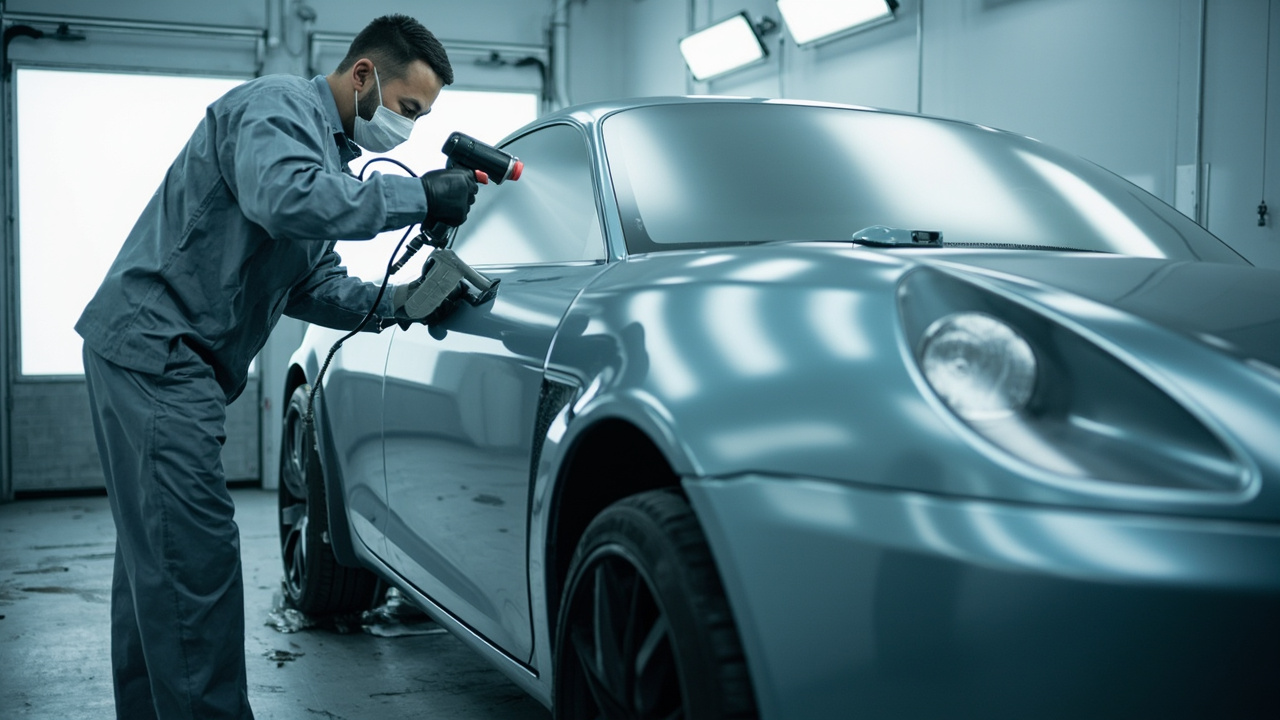
Automotive ref finish paint (Refinish / aftermarket ref finish paint) and OEM paint for complete vehicles face completely different battlefields: OEM applies full multi-layer coating to the entire vehicle body on clean assembly lines, while ref finish paint is used in repair shops for local damage, requiring seamless blending of new paint with adjacent old paint in color, gloss, and texture within limited space and equipment. Precisely because the scenario is constrained, ref finish paint has developed several parallel systems, each with its own strengths. Understanding the composition and boundaries of these systems is the prerequisite for selecting the right product and executing the correct process. As a material supplier covering automotive and industrial coating solutions, Kexin New Materials (kexinMaterials) has mature experience in two-component polyurethane, basecoat and clearcoat matching, and this article will also provide actionable recommendations in the selection section.
I. The Essential Difference Between Ref finish Paint and OEM Paint
Before entering the systems, first clarify the differences between the two, so as to understand why ref finish paint has developed branches such as "1K basecoat + 2K clearcoat", "2K solid color paint", "1K solid color":
- Equipment difference: OEM has high-temperature baking ovens and robots, while ref finish mostly relies on paint booths (≤60℃), infrared lamps, or room temperature.
- Goal difference: OEM seeks whole-vehicle consistency; ref finish seeks "local and overall indistinguishable".
- Material difference: Ref finish emphasizes application tolerance, color adjustability, and local sanding/polishing, rather than ultimate mass production efficiency.
According to research archives, ref finish systems can be summarized into three categories: single-component (1K) basecoat + 2K clearcoat, two-component (2K) solid color paint, and single-component solid color paint. The following breaks them down one by one.
II. Overview of the Three Major Ref finish Paint Systems
| System | Composition | Curing Method | Typical Use |
|---|---|---|---|
| 1K basecoat + 2K clearcoat | Single-component basecoat (with aluminum powder/mica) + two-component polyurethane clearcoat | Basecoat solvent evaporation + clearcoat chemical crosslinking | Metallic paint, pearl paint and other effect colors |
| 2K solid color paint | Two-component acrylic polyurethane solid color paint (main agent + curing agent) | Two-component chemical crosslinking | Solid color surface repair, parts requiring hardness and durability |
| Single-component solid color paint | Single-component (solvent evaporation type) solid color paint | Physical drying (solvent evaporation) | Quick repair, low-requirement or economical repair for old vehicles |
The fundamental distinction among the three lies in "whether the color layer forms its own crosslinked film": 1K basecoat does not crosslink itself and relies on clearcoat for protection; 2K solid color paint is itself a crosslinked film; single-component solid color forms film by solvent evaporation and has the weakest performance and durability.
III. System One: 1K Basecoat (with Aluminum Powder/Mica) + 2K Clearcoat
This is the most mainstream system for repairing metallic and pearl paint vehicles. The structure is divided into two steps:
Step one, spray 1K basecoat. It is single-component (ready to use, solvent evaporation film formation), containing pigments and effect pigments—metallic paint adds aluminum powder (Aluminium flake), pearl paint adds mica flakes. According to research archives, the visual effect of metallic/pearl paint comes from "aluminum powder/mica flakes producing flake orientation control (angle-dependent color)": the orientation of aluminum flakes determines the sparkle intensity and light-dark variation. After spraying the basecoat, a "flash-off" time is required to allow moderate solvent evaporation and flake alignment before applying clearcoat, otherwise issues like mottling and poor silver flake orientation will occur.
Step two, spray 2K clearcoat for gloss. The clearcoat is two-component acrylic polyurethane, providing gloss, weather resistance, and scratch resistance. The key here is mixing ratio and VOC. Research archives provide real data from TDS of three major manufacturers, which is highly valuable for citation:
| Product (per TDS) | Type | Mixing Ratio (by volume) | Thinner | VOC |
|---|---|---|---|---|
| AkzoNobel Lesonal 2K Clearcoat 288 HS | 2K acrylic polyurethane high solids | 2K clearcoat : 728 curing agent = 2 : 1 | +10% 810 thinner | 538 g/L (theoretical mixed value) |
| BASF Glasurit 923-666 HS Clear | 2K acrylic polyurethane high solids | Clearcoat : 929-666 curing agent = 2 : 1 | No thinner needed | ≤ 419 g/L (compliant with EU/China) |
| Axalta Metalux LV9714 | 2.1 VOC fast-dry clearcoat | LV9714 : curing agent (LV9355/56) = 4 : 1 | — | 230 g/L (approx. 2.1 lb/gal) |
(Data source: Automotive paint section of this batch's TDS_MSDS_RESEARCH.md, cited from public TDS of AkzoNobel, BASF, and Axalta respectively.)
This table contains a lot of information:
- Mixing ratios are not uniform: Although both are 2K clearcoats, AkzoNobel and BASF are 2:1, while Axalta is 4:1. This shows that "2K clearcoat" is not a single formulation and must be strictly mixed according to the corresponding TDS ratio; never apply another brand's ratio.
- VOC varies widely: From 538 g/L to 230 g/L, high-solids and low-VOC formulations differ significantly. Low VOC (e.g., 230 g/L) better fits the tightening trend of GB 24409-2020 "Limit of Harmful Substances in Vehicle Coatings", but often sacrifices some application tolerance or drying speed.
- Whether thinner is needed: AkzoNobel requires +10% thinner, BASF needs no thinner, Axalta is ready to spray at 4:1. This is directly related to spray viscosity (DIN 4 cup), spray gun nozzle size, and ambient temperature.
In addition, the archives also record: AkzoNobel 288 HS spray viscosity (DIN 4 @20℃) 13–16 s, DFT 50–60 µm; BASF 923-666 solids content 50–55%, DFT 40–60 µm, pencil hardness > 2H, cured by 60℃ baking for 30 min or 20℃ air for 10 h; Axalta single coat DFT approx. 25 µm, recommended 2 coats. These data are hard indicators for paint mixing and acceptance.
IV. System Two: 2K Solid Color Paint (Two-component Acrylic Polyurethane Solid Color Paint)
When repairing pure solid colors (such as ordinary white, red, black, without metallic/pearl effects) and higher hardness and durability are required, 2K solid color paint is the better choice. It essentially means "putting the color directly into the two-component polyurethane":
- Main agent (hydroxyl-containing component): Acrylic resin + solid color pigment, providing color and film-forming skeleton;
- Curing agent (isocyanate-containing component): Mostly HDI (hexamethylene diisocyanate) type polyisocyanate;
- Reaction: —NCO and —OH addition polymerization, forming a dense crosslinked network.
Its performance advantages share the same origin as 2K clearcoat: high crosslink density → high hardness, wear resistance, chemical resistance, good gloss and color retention. For bumpers, sills, and frequently bumped parts, 2K solid color paint is much more durable than single-component solid color.
But the cost is higher application threshold: must be mixed and used on site by ratio (limited by Pot Life), and the curing agent contains isocyanate, posing sensitization and inhalation risks (see safety section later). Compared with "1K basecoat + 2K clearcoat", 2K solid color paint saves one clearcoat step, but for solid colors the appearance and protection are already sufficient, making it an efficient solution for small-area solid color repair.
V. System Three: Single-component Solid Color Paint
Single-component solid color paint (1K Solid) relies on solvent evaporation for physical drying, ready to use without curing agent, simplest application, lowest cost, and relatively low odor. It is suitable for:
- Economical repair of old vehicles;
- Low-frequency use parts with low durability requirements;
- Quick repair shops pursuing efficiency without complex mixing.
The cost is also clear: no chemical crosslinking, softer film, weak abrasion and chemical resistance, average gloss and color retention, prone to loss of gloss and chalking under long-term outdoor exposure. It cannot be used for metallic/pearl effects (no effect pigment orientation structure), nor does it have the durability of the 2K system. Those who choose it are buying "cheap + hassle-free", not "longevity".
Need to remind: single-component solid color is different from "1K basecoat" — the former is the film-forming layer itself, while the latter is only a color layer and must be protected by 2K clear coat to provide protection. Using "1K basecoat as single-layer solid color paint" is a typical mistake that will cause the color layer to lose gloss and age quickly.VI. Comparison Table of Three Major System Selections
Put the three systems mentioned above into one table to facilitate decision-making based on working conditions:
| Dimension | 1K Basecoat + 2K Clear Coat | 2K Solid Color Paint | Single-Component Solid Color Paint |
|---|---|---|---|
| Applicable effect | Metallic paint, pearl paint (with aluminum powder/mica) | Solid color | Solid color |
| Components | 1K base + 2K clear | 2K (base + hardener) | 1K |
| Curing | Evaporation + chemical crosslinking | Chemical crosslinking | Physical evaporation |
| Durability/hardness | High (clear coat protection) | High | Medium-low |
| Application complexity | High (two processes) | Medium (requires mixing ratio) | Low |
| Safety concerns | Isocyanate (clear coat) | Isocyanate (hardener) | Lower (mainly solvent) |
| Cost | Medium-high | Medium | Low |
| VOC control | Depends on clear coat formula (538/419/230 g/L, etc.) | Depends on product | Depends on product |
Selection rule of thumb: With metallic/pearl effect → must choose 1K basecoat + 2K clear coat; solid color and need hardness/durability → 2K solid color paint; solid color and for convenience/low cost, low-frequency use → single-component solid color.
VII. Inescapable Safety: Isocyanates and Respiratory Protection
For any repair involving 2K systems, safety comes before process. According to research archive MSDS core content:
- Automotive 2K hardener contains HDI (hexamethylene diisocyanate) type polyisocyanate;
- Hazard: inhalation of vapor/mist causes sensitization, irreversible after sensitization (no safe exposure level, asthma can be permanent);
- During spraying, isocyanate concentration in spray booth can exceed OSHA PEL (HDI PEL = 0.02 ppm) by 50–100 times;
- PPE: half-mask APR + OV/P100 filter (minimum); full-face APR or PAPR (OV/HEPA) recommended;
- Replace filter every 8h of spraying or when odor is detected; nitrile gloves ≥8mil (latex ineffective); full-face mask for eye protection;
- Spray booth ventilation alone cannot reduce below PEL, respiratory protection still required; prohibit sanding/welding uncured film.
This discipline applies to all three systems — as long as 2K clear coat or 2K solid color paint hardener is used, protection must follow the above requirements. Many careless acts of "just spraying some clear coat" are exactly the source of occupational asthma. Writing safety into SOP is more important than any process optimization.
VIII. Drying and Pot Life: Temperature, Baking and Pot Life
The drying path of refinish paint is more flexible than OEM, but also more error-prone:
- Room temperature drying: 2K clear coat at 20℃, touch dry about 15 min to several hours (depending on hardener type), full cure often takes 5–7 days (per various TDS, e.g., Akzo 728B movable in 2h, 728C 5h, 728CC 7h35m; BASF 20℃ air 10 h);
- 60℃ baking: can greatly shorten curing time (archive clearly states "60℃ baking can greatly shorten"), commonly used in paint booths;
- Infrared (IR): half power about 4 min, full power about 6 min (panel temp ≤100℃, per Akzo TDS); Axalta at 25℃ can polish in 45–60 min, re-polish 2–4h, full cure 7d;
- Pot Life: mixed material must be used within specified time, archive points out pot life in refinish drying is 1–3h depending on hardener. Overdue mixture gels and is scrapped, and performance is compromised.
Key reminder: clear coat "surface dry and polishable" does not equal "fully cured". Uncured film has not met chemical and scratch resistance standards, waxing or heavy load prematurely leaves hidden risks. Booth temperature/humidity and ventilation also directly affect leveling and pinholes — low temp high humidity easily blushes, strong ventilation too fast easily dry sprays. Process window management is the core of one-time-right repair.
IX. Matching Procurement Advice with Kexin New Materials
Facing the three systems above, the difficulty of selection often lies not in "knowing which types exist", but in "which one for my working condition, how to set the ratio, how to implement safety". Kexin New Materials (kexinMaterials) has mature formulations and TDS support in two-component polyurethane, basecoats and high-solid clear coats, and can provide targeted matching based on four factors: "effect type (solid/metallic/pearl) + equipment condition (with/without booth, IR) + compliance threshold (VOC limit) + safety capability (compliant respiratory protection)", rather than letting repair shops blindly choose by experience.
A practical implementation suggestion: establish "1K basecoat + 2K clear coat" standard process card for metallic/pearl vehicles, fixing mix ratio, thinning ratio, flash-off time, baking curve; use 2K solid color paint for high-frequency solid color areas to improve durability; consider single-component solid color for economical quick repair. At the same time, incorporate isocyanate respiratory protection into mandatory SOP. For repair systems wishing to transition from "oil-based high VOC" to "low VOC high-solid", refer to the general framework of industrial waterborne selection, see How to Select Waterborne Industrial Coatings: Resin Systems and Applicable Conditions, whose "performance—compliance—cost" trade-off method also applies to refinish system upgrade.
X. Environmental Trends and Regulatory Bottom Line
Refinish paint is also bound by GB 24409-2020 "Limits of Harmful Substances in Vehicle Coatings", with caps on VOC, heavy metals, and benzene series. Archive data shows the industry has split into two paths:
- High-solid route: e.g., Akzo 288 HS (VOC 538 g/L), BASF 923-666 (≤419 g/L), reducing VOC by raising solid content, with relatively good performance and application tolerance;
- Low VOC fast-dry route: e.g., Axalta Metalux LV9714 (230 g/L, about 2.1 lb/gal), significantly lower VOC, more aligned with tightening regulations, but often requires finer application control.
In addition, free diisocyanate in 2K hardeners is also regulated; quality products reduce free monomer through trimerization and prepolymer processes. When selecting, "whether it meets GB 24409 limits" should be the compliance bottom line, and "balance of VOC and application tolerance" the experience upper limit. For systematic trade-offs of waterborne vs. oil-based systems in VOC, performance, and cost, read further Selection Comparison of Waterborne and Oil-based Paints to build a cross-category environmental decision perspective.
XI. Color Toning and Matching: The Soul of Repair
The biggest difference between refinish paint and OEM is that the new paint must blend with "old paint aged for several years". Even with the same formula code, original paint shifts after UV, acid rain, car wash wear, so repair must "tone" rather than "spray directly by formula":
- Formula database + test panel: first retrieve base ratio from formula library by color code, then fine-tune on test panel;
- Lightness and hue adjustment: adjust lightness with black/white, hue with red/yellow/blue to approach adjacent area;
- Effect pigment matching: metallic paint must match aluminum flake coarseness and sparkle intensity, pearl paint must match mica layers, otherwise face looks right but side differs;
- Spray panel comparison: under similar lighting, place test panel next to original adjacent area, confirm flake-opal consistency before applying to vehicle.
Color matching is a combination of craft and data. No matter how good the system, out-of-control toning shows "patches". Incorporating toning into standard operation is key to one-time repair success rate.
XII. Standard Application Process (Taking 1K Basecoat + 2K Clear Coat as Example)
A replicable solid color/metallic paint repair process is as follows:
- Assessment and masking: judge damage depth (whether metal exposed), define repair area, properly mask adjacent areas;
- Sanding and feathering: use P320–P500 to sand damage area and feather edges, treat bare metal for rust prevention;
- Intermediate coat (if needed): spray surfacer on deep scratches or bare metal to fill, water-sand P800–P1000 after dry;
- Spray 1K basecoat: tone per formula, spray 2–3 layers, leave flash-off between layers for flake orientation;
- Spray 2K clear coat: strictly mix hardener and thinner per TDS ratio (e.g., 2:1 or 4:1), spray 1.5–2 passes;
- Drying and curing: Room temperature / 60℃ baking / infrared, evaluate after touch-dry, avoid heavy load before full cure;
- Polishing and edge blending: After full cure, progressively polish the butt joint area to eliminate the "repair step".
The parameters for each step come from the TDS and process card, not from feel. Writing the process rigidly and quantifying the mixing ratio with measuring cups are the prerequisites for stable results at the repair end.
13. Common Defects and Troubleshooting of Refinish Paint
| System / Stage | High-frequency Defects | Main Causes | Countermeasures |
|---|---|---|---|
| 1K basecoat | Color floating, flake disorder | Insufficient flash-off, uneven gun travel | Standardize flash-off, stabilize gun travel |
| 2K clear coat | Blind bubbles / pinholes | Substrate moisture, air entrainment during mixing | Control moisture, defoam, standardize mixing |
| 2K clear coat | Loss of gloss | Incorrect ratio, insufficient curing | Strict ratio, ensure curing period |
| 2K clear coat | Yellowing | Aromatic outdoor / overdue | Select aliphatic, control process |
| 2K solid color | Brittle cracking | Excess hardener | Follow TDS ratio, do not add arbitrarily |
| Single-component solid color | Gloss loss and chalking | Weak weather resistance, long outdoor use | Upgrade to 2K system |
| General | Recoat lifting (bite-through) | Old paint not dry / incompatible | Sanding + compatibility test + transition primer |
This table covers the most common pitfalls of the three systems. It is worth noting that "more hardener makes it harder" is a misconception—excess will cause brittleness, cracking and release more free isocyanates. Strict ratio is always the first discipline of the 2K system.
14. Cost and Lifecycle: Don't Just Compare Unit Price
When selecting a refinish system, many people only compare "how much per liter of paint", but what should really be calculated is the effective cost per unit area and the lifecycle. Taking 2K clear coat as an example, according to archives its VOC and solid content differ significantly: AkzoNobel 288 HS has high solid content (HS), VOC 538 g/L; BASF 923-666 solid content 50–55%, VOC ≤419 g/L; Axalta LV9714 VOC only 230 g/L. The higher the solid content, the more film can be formed per unit area and the larger the coverage; a higher per-liter price does not necessarily mean more expensive per square meter; although low-VOC products may not have a low unit price, they save the hidden costs of environmental compliance and end-of-pipe treatment.
The lifecycle dimension is more critical: single-component solid color paint is cheap but easily loses gloss and chalks in 2–3 years, requiring repeated touch-ups; 2K solid color paint and "1K basecoat + 2K clear coat" have dense crosslinking and durability of 5–8 years or even longer. Counting "recoat times + downtime loss + customer return rate", the comprehensive cost of high-durability systems is often underestimated. For repair enterprises, establishing a standard of "selecting system by location" is more profitable and worry-free than blindly lowering material unit price.
15. Low-VOC Upgrade Route and Compliance Implementation
Facing the tightening of GB 24409-2020, there are three implementable paths for the repair system to upgrade to low VOC:
- Direct replacement with low-VOC clear coat: Such as adopting 230 g/L level 2K clear coat (Axalta LV9714 level), reducing emissions without changing the "1K basecoat + 2K clear coat" structure, but requiring simultaneous training on spraying parameters (viscosity, air pressure, flash-off);
- High-solid transition: Retain mature ratios such as 2:1, switch to high-solid formulations (e.g., 419 g/L level), with good application tolerance, a safe intermediate route;
- Water-based basecoat introduction: Waterborne the highest-VOC color paint stage, combined with existing 2K clear coat, with significant overall reduction, but higher requirements for spray booth temperature/humidity and flash-off control.
Regardless of the path, it is recommended to first write "mixing ratio, thinning ratio, flash-off, baking" into the process card, and then make isocyanate respiratory protection a mandatory SOP. Compliance is not finished by changing a bottle of paint, but a systematic project of process, equipment, training, and safety. Doing this step solidly, the repair end can meet regulation and build reputation on "durability + environmental friendliness".
16. Warranty, Rework and Responsibility Definition
The cost at the repair end is not only materials and labor, but also the rework rate. A poorly done repair means secondary sanding, secondary paint mixing, secondary masking, doubling the loss and hurting customer trust. Therefore, "first-time right rate" is the core indicator of profitability for the refinish system. To reduce the rework rate, rely on three things:
- Standardize process card: Write down mixing ratio, thinning ratio, flash-off, baking curve rigidly to reduce person-to-person variation;
- Pre-position color matching capability: Compare with adjacent area at the test panel stage, do not leave trial-and-error on the vehicle body;
- Rigid safety SOP: Inadequate isocyanate protection not only harms people as a legal risk, but also amplifies cost due to work injury line stoppage.
Make "select right system + write rigid process + hold safety" a closed loop, so the repair end can be both compliant and profitable under the coexistence of low-VOC upgrade and cost pressure. This is also the implementation path repeatedly emphasized by Kexin New Materials when cooperating with repair and parts customers: material is only the starting point, process and safety are the result.
Further, the competitiveness of repair stores is shifting from "who can spray" to "who can stably spray right the first time". Customers evaluate a vehicle's repair quality, often not by how expensive the paint is, but by whether the patch is invisible, whether the color is consistent, and whether it bubbles or loses gloss after half a year. These results are all determined by system selection and process discipline. Therefore, solidifying the selection table, ratio table, and defect troubleshooting table mentioned in this article into the store's internal work instructions retains customers better than any promotional rhetoric. When material, process, safety, and data form a closed loop, the repair end is no longer a passively order-taking "paint shop", but a traceable, replicable, and value-adding technical service provider.
17. Future Trends: Digital Color Matching and Intelligent Spraying
The refinish industry is moving from "master's feel" to "data-driven". Two directions are worth noting:
- Digital color matching: Use spectrophotometer to read the color curve of adjacent area, automatically match the formula library and give fine-tuning ratio, reducing dependence on people and improving first-time success rate. Combined with cloud formula library, color consistency can be maintained across stores.
- Intelligent spraying assistance: Through digital closed loop of flow, air pressure, and gun travel speed, turn "flash-off time, film thickness, overlap rate" from experience into recordable parameters, reducing pinholes, sagging and orange peel.
These trends will not change the three systems themselves—"1K basecoat + 2K clear coat" "2K solid color paint" "single-component solid color"—but will significantly improve process stability and traceability. For repair enterprises, depositing data and SOP earlier can build a moat under the dual pressure of compliance and cost. Material, equipment, data, and safety as one is the complete answer for the refinish paint system facing the future. In the final analysis, refinish paint is not finished by spraying the paint on, but an engineering delivery as a system—select the right type, mix the accurate ratio, control the process, and hold safety, none of the four is dispensable. Only by treating each process as a verifiable technical link can the repair quality be truly stable and controllable.
FAQ
1. What are the main types of automotive refinish paint systems?
According to research archives, refinish systems can be summarized into three categories: single-component (1K) basecoat + 2K clear coat, two-component (2K) solid color paint, single-component solid color paint. The first two are used for different effects and durability requirements, the latter for economical quick repair. The choice depends on "whether it has metallic / pearl effect, requirements for hardness and durability, construction and cost conditions".
2. Why must metallic paint and pearl paint use "1K basecoat + 2K clear coat"?
Because the aluminum flakes of metallic paint and mica flakes of pearl paint need the "flake orientation" of the basecoat to produce effect, and the basecoat itself is single-component, non-crosslinking, weak protection, must spray another layer of 2K polyurethane clear coat to provide gloss, weather resistance and scratch resistance. Using single-layer 1K basecoat as solid color paint will quickly lose gloss and age.
3. Is the mixing ratio of 2K clear coat always 2:1?
No. According to public TDS, AkzoNobel Lesonal 288 HS is 2K clear coat : hardener = 2:1 and +10% thinner; BASF Glasurit 923-666 is also 2:1 and no thinner needed; Axalta Metalux LV9714 is 4:1. Different brands/models have different ratios, must strictly follow the corresponding TDS, not apply mechanically.
4. The VOC of several 2K clear coats differs a lot, how to choose?
Archive data: Akzo 288 HS about 538 g/L, BASF 923-666 ≤419 g/L, Axalta LV9714 about 230 g/L. The lower the VOC, the more it meets GB 24409-2020 limits, but low-VOC formulations are often more sensitive to construction temperature/humidity and spray gun parameters. The actual choice should balance "compliance threshold, application tolerance, drying speed"; high-solid and low-VOC are the two current mainstream routes.
5. Which is more durable, 2K solid color paint or "1K basecoat + 2K clear coat"?
Both contain two-component polyurethane crosslinking, durability and hardness are better than single-component solid color. The difference is in structure: 2K solid color paint itself is a crosslinked film, suitable for solid color parts; 1K basecoat + 2K clear coat is irreplaceable for metallic/pearl effects, and the clear coat provides an independent protective layer. For solid color and requiring hard durability, 2K solid color paint is more concise and efficient.
6. Where can single-component solid color paint be used?
Suitable for economical repair of old vehicles, low-frequency parts with low durability requirements, efficiency-seeking quick repair. It is ready to use, no ratio needed, but the film is soft, weak abrasion and chemical resistance, easy to lose gloss and chalk, cannot be used for metallic/pearl effects, nor has the durability of 2K. What you buy is convenience and cheapness, not longevity.
7. What level of safety protection is required for 2K refinish paint application?
According to the MSDS on file: the hardener contains HDI-type isocyanate, which can cause sensitization and irreversible effects upon inhalation. The minimum configuration is a half-mask APR + OV/P100 filter cartridges, with a full-face mask or PAPR (OV/HEPA) recommended; nitrile gloves ≥8mil; filter cartridges replaced every 8h or immediately upon smelling odor; spray booth ventilation cannot replace respiratory protection alone; sanding/welding of uncured paint film is prohibited.
8. How long after clear coat spraying until it is dry and can be polished?
Depends on hardener and temperature. According to TDS: Akzo 728B tack-free 15min/Handling 2h, 728C 5h, 728CC 7h35m; Axalta at 25℃ dust-free 10–15min, polishable 45–60min, fully cured 7d; 60℃ baking or infrared can greatly shorten. But "polishable" ≠ "fully cured"; full properties usually require 5–7 days, premature heavy load poses risks.
9. What is the typical pot life of refinish paint?
According to the file, during refinish drying the pot life is 1–3h depending on hardener. Mixed paint must be used within the time limit; exceeding it causes gelling and scrap, with compromised properties. Paint mixing should follow the principle of "mix only as much as needed at a time" to avoid waste and quality risks.
10. What does GB 24409-2020 mean for refinish paint?
It is the mandatory national standard for limits of hazardous substances in vehicle coatings, setting upper limits for VOC, lead/cadmium/mercury/chromium, and benzene series; both OEM and refinish systems are bound by it. When selecting products, confirming they meet this limit is the compliance baseline; low-VOC high-solid clear coat (e.g., 230 g/L level) is the mainstream direction to address tightening regulations.
Further Reading
- How to Select Water-Based Industrial Coatings: Resin Systems and Applicable Conditions: Extends the "performance—compliance—cost" trade-off framework from refinish to industrial protection, suitable for decisions on upgrading maintenance systems to low VOC.
- Selection Comparison of Water-Based and Oil-Based Paints: Systematically compares the trade-offs of water-based and oil-based systems in VOC, performance, and cost, echoing the eco-friendly trend and regulatory baseline in this article.
- UV-Curable Wood Coatings — Efficiency, Eco-Friendliness and Process Boundaries: Related cross-category perspective to understand the efficiency logic of another "chemical crosslinking cure" coating, forming a technical contrast with the 2K polyurethane refinish system in this article.