
A paint bake window (cure window) is the temperature–time range in which the peak metal temperature (PMT) reached by the workpiece and its dwell time both fall, so that coating crosslink density is neither below the in-service floor nor above the overbake ceiling inside a bake oven or bake tunnel. The window is not the nominal "set temperature × set time" value; it is the effective cure accumulated from the metal temperature actually attained in the workpiece's thick-wall sections. When the window is narrow, two panels from the same oven load — one near the air vent and one near the inner cavity — can end up one underbaked and one overbaked. That is the recurring root cause behind complaints of "paint that stays soft and must be sanded off" and of "yellowed, brittle clearcoat".
TL;DR: The Bake Window on One Page
- The reference is peak metal temperature (PMT), not the oven set point; typical OEM nominal ranges run from about 121 °C/30 min to 140 °C/20–30 min
- The lower edge, underbake, means insufficient crosslinking: hardness, chemical resistance and intercoat adhesion drop. The upper edge, overbake, means yellowing, embrittlement and gloss loss, mostly irreversible
- Line cure checks use the B-st solvent rub (ASTM D5402): 2000–3000 g force, a 45° angle, commonly 50 or 100 double rubs, rated per ASTM D4752
- B-st proves solvent resistance, not full cure; for critical parts add DSC residual-exotherm conversion (≥ 95% is a common in-window criterion) or cross-check with Tg
- Rule of thumb: each ~10 °C rise roughly doubles the reaction rate; within one oven load, thin panels and closed-section parts can differ by 15–20 °C, and racking density is the main source of deviation
- Insufficient flash-off or too-fast heat-up causes boiling, pinholes and blistering; waterborne layers carrying moisture into the oven are especially prone, so the flash-off stage typically runs 5–10 min
What a Paint Bake Window Is: From Set Point to Metal Temperature
A formulation sheet reading "140 °C / 30 min" usually refers to the air set temperature and a nominal dwell, while what actually drives the crosslinking reaction is the temperature of the coating film itself. A car body is a composite of steel, aluminium, plastics and rubbers with very different heat capacities: a hood outer panel heats quickly, while door-cavity reinforcement beams and A-pillar closed sections heat slowly. Only the peak metal temperature (PMT) tells you whether the part is in the window. Industry-experienced automotive OEM bake ranges run roughly from 121 °C / 30 min (low-temperature systems) to 140 °C / 20–30 min (2K clearcoat), with the coatings supplier's TDS and first-article metal temperature profiles governing the specifics. Treating the set point as the metal temperature is how you get "the oven dial reads 140 °C, but the thin panels passed 160 °C and were overbaked long ago while the thick parts only reached 118 °C and stayed undercured". For how process parameters interact overall, see OEM paint line process parameter optimization.
The image below shows a typical body sent into the bake after spraying; the heat accumulation of that film, from flow-out to crosslinking, is exactly what window management controls.

Which Boundaries Define the Bake Window
A passing cure curve is constrained by three boundaries at once: the lower limit, the upper limit, and the heat-up/cool-down gradients; crossing any one of them shows up as a different failure mode.
Lower Limit — Underbake and Insufficient Crosslinking
Underbaking means the crosslinking reaction never finished. Symptoms: hardness that will not rise, B-st solvent rubs that pick back up too early, poor chemical and chip resistance, and insufficient intercoat adhesion causing clearcoat peeling. Low-surface-energy and low-temperature-cure systems are especially sensitive to this line: cutting oven temperature below the critical level to save energy can leave a coating that has reached "dry to the touch" but is far from "deliverable cure". Adhesion can be quantified by cross-cut and pull-off tests, judged on the same basis as the 2K clearcoat system.

Upper Limit — Overbake, Excess Crosslinking and Thermal Oxidation
Overbaking is heat accumulation beyond the material's tolerance ceiling: yellowing of polyurethane/acrylic-melamine systems, excessive Tg causing embrittlement, reduced chip resistance and recoatability, falling gloss, and even deformation of plastic parts and rubbers. Once clearcoat yellowing and gloss loss cross the reversibility line, the usual remedy is full-layer sanding and respraying. This is a separate degradation path from appearance deterioration caused by clearcoat contamination etching, and it is handled differently.
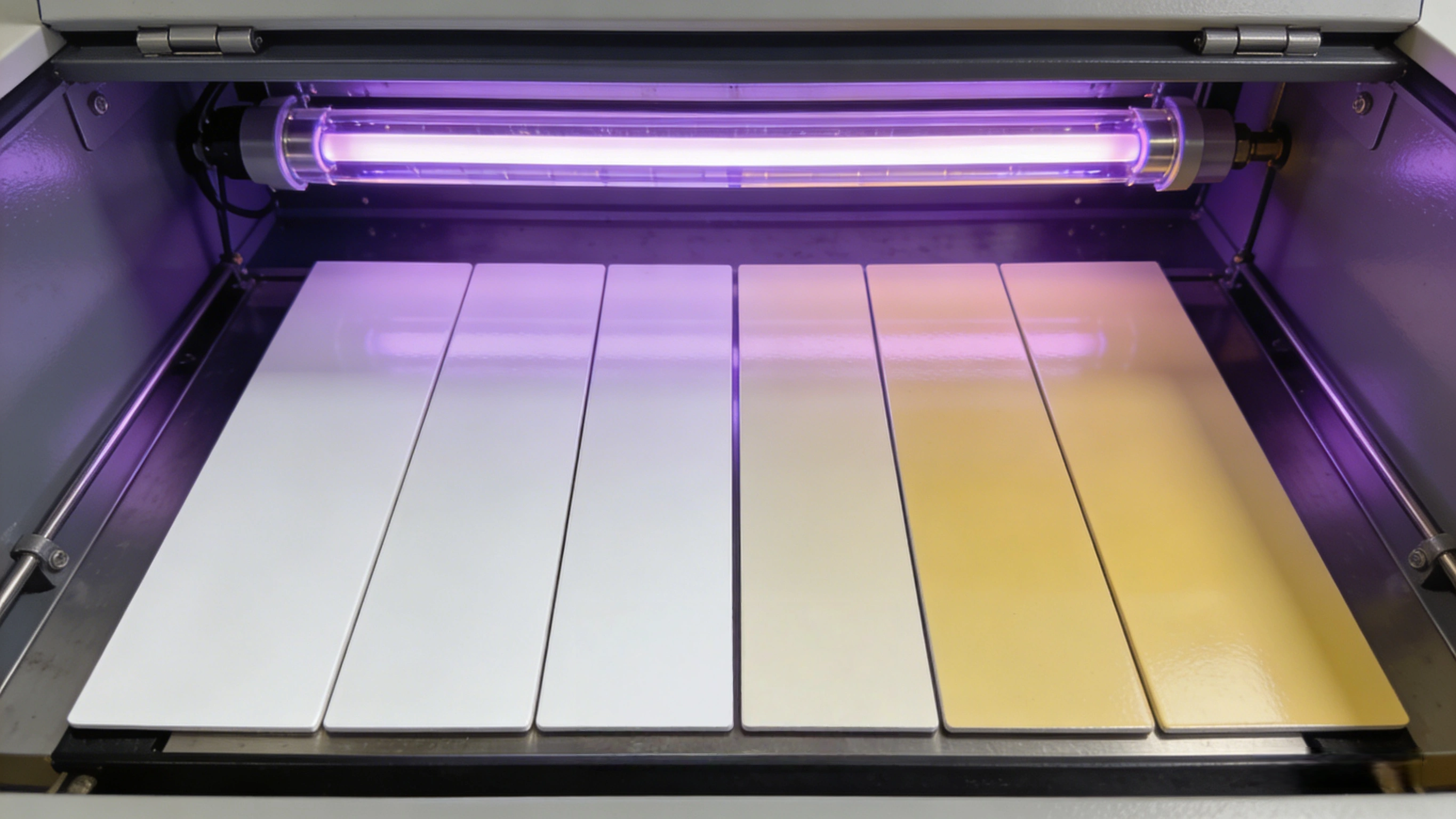
How Cure Level Is Measured: B-st Solvent Rubs and What DSC Adds
The convenient, easy-to-run field criterion on the line is the block solvent rub (B-st). It follows ASTM D5402 — rating solvent resistance of organic coatings using solvent rubs — Method B (coil-stock method): rub back and forth at about 1 cycle per second with 2000–3000 g of force at a 45° angle on a fingertip pad, counting one forward-and-back pass as 1 double rub; change or re-saturate the gauze every 25 double rubs; suppliers commonly set acceptance at 50 or 100 double rubs, and ratings may follow the ASTM D4752 solvent-rub resistance table (Level 5 = no effect). B-st reflects solvent resistance only, and reaching solvent resistance is not always equal to "fully cured" — some coatings gain solvent resistance before their mechanical properties and intercoat adhesion develop. Critical parts should therefore be supported by DSC (differential scanning calorimetry) to convert residual exothermic enthalpy into degree of conversion, or by FTIR tracking the decay of characteristic functional groups; the correspondence is in the table below.
| Method | Principle | Criterion | Limitation |
|---|---|---|---|
| B-st solvent rub ASTM D5402 | The higher the crosslink density, the harder it is for solvent to re-dissolve the film | No pickup or gloss loss after 50–100 double rubs; Level 5 per ASTM D4752 | Measures solvent resistance only, not full cure; affected by film thickness, temperature and humidity |
| DSC residual exotherm | Residual cure enthalpy ÷ total cure enthalpy = unconverted fraction | Conversion ≥ 95% counts as in-window | Requires sampling, destructive, about 30 min per run |
| TMA / DSC Tg measurement | Rising cure level shifts the glass transition temperature upward | Measured Tg ≥ formulation target Tg | Expensive equipment, demanding sample requirements, not suited to inline use |
| FTIR functional groups | Tracks decay of isocyanate/epoxy and other characteristic peaks | Target peak area falls to threshold | Needs calibration and spectral libraries; limited penetration depth |
Temperature–Time Equivalence: Oven Profiles, Workpiece Heat Capacity and Racking Density
Curing is a thermally activated process that can be managed through temperature–time equivalence: each rise of about 10 °C roughly doubles the reaction rate (an empirical approximation, not a universal constant; the actual activation energy must be calibrated per system). High-temperature/short-time and low-temperature/long-time profiles can therefore partly substitute for each other, but side effects exist outside the equivalence band — the temperature ceiling is bounded by yellowing and substrate heat resistance, the time floor by solvent evaporation and flow-out; neither end extrapolates indefinitely. Measured in-oven deviation comes mainly from three sources: the heat-up gradient, the workpieces' heat capacity (thin panels versus closed-section beams in one load can differ by 15–20 °C), and hangers and racking density blocking the hot air. The quantitative points below are the checks commonly used when judging the window.
- Peak metal temperature (PMT) is verified by thermocouples bonded to thick-wall sections; set points are reference only
- The typical OEM nominal bake range is about 121 °C / 30 min to 140 °C / 20–30 min, to be finalized against the TDS
- Rule of thumb: each ~10 °C rise roughly doubles the cure reaction rate (activation energy varies by system)
- Thin panels and closed-section parts in one oven load can differ by 15–20 °C, more when racking is dense
- B-st acceptance commonly takes 50 or 100 double rubs at 2000–3000 g force, a 45° angle and about 1 cycle per second
- DSC conversion ≥ 95% is a common "in-window" criterion; re-saturate the solvent gauze every 25 double rubs
- The cool-down gradient matters too: quenching traps solvent and induces boiling and pinholes; the flash-off stage typically runs 5–10 min
- Dry film thickness (DFT) is measured by magnetic/eddy-current methods per ASTM D1186 / ISO 2808; film thickness directly affects time-to-window
Window Differences by System: 2K Clearcoat, Waterborne Basecoat, PVC and E-coat
The idea of "one universal oven curve" is a hidden hazard: different coating systems sit on completely different cure bands, and wet-on-wet stacking compresses several layers' constraints into one window. E-coat and high-solids systems need higher metal temperatures to crosslink densely, PVC plastisol needs enough heat to gel and fuse, and waterborne basecoat is especially vulnerable to insufficient flash-off carrying moisture into the oven. For masking zones, grounding and mating-surface conditions, see the body masking zones; for PVC seam sealer and hemming adhesive parameters, see BIW seam sealer and hemming adhesive.
| System | Typical metal temperature/time | Lower-window risk | Upper-window risk | Main criteria |
|---|---|---|---|---|
| Cationic e-coat | About 165–180 °C / 20–30 min | Underbake: poor corrosion and adhesion resistance | Overbake: yellowing and embrittlement | PMT + salt spray + B-st |
| Waterborne basecoat | Pre-bake at about 60–80 °C after flash-off | Moisture entering the oven causes blistering | High heat causes color shift and floating | Flash-off time + moisture content |
| 2K polyurethane clearcoat | About 140 °C / 20–30 min | Insufficient hardness/chemical resistance | Yellowing, gloss loss, brittle cracking | D5402 double rubs + ΔE |
| PVC plastisol/sealant | Gels at about 160–180 °C | Poor fusion, peeling | Charring, fume contamination | Gel level + appearance |
| Low-temperature cure / repair systems | About 60 °C, or UVLED | Undercrosslinked, tends to re-tack | Plastic part deformation | Hand-feel hardness + B-st |
Body filler putty cures on a window layer separate from the topcoat and needs its own "sandable point" criterion; its criteria and exotherm peak are covered in the body filler cure window article. For avoiding "surface dry, inner layer soft" in low-temperature or UVLED repair, see UVLED repair curing.
Flash-Off and Heat-Up Gradient: Solvent-Related Boiling, Blistering and Pinholes
The window is not only about "hot enough, long enough" — it is also about "whether the solvent left before the heat arrived". Heat-up that is too fast or flash-off that is too short traps solvent under a gelled skin; as it expands it bursts the surface, producing boiling/cratering and pinholes; in waterborne systems, moisture carried into the oven causes blistering and gloss loss. The defect–cause–field-criterion mapping is the key input for rework decisions.
| Defect | Main cause | Field criterion | Window-side countermeasure |
|---|---|---|---|
| Boiling / pinholes | Insufficient flash-off, heat-up too fast | Micro-craters on the surface, breaks down to substrate | Extend flash-off by 5–10 min, soften the initial heat-up ramp |
| Blistering | Waterborne layers carrying moisture, or substrate volatiles entering the oven | Blisters that feel elastic under pressure | Pre-bake to drive off moisture, reduce racking that blocks airflow |
| Gloss loss / orange peel | Flow-out temperature window not reached | Low 60° gloss, coarse texture | Correct the flow-out stage and PMT |
| Yellowing | Overbake, thermal oxidation | Rising ΔE*b*, white parts turning yellow | Compress the upper temperature and dwell time |
| Intercoat peeling | Next coat applied before the lower layer cured | Cohesive or interfacial failure in cross-cut/pull-off | Re-verify per ASTM D4541 / D3359 before release |
Shop-Floor Implementation: Sensor Placement, Profile Audit Frequency and Disposition of Nonconforming Parts
Holding the window relies on repeatable measurement and clear disposition rules, not on "the oven gauge looks acceptable". Thermomelt pellets (temperature-indicator lacquers) and thermocouple instrument profiles are two complementary tools: the former gives a qualitative "was it reached" threshold, the latter the complete temperature–time curve. Sensor placement must cover four representative locations: thick-wall closed sections, thin outer panels, air inlets/outlets, and dense-racking zones; audit frequency per load or per shift should tighten dynamically with takt time and first-article results. For nonconforming parts, first separate a salvageable "underbake that can be re-baked" from an "irreversible overbake", then decide between re-oven, rework or downgrade — never push an already overcrosslinked part through another hot cycle that makes it more brittle.
The Rework Boundary: When It Can Be Saved and When Only Full-Layer Sanding Works
Deciding reworkability comes down to which side of the window the defect sits on.
- Underbake (low hardness, adhesion or chemical resistance, but no contamination): most cases can be corrected by a second bake inside the window; reversible
- Flash-off-type boiling and pinholes (not overcrosslinked): minor cases are saved by light sanding and respray; severe ones need local filler and full-panel rework
- Overbake yellowing/embrittlement: past the upper limit and irreversible; another oven pass only makes it worse — usually full-layer sanding and respray
- Intercoat peeling: first tell interfacial failure from cohesive failure; interfacial patterns usually mean the lower layer was underbaked, and you must step back to the defective layer
- Thermal deformation of plastics/rubbers: beyond the substrate's heat-resistance limit; rework is uneconomical, so scrap or downgrade
- Contamination etching combined with overbake: eliminate the contamination root cause first, otherwise respraying reproduces the defect; see the clearcoat etching criteria
FAQ
If the oven is set to 140 °C with a 30-minute dwell, is the workpiece necessarily cured?
Not equivalent. The set value is the oven's air temperature; the real driving variable is the peak metal temperature (PMT) of the coating itself. Thin panels may already sit well above 140 °C and be overbaked, while thick closed-section parts may not even reach 130 °C and stay underbaked. Bond thermocouples to thick-wall sections, take the measured curve, and use the "effective dwell time after reaching PMT" against the coatings supplier's TDS as the criterion; the set point is process reference only. Once the first-article profile passes, lock it in as the production parameter.
The MEK/B-st rub passed at 50 double rubs — does that mean the film is fully cured?
You cannot equate the two. B-st (ASTM D5402/D4752) measures solvent resistance, and some coatings have not yet fully developed their mechanical properties and intercoat adhesion when they reach sufficient solvent resistance. 50 or 100 double rubs without pickup is a necessary but not sufficient condition; critical parts should add DSC residual-exotherm conversion (commonly ≥ 95%) or cross-verify with Tg and pull-off adhesion, to avoid the miss of "solvent rub passed, but too soft in service".
Where is the boundary for low-temperature cure and energy-saving oven reductions?
The boundary is that crosslinking must stay above the lower limit. By the empirical approximation, each ~10 °C drop roughly halves the reaction rate, requiring longer time to compensate — but time is constrained by takt and flash-off. A workable approach: step down first to the low-temperature level the system's TDS allows, then close the loop with PMT profiles plus B-st/DSC verification. Once adhesion or chemical resistance starts to drop, you have touched the lower limit and should raise the temperature back instead of pushing energy savings further.
Can yellowing caused by overbake be saved by re-baking or polishing?
In most cases, no. Overbake is thermal oxidation plus excess crosslinking; yellowing and embrittlement occur within the coating itself and are irreversible, and another oven pass only worsens them. A very light surface haze can be improved cosmetically by polishing, but that cannot restore the sacrificed flexibility and chip resistance. The sound disposition is full-layer sanding and respray, followed by correcting the oven upper temperature, dwell time and racking blockage so the condition cannot recur.
In wet-on-wet processing, how do you balance several layers sharing one bake window?
Take the window of the most constrained layer as the constraint. E-coat, basecoat, clearcoat and PVC sit on different cure bands. In wet-on-wet, let the layer with the highest metal-temperature requirement (often e-coat or PVC) set the PMT ceiling, let the heat-sensitive layers (basecoat color shift, clearcoat yellowing) set the safety margin, and reconcile the two with the heat-up gradient and flash-off time. For the overall parameter-interaction approach, see OEM line process parameter optimization; for PVC and hemming adhesive pairing, see the seam sealer criteria.
Some parts in the same load come out overbaked and others underbaked — what do you check first?
Check the heat distribution before the set point. Work through the order: (1) whether racking and hanger density block the hot air and create dead zones; (2) nozzle and duct alignment or blockage; (3) whether thermocouple placement covers both thick closed sections and thin outer panels; (4) stability of the blower VFD during heat-up. Aligning the representative-position profiles against PMT and dwell time usually shows the problem is "uneven distribution", not "a narrow formulation window".
How do you build a bake-window baseline for a new color or a new substrate?
Use a two-step "profile–criterion" method. First run a temperature × time matrix (e.g., PMT at 130/140/150 °C × 15/20/30 min); then, at each point, measure hardness, B-st double rubs, ΔE color difference, pull-off adhesion and appearance defects, and the rectangle that reaches the property floor without crossing the yellowing ceiling is the window. Body filler and low-temperature/UV repair each need their own window and cannot inherit the topcoat baseline; see the body filler cure window and the UVLED repair criteria for specifics.
References and Basis of Numbers
The methodology and criteria in this article are compiled from public standards and common engineering references: ASTM D5402 (solvent rubs for solvent resistance of organic coatings, including Method B coil-stock: 2000–3000 g force, a 45° angle, re-saturated gauze every 25 double rubs, commonly 50/100 double rubs as the line); ASTM D4752 (solvent-rub rating scale, Level 5 = no effect); ASTM D4541 pull-off adhesion; ASTM D3359 cross-cut adhesion; ASTM D523 gloss; ASTM D3363 pencil hardness; ASTM D1186 / ISO 2808 dry film thickness; DSC residual-exotherm conversion and the diBenedetto Tg relation are standard polymer-cure characterization methods; automotive OEM baking at the 121 °C/30 min to 140 °C level, thermal cure ranges, rest/flash stages, and near-infrared/forced-air heating are taken from public coating patents and technical literature.
Note on the numbers: statements such as "each ~10 °C rise doubles the rate", "15–20 °C thin-panel versus closed-section difference", "flash-off 5–10 min" and "conversion ≥ 95% counts as in-window" are published industry practice and engineering rules of thumb, used here to illustrate method and order of magnitude; the actual window must be set by the specific coating system's TDS, first-article PMT profiles and project validation, and these values must not be used directly as production release constants. Numeric ranges shift with substrate, film thickness, oven type and racking.
Compiled by the technical team of Kexin New Materials (Guangdong) Co., Ltd. for process, quality and procurement staff at automotive OEM and refinish lines. This is a B2B technical compilation and does not constitute product design guidance or a performance guarantee; cure windows and acceptance limits for any specific system should be confirmed by laboratory retest and on-site validation data. The company's external business is industrial-grade product supply and technical support, with trade terms EXW / FOB. Last updated: 2026-11-19