
Coating chalking is the failure mode in which, under the long-term combined action of ultraviolet radiation, heat-and-humidity and oxygen, the surface film-forming resin (binder) undergoes photo-oxidative degradation and pigment and extender particles, no longer wrapped in binder, migrate out of the surface as a loose powder; gloss loss is its precursor and companion symptom — rising micro-roughness converts specular reflection progressively into diffuse reflection, so gloss readings have usually fallen before any color change is visible to the eye. Together they form the early degradation signal of both appearance and protection for coatings in outdoor and industrial service.
Typical scenario: an outdoor electrical control cabinet in a coastal plant was finished with a single alkyd topcoat. About 3 years after commissioning, gloss on the sun-facing side had dropped from 85 units (60°) as applied to below 30 units, wiping the surface lightly with a white cloth left white powder, and film thickness had already lost roughly 20–30 µm; the shaded side and cabinets of the same batch at a non-coastal site still held higher gloss. The difference comes from radiant dose, condensation duration and the weathering margin built into the formulation, not from the quality of application itself. Understanding the mechanism of chalking and gloss loss, the quantitative rating scales, and how both map onto accelerated weathering is what turns "when to intervene and against what criteria to recoat" into a calculable engineering question. For the systematic route from ageing to service-life prediction, the model framework is set out in Coating ageing and service-life prediction: accelerated weathering, Arrhenius and electrochemical impedance spectroscopy.
1. TL;DR: engineering takeaways and key criteria
- The rating is standardized: chalking is graded 0–5 by the tape method of ISO 4628-6:2023 (adopted in China as GB/T 1766), with tape at least 15 mm wide; reaching grade 2 or above usually means a clear binder deficit at the surface and belongs in an intervention plan.
- Gloss loss precedes color change: gloss is measured per ISO 2813:2014 at 20°/60°/85°, and gloss retention = post-ageing gloss ÷ pre-ageing gloss ×100%; readings above 70 units at 60° are better taken at 20°, readings below 30 units at 85°.
- The two accelerated paths cannot be inferred from each other: QUV (ASTM G154 / ISO 4892-3 / GB/T 16422.3) uses UVA-340 at an irradiance of about 0.77 W/(m²·nm)@340 nm, cycling 8 h light at 60 ℃ plus 4 h condensation at 50 ℃; xenon-arc (ASTM G155 / ISO 4892-2 / GB/T 16422.2) covers about 295–800 nm and is closer to the full daylight spectrum.
- The formulation root cause is often CPVC: once pigment volume concentration (PVC) crosses the critical pigment volume concentration (CPVC), air becomes the continuous phase and binder runs short, so chalking starts at the surface; outdoor topcoats should use rutile TiO₂ (anatase has high photocatalytic activity and accelerates binder degradation).
- Stabilization rests on HALS with UVA in synergy: hindered amine light stabilizers capture peroxy radicals through the Denisov cycle and are regenerated, UV absorbers cut photo-initiation, and the two together outperform either alone; but SO₂/NOₓ acid gases and acid-catalyzed systems deactivate HALS.
- Recoating needs criteria: the chalked layer must be removed down to a layer that is cohesive and sound, with adhesion verified; overcoating directly onto a chalked face sharply reduces intercoat adhesion, and pull-off adhesion is commonly accepted at no less than 5 MPa (ISO 4624).
2. The physical chemistry of chalking and gloss loss
Weathering degradation of a coating is a chain reaction. After ultraviolet photons are absorbed by chromophores in the resin, by impurities, or by a photocatalytic pigment, radicals form; oxygen adds to give peroxy radicals ROO·, which then abstract hydrogen from the polymer chain to form hydroperoxides ROOH; ROOH decomposition releases further radicals, producing autocatalytic branching. The outcome is main-chain scission, destroyed crosslink points and low-molecular-weight products: the surface binder is eaten away step by step while pigment and extender particles become exposed, loosen and migrate out, which is what appears macroscopically as powdery chalking.
Gloss loss is the earlier and more sensitive optical expression of the same process. An intact smooth surface reflects predominantly in specular fashion; once the surface is eroded into bumps and hollows in the micro- to sub-micron range, comparable to the wavelength of visible light, reflection is broken up by scattering and the specular component reaching the glossmeter falls. Gloss retention therefore usually drops before ΔE color difference, and before wipeable chalking appears. For the systematic search for root causes and characterization methods (FTIR carbonyl index, DSC, SEM/EDS, EIS), see Coating failure analysis: FTIR, DSC, SEM/EDS, EIS and root-cause diagnosis.
2.1 Gloss loss is the precursor of chalking
On panels from the same batch, 60° gloss retention typically falls into the 70%–80% band before anything else is visible; only then does wipeable bloom appear, and area-wide powdering comes later still. Treating gloss retention as the early sentinel and the chalking grade as the intervention threshold is the two-level criterion most often used in weathering acceptance. One qualification: chalking is not always a defect. Some systems are deliberately designed for "controlled sacrificial chalking", letting the surface chalk slowly so that soil is carried off and appearance is maintained; that is a different matter from structural early failure, and reading a result correctly requires the service age and the orientation of the face concerned.
2.2 Three initiation routes to chalking
- Binder-deficiency type: PVC approaches or exceeds CPVC, interconnected porosity forms inside the film, ultraviolet and moisture penetrate unhindered, and the surface exhausts its binder ahead of time.
- Photochemical degradation type: the resin itself carries groups that absorb near-UV or visible light (the urea and carbamate linkages of aromatic polyurethanes, for instance), and chains break under radiation.
- Pigment-catalyzed type: anatase TiO₂, some zinc oxides and other strongly photocatalytic extenders generate reactive oxygen under UV and accelerate degradation of the binder around them.
3. Chalking rating: the ISO 4628-6 tape method and GB/T 1766
The ISO 4628 series assesses coatings by the number, size and degree of uniform change in appearance of their defects, and Part 6 is devoted to rating chalking with the tape method. The key change of the 2023 edition against the previous one is the return to photographs as the atlas reference (computer-generated atlases lacked discrimination at the higher grades), together with an explicitly stated 0–5 rating range. The corresponding Chinese method is GB/T 1766, Paints and varnishes — Rating of degradation of coatings.
Operating points: press clear tape at least 15 mm wide onto the coating surface, peel it off, and compare it with the atlas against a black-and-white background — black background for light-colored coatings, white for dark ones; where chalking is evenly distributed, a photoelectric method can assist, measuring the light transmittance of the tape after pickup, with chalking judged present when it falls below 70% of that of unused tape. Outdoor panels also require separating "true chalking" from "surface soil deposition". The table below gives the engineering reading of each grade.
| Chalking grade | Atlas reading (area/intensity) | What is observable on site | Recommended engineering action |
|---|---|---|---|
| Grade 0 | No chalking | No powder on wiping, gloss stable | Routine inspection, no action needed |
| Grade 1 | Slight, only traces on wiping | Trace powder on light local wiping | Record a baseline, carry into the next assessment |
| Grade 2 | Moderate, obvious powder on wiping | White streaks when the sun-facing side is wiped | Trigger an intervention plan, verify gloss retention |
| Grade 3 | Fairly severe | Powder on light touch, film thickness starting to fall | Remove chalk down to the sound layer before recoating |
| Grade 4 | Severe | Widespread surface chalking, substrate beginning to show | Assess substrate and coating system, repaint as a whole |
| Grade 5 | Very severe | Protective function largely lost | Treat as a failure, redo preparation and coating system |

4. Measuring gloss and gloss retention: ISO 2813:2014
ISO 2813:2014 specifies the determination of specular gloss at the 20°, 60° and 85° geometries, for non-metallic gloss coatings on smooth, opaque substrates (metallic paints fall outside it). The 60° geometry suits most systems; to improve discrimination for high-gloss or near-matt finishes, use 20° when the 60° reading is above 70 units and 85° when it is below 30 units. Equivalent standards include ASTM D523 and the Chinese GB/T 9754.
| Geometry angle | Applicability (keyed to the 60° reading) | Typical use |
|---|---|---|
| 20° | High gloss, 60° above 70 units | Tracking gloss loss on automotive clearcoats and high-gloss industrial topcoats |
| 60° | General purpose, full range | Main angle for gloss-retention acceptance and accelerated-weathering comparisons |
| 85° | Low gloss/matt, 60° below 30 units | Gloss-loss assessment on matt industrial paints and protective undercoats |
Gloss retention is calculated as post-ageing gloss ÷ pre-ageing gloss ×100%. A reference commonly used in engineering acceptance: after 1000 h of ageing, gloss retention of at least 80% counts as good, at least 70% as acceptable, and below 70% calls for improvement (this grading follows public-industry practice and must be fixed against the product data sheet and the project acceptance standard). On the color side it can be supplemented by ΔE under ISO/CIE conventions, together with visual rating on the GB/T 250 grey scale.
5. Accelerated weathering: how QUV and xenon-arc accelerate chalking on different logics
The purpose of accelerated weathering is not to copy the sun but to compress years of degradation into a few hundred to a few thousand hours under controlled, repeatable stress. Fluorescent UV (ASTM G154 / ISO 4892-3 / GB/T 16422.3) excels in short-wave ultraviolet: UVA-340 lamps cover about 295–365 nm at the peak, which lands precisely on the short-wave ultraviolet that reaches the ground and on the solar cutoff near about 295 nm, so it drives binder photo-oxidation, chalking and gloss loss hard and with good reproducibility; xenon-arc (ASTM G155 / ISO 4892-2 / GB/T 16422.2) approximates daylight with a filtered continuous spectrum of about 295–800 nm, reproducing ultraviolet, visible and thermal effects at once, and is therefore better suited to regression against natural exposure. Correlation modelling between artificial accelerated weathering and natural exposure is covered in Correlation between accelerated weathering and natural exposure; the specific case of fluorocarbon topcoat gloss retention under QUV-UVA340 is in QUV accelerated weathering and fluorocarbon topcoat gloss retention.
| Dimension | Fluorescent UV (QUV) | Xenon-arc |
|---|---|---|
| Standard number | ASTM G154 / ISO 4892-3 | ASTM G155 / ISO 4892-2 |
| Spectral range | about 295–365 nm (short-wave dominated) | about 295–800 nm (visible and near-infrared included) |
| Irradiance (typical) | 0.77 W/(m²·nm) @ 340 nm | 0.35–0.51 W/(m²·nm) @ 340 nm |
| Common cycle | 8 h light at 60 ℃ + 4 h condensation at 50 ℃ | Light with spray/condensation combinations, black standard temperature 60–70 ℃ |
| Reproduces well | Ultraviolet-dominated failures: chalking, gloss loss, embrittlement | Color change, temperature rise and combined full-spectrum effects |
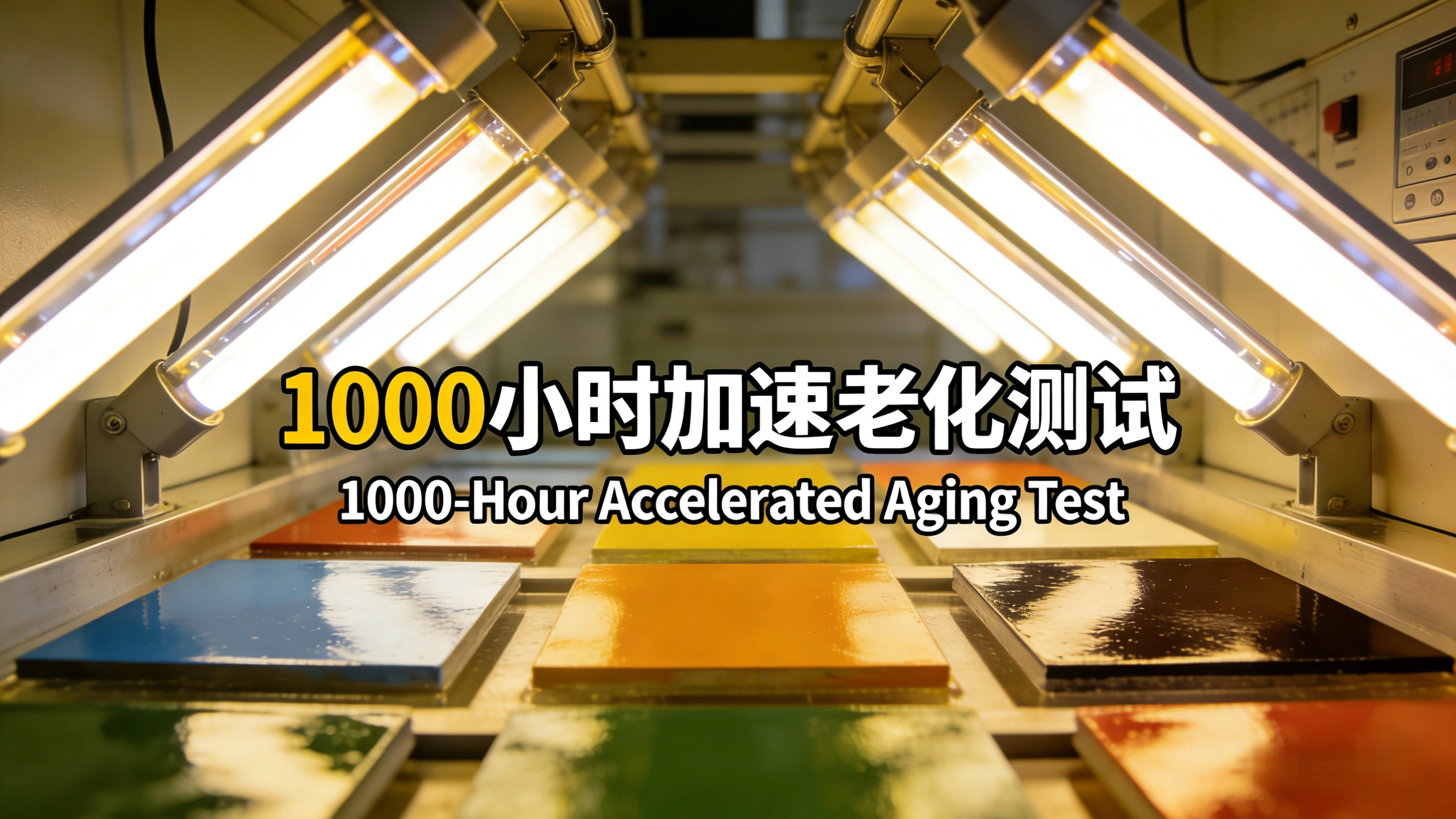
Rough conversions between QUV hours and outdoor years are often quoted, such as 500 h for about 2–3 years, 1000 h for about 3–5 years, 2000 h for about 5–8 years. This must be stressed as an order-of-magnitude reference only: the real conversion depends on the latitude and altitude of the installation site (ultraviolet dose), orientation and shading, coating color (dark shades weather better but run hotter), and the failure criterion itself, and it cannot be used as a warranty term. For life extrapolation, return to Arrhenius/EIS/infrared-thermography models together with field exposure rack data, as detailed in the service-life prediction and correlation articles linked above.
6. Formulation root causes: CPVC, TiO₂ crystal form and pigment volume concentration
CPVC, the critical pigment volume concentration, is the point at which the film flips from a continuous binder phase to air as the continuous phase. The closer PVC comes to and then passes CPVC, the more interconnected porosity appears in the dry film, binder is no longer sufficient to wrap every pigment particle, and the surface is where binder gives out and powdering begins under the coupled action of stress and radiation. Expressed on the dry film, porosity can be estimated as 1 − CPVC/PVC; in dispersion-type latex paints, CPVC is also influenced by particle size and particle size distribution. Outdoor high-gloss topcoats are normally formulated at PVC clearly below CPVC, so that binder is in excess and gloss is held.
| Property | Rutile | Anatase |
|---|---|---|
| Refractive index | about 2.7 (higher hiding power) | about 2.5 |
| Photocatalytic activity | lower, more resistant to binder degradation | higher, readily generates reactive oxygen |
| Outdoor recommendation | preferred for topcoats | mostly interior use, or after surface coating treatment |
| Typical median particle size | about 0.2 µm | about 0.2 µm |
In practice, outdoor and industrial topcoats should use rutile TiO₂, with extenders given a coating treatment; holding PVC clearly below CPVC and limiting the loading of high-porosity flattening extenders are the two main formulation lines for delaying chalking and gloss loss. The quantitative relations between pigment volume concentration and hiding power, porosity and gloss retention can be calibrated at formulation stage with CPVC step experiments.
7. Stabilizing systems: the HALS Denisov cycle and its failure boundaries
Hindered amine light stabilizers (HALS) do not shield the coating from light; they interrupt photo-oxidation catalytically. The hindered amine is oxidized to the nitroxyl radical R₂NO·, which captures alkyl and peroxy radicals and, through a series of intermediates, is regenerated as R₂NO· — the so-called Denisov cycle — so a small dosage gives lasting action. HALS slows the growth of carbonyl, the decline of gloss retention, chalking and cracking. HALS acts in synergy with ultraviolet absorbers (UVA): UVA reduces the sources of radical initiation, HALS reduces propagation efficiency, and the combination often extends weathering life markedly. Photodegradation of TDI/HDI systems in polyurethane topcoats and HALS/UVA blends is treated in Polyurethane topcoat weatherability: TDI/HDI, QUV and HALS light stabilization.
- Dosage and release: by public-industry practice, HALS is typically blended at about 0.5%–2% of resin solids (the product data sheet and ageing data decide), and overdosing leads to bloom.
- Acid deactivation: acid gases such as SO₂/NOₓ, acid-catalyzed resins or halogenated flame retardants convert the amine into inactive salts and weaken HALS; industrial atmospheres and some bake systems need particular attention.
- Migration and molecular weight: low-molecular-weight HALS migrates with water or volatilizes, so long-term outdoor service should use polymeric or reactive grades.
- Synergistic blending: UVA, HALS and antioxidants form a three-stage defense, covering radical control both during processing and in service.
8. Service life and climate zoning: ISO 12944-1:2017
ISO 12944 is the corrosion-protection standard for protective paint systems on steel structures; Part 1 divides coating durability (years to the initial major maintenance) into four classes, and Part 2 adds the radiation (R) and temperature (T) climate elements alongside the corrosivity categories C1–CX, which is what characterizes ultraviolet-dominated chalking and gloss-loss risk. The Chinese adoption is the GB/T 30790 series — note that the 2014 edition modified-adopts the three-class wording of ISO 12944:1998, so any discussion of four classes should cite ISO 12944-1:2017 directly and state the version.
| Durability class | Stated years to the initial major maintenance | System highlights (illustrative) |
|---|---|---|
| Low L | up to 7 years | Light corrosion protection, a single topcoat may suffice |
| Medium M | 7–15 years | Primer/intermediate/topcoat system, dry film thickness controlled |
| High H | 15–25 years | Weatherable topcoat (aliphatic polyurethane/fluorocarbon) |
| Very high VH | more than 25 years | Heavy-duty protection plus high weatherability, with periodic maintenance |
The radiation category R (low/medium/high, by annual global solar radiation) combines independently with the corrosivity category C: within the same C3, high radiation (R3) can still make chalking and gloss loss the dominant failure before corrosion. Design should therefore keep appearance retention (gloss and chalking) and corrosion protection (rusting and blistering) as two parallel criteria. The thicker the coating, the longer media take to reach the substrate, in proportion to the square of film thickness by Fick's law, which is also the basis for thick-film heavy-duty systems.
9. Recoat window and pre-recoat preparation criteria
Overcoating straight onto a chalked face is a common root cause of rework: the loose powder layer anchors the new paint in dust, intercoat adhesion falls far below the service requirement, and peeling returns within a short time. Before recoating, the chalked layer must be removed down to a layer that is cohesive and sound, and adhesion must be verified.
9.1 Powder removal, cleaning and sealer
- Mechanical powder removal: abrade, sweep or use high-pressure water (against the ISO 8501 preparation grades) until no powder remains and a dense layer is exposed; remove dust promptly after de-powdering.
- Cleaning: remove oil, grease, soluble salts and biological film to prevent flash rust and blistering.
- Sealer/transition primer: on chalked or porous substrates, begin by restoring binder continuity with a high-penetration sealer, then apply the specified topcoat system.
- Acceptance criterion: pull-off adhesion is verified against ISO 4624, commonly taken in engineering practice at no less than 5 MPa; if it does not reach this, the topcoat must not be applied directly.
9.2 The two failure ends of the intercoat recoat interval
Recoating too early leaves solvent or water in the lower coat trapped at the interface, producing blistering, pinning and gloss loss; recoating too late passes the recoat interval stated for the system, the window for intercoat chemical bonding closes, and adhesion falls. Both present as a film that looks sound yet delaminates between coats. The actual recoat window follows the dry-to-touch, hard-dry and recoat intervals in each product data sheet, and work spanning seasons must also re-check whether ambient temperature and humidity meet the lower limits for film formation.
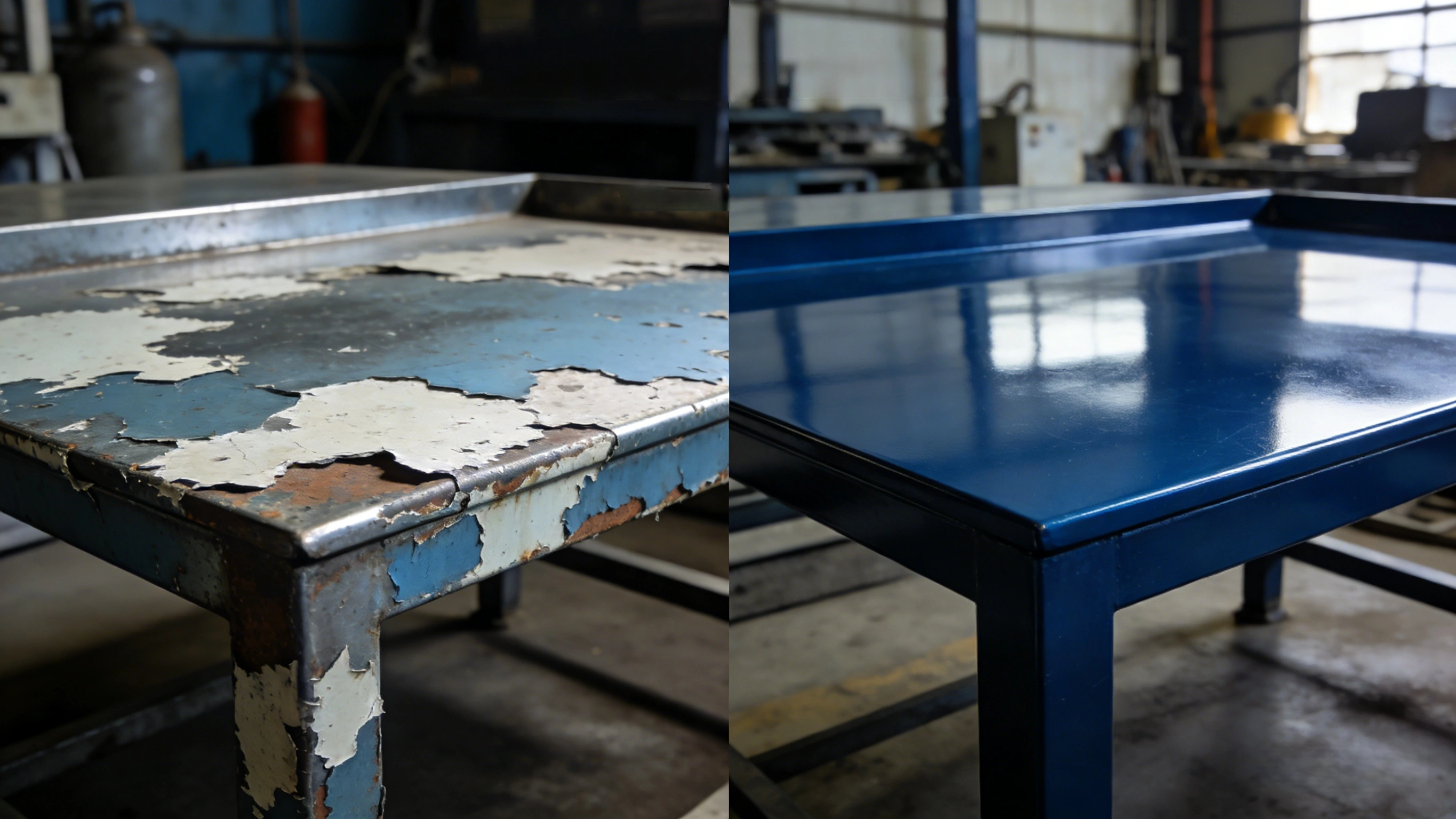
Where an old coating has lost only gloss with a slight color difference and its structure is not yet failed, the feasibility of polishing and color-retention restoration can be assessed; criteria and practice are in Paint ageing, fading and color-retention restoration. Whether to escalate to a full repaint returns to the chalking grades and adhesion acceptance criteria set out in this article.
10. Key data at a glance (with units)
- Chalking rating range: ISO 4628-6:2023 tape method, grades 0–5; tape width not less than 15 mm; the photoelectric criterion is transmittance of the tape after pickup below 70% of unused tape.
- Gloss geometries: ISO 2813:2014 at 20°/60°/85°; a 60° reading above 70 units favors measuring at 20°, below 30 units favors 85°.
- QUV cycle: ASTM G154 Cycle 1 is 8 h light at (60 ±3) ℃ plus 4 h condensation at (50 ±3) ℃, with UVA-340 at about 0.77 W/(m²·nm)@340 nm.
- Xenon-arc spectrum: ASTM G155 and ISO 4892-2 give about 295–800 nm after filtering, with black standard temperature commonly 60–70 ℃.
- Gloss retention reference: after 1000 h of ageing, at least 80% is good and at least 70% acceptable (public-industry practice, to be fixed against the data sheet).
- CPVC: porosity is approximately 1 minus CPVC divided by PVC; topcoat PVC should stay clearly below CPVC; rutile and anatase TiO₂ median particle size about 0.2 µm.
- HALS: about 0.5%–2% of resin solids (public-industry practice); readily deactivated by SO₂/NOₓ acid gases.
- Durability: ISO 12944-1:2017 gives L up to 7 years, M 7–15 years, H 15–25 years, VH more than 25 years; adhesion acceptance ISO 4624 commonly at no less than 5 MPa.
11. Frequently asked questions
Q1: Gloss has dropped but there is no powder — is that a failure?
It is an early degradation signal, but not the same as loss of function. Gloss loss reflects micro-roughening of the surface and normally appears before wipeable chalking. Run the two criteria in parallel: keep 60° gloss retention as the sentinel (for instance, a fall below 80% after 1000 h triggers a review) and the ISO 4628-6 chalking grade as the intervention threshold (grade 2 or above enters the recoat plan). Combine film-thickness loss and ΔE color difference so that gloss alone does not lead to a misjudgment.
Q2: Can 1000 h of QUV be converted into years outdoors?
Only as an order of magnitude, never as a warranty term. There is no constant conversion factor between QUV and the outdoors; it depends on the ultraviolet dose of the site, orientation, color, temperature and humidity cycling, and the criterion chosen. By public-industry practice 1000 h is often mapped to about 3–5 years, but that is not a commitment. For life judgments, return to xenon-arc to outdoor correlation regressions, Arrhenius extrapolation, EIS impedance spectra and field exposure rack data, as in the correlation article linked above.
Q3: With the same formulation, why does the sun-facing side chalk sooner?
The sun-facing side receives a higher cumulative radiant dose and a higher peak surface temperature; the rate of the photo-oxidation chain rises with temperature, and condensation and drying cycles are more frequent, so binder is consumed faster. Shaded faces and same-batch units away from the coast often still hold higher gloss retention. Selection should set the weathering margin by climate zoning (the radiation class R of ISO 12944-2 combined with the actual orientation) rather than by a rough average of sunshine.
Q4: Can anatase TiO₂ be used in outdoor topcoats at all?
Uncoated anatase is generally not recommended for long-term outdoor high-gloss topcoats. Anatase has high photocatalytic activity: under ultraviolet it readily generates reactive oxygen and accelerates degradation of the binder around it, which in turn triggers gloss loss and chalking. For outdoor service, prefer rutile (refractive index about 2.7, lower photocatalysis), or grades given an inorganic or organic surface coating treatment, and keep PVC clearly below CPVC.
Q5: HALS was added — why is it still chalking?
Three causes are common. The initial one is acid deactivation: SO₂/NOₓ or an acid-catalyzed system converts the amine into an inactive salt, so HALS underperforms in industrial atmospheres and in some baked systems. Wrong grade or wrong dosage is another: low-molecular-weight HALS migrates and is lost, the dosage may be too low, or too high and it blooms (public practice blends about 0.5%–2% of resin solids, subject to verification). The remaining case is that the root cause lies outside light stabilization: if the formulation already puts PVC past CPVC, or the resin lacks weatherability, HALS only delays the process rather than reversing it. Blend UVA and antioxidants into a three-stage defense and verify with accelerated weathering data.
Q6: Can new paint be applied straight over a chalked surface?
Direct overcoating is not recommended. The loose powder layer sharply reduces intercoat adhesion, the new paint anchors in dust, and peeling and flaking usually return within a short time. The correct route is mechanical removal down to a cohesive, dense layer, cleaning to remove soil, a high-penetration sealer where needed to restore binder continuity, and pull-off adhesion verification against ISO 4624 (commonly no less than 5 MPa in engineering practice) before applying the system. Removal and acceptance criteria are in section 9.
Q7: Do matt or flat paints inevitably chalk?
The risk is higher, but not inevitable. Matt finishes usually reach their appearance by raising PVC and adding flattening extenders that form controlled microporosity; when PVC approaches or exceeds CPVC, binder deficiency accelerates gloss loss and chalking. In engineering terms, a weatherable resin, limited porous flattening extenders, rutile TiO₂ and a HALS plus UVA blend can push the chalking rate down to a level acceptable within the service life. What matters is backing the choice with ageing data on 60° or 85° gloss retention and chalking grade, rather than on feel.
Q8: Can GB/T 30790 simply be used in place of ISO 12944-1:2017?
That should not be assumed. The GB/T 30790 series (2014) modified-adopts ISO 12944:1998 and its durability is split into three classes, low, medium and high, whereas ISO 12944-1:2017 uses four — L, M, H and VH (L up to 7, M 7–15, H 15–25, VH more than 25 years). To state a VH class or the four-class wording externally, cite ISO 12944-1:2017 directly with the version number, so that an old three-class mapping is not stretched over the new class years and the system design and the quotation no longer match.
12. References and notes on practice
- ISO 4628-6:2023 Paints and varnishes — Assessment of the degree of deterioration of coatings. Part 6: Determination of resistance to chalking by a tape method; adopted in China as GB/T 1766 (rating methods for coating ageing).
- ISO 2813:2014 Paints and varnishes — Determination of gloss value at 20°, 60° and 85°; corresponding ASTM D523 and GB/T 9754.
- ASTM G154 (fluorescent UV exposure, non-metallic materials) with ISO 4892-3 and GB/T 16422.3; ASTM G155 with ISO 4892-2 and GB/T 16422.2 (xenon-arc).
- ISO 12944-1:2017 (general principles and durability classes), ISO 12944-2 (corrosivity, radiation and temperature environment classifications), ISO 12944-5 (protective systems); the Chinese GB/T 30790 series is the older adoption (three-class wording).
- ISO 4624 (pull-off adhesion), ISO 8501 (surface preparation grades), GB/T 250 (grey scale for visual rating).
- Mechanism and stabilization literature: reviews by H. J. Gijsman et al. on the mode of action and applicability of hindered amine light stabilizers (HALS) (Polymer Degradation and Stability, 2017), together with published coatings references on the CPVC phase transition and pigment photocatalysis.
Note on practice: figures marked in this article as public-industry practice (the gloss-retention grading, the QUV-to-outdoor conversion, HALS dosage and the like) are experience ranges intended for relative judgments in selection and acceptance; the product data sheet, the project acceptance standard and measured ageing data govern, and standards are as formally published.
About Kexin New Materials
The technical content of this article was compiled by the industrial coatings technology team of Kexin New Materials (Guangdong) Co., Ltd. as a B2B reference for coating selection and acceptance on steel structures, storage tanks, industrial equipment and outdoor installations. Data follow published standards and industry references; the specific systems and weatherability figures are governed by the product technical data sheet and third-party testing. Supply and trade terms are handled on an EXW and FOB basis, serving industrial project and distributor supply only, with no individual retail sales to consumers.
Last updated: 2026-11-23 | Kexin New Materials (Guangdong) Co., Ltd.