Key Takeaways:
1. Transparent Glass Anti-UV Heat-Insulating Nano Film constructs multi-scale synergistic protective networks through nanoscale fillers for long-term architectural protection.
2. Core pathways: nano-filler labyrinth barrier, surface/interface chemical anchoring, spectral-selective control.
3. 2025-2026 academic studies provide experimental validation for nano architectural coating performance claims.
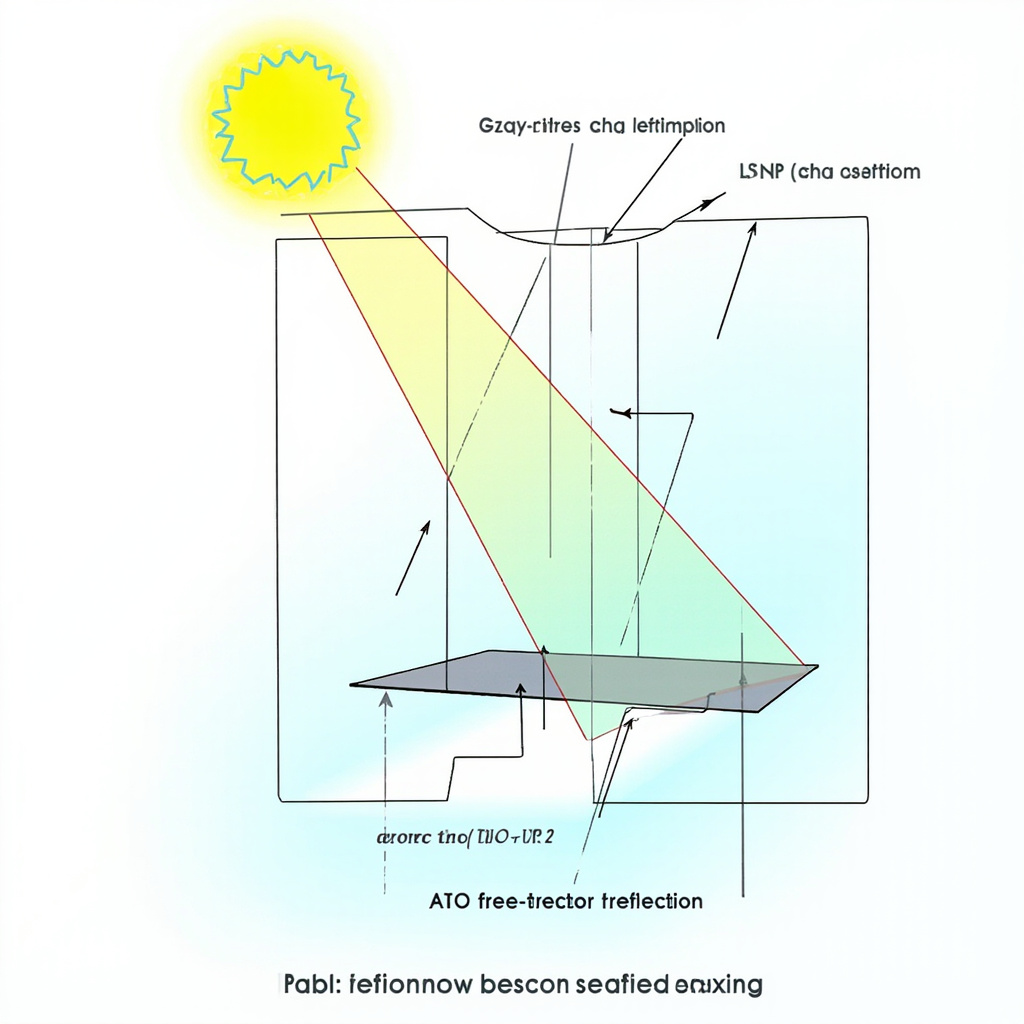
Transparent glass nano films achieve spectral-selective solar control through three mechanisms: Cs0.33WO3 (LSPR peak 950nm) absorbs NIR (800-1200nm), ATO (free electron density 10^20-10^21/cm3, plasma frequency in IR band) reflects IR, nano-ZnO (bandgap 3.3eV)/TiO2 (bandgap 3.0-3.2eV) absorbs UV (<380nm). Results: >90% IR rejection, >95% UV rejection, >70% visible light transmission. Global architectural glass energy-saving coating market ~$4.2B (2025), Asia-Pacific >40%. Sumitomo Metal Mining CWO series and Merck LAZERFLAIR series are benchmark Cs0.33WO3 nano-dispersions.
Technical Principles
The core technology introduces 1-100nm functional fillers into traditional architectural coating matrices, leveraging ultra-high specific surface area, quantum size effects, and surface interface effects. Lamellar nano-fillers reduce diffusion coefficient 50-500x. Nano-SiO2 silanol groups elevate adhesion to 10-18 MPa. Nano-TiO2/ZnO provide UV absorption; Cs0.33WO3 LSPR absorbs NIR.
2025-2026 validation: Composite Interfaces (2026) — 57.42% water absorption reduction. MDPI Coatings (2025) — UV transmission<1%. Main Group Chemistry (2026) — anti-mold validation.
Engineering & FAQ
Initial cost 30-80% higher, 10-20yr LCC 20-40% lower. Global architectural coatings market ~$72B (2025). Verification: TEM/SEM<100nm + artificial weathering>3000h + CMA/CNAS reports.
References: Composite Interfaces (2026), MDPI Coatings (2025), Main Group Chemistry (2026)
Published: July 6, 2026