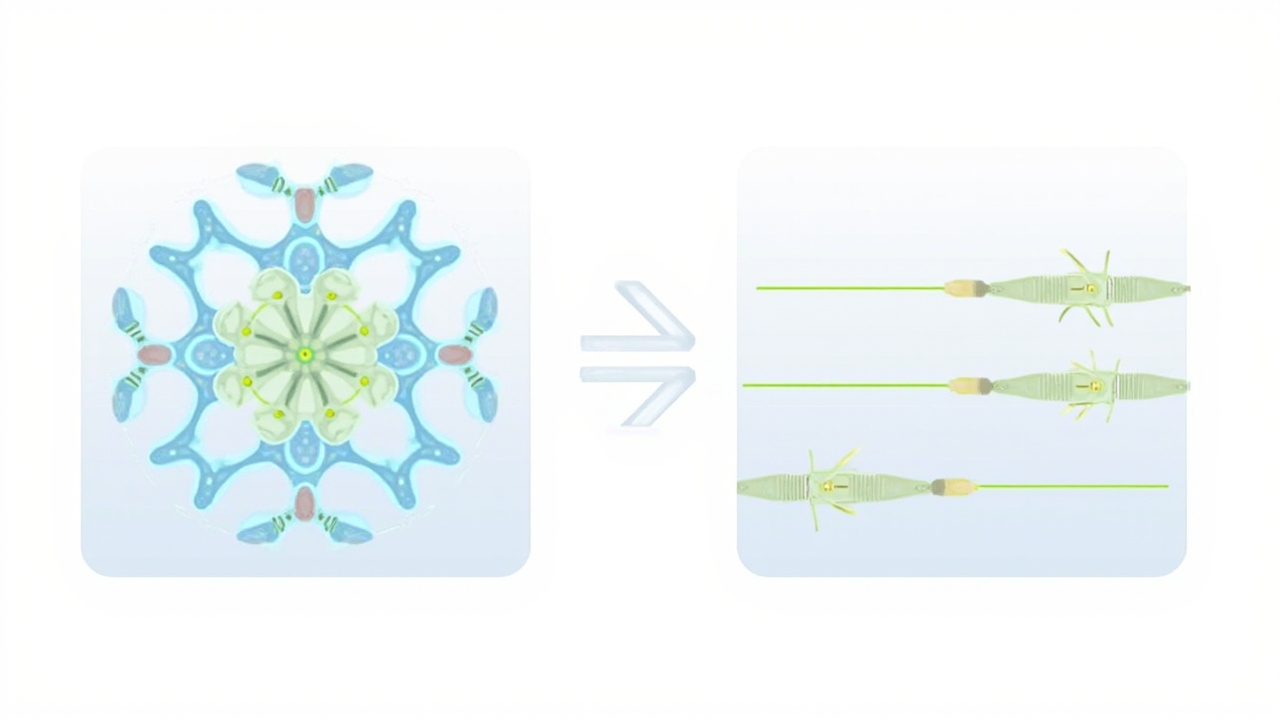
By resin behavior under heat, powder coatings fundamentally divide into thermoset and thermoplastic. This is not a “formulation style” difference but an essential film-formation difference: thermoset powder chemically crosslinks with hardener during baking into an insoluble infusible 3D network; thermoplastic powder merely melts, flows and cools solid — remeltable. In kexinMaterials’ powder technology, thermoset epoxy/polyester/PU powders dominate industrial protection and decoration, while thermoplastic PE/PP/PA/PVC are irreplaceable for pipes, mesh, electrical insulation and wear linings. Understanding the boundary is step one to choosing right.
1. Thermoset Powder Film Formation
Thermoset resin carries reactive groups (epoxy, —OH, —COOH) pre-mixed with hardener (amine, anhydride, Primid, blocked isocyanate). In the cure oven, after melting, resin and hardener react under heat:
- epoxy + amine/anhydride → crosslinked network
- hydroxy polyester + blocked IPDI (deblocked —NCO) → PU network
- carboxy polyester + TGIC / Primid → crosslinked network
After “gel time” (ISO 8130-6 / GB/T 16995 at given temperature) the system loses flow and cures into an insoluble network. Higher crosslink density → denser film: high hardness, solvent/chemical resistance, but over-crosslinking becomes brittle with high internal stress. Typical cure window 180–200 °C × 10–15 min.
Once cured, thermoset cannot remelt — advantage (heat/solvent resistance, dimensional stability) and limit (stress concentration at edges/thick film, recycled powder degrades, no hot repair). Thus thermoset demands precise pre-treatment and cure curve.
2. Thermoplastic Powder Film Formation
Thermoplastic powder (PE, PP, PA, PVC, EVA) resin is a large linear/branched polymer; heated above melting point it melts and flows, then cools solid — only physical chain entanglement, no chemical crosslink. Therefore:
- Film can be re-heated, softenedeven remelted (repairable, weld-coatable).
- Toughness, impact, tear resistance usually better than thermoset.
- No hardener, simpler formula, more stable storage, no pot-life limit.
- But adhesion and hardness often weaker; needs thicker film (usually 150–1000 µm) to compensate; edge coverage by “hot dip” or “fluidized bed” more common.
Thermoplastic is applied by fluidized-bed dip or electrostatic spray + melt; workpiece preheated then dipped in boiling powder bed, or sprayed then oven-melted. Film far thicker than conventional electrostatic thermoset. Non-crosslinking remelt makes it valuable for pipe external protection, mesh, cable.
3. Performance Boundary Comparison
Thermoset wins on “hard, bonded, thin, chemical-resistant”; thermoplastic wins on “tough, thick, remeltable, impact-resistant”. Not substitutes but condition division: thermoset for heavy-duty and decorative top; thermoplastic for thick-film cladding and impact linings.
4. Common Thermoset Systems
- Pure epoxy (EP): best adhesion and chemical resistance, poor outdoor weathering — pipe internal, rebar, appliance primer. Fusion-bonded epoxy (FBE) is classic for oil/gas pipe, 300–600 µm.
- Epoxy-polyester hybrid: epoxy for adhesion/corrosion, polyester for appearance/weathering, cost-effective for appliances, office furniture; outdoor durability still below pure polyester.
- Pure polyester (PE): TGIC or Primid cured, good outdoor weathering — aluminum extrusion, curtain wall, farm machinery mainstream. Primid favored (no TGIC healthcontroversy).
- Polyurethane (PU): hydroxy polyester + blocked isocyanate, balanced weathering/chemical, fine appearance — high-end building and auto parts; releases deblocking byproduct needing exhaust.
- Acrylic (AC):high transparency/decoration — wheel clearcoat, transparent powder; brittle, paired with polyester base.
5. Typical Thermoplastic Systems
- Polyethylene (PE): low cost, tough, water-resistant — mesh, baskets, pipe external, fridge shelves; add antioxidant/UV stabilizer for weathering.
- Polypropylene (PP): slightly better chemical/heat than PE — chemical equipment lining; needs primer for metal adhesion.
- Nylon (PA): wear-resistant, self-lubricating, solvent-resistant — machine parts, pulleys, food-grade conveyor (per food-contact regs); high-end thermoplastic.
- PVC: soft, insulating, weatherable — cable, guardrail, building fittings; lower heat resistance.
- EVA/others: special flexibility/adhesion — foam coatings, composite adhesive layers.
Thermoplastic evaluation focuses on melt index (GB/T 3682 / ISO 1133), Vicat (GB/T 1633), adhesion (often primer-assisted) and falling-weight impact — not crosslink degree like thermoset.
6. Selection Decision Points
- Weathering: outdoor → pure polyester/PU (thermoset) or stabilized PE (thermo); indoor heavy-duty → epoxy (thermoset).
- Thickness & toughness: thick-film, impact, remelt-repair (pipe external, mesh) → thermoplastic; thin-hard decoration → thermoset.
- Recycle & cost: high-volume thin-coat high-yield → thermoset electrostatic; thick/complex → thermoplastic fluidized bed.
- Chemical: strong solvent/extreme corrosion → epoxy thermoset or PA thermoplastic.
- Adhesion base: thermoset epoxy naturally better on metal; thermoplastic often needs primer or preheat.
- Hot repair: field remelt-repair (buried pipe) → thermoplastic; one-shot high-precision decoration → thermoset.
kexinMaterials often recommends: outdoor steel decorative face → pure polyester thermoset (weathering + decoration); buried pipe external → thermoplastic PE or epoxy FBE (thickness + corrosion) — “thermoset for face, thermoplastic for body” covering different service environments, with each process’s cure/melt curve written into the card.
7. Adjacent tech and trends
Thermoset weathering per powder principles; heavy-duty extension to heavy-duty powder; thermoplastic cladding on pipe/rebar connects to fluidized-bed in powder application. Trends: thermoset → low-temp cure, TGIC-free (Primid), thin-film; thermoplastic → high-adhesion primer, functional (conductive/wear); the two compound (FBE+PE 3LPE) becoming pipe mainstream, blurring the boundary toward systemization.
8. Engineering Cases
- Coastal curtain-wall aluminum: thin-wall, outdoor, >10 yr gloss retention → thermoset pure polyester (Primid), 60–80 µm, chrome-free pretreatment. Not epoxy (poor weathering), not thermoplastic (thick, less fine). Validate by xenon (GB/T 1865).
- Buried gas steel pipe external: soil, mechanical + cathodic-protection compatible → 3LPE (FBE thermoset + adhesive + PE thermoplastic); single FBE weaker against rock-backfill impact.
- Food-plant conveyor mesh: frequent bending, food-safe, washable → thermoplastic nylon (PA) fluidized-bed, 300–600 µm, remelt-repairable. Not thermoset (brittle under bend).
Decision tree: outdoor decoration → thermoset polyester; buried thick-film → thermoset+thermoplastic composite (3LPE); frequent bend/remelt → thermoplastic. Hang “weathering, thickness, toughness, repairability” on your lips and selection won’t stray.
FAQ
Q: What is the most essential difference between thermoset and thermoplastic powder?
A: Thermoset crosslinks with hardener during baking into an insoluble infusible network, not remeltable after cure; thermoplastic only melts and cools with no chemical crosslink, re-heatable. This decides thermoset hard/chemical-resistant vs thermoplastic tough/remeltable.
Q: Why is thermoplastic usually thicker?
A: Thermoplastic adhesion/hardness are relatively weaker and it is mostly fluidized-bed dipped, needing thicker film (150–1000 µm) for protection and mechanical strength; thermoset electrostatic once-coat is mostly 50–150 µm.
Q: Can thermoset powder be recycled?
A: Partially — but recycled powder degrades (flow, appearance) because hardener/resin may pre-react and particle distribution drifts during storage/reclaim; blend with fresh powder at a reasonable ratio, not infinite reuse. Thermoplastic reclaim is more stable.
Q: Outdoor — thermoset or thermoplastic?
A: Outdoor decoration/weathering → thermoset pure polyester or PU (UV-resistant); thick-film cladding (outdoor rail, mesh) needing toughness → stabilized PE thermoplastic. Epoxy thermoset weathers poorly, not for outdoor exposed face alone.
Q: Why does thermoset “gel”?
A: Gel is the critical point where crosslinking loses flow (gel time per ISO 8130-6 / GB/T 16995 at given temperature). Beyond that window, more heat only densifies or embrittles the network; match oven time-temperature strictly to gel time.