Introduction: Flash-off — the "golden window" between basecoat and clearcoat
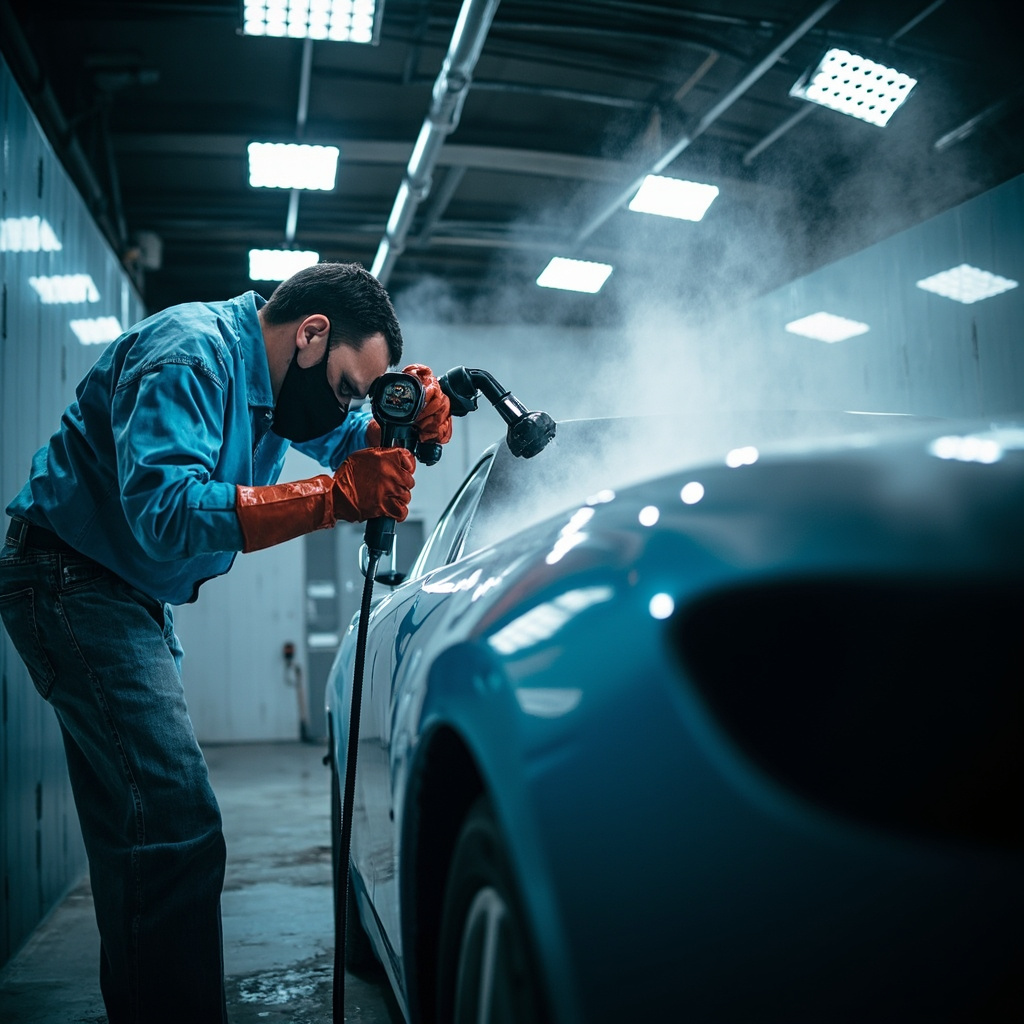
Two-coat application of automotive refinish paint (basecoat + clearcoat) is the standard process for over 90% of repair scenarios. Insufficient flash-off of the basecoat is the number one cause of topcoat yellowing, lifting, poor intercoat adhesion, and low gloss. If the solvents in the basecoat have not fully evaporated and are covered by the clearcoat, the residual solvents will penetrate upward to attack the clearcoat layer and dissolve the basecoat layer downward, causing irreversible interlayer damage.
I. Flash-off Time vs. Environmental Conditions Reference
| Ambient Temperature (°C) | Relative Humidity (%) | Recommended Flash-off Time (min) | Determination Method |
|---|---|---|---|
| 20-25 | <50 | 10-15 | Tack-free to touch + no solvent odor |
| 15-20 | 50-70 | 15-25 | Tack-free to touch + no solvent odor |
| 10-15 | 70-85 | 25-40 | Requires IR short-wave assisted flash-off (50-60°C/3-5min) |
| <10 | >85 | >40 or forced IR | Must use IR baking |
II. Flash-off Time and Spray Parameter Adjustment under Different Environments
| Environmental Conditions | Flash-off Time (min) | Spray Pressure (bar) | Gun Distance (cm) | Thinner Selection |
|---|---|---|---|---|
| Standard (23°C/50%RH) | 10-15 | 2.0-2.5 | 15-20 | Standard Thinner |
| High Temperature (>35°C) | 5-8 | 2.5-3.0 | 20-25 | Slow-drying Thinner |
| Low Temperature (<15°C) | 20-30 | 2.5-3.0 | 12-15 | Fast-drying Thinner |
| High Humidity (>80%RH) | 20-25 | 2.0-2.5 | 15-20 | Blush Retarder Additive |
II. Troubleshooting Procedure for Lifting
Solvent lifting — Strong solvents in the clearcoat penetrate into insufficiently dried basecoat layers, softening and swelling them, causing the coating to wrinkle, lose gloss, and lose adhesion. Troubleshooting sequence: (1) Confirm whether the basecoat is sufficiently flash-dried (touch test + solvent odor test); (2) Check the solvent strength of the clearcoat — use a "weak-solvent type" clearcoat (using aliphatic hydrocarbons as the main solvent instead of ketones/esters) to reduce the tendency for solvent lifting; (3) Reduce the film thickness of the first clearcoat pass (apply one "dust coat" pass, flash dry for 2–3 min, then apply normal film thickness); (4) For sensitive colors (e.g., red, yellow organic pigment basecoats), the risk of solvent lifting is higher and flash drying should be extended by 50%.

Technical deepening: systematic optimization methods for process parameters (DOE experimental design)
Coating production process optimization should not rely on the "trial-and-error method" but should adopt the scientific method of DOE experimental design. Taking the dispersion process as an example—factors affecting quality (linear velocity/time/filling rate/temperature), 4 factors each at 3 levels—full factorial requires 81 experiments—DOE uses orthogonal experiment L9 (9 times) or response surface methodology (27 times) to greatly reduce the number of experiments—while obtaining the main effects and interactions of each factor. For example, it is found that "the interaction of linear velocity × time is significant"—high linear velocity + short time and low linear velocity + long time can achieve the same dispersion effect—but the former saves energy by >20%.
In DOE analysis, interpretation of the P-value — P95% confidence). DOE ultimately outputs a set of prediction models (polynomial regression equations) — input line speed/time/temperature → predict fineness/viscosity/gloss — providing formulation engineers with a "digital formulation optimization" tool.
Industry practice: from "master craftsman's feel" to "parameter standardization"
The common challenge in the coatings industry — when experienced veteran workers retire, their "feel" (mixing resistance / fineness gauge scraping / visual inspection of wet-film gloss) is taken away — new employees cannot replicate it. Transform the "feel" into quantifiable standard parameters (1) mixing resistance → viscometer reading; (2) fineness gauge scraping → fineness gauge reading (μm); (3) wet-film gloss → gloss meter (GU value). The "standard parameter card" for each process is posted next to the equipment — new employees operate according to the "card" rather than "by feel". "Parameter standardization" is a key step for coating factories to move from "workshop" to "factory".
FAQ
Q1: Consequences of over-flashing of basecoat?Over-flashing (>60min@23°C) causes the basecoat surface to be overly cured, so the clearcoat cannot achieve chemical penetration and anchoring effect on it, leading to reduced interlayer adhesion. Best recoat window: apply clearcoat within 30 min after the basecoat is flash-dried to touch-dry.
Q2: What is the difference in flash-off between water-based basecoat and solvent-based basecoat? Water-based basecoat requires a longer flash-off time (20-30 min vs 10-15 min) because water has a high latent heat of vaporization (2260 kJ/kg). Also, water-based flash-off needs to be paired with Venturi blowing (air speed 0.5-1 m/s) to accelerate moisture removal.
Q3: What are the special requirements for basecoat flash-off when using high-solid clearcoat (HS Clear)?HS clearcoat has low solvent content (solid content >60%), so the risk of lifting the underlying coat is actually lower than that of medium- to low-solid clearcoats (solid content 30%-40%, with more solvent). However, HS clearcoat has a greater film thickness (50-70μm vs 30-40μm) and provides stronger sealing over the basecoat surface; if there is a trace of solvent residue in the basecoat, it will be sealed in the lower layer with no way to evaporate, forming micro-bubbles.
Q4: What is the difference in flash-off between metallic basecoat and solid basecoat?Metallic basecoats containing aluminum or pearl flakes need to complete directional alignment during the flash-off stage. Too fast flash-off (excessive IR) causes the aluminum flakes to be unable to orient sufficiently—resulting in a darker color and weak flake effect. For metallic basecoats, natural flash-off is recommended as the primary method (15–20 min), avoiding excessive forced IR flash-off.
Q5: How to quickly determine if the basecoat can be clearcoated?“Tack-free test” Wear clean finger cots and lightly touch the coating surface; there should be no tacky feeling and no paint film transferred to the finger cot, and no solvent odor when smelled up close. Only when both conditions are met can clearcoat be applied.”Tack-free but with solvent odor” Insufficient flash-off!
Q6: What to do if flash-off time exceeds 40 min under low temperature and high humidity in winter?(1) Use IR short-wave infrared lamps (distance 50-60 cm / temperature 50-60°C) to accelerate flash-off; (2) Heat the application environment (use a mobile warm air blower to raise local temperature above 20°C); (3) Select a fast-drying thinner (low boiling point, high evaporation rate).
Q7: Is the occurrence of "fish eye" in clear coat related to the flash drying of the basecoat?Usually not. Fish eyes are mainly caused by silicone oil/oil contamination (low surface energy sites) present in the basecoat or the environment. But in extreme cases—insufficient flash drying of the basecoat + oil mist in the environment—the combination of the two may increase the probability of fish eyes.
Q8: How to verify the compatibility between basecoat and clearcoat?The simplest method: Spray the complete primer + basecoat + clearcoat system on a discarded sheet metal part → After full curing, perform cross-cut test for interlayer adhesion (ISO 2409). If interlayer peeling > grade 1 → poor compatibility between basecoat/clearcoat or flash-off process needs adjustment.
Q9: Can the flash-off step be omitted for single-layer painting (direct gloss topcoat without clearcoat)? Single-layer painting has no interlayer issues, so flash-off can be shortened to surface dry. However, 2K direct high-gloss topcoat (which naturally levels and films after spraying) needs to maintain sufficient wet-film flow before surface dry; too fast flash-off instead causes orange peel. This is the key difference between single-layer and double-layer processes.
Q10: How to precisely control flash-off time in the spray robot automatic line?(1) There is a fixed conveyor belt running time between each spraying station (e.g., 10 min/station); (2) The conveyor section is equipped with IR short-wave infrared heaters (power and irradiation time controlled by PLC); (3) End-of-line flash-off detection — infrared temperature measurement + solvent concentration sensor (online FID detection) VOCs concentration decays to <10% of peak → flash-off judged complete.

FAQ: In-Depth Technical Q&A Supplement
Q11: How do the differences in domestic and international standards for this technology affect product export?Domestic standards (GB) differ from ISO/ASTM standards in test methods and acceptance criteria. For example, salt spray testing—GB/T 1771 (equivalent to ISO 7253) has test conditions basically consistent with ASTM B117—but the rating systems (ISO 4628 vs ASTM D610/D714) differ—when providing test reports for exported products, the corresponding international standards must be indicated simultaneously, otherwise overseas customers cannot make a comparative assessment. It is recommended to list both GB and ISO/ASTM dual-standard indicators in the TDS (Technical Data Sheet) of exported products—to enhance the trust of international customers.
Q12: How to verify the long-term service performance of this technology in actual engineering?Laboratory accelerated testing (salt spray/QUV/cyclic corrosion) provides comparative data—but cannot fully replace actual outdoor exposure testing. Recommendations—(1) Set up outdoor exposure racks at both the factory location and typical customer locations (e.g., coastal C5-M/industrial C4)—conduct annual inspections of coating appearance/adhesion/film thickness changes—establish a company-owned outdoor service database; (2) Collaborate with universities/research institutes—combine enterprise data with academic research—enhance data credibility.
Q13: What should SMEs pay attention to when purchasing related raw materials/equipment?(1) The batch stability of suppliers is more important than unit price—it is recommended to require suppliers to provide COA data for >10 batches—and evaluate batch variation (CpK); (2) When purchasing equipment, visit peers who have used the equipment for >2 years to understand the long-term reliability and after-sales service quality of the equipment—rather than relying only on the demonstration data from the equipment supplier; (3) For key raw materials (resin/curing agent)—maintain at least 2 qualified suppliers to guard against single-supply risk.
Q14: What is the current state and trend of digital transformation in this field?The digital transformation of the coatings industry is evolving from “point-based applications” (automation of individual equipment/processes) to ”system integration” (full-chain ERP+MES+PMS). Currently, for small and medium-sized coatings factories, the digitalization with the ”highest ROI investment” is automatic batching systems + digitalization of quality control data—payback period of 1-3 years—which is the prioritized recommended direction. Future trend—AI + sensors enabling real-time optimization of process parameters—further reducing quality fluctuations between batches.
Q15: How can a newly entered coating engineer quickly master this technology?(1)Combine theory and practiceDo not only read literature without touching actual production—nor rely solely on experience without studying theory;(2)Establish a “failure case archive”Every customer complaint/production anomaly/coating failure—record the root cause and resolution process—this is the most effective learning material;(3)Learn from suppliersTechnical personnel from resin/additive/pigment suppliers are carriers of "tacit knowledge" in this field—communicate more with them about solutions to specific problems.
Related Reading
Summary
The flash-off process between basecoat and clearcoat is a critical step determining the success of two-layer automotive refinish painting. Recommended flash-off time is 10–25 min (23°C / <70% RH) or IR forced flash-off for 3–5 min (under low-temperature and high-humidity conditions); the safe window for applying clearcoat is confirmed by the dual criteria of non-tacky to touch and no solvent odor. Adequate basecoat flash-off is the prerequisite for avoiding lifting/solvent attack, ensuring interlayer adhesion, and achieving topcoat gloss.