Introduction: Solvents—the fifth component of coatings—right choice doubles the results with half the effort, wrong choice loses it all.
Solvents are not components that ultimately remain in the coating film—yet they are critical to whether the coating can be applied and film-formed successfully. The threefold role of solvents: (1) dissolve resins—reduce viscosity—make the coating applicable (true solvents—solubility parameters match those of the resin); (2) regulate evaporation rate—control leveling time and drying speed (co-solvents—assist dissolution + extend open time); (3) reduce cost—thinners—do not dissolve resins but reduce viscosity—lower formulation cost. The scientific basis for solvent selection is the Hansen Solubility Parameters (HSP—δD dispersion / δP polar / δH hydrogen bonding, three-dimensional space)—the smaller the HSP distance Ra between resin and solvent, the stronger the solvency—Ra<8 soluble—Ra<4 highly soluble.
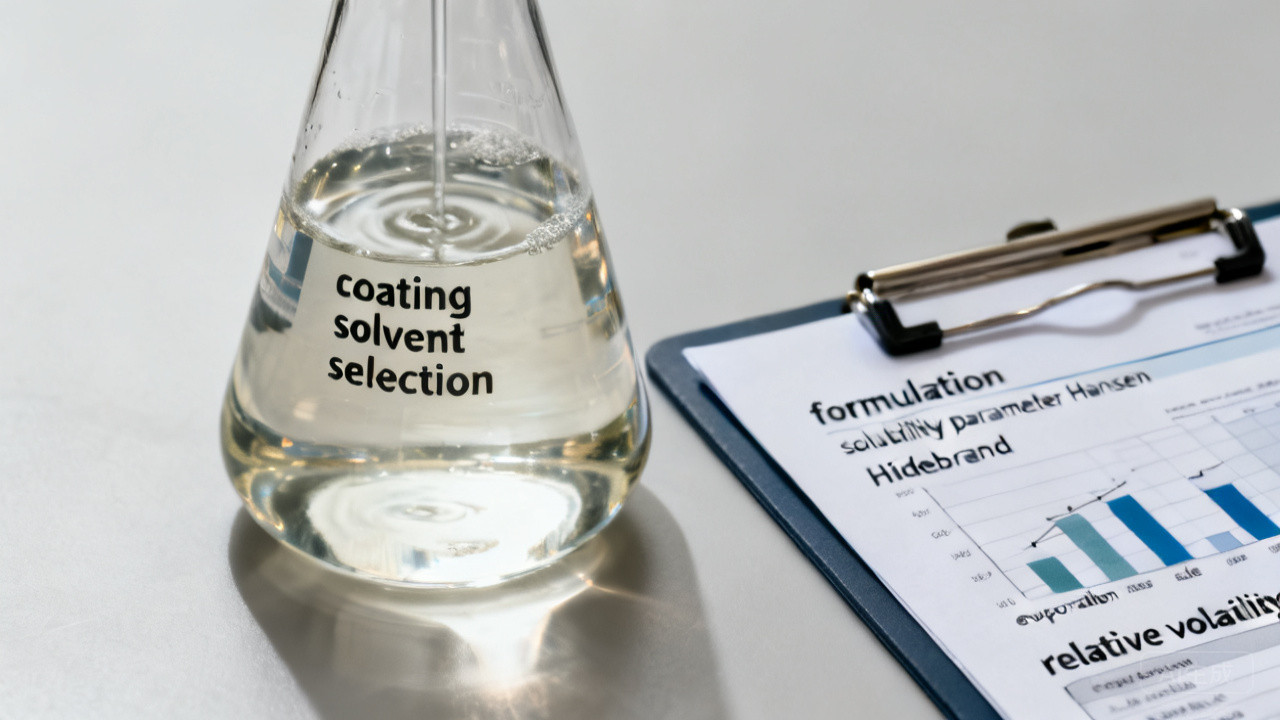
Coating solvent selection is based on Hansen Solubility Parameters (HSP) and solvent evaporation rate (RER—with butyl acetate = 1.0 as the reference)—true solvents (Ra<4—provide solvency), co-solvents (Ra8—only reduce viscosity and cost) together form the solvent triangle of the formulation—through rational combination—the optimal balance of sufficient resin dissolution, application viscosity, and drying speed is achieved—while simultaneously meeting the environmental requirements of VOC regulations (GB 30981/GB 38468/EU Decopaint).
I. HSP Parameters and Evaporation Rates of Common Solvents
| Solvent | δD | δP | δH | RER (butyl acetate = 1) | Boiling point (°C) | VOC exempt |
|---|---|---|---|---|---|---|
| Xylene | 17.8 | 1.0 | 3.1 | 0.7 | 138-144 | No |
| Butyl acetate | 15.8 | 3.7 | 6.3 | 1.0 (reference) | 126 | No |
| Acetone | 15.5 | 10.4 | 7.0 | 5.5 (very fast) | 56 | Yes (EPA/GB exempt) |
| Butanol | 16.0 | 5.7 | 15.8 | 0.4 (slow) | 118 | No |
| PCBTF | 16.6 | 3.0 | 2.0 | 0.9 | 139 | Yes (EPA exempt — contains F/Cl) |
| Propylene glycol methyl ether (PM) | 15.6 | 6.3 | 11.6 | 0.6 | 120 | No |

FAQ
Q1: Hansen Solubility Parameters—What does Ra<4 being soluble mean—How to use it?Hansen decomposes the solubility parameter into three dimensions—δD (dispersion forces), δP (polar forces), and δH (hydrogen bonding forces). The distance Ra between solvent and resin in three-dimensional space = √[4(ΔδD)2+(ΔδP)2+(ΔδH)2]. The smaller the Ra—the more compatible the solvent and resin—the stronger the dissolving power. Taking alkyd resin as an example—its HSP is approximately (δD=18, δP=8, δH=6)—xylene’s HSP (δD=17.8, δP=1, δH=3.1)—Ra≈7.9—Ra<8 is soluble but not optimal—this is why xylene can dissolve alkyd but requires heating or a cosolvent to improve dissolution efficiency.
Q2: VOC-exempt solvents—acetone/PCBTF—not counted as VOC—can be used freely?Acetone and PCBTF are listed as VOC-exempt by the US EPA and China’s GB standards—because their photochemical reactivity in the atmosphere is extremely low—they do not participate in the formation of photochemical smog (ozone). But this does not mean they are non-volatile or non-toxic—PCBTF has a boiling point of 139°C—it still volatilizes—it is just not counted in VOC emissions. Moreover, PCBTF is costly (50-80 RMB/kg—5-8 times that of xylene)—contains fluorine/chlorine—and requires special treatment for incineration disposal. Exempt solvents are a technical loophole in environmental regulations rather than a free lunch—their use requires careful evaluation of cost and end-of-life disposal.
Q3: The triangular formulation logic of true solvent/co-solvent/diluent?True solvent (core of dissolving power—accounts for 30-50%): Ra with resin <4—ensures thorough resin dissolution—coating is transparent and particle-free. Co-solvent (auxiliary dissolution + adjust volatility—accounts for 20-40%): Ra 8—does not dissolve resin—merely reduces viscosity and cost—but excess will cause resin precipitation—coating becomes cloudy. “Money saved on diluent = resin precipitation = coating scrapped”.
Related Reading
Summary
Coating solvents — true solvent (Ra<4) + co-solvent (Ra8) = formulation solvent triangle. Hansen HSP is the core scientific tool for solvent selection — relative evaporation rate (RER) determines the application window. VOC regulations and exempt solvents (acetone/PCBTF) are the environmental constraints in formulation design. Kexin New Materials provides solvent formulation optimization and VOC compliance solutions — achieving the best dissolution with the minimum solvent — meeting the strictest regulations.