Automotive电泳Coating Application(ED)原理与Process/Craft:阴极电泳为什么Rust-Proof好

2026-07-12 · Category: Technical Knowledge, Paint & Coatings

🌐 This article was automatically translated from Chinese. Please refer to the original Chinese version if needed. · 查看中文原文

.kx-article{max-width:860px;margin:0 auto;background:#ffffff;color:#232a33 !important;
border-radius:16px;padding:32px 30px 40px;box-shadow:0 8px 40px rgba(0,0,0,.25);
font-family:-apple-system,”Segoe UI”,”PingFang SC”,”Microsoft YaHei”,sans-serif;line-height:1.9;font-size:16px}
.kx-article *{box-sizing:border-box}
.kx-article h1,.kx-article h2,.kx-article h3,.kx-article p,.kx-article li,.kx-article td,.kx-article th,.kx-article strong,
.kx-article .summary,.kx-article .summary p,.kx-article .summary strong,
.kx-article .note,.kx-article .note p,.kx-article .kxbox-brand,
.kx-article .related,.kx-article .related li,.kx-article .kx-foot,
.kx-article .kxqa-q,.kx-article .kxqa-a{color:#232a33 !important}
.kx-article h1{font-size:28px;line-height:1.35;font-weight:800;margin:0 0 18px;color:#1a1d21 !important}
.kx-article .lead,.kx-article p{margin:14px 0}
.kx-article .cover{width:100%;border-radius:14px;box-shadow:0 6px 24px rgba(0,0,0,.15);margin:6px 0 26px;display:block}
.kx-article h2{font-size:22px;font-weight:700;margin:40px 0 16px;padding-bottom:10px;border-bottom:2px solid #eceff3;position:relative;color:#1a1d21 !important}
.kx-article h2::before{content:””;position:absolute;left:0;bottom:-2px;width:64px;height:2px;background:#e8720c}
.kx-article h3{font-size:18px;font-weight:700;margin:26px 0 12px;color:#2a2f36 !important}
.kx-article strong{color:#111418 !important;font-weight:700}
.kx-article img.inline{width:100%;border-radius:12px;box-shadow:0 4px 16px rgba(0,0,0,.12);margin:22px 0 8px}
.kx-article figcaption{color:#7a828d !important;font-size:13px;text-align:center;margin:6px 0 24px}
.kx-article table{width:100%;border-collapse:collapse;margin:20px 0;font-size:14.5px;background:#fff;border-radius:10px;overflow:hidden;box-shadow:0 2px 12px rgba(0,0,0,.06);border:1px solid #eceff3}
.kx-article th,.kx-article td{padding:12px 14px;text-align:left;border-bottom:1px solid #eceff3;vertical-align:top}
.kx-article th{background:#2a2f36;color:#ffffff !important;font-weight:600;font-size:14px}
.kx-article tr:last-child td{border-bottom:none}
.kx-article tbody tr:nth-child(even){background:#fafbfc}
.kx-article .note{background:#eef6ff !important;border-left:4px solid #0a67d0;padding:14px 18px;border-radius:0 10px 10px 0;margin:22px 0}
.kx-article .note strong{color:#0a4a97 !important}
.kx-article .kxbox-brand{background:#fff3e8 !important;border-left:4px solid #e8720c;padding:16px 18px;border-radius:0 10px 10px 0;margin:22px 0}
.kx-article .kxbox-brand strong{color:#5a4632 !important}
.kx-article ul{margin:12px 0;padding-left:22px}
.kx-article li{margin:8px 0}
.kx-article .kxqa-item{background:#fbfcfd;border:1px solid #eceff3;border-radius:12px;padding:16px 20px;margin:14px 0}
.kx-article .kxqa-q{font-weight:700;color:#e8720c !important;font-size:16px;margin-bottom:8px}
.kx-article .kxqa-a{color:#3a4048 !important;display:block;margin:0}
.kx-article .related{background:#fff !important;border:1px dashed #e8720c;border-radius:12px;padding:16px 22px;margin:26px 0}
.kx-article .related h3{margin:0 0 6px;color:#e8720c !important}
.kx-article .summary{background:linear-gradient(135deg,#fff3e8,#ffe9d6) !important;border-radius:12px;padding:20px 22px;margin:26px 0}
.kx-article .summary h3{margin:0 0 10px;color:#1a1d21 !important}
.kx-article .kx-foot{margin-top:34px;padding-top:18px;border-top:1px solid #eceff3;text-align:center;color:#8a929d !important;font-size:13px}
.related{margin:30px 0 6px;}
.related h3{font-size:18px;color:#1C1917;margin:0 0 12px;padding-left:10px;border-left:4px solid #F97316;}
.related ul{list-style:none;margin:0;padding:0;}
.related li{margin:0 0 9px;padding-left:16px;position:relative;}
.related li:before{content:”203A”;position:absolute;left:0;color:#F97316;font-weight:700;}
.related a{color:#F97316 !important;text-decoration:underline !important;font-weight:600;}
.related a:hover{color:#EA580C !important;}

.kx-article{max-width:860px;margin:0 auto;background:#ffffff;color:#232a33 !important;
border-radius:16px;padding:32px 30px 40px;box-shadow:0 8px 40px rgba(0,0,0,.25);
font-family:-apple-system,”Segoe UI”,”PingFang SC”,”Microsoft YaHei”,sans-serif;line-height:1.9;font-size:16px}
.kx-article *{box-sizing:border-box}
.kx-article h1,.kx-article h2,.kx-article h3,.kx-article p,.kx-article li,.kx-article td,.kx-article th,.kx-article strong,
.kx-article .summary,.kx-article .summary p,.kx-article .summary strong,
.kx-article .note,.kx-article .note p,.kx-article .kxbox-brand,
.kx-article .related,.kx-article .related li,.kx-article .kx-foot,
.kx-article .kxqa-q,.kx-article .kxqa-a{color:#232a33 !important}
.kx-article h1{font-size:28px;line-height:1.35;font-weight:800;margin:0 0 18px;color:#1a1d21 !important}
.kx-article .lead,.kx-article p{margin:14px 0}
.kx-article .cover{width:100%;border-radius:14px;box-shadow:0 6px 24px rgba(0,0,0,.15);margin:6px 0 26px;display:block}
.kx-article h2{font-size:22px;font-weight:700;margin:40px 0 16px;padding-bottom:10px;border-bottom:2px solid #eceff3;position:relative;color:#1a1d21 !important}
.kx-article h2::before{content:””;position:absolute;left:0;bottom:-2px;width:64px;height:2px;background:#e8720c}
.kx-article h3{font-size:18px;font-weight:700;margin:26px 0 12px;color:#2a2f36 !important}
.kx-article strong{color:#111418 !important;font-weight:700}
.kx-article img.inline{width:100%;border-radius:12px;box-shadow:0 4px 16px rgba(0,0,0,.12);margin:22px 0 8px}
.kx-article figcaption{color:#7a828d !important;font-size:13px;text-align:center;margin:6px 0 24px}
.kx-article table{width:100%;border-collapse:collapse;margin:20px 0;font-size:14.5px;background:#fff;border-radius:10px;overflow:hidden;box-shadow:0 2px 12px rgba(0,0,0,.06);border:1px solid #eceff3}
.kx-article th,.kx-article td{padding:12px 14px;text-align:left;border-bottom:1px solid #eceff3;vertical-align:top}
.kx-article th{background:#2a2f36;color:#ffffff !important;font-weight:600;font-size:14px}
.kx-article tr:last-child td{border-bottom:none}
.kx-article tbody tr:nth-child(even){background:#fafbfc}
.kx-article .note{background:#eef6ff !important;border-left:4px solid #0a67d0;padding:14px 18px;border-radius:0 10px 10px 0;margin:22px 0}
.kx-article .note strong{color:#0a4a97 !important}
.kx-article .kxbox-brand{background:#fff3e8 !important;border-left:4px solid #e8720c;padding:16px 18px;border-radius:0 10px 10px 0;margin:22px 0}
.kx-article .kxbox-brand strong{color:#5a4632 !important}
.kx-article ul{margin:12px 0;padding-left:22px}
.kx-article li{margin:8px 0}
.kx-article .kxqa-item{background:#fbfcfd;border:1px solid #eceff3;border-radius:12px;padding:16px 20px;margin:14px 0}
.kx-article .kxqa-q{font-weight:700;color:#e8720c !important;font-size:16px;margin-bottom:8px}
.kx-article .kxqa-a{color:#3a4048 !important;display:block;margin:0}
.kx-article .related{background:#fff !important;border:1px dashed #e8720c;border-radius:12px;padding:16px 22px;margin:26px 0}
.kx-article .related h3{margin:0 0 6px;color:#e8720c !important}
.kx-article .summary{background:linear-gradient(135deg,#fff3e8,#ffe9d6) !important;border-radius:12px;padding:20px 22px;margin:26px 0}
.kx-article .summary h3{margin:0 0 10px;color:#1a1d21 !important}
.kx-article .kx-foot{margin-top:34px;padding-top:18px;border-top:1px solid #eceff3;text-align:center;color:#8a929d !important;font-size:13px}
.related{margin:30px 0 6px;}
.related h3{font-size:18px;color:#1C1917;margin:0 0 12px;padding-left:10px;border-left:4px solid #F97316;}
.related ul{list-style:none;margin:0;padding:0;}
.related li{margin:0 0 9px;padding-left:16px;position:relative;}
.related li:before{content:”203A”;position:absolute;left:0;color:#F97316;font-weight:700;}
.related a{color:#F97316 !important;text-decoration:underline !important;font-weight:600;}
.related a:hover{color:#EA580C !important;}

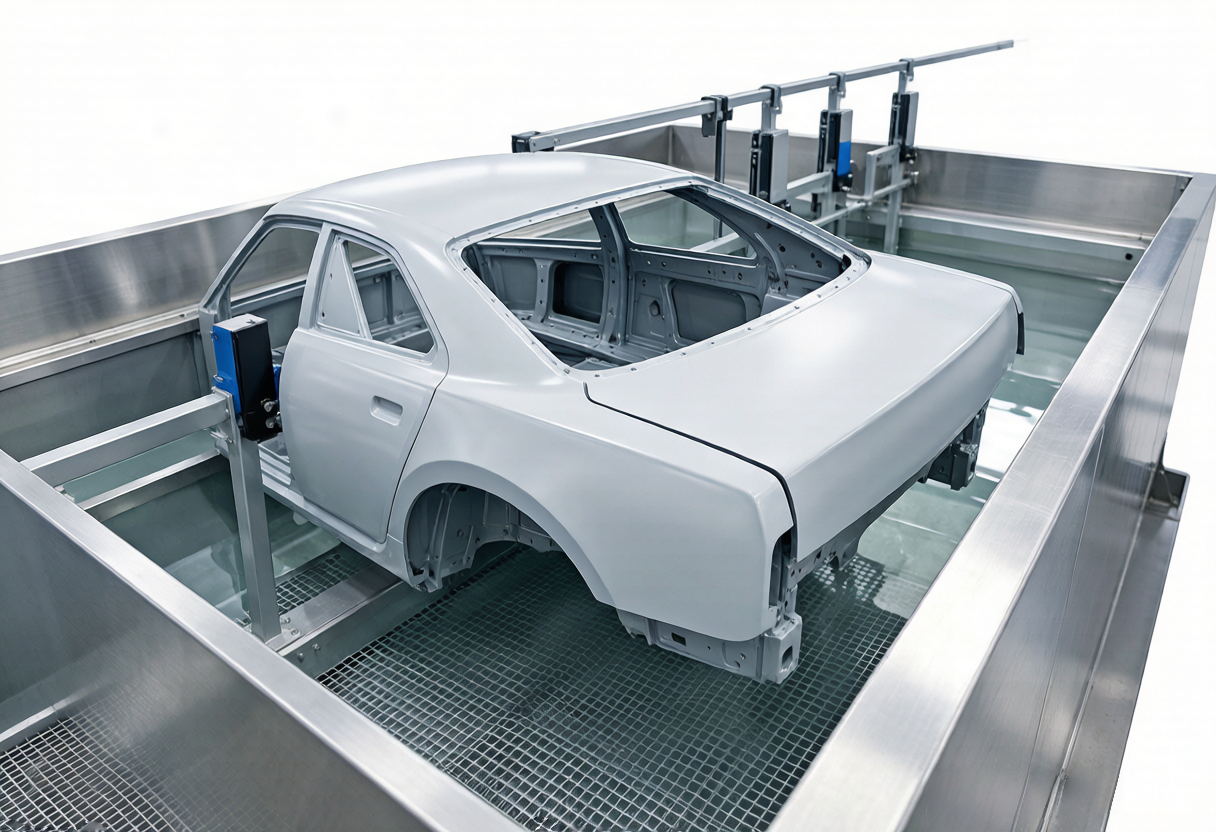
Automotive full-vehicle cathodic electrophoretic coating: car body immersed in electrophoretic tank, paint film uniformly covering illustration

Have you ever wondered: why don’t the internal cavities, welds, and edges of a car—places a spray gun can never reach—rust for years? The secret lies in electrophoretic deposition (ED, Electrocoat). It is the first and most critical “priming” process for vehicle corrosion protection. This article explains the principle of electrocoating, why it provides such excellent rust prevention, and the standard process flow of full-vehicle electrocoating.

In one sentence: Electrophoresis = immersing the entire vehicle in a charged paint bath, using an electric field to make the paint uniformly “grow” into every crevice. Cathodic electrophoresis is the current mainstream, with corrosion resistance far superior to spraying.

I. How Electrophoresis “Applies the Coating”

Electrophoresis utilizes electrochemical principles: the car body is used as an electrode and immersed in a water-soluble electrophoretic paint bath; after electrification, paint particles with opposite charges migrate toward the car body and deposit to form a film. Its most prominent feature is throw power — it can uniformly cover dead spots of spraying such as inner cavities and welds.
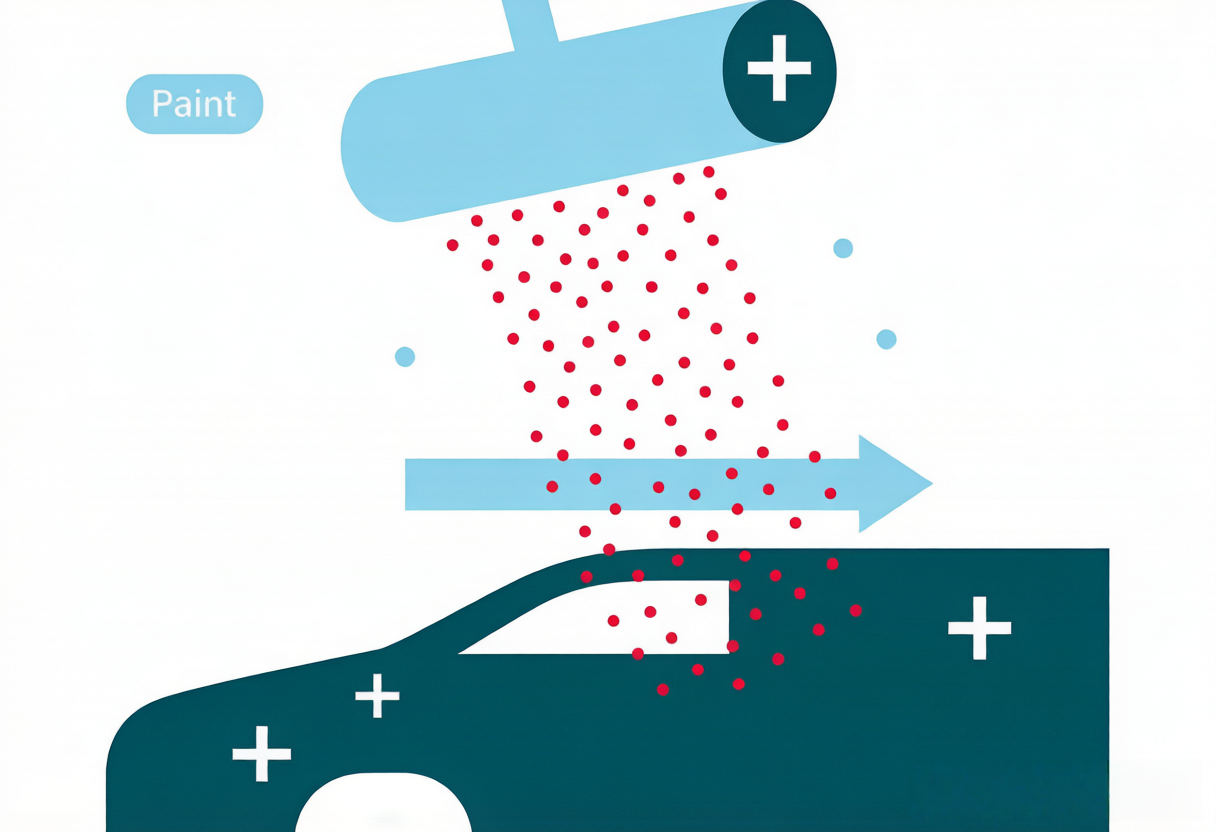
Electrophoretic coating electrochemical principle: schematic of charged paint particles migrating and depositing to form a film on the vehicle body electrode
Figure: Electrophoretic principle — charged paint particles migrate under an electric field and deposit onto the vehicle body surface.

II. Anodic Electrophoresis vs Cathodic Electrophoresis

Type Body Polarity Features
Anodic Electrodeposition (AED) Anode (dissolved out) Early process, average corrosion resistance
Cathodic Electrodeposition (CED) Cathode (more corrosion resistant) Mainstream, better anti-corrosion and salt spray resistance

Cathodic electrophoresis uses the car body as the cathode, so metal is less likely to dissolve out; the coating is denser and salt spray resistance can reach the 1000-hour level, making it the current standard process in vehicle factories.

III. Standard Process for Whole-Vehicle Electrophoretic Coating

  • Pre-treatment: Degreasing, phosphating/silane treatment to provide a clean and active surface.
  • Electrophoresis: Immerse in the bath solution, apply current for deposition, and control voltage/time/temperature.
  • Ultrafiltration water washing: Recover floating paint, reducing waste and pollution.
  • Baking cure: Cure at approx. 160–180℃ to form a dense primer coat.
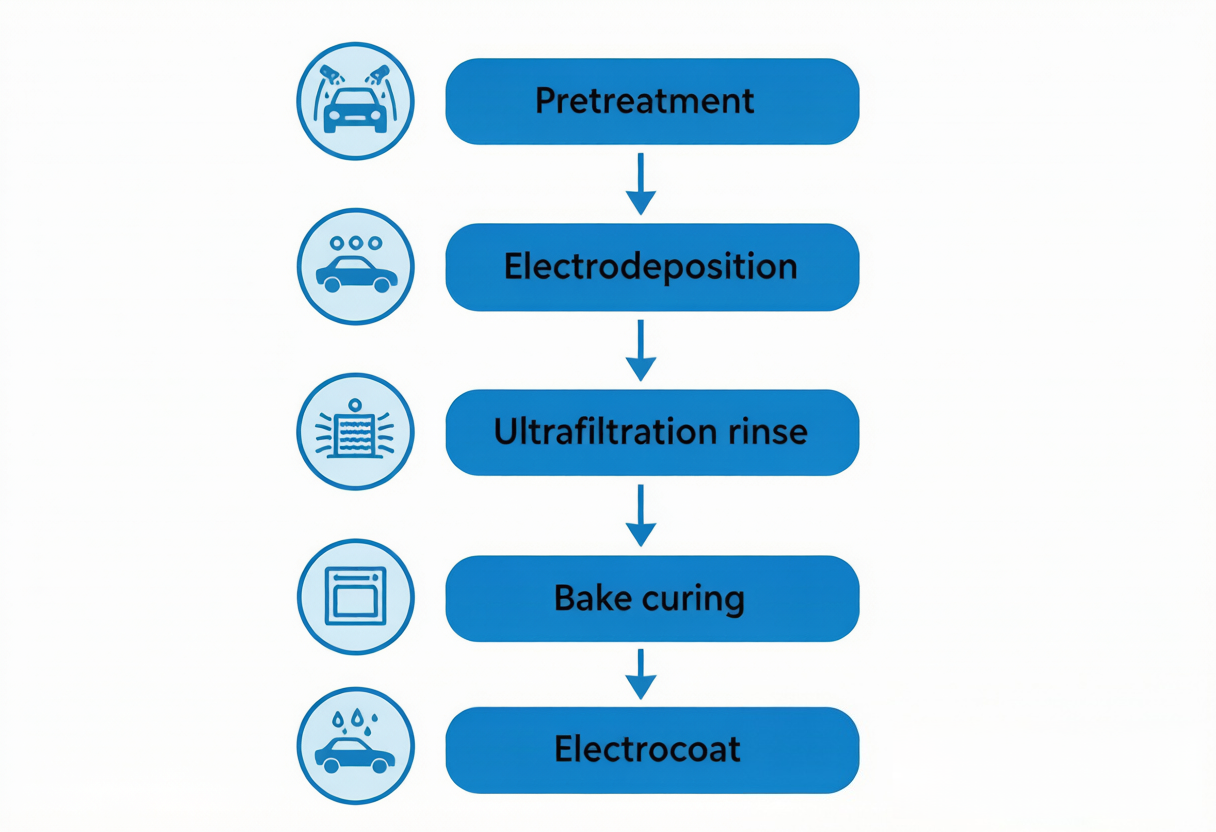
Vehicle electrophoresis process: pretreatment—electrophoresis—ultrafiltration water rinse—baking cure schematic
Figure: Four steps of vehicle electrophoresis — pretreatment, electrophoretic deposition, ultrafiltration water rinse, and baking cure.
Key application points: Electrophoresis quality highly depends on pretreatment and bath parameters (pH, solids content, temperature, voltage). The electrophoretic coating is the vehicle’s “anti-rust armor,” and its uniformity directly determines the vehicle’s service life.

Summary

Electrophoretic coating uses an electric field to uniformly deposit water-soluble paint, with throw power covering spray dead corners, making it the core of whole-vehicle anti-corrosion. Currently, mainstream cathodic electrophoresis offers better corrosion resistance than anodic electrophoresis; the standard process is pre-treatment → electrophoresis → ultrafiltration water rinse → bake curing. The quality of the electrophoretic layer depends on pre-treatment and bath parameters, and is the foundation of whole-vehicle durability.

Frequently Asked Questions (FAQ)

Why is electrophoretic coating especially good at rust prevention?
Electrophoresis uses an electric field to make the coating deposit evenly, even covering spray dead corners such as inner cavities and welds (throwing power), forming a continuous and dense film layer; cathodic electrophoresis can resist salt spray for up to thousands of hours, so its corrosion protection is far superior to spraying.
What is the difference between anodic electrophoresis and cathodic electrophoresis?
The polarity of the vehicle body differs: in anodic electrophoresis the body acts as the anode and metal is easily dissolved out, giving only average corrosion resistance; in cathodic electrophoresis the body acts as the cathode and the film is denser and more corrosion-resistant, making it the mainstream process in current vehicle factories.
How many steps does the electrophoresis process roughly consist of?
Usually four steps: pre-treatment such as degreasing/phosphating → immersion in the tank liquid and energized deposition → ultrafiltration water washing to recover floating paint → baking and curing at about 160–180℃ to form the primer layer.
What is the general thickness of the electrophoretic layer?
The film thickness of whole-vehicle cathodic electrophoresis is typically in the range of 15–30 microns, which is sufficient to provide excellent corrosion protection; too thin fails to prevent rust, too thick may affect the compatibility of subsequent coatings, so it must be controlled according to process standards.
Can the electrophoretic layer be partially redone during repair?
It is very difficult. Electrophoresis is a whole-vehicle tank immersion process that cannot be reproduced at the repair end; usually epoxy primer or the like is used as a substitute for local rust prevention, achieving a similar protective effect.
Kexin New Materials · Automotive Coating Technology Library | This article is technical Q&A content, for reference in selection and application

{
“@context”: “https://schema.org”,
“@type”: “FAQPage”,
“mainEntity”: [
{“@type”:”Question”,”name”:”Why is electrophoretic coating especially good at rust prevention?”,”acceptedAnswer”:{“@type”:”Answer”,”text”:”Electrophoresis uses an electric field to deposit paint evenly, covering even dead spots of spraying such as inner cavities and welds (throwing power), forming a continuous and dense film; cathodic electrophoresis can resist salt spray for up to thousands of hours, so its corrosion protection far surpasses spraying.”}},
{“@type”:”Question”,”name”:”What is the difference between anodic and cathodic electrophoresis?”,”acceptedAnswer”:{“@type”:”Answer”,”text”:”The polarity of the body is different: in anodic electrophoresis the body acts as the anode and metal is easily dissolved out, with average corrosion resistance; in cathodic electrophoresis the body acts as the cathode and the film is denser and more corrosion-resistant, making it the mainstream process in current vehicle factories.”}},
{“@type”:”Question”,”name”:”How many steps does the electrophoresis process roughly consist of?”,”acceptedAnswer”:{“@type”:”Answer”,”text”:”Usually four steps: pre-treatment such as degreasing/phosphating → immerse into the tank liquid and apply current for deposition → ultrafiltration water washing to recover floating paint → bake and cure at about 160–180℃ to form the primer coat.”}},
{“@type”:”Question”,”name”:”What is the general thickness of the electrophoretic layer?”,”acceptedAnswer”:{“@type”:”Answer”,”text”:”The film thickness of whole-vehicle cathodic electrophoresis is usually in the range of 15–30 microns, which is sufficient to provide excellent corrosion protection; too thin fails to prevent rust, too thick may affect the compatibility of subsequent coatings, so it must be controlled according to process standards.”}},
{“@type”:”Question”,”name”:”Can the electrophoretic layer be partially redone during repair?”,”acceptedAnswer”:{“@type”:”Answer”,”text”:”It is difficult. Electrophoresis is a whole-vehicle tank immersion process that cannot be reproduced at the repair end; usually alternatives such as epoxy primer are used for local rust prevention to achieve a similar protective effect.”}}
]
}