Core Conclusions:
1. Nano anti-rust primer penetrates into the tight rust layer (depth up to 50-100μm) through <1μm nanoparticles, chemically converting rust (Fe2O3/Fe3O4) into stable iron phosphate (FePO4) — upgrading from "covering rust" to "converting rust".
2. High-pressure water washing (3000-3500psi) replaces traditional sandblasting (Sa2.5 grade) — surface treatment cost reduced by 60-80%, construction time shortened by 50-70%, and avoiding the environmental and occupational health risks of sandblasting dust.
3. Conductive polymer nano-dispersion (CPND) primer (Rust-Legend™) achieves heavy anti-corrosion without heavy metals (no chromate/lead/zinc) by forming a dense metal oxide passivation layer — service life is more than 6 times that of traditional primers.
Heavy-duty trucks are the transportation tools with the harshest operating conditions on the road—the chassis and frame arelong-term exposed to the multiple attacks of muddy water, de-icing salts (NaCl/CaCl2), gravel impact, and chemical corrosion from de-icing agents. The protection logic of traditional anti-rust primers (alkyd anti-rust paint, epoxy zinc-rich primer) is "barrier"—forming a dense coating on the steel surface to prevent water and oxygen from reaching the substrate. But under the vibration, stone impact, and thermal cycling conditions of heavy trucks, the generation of micro-cracks in the coating is inevitable; once the cracks penetrate to the substrate, the barrier-type primer loses all protective function. Heavy-Duty Truck Wear-Resistant Anti-Rust Nano Primer upgrades the anti-rust logic from passive defense to active protection through the triple mechanism of "chemical conversion + nano penetration + dense barrier".
Rust-conversion chemistry — how nanoparticles turn rust into a valuable resource?
Direct answer: The corrosion products of steel—Fe2O3 (red rust, Hematite) and Fe3O4 (black rust, Magnetite)—are loose, porous, non-protective oxides with a density only 1/4 to 1/3 that of metallic iron; volume expansion is the main cause of coating cracking and delamination. The active components in nano anti-rust primers (phosphate/phosphate nanoparticles + organic chelating agents) penetrate into the pores of the rust layer and react chemically with the rust: Fe2O3 + 2H3PO4 → 2FePO4 + 3H2O and Fe3O4 + 4H3PO4 → Fe3(PO4)2 + FePO4 + 6H2O. The reaction product FePO4 (iron phosphate) is a dense, water-insoluble stable compound—unlike Fe2O3, it does not continuously catalyze new corrosion, but instead forms a protective "rust conversion layer".
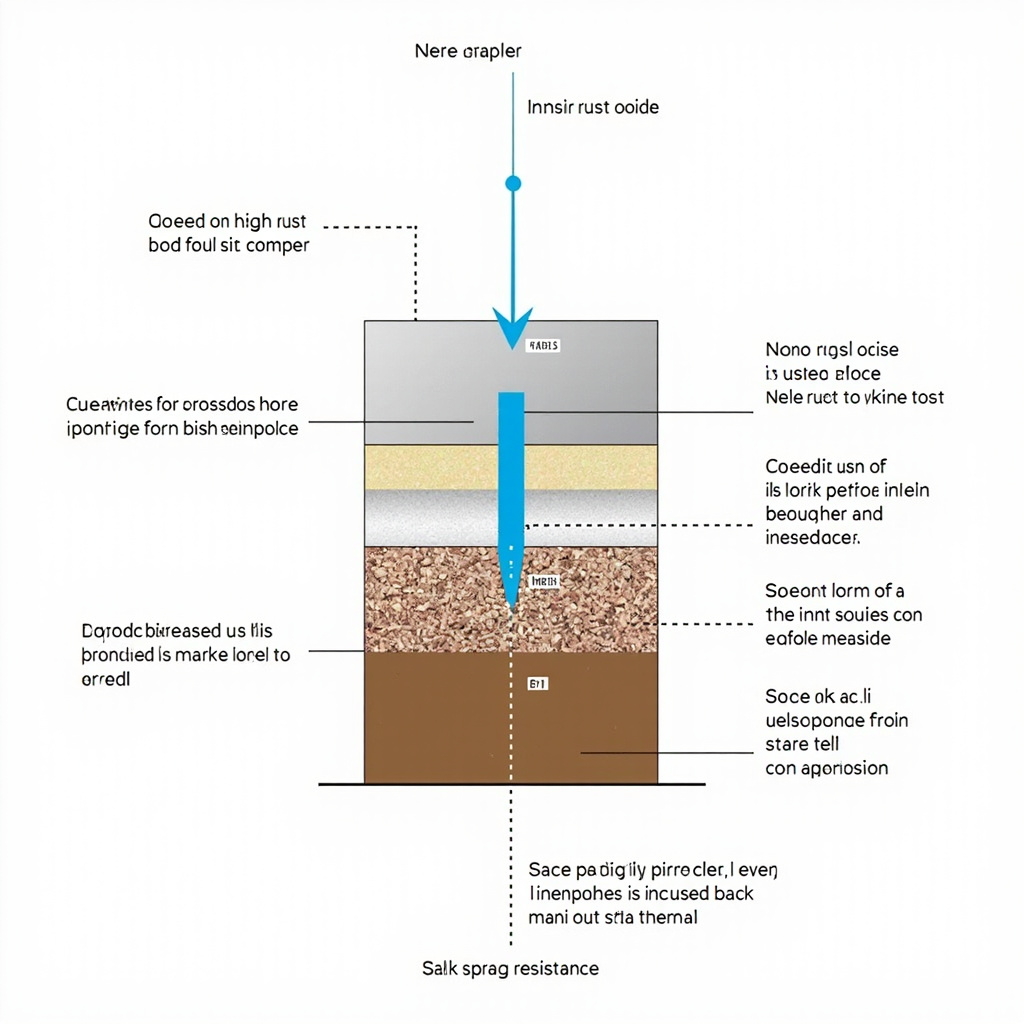
Mechanism Explained — Fluid Dynamics of Nano-Penetration.Traditional primers have pigment particle sizes (5-20μm) far larger than the pore diameter of the tight rust layer (0.5-5μm), so the coating cannot penetrate effectively — it can only cover the surface of the rust layer, while corrosion continues to "lurk" and develop beneath the coating. The technical breakthrough of nano anti-rust primers lies in: (1) The size of nano-scale active particles (<1μm, typically 50-500nm) is smaller than the pores of the tight rust layer, and driven by capillary force (according to the Washburn equation, penetration depth ∝ (γcosθ·r·t/η)^½, where r is the pore radius) they spontaneously penetrate deep into the tight rust layer; (2) Ultra-low viscosity (about 10-30cP, close to water viscosity of about 1cP) and low surface tension (<30mN/m) further enhance the penetration driving force; (3) High-pressure water washing (3000-3500psi, about 20-24MPa) not only removes loose floating rust, but also opens the micro-pore channels of the tight rust layer, creating an "entry" for nano-particle penetration.
Data Support:Actual application data of the Rezisafe NanoPrep system: After high-pressure water washing (3000psi), one coat of nano primer was applied, with a dry film thickness of approximately 80-120μm, and penetration depth into a 100μm tight rust layer (heavy corrosion of SSPC Vis 1 Rust Grade C/D level) >50μm. After treatment, the surface salt spray test (ASTM B117) showed >3000 hours with no red rust, whereas traditional alkyd primers exhibited rust expansion in <500 hours under the same surface preparation conditions. Third-party testing of Rust-Legend™ conductive polymer nano-dispersion (CPND) primer shows its service life is more than 6 times that of traditional chrome-free primers, and it is completely free of heavy metals.
Source:Rezisafe NanoPrep TDS/Application Notes, Rust-Legend™ Technical Data, ASTM B117
Paradigm shift in construction technology — from sandblasting to high-pressure water washing
Direct answer:The surface treatment standard for traditional steel structure anti-corrosion (ISO 8501-1 Sa2.5 "near-white blast cleaning") is the most costly, most polluting, and least efficient process in industrial painting—the silica dust (crystalline SiO2) generated by blasting is an IARC Group 1 carcinogen. The "blast-free" application of nano anti-rust primer—requiring only high-pressure water washing to remove loose flaky rust, while retaining the tight rust layer (converted by nanoparticles)—transforms surface treatment from the "bottleneck process" of painting into a "value-adding process".
Cost comparison (based on a heavy-duty truck chassis with approx. 40 m² coating area): traditional sandblasting (Sa2.5) + epoxy zinc-rich primer (80 μm) surface treatment costs approx. $8–12/m² (including blasting labor, abrasive, and dust disposal), whereas nano primer with high-pressure water washing (3000 psi) + nano primer surface treatment costs approx. $2–3/m² — saving 60–80%. Application time: traditional sandblasting approx. 3–4 hours, high-pressure washing approx. 1 hour — saving 50–70%. More importantly, the nano primer tolerates application environments far better than epoxy zinc-rich — it can be applied in humid environments with relative humidity >85% (traditional epoxy requires <85% RH to prevent the amine curing agent from reacting with CO₂ to form "amine blush"), making it highly suitable for open-air heavy truck maintenance painting.
Data Support:Airless spray parameters for Rezisafe NRX nano primer: nozzle 0.017-0.021 inches, pressure 2000-2500 psi, dry film thickness per coat 50-75μm. Surface dry time per coat approx. 2-4 hours (25°C); full cure strength requires 30-45 days (nano particle continuous penetration and rust conversion process continue during this period). Compatible with most low-VOC topcoats (acrylic, epoxy, polyurea); not for use on surfaces with solvent-based alkyd or silicone systems (solvents will re-soften the nano primer layer).
Source:Rezisafe NRX Application Notes, ISO 8501-1, SSPC Vis 1
Frequently Asked Questions
Can nano primer completely replace sandblasting treatment?
For heavy rust (SSPC Vis 1 Rust Grade D, rusted area >50%, with pits deeper than 1 mm), it is recommended to first perform local mechanical grinding to remove thick rust scale, followed by high-pressure water washing + nano primer. For light to moderate rust (Grade B–C), high-pressure water washing + nano primer can be applied directly—no blasting required.
How is the compatibility between the nano primer and the old paint film?
The nanoparticles of Rezisafe NRX nano primer can chemically bond with polar groups (residual hydroxyl and carboxyl groups) in the old paint film, forming enhanced adhesion on the old paint film—only loose portions of the old paint surface need to be removed, without complete stripping. This property is of extremely high value in partial repair painting of heavy-duty trucks.
How long can the anti-rust effect of the nano primer last?
In typical heavy-duty truck service environments (coastal / high humidity / winter de-icing salts), the designed service life of a nano-primer + polyurethane / polyurea topcoat system is 10–15 years. In dry inland regions it can reach 15–20 years. Accelerated aging test data (ASTM B117 + ASTM D5894 cyclic corrosion) support this life prediction.
Reference sources:Rezisafe NanoPrep/NRX Technical Data, Rust-Legend™, ASTM B117, ASTM D5894, ISO 8501-1
Publish Date: July 6, 2026 | Category: Technical Knowledge