Introduction: CX Category – the "Hell Mode" of Coating System Design
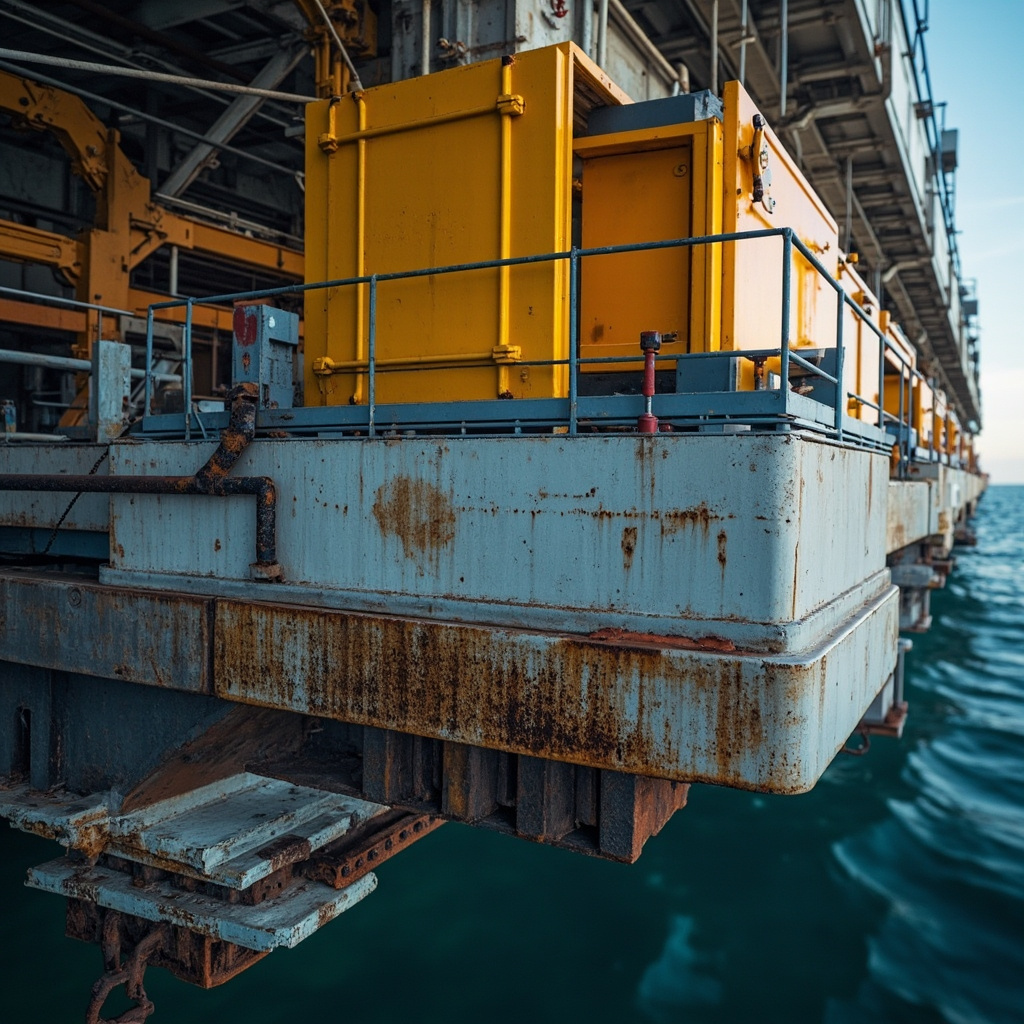
The CX extreme corrosivity category (upgraded version of the former C5-M) defined in ISO 12944-2 applies to offshore platform splash zones, steel structures within 50 m of the coastline, and offshore wind turbine towers—the corrosion rate in these areas can reach 0.1–0.3 mm/year (bare steel), which is 10–30 times that of inland C3 environments. When designing a coating system under this category, it is not only necessary to select the highest-grade specification, but also to accurately calculate the design life and plan periodic maintenance, so as to ensure structural safety throughout the total service life of 25–30 years.

I. Coating System Recommended by CX Environment
| Coating Layer | Product Type | Dry Film Thickness (μm) | Function | Service Life Contribution |
|---|---|---|---|---|
| Primer | Epoxy zinc-rich (zinc dust ≥80%) | 60-80 | Cathodic protection | 5-8 years (before zinc dust is consumed) |
| Intermediate Coat 1 | Epoxy micaceous iron oxide (MIO) | 100-150 | Barrier corrosion protection | 10-15 years |
| Intermediate Coat 2 | Glass flake reinforced epoxy | 200-300 | Superior barrier + abrasion resistance | 15-20 years |
| Topcoat | Polysiloxane / FEVE fluorocarbon | 60-80 | Weather resistance + color and gloss retention | 15-25 years |
| Total DFT | 420-610 | Design life >25 years |
II. Comparison of Salt Spray Resistance Tests among Different Coating Systems
| Coating System | Salt Spray Resistance (h/ASTM B117) | Scribe Creep (mm) | Blistering Rating (ISO 4628) | Applicable Environment |
|---|---|---|---|---|
| Epoxy Primer (Single Layer) | 400-600 | >3.0 | Class 3 | C1-C2 |
| Zinc-rich Epoxy + Epoxy Micaceous Iron Oxide | 1000-1500 | 1.0-2.0 | Class 1-2 | C3-C4 |
| Zinc-rich Epoxy + Epoxy Micaceous Iron Oxide + Polyurethane | 1500-2000 | 0.5-1.0 | Class 0-1 | C5-M |
| Zinc-rich Epoxy + Epoxy Micaceous Iron Oxide + Glass Flake + Polysiloxane | >2500 | <0.5 | Class 0 | CX |

II. Maintenance Cycle Model
The maintenance strategy for the coating system in CX environment is “periodic inspection + preventive maintenance”: (1) Annual visual inspection + local repair (coating damage <1% of area); (2) Comprehensive inspection every 5 years (adhesion/film thickness/corrosion rating/salt contamination) — decide whether to initiate full repainting based on ISO 4628 rating; (3) Every 10-15 years — local blasting and repainting (splash zone and severe corrosion areas); (4) Every 20-25 years — full blasting and repainting (complete coating system refurbishment). Maintenance cost is calculated using the LCCA discounted model (discount rate 5%, 25-year service life): the total discounted maintenance cost of regular maintenance + 1 full repainting is approximately 1.5-2 times the initial construction cost — but 5-10 times lower than the structural replacement cost caused by no maintenance.
Technical deepening: systematic optimization methods for process parameters (DOE experimental design)
The optimization of coating production processes should not rely on the "trial-and-error method" but should adopt the scientific method of DOE experimental design. Taking the dispersion process as an example—factors affecting quality (linear velocity/time/filling rate/temperature), 4 factors each at 3 levels—a full factorial requires 81 experiments—DOE uses orthogonal experiments L9 (9 times) or response surface methodology (27 times) to greatly reduce the number of experiments—while simultaneously obtaining the main effects and interactions of each factor. For example, it is found that "the interaction of linear velocity × time is significant": high linear velocity + short time and low linear velocity + long time can achieve the same dispersion effect—but the former saves over 20% energy.
In DOE analysis, interpretation of the P-value — P95% confidence). DOE ultimately outputs a set of prediction models (polynomial regression equations) — input line speed/time/temperature → predict fineness/viscosity/gloss — providing formulation engineers with a "digital formulation optimization" tool.
Industry practice: from "master craftsman's feel" to "parameter standardization"
The common challenge in the coatings industry — when experienced veteran workers retire, their "feel" (mixing resistance / fineness gauge scraping / visual inspection of wet-film gloss) is taken away — new employees cannot replicate it. Transform the "feel" into quantifiable standard parameters (1) mixing resistance → viscometer reading; (2) fineness gauge scraping → fineness gauge reading (μm); (3) wet-film gloss → gloss meter (GU value). The "standard parameter card" for each process is posted next to the equipment — new employees operate according to the "card" rather than "by feel". "Parameter standardization" is a key step for coating factories to move from "workshop" to "factory".
FAQ
Q1: What are the specific differences between CX grade and C5-M?CX is a new grade added in ISO 12944-2:2018, suitable for extreme marine environments more severe than C5-M. Distinction criteria: (1) Bare steel corrosion rate — CX > 0.2mm/year, C5-M approximately 0.1-0.2mm/year; (2) Salt spray deposition — CX > 300mg/m²·day (within <50m from coastline), C5-M approximately 100-300mg/m²·day. The coating system for CX usually has one more intermediate coat than C5-M and the total DFT increases by 100-150μm.
Q2: Why is the splash zone the most severely corroded area of offshore platforms?Three factors combine: (1) Seawater scouring—periodic wet/dry cycles from tides; (2) High dissolved oxygen—seawater splash brings in large amounts of O₂, accelerating corrosion; (3) UV exposure—sea surface reflection of UV causes photodegradation of coating resins. Splash zone coating design thickness is typically 50%–100% higher than in the atmospheric zone.
Q3: What is the difference in shielding effect between glass flake epoxy and ordinary epoxy intermediate coat?Glass flakes (thickness 2-5μm/flake diameter 50-500μm) form an overlapping layered arrangement in the coating, extending the permeation path of water molecules and Cl⁻ by 20-50 times (maze effect). The water vapor transmission rate (WVTR) of epoxy coating with 20%-30% glass flakes added is one order of magnitude lower than that of ordinary epoxy without addition. However, glass flake coating requires airless spray at high pressure (nozzle ≥0.53mm) to avoid clogging.
Q4: What is the zinc powder consumption rate of epoxy zinc-rich primer in CX environment?The high salt spray and wet-dry alternation in CX environment accelerate the sacrificial anode dissolution of zinc powder. In laboratory accelerated tests, the equivalent consumption rate of zinc powder under CX grade is approximately 5-8 μm/year (calculated by the thickness of the zinc powder layer in the coating), which means a 60-80 μm zinc powder layer is consumed within 8-12 years—after that, the cathodic protection effect of the coating disappears and it relies entirely on the barrier function of the intermediate paint. Therefore, the first round of maintenance must be considered within the zinc powder consumption window (8-12 years).
Q5: Special challenges in coating maintenance for offshore wind turbine towers?(1) Extremely short offshore construction windows (only 4-6 months per year available for offshore operations); (2) Extremely high maintenance costs (vessels + personnel + weather waiting, daily cost 100,000-300,000 RMB); (3) Some areas (submerged zone) cannot be maintained. Therefore, the initial construction standard for offshore wind power coatings is usually 1-2 grades higher than other scenarios, aiming for "maintenance-free for 25 years in one go."
Q6: How to monitor the long-term adhesion degradation of CX coating?Conduct pull-off adhesion tests (ISO 4624) annually at representative locations (3 points each in splash zone and atmospheric zone). Initial adhesion ≥8MPa, ≥6MPa after 5 years, ≥4MPa after 10 years, ≥3MPa after 15 years. When adhesion <3MPa, the risk of coating blistering/peeling increases sharply, and a maintenance plan needs to be initiated within 1-2 years. The adhesion degradation rate is the best single indicator for predicting the remaining service life of the coating.
Q7: Choice between polysiloxane topcoat vs FEVE fluorocarbon topcoat in CX environment?Polysiloxane topcoat: excellent gloss retention (>80%@QUV 3000h), high hardness (H-2H), resistant to chemical cleaners, but slightly inferior flexibility (elongation 2%-5%). FEVE fluorocarbon topcoat: higher gloss retention (>85%@QUV 3000h), better flexibility (5%-15%), but slightly lower hardness (HB-H). For the splash zone in CX environment, polysiloxane is recommended (erosion resistance + hardness); both are acceptable in the atmospheric zone. In terms of cost, polysiloxane is 20%-30% lower than FEVE.
Q8: What is the relationship between ISO 20340 (Performance standard for protective paint systems for offshore structures) and ISO 12944?ISO 20340 is a standard specifically for coating performance requirements of offshore structures (oil and gas industry), and is more stringent than ISO 12944: (1) requires passing a 4200h cyclic aging test (72h UV + 72h salt spray + 24h low temperature) rather than a single ASTM B117; (2) requires cathodic disbondment resistance test (ISO 15711) — CX coatings shall have disbondment diameter <8mm at 1.5V potential. ISO 20340 is the "ultimate exam" for CX environment coating system certification.
Q9: How to make a scientific decision on the optimal timing for coating maintenance? Use the "ISO 4628 rating matrix method": full maintenance is triggered when the coating simultaneously exhibits two or more of the following conditions — (1) corrosion Ri ≥ grade 3 (>1% area); (2) blister density ≥ grade 3; (3) adhesion < 3 MPa. Mere chalking or slight loss of gloss (without corrosion/blistering/cracking) does not trigger maintenance — the chalked layer can be recoated after high-pressure water washing, and adhesion can still meet requirements.
Q10: After the designed service life of the coating ends, how to determine whether to maintain or scrap and redo it?Key decision basis: (1) Residual coating adhesion — ≥3MPa and failure mode is cohesive failure → can be maintained and recoated; <3MPa or interfacial failure → need to completely remove and redo; (2) Degree of substrate corrosion under coating — pitting depth 1mm or large-area corrosion pits → need structural assessment and possible steel plate replacement; (3) Economy — maintenance cost < 60% of redo cost → choose maintenance; otherwise redoing is more economical.
FAQ: In-Depth Technical Q&A Supplement
Q11: How do the differences in domestic and international standards for this technology affect product export?Domestic standards (GB) differ from ISO/ASTM standards in test methods and acceptance criteria. For example, salt spray testing—GB/T 1771 (equivalent to ISO 7253) has test conditions basically consistent with ASTM B117—but the rating systems (ISO 4628 vs ASTM D610/D714) differ—when providing test reports for exported products, the corresponding international standards must be indicated simultaneously, otherwise overseas customers cannot make a comparative assessment. It is recommended to list both GB and ISO/ASTM dual-standard indicators in the TDS (Technical Data Sheet) of exported products—to enhance the trust of international customers.
Q12: How to verify the long-term service performance of this technology in actual engineering?Laboratory accelerated testing (salt spray/QUV/cyclic corrosion) provides comparative data—but cannot fully replace actual outdoor exposure testing. Recommendations—(1) Set up outdoor exposure racks at both the factory location and typical customer locations (e.g., coastal C5-M/industrial C4)—conduct annual inspections of coating appearance/adhesion/film thickness changes—establish a company-owned outdoor service database; (2) Collaborate with universities/research institutes—combine enterprise data with academic research—enhance data credibility.
Q13: What should SMEs pay attention to when purchasing related raw materials/equipment?(1) The batch stability of suppliers is more important than unit price—it is recommended to require suppliers to provide COA data for >10 batches—and evaluate batch variation (CpK); (2) For equipment procurement, visit peers who have used the equipment for >2 years to understand the long-term reliability and after-sales service quality of the equipment—rather than relying only on the demonstration data from the equipment supplier; (3) For key raw materials (resin/curing agent)—maintain at least 2 qualified suppliers to guard against single-source supply risk.
Q14: What is the current state and trend of digital transformation in this field?The digital transformation of the coatings industry is evolving from “point-based applications” (automation of individual equipment/processes) to ”system integration” (full-chain ERP+MES+PMS). Currently, the digitalization of small and medium-sized coatings factories has the ”highest ROI investment”: automatic batching systems + digitalization of quality control data—payback period of 1–3 years—which is the prioritized recommended direction. Future trend—AI + sensors enabling real-time optimization of process parameters—further reducing quality variation between batches.
Q15: How can a newly entered coating engineer quickly master this technology?(1)Combine theory and practiceDo not only read literature without touching actual production—nor rely solely on experience without studying theory;(2)Establish a“failure case archive”Every customer complaint/production anomaly/coating failure—record the root cause and resolution process—this is the most effective learning material;(3)Learn from suppliersTechnical personnel from resin/additive/pigment suppliers are the carriers of ”tacit knowledge” in this field—communicate more with them about solutions to specific problems.
Related Reading
Summary
The CX extreme marine environment coating system (epoxy zinc-rich + epoxy micaceous iron oxide + glass flake epoxy + polysiloxane/FEVE, total DFT 420-610 μm) is designed for a service life of >25 years. The maintenance cycle consists of annual inspection, testing every 5 years, partial repainting every 10-15 years, and full refurbishment every 20-25 years. Adhesion (ISO 4624) is the best single life-prediction indicator—<3 MPa triggers maintenance. Kexin New Materials provides full-process technical support in CX-grade coating system design, product matching, and maintenance planning for offshore platform and wind turbine tower clients.