In the fields of industrial and architectural coating, "nano coating" has become a high-frequency technical term, yet its meaning is often used ambiguously—from ordinary pigmented paint with trace nano powders added, to coatings that construct entirely new surface functions via nanoscale structures, the two differ greatly in mechanism, performance, and value. As technical readers oriented toward engineering material selection, clarifying "what is a nano coating," "which particles truly take effect," and "why the nanoscale can alter material behavior" is the prerequisite to avoid being misled by marketing rhetoric. Based on public technical data and standards, this article systematically reviews the definitional boundaries of nano coatings, common particle types, core action mechanisms, and key engineering challenges, and helps you distinguish between the two concepts often conflated: "nano addition" and "nanostructured coating."

I. What is a nano coating: starting from the definitional boundary
In the materials science context, a nano coating does not mean the entire coating layer is at the nanoscale, but refers to a coating system in which at least one phase (or at least one dimension) has a size within the 1–100 nm range. This definition comes from the general definition of nanomaterials and is also the technical baseline for judging whether a product possesses "nano" attributes. According to the summary in Part 5 "Real Data on Nano Paint" of this batch of research archives (TDS_MSDS_RESEARCH.md), the key points of the definition of nano coating are: at least one phase has a size of 1–100 nm (per the general properties entry on nano paint in the research archives).
It must be emphasized that "1–100 nm" describes the characteristic size of the functional phase, not the total thickness of the coating. In actual engineering, the dry film thickness of nano coatings often remains at tens of micrometers (µm) or even thicker; what truly exhibits nano effects are the nanoparticles and nano flakes dispersed in the resin matrix, or the nanoscale rough structures built on the surface. In other words, nanoparticles are the "dispersed phase," and the resin/film former is the "continuous phase," together determining the final performance.
This point is extremely important for engineering selection: for a product labeled "nano coating," is it because the nanoparticles endow shielding, self-cleaning, or antibacterial new functions, or is it merely adding a small amount of nano powder as filler with performance no different from traditional coatings? The answer depends on whether the nano phase truly exerts its size effect and surface effect. Later we will specifically discuss the distinction between "nano addition" and "nanostructured coating."
II. Common nanoparticles and their characteristics
The research archives list in the general properties entry of nano paint that the most common nanoparticles in industrial and architectural fields include: titanium dioxide (TiO₂), silica (SiO₂), zinc oxide (ZnO), silver (Ag), copper (Cu), calcium carbonate (CaCO₃), etc. These particles are selected because they each assume different functional roles at the nanoscale. The table below summarizes them by "typical function—direction of action" for readers to reference during material selection.
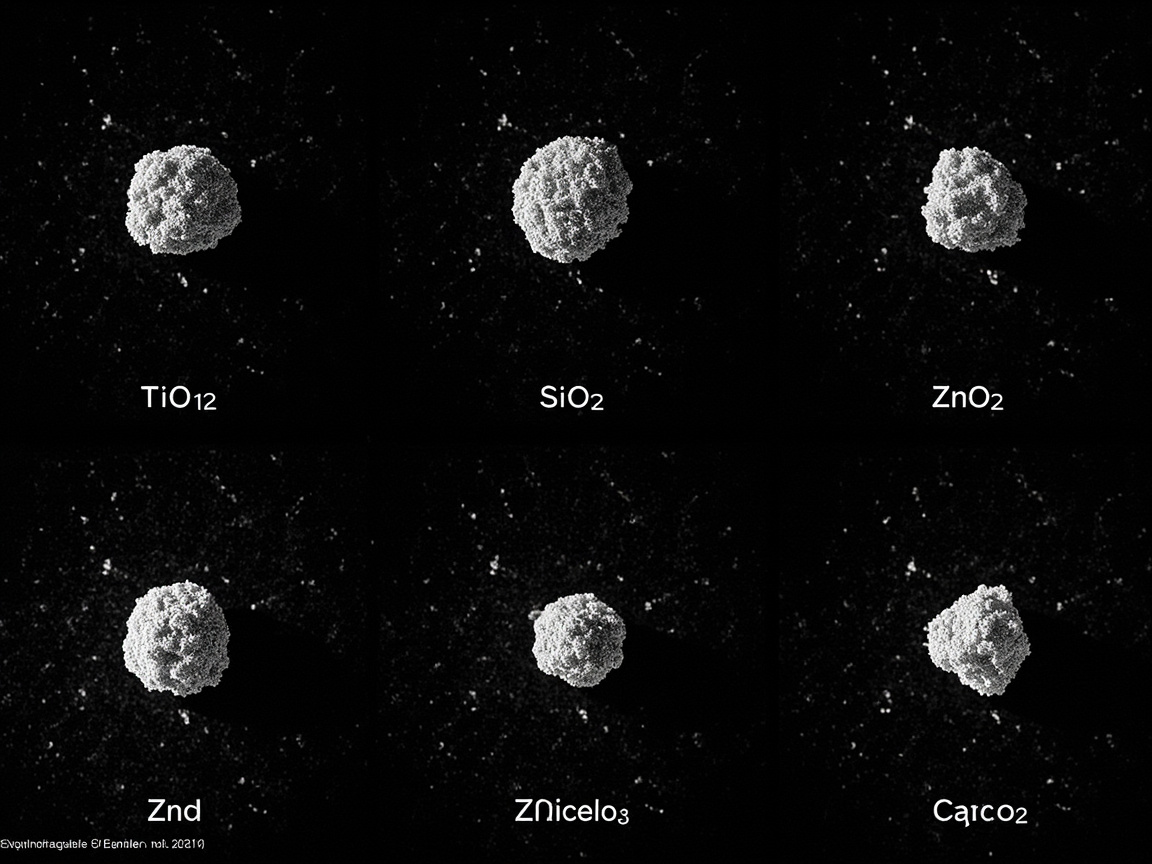
| Nanoparticle | Typical functional role | Direction of action (based on archives and general mechanisms) | Typical application fields |
|---|---|---|---|
| TiO₂ (titanium dioxide) | Photocatalytic self-cleaning, UV shielding | UV excitation generates photogenerated electrons/holes, degrades organic pollutants and exhibits antibacterial properties; also absorbs UV | Building exterior walls, glass curtain walls, self-cleaning topcoat |
| SiO₂ (silica) | Enhanced shielding, hardening and wear resistance | Nanoparticles/flakes improve coating density, reduce water/oxygen permeability, enhance hardness and wear resistance | Industrial protection, ceramic coating, wear-resistant topcoat |
| ZnO (zinc oxide) | Antibacterial, UV shielding | Has antibacterial activity and blocks UV, often synergized with TiO₂ | Interior walls, medical environments, outdoor weather resistance |
| Ag (silver) | Broad-spectrum antibacterial | Silver ions destroy microbial cell membranes and enzymes, with high inhibition rates against E. coli / S. aureus | Interior walls, medical, plastic masterbatch |
| Cu (copper) | Antibacterial, conductive | Nano copper has antibacterial and certain conductive uses, as a functional additive | Antibacterial coating, conductive coating |
| CaCO₃ (calcium carbonate) | Reinforcement/filler | Conventional nano filler, improves mechanical properties and reduces cost | General pigmented paint, primer filler |
Functional details and selection key points of each particle
For engineering reference, further explanation of the above particles is provided:
- TiO₂ (titanium dioxide). In nano coatings, it assumes the dual roles of photocatalytic self-cleaning and UV shielding. Anatase phase has high photocatalytic activity, rutile phase is more stable and strongly absorbs UV but weakly photocatalytic; actual products often use mixed crystals to balance. Its white opaque characteristic determines it is more suitable for pigmented paint or functional surface layers, rather than varnish requiring high transparency (unless specially treated). The archives point out TiO₂ is used for self-cleaning of building exterior walls and glass, but its photocatalytic activity also attacks adjacent resins and requires encapsulation (see np-tio2-selfclean article for details).
- SiO₂ (silica). It is the mainstay of nano composite anti-corrosion and ceramic coatings. The archives clearly state in the nano composite anti-corrosion entry: nano SiO₂/TiO₂/clay flakes enhance shielding, reduce water/oxygen permeability, and when compounded with epoxy/polyurethane can delay the path of corrosive media. Its high chemical inertness and good thermal stability make it often used as a hardening, wear-resistant, and densifying filler.
- ZnO (zinc oxide) and Ag (silver). Both are antibacterial mainstays. ZnO also provides UV shielding, while Ag is known for broad-spectrum, high inhibition rates (per the archives' summary on Ag, inhibition rates against E. coli / S. aureus can be ≥99%), commonly used in interior walls, medical, and plastic masterbatch. Both are often compounded with TiO₂ to cover light/no-light conditions.
- Cu (copper) and CaCO₃ (calcium carbonate). Copper nanoparticles are useful in antibacterial and conductive aspects, while calcium carbonate serves as a conventional nano filler to improve mechanical properties and reduce cost. Both are listed as common particles in the archives, with specific functions subject to product test reports.
Understanding the "capabilities" and "limits" of these particles is the first step to bring nano coatings from concept to metrics: first lock down the specific function you need (self-cleaning, antibacterial, shielding, hardening), then check backward whether the corresponding particle has archive support, rather than being led by the vague "nano" label.
It should be noted: the specific functions of TiO₂, SiO₂, ZnO, and Ag in the table have clear corresponding entries in the archives (e.g., TiO₂ photocatalytic self-cleaning, SiO₂ enhanced shielding, ZnO and Ag antibacterial), while Cu and CaCO₃ are listed as "common particles" in the archives, their roles positioned according to general material mechanisms, and engineering selection should be based on specific product test reports.
It is worth pointing out that the "function" of nanoparticles is not automatically realized. The archives also clearly state: due to high surface energy, nanoparticles are extremely prone to aggregation; if poorly dispersed, they not only fail to exert nano effects but also become defect points in the coating. Therefore, the premise of the functions listed in the table is that the particles are uniformly dispersed at the nanoscale in the matrix—which is the core difficulty of nano coating engineering (see Section IV for details).
III. Three major action mechanisms of nanoparticles
The reason nanoparticles can change coating performance stems from the three types of physical effects they exhibit at the 1–100 nm scale. The research archives summarize the action mechanisms of nano coatings as: small size effect, surface effect (high specific surface area), and quantum size effect. Understanding each of these three is key to judging whether "nano" truly generates value.
1. Small size effect. When particle size decreases to be comparable to or even smaller than certain physical characteristic lengths (such as light wavelength, magnetic domain, defect size), the mechanical, optical, and electromagnetic properties of the material change significantly. For example, when the particle size of nano TiO₂ approaches or is smaller than the order of UV wavelength, its light scattering and absorption behaviors differ from bulk materials, providing the basis for photocatalysis and UV shielding; the small size of nano SiO₂ enables it to fill the gaps between resin molecules and improve coating density.
2. Surface effect (high specific surface area). This is the most intuitive and critical feature of nanoparticles. As particle size decreases, the ratio of surface area to volume rises sharply, and the proportion of surface atoms increases substantially. According to the research archives, nanoparticles have high specific surface area, meaning per unit mass of particles possesses extremely many surface active sites—this is also the physical root for nano Ag and ZnO to efficiently contact and act on microorganisms, as well as for nano TiO₂ to provide a large number of photocatalytic reaction sites. The surface effect also explains why nanoparticles have high surface energy and are prone to aggregation: the excess surface energy drives particles to adsorb each other to lower energy.
3. Quantum size effect. When particle size becomes small enough to approach the electron de Broglie wavelength, the material's band structure changes from continuous to discrete, and the optical absorption edge and band gap shift. For TiO₂, the quantum size effect finely tunes its light absorption threshold and the behavior of photogenerated carriers, affecting photocatalytic efficiency and response band. For engineering material selection, understanding this helps judge the differences in UV/visible response among TiO₂ of different particle sizes.
These three effects are not isolated: the surface effect provides the "number of reaction sites," the small size effect determines the "mode of interaction with light," and the quantum size effect influences the "electronic band and reaction driving force." A truly effective nano coating is the result of the synergy of the three and good dispersion.
IV. Key challenge: aggregation problem and dispersion countermeasures
The research archives list "aggregation" as a key challenge of nano coatings, and clearly state: due to high surface energy, nanoparticles are prone to aggregation and need to be solved through surface modification, dispersants, or ultrasonication. This is the biggest obstacle for nano coatings to move from "laboratory formula" to "stable engineering product."
Why is aggregation inevitable?Nanoparticles have an enormous specific surface area and extremely high surface energy, making them thermodynamically highly unstable. Without external intervention, van der Waals forces drive the particles to spontaneously aggregate, forming micron-scale agglomerates. Once agglomerated, the effective size of the particles far exceeds 100 nm, the nano effects (high specific surface area, surface reaction sites) are essentially lost, and the agglomerates become stress concentration points and defects in the coating, which may instead reduce adhesion and density.
The main engineering countermeasures are of three types:
- Surface modification. Through coupling agents, silanization treatment, or polymer encapsulation, functional groups compatible with the resin are introduced onto the surface of the nanoparticles to reduce surface energy and enhance interfacial bonding with the matrix. For example, nano TiO₂ used for self-cleaning is often subjected to encapsulation treatment (see the article np-tio2-selfclean), which both prevents its photocatalytic side effects and improves dispersion.
- Dispersants. High-molecular-weight dispersants are added during the grinding stage to maintain monodispersion of particles through steric hindrance or charge repulsion (electrostatic stabilization). The type and dosage of dispersant in formulation design directly affect the final performance.
- Ultrasonic and high-shear dispersion. Using ultrasonic cavitation and high-shear equipment such as three-roll mills/bead mills to break soft agglomerates is a standard process step in the preparation of nano dispersions.
The most direct way to judge whether a nano coating is "truly nano" is to check its particle size distribution and Zeta potential characterization data (see Section 6).

V. The Essential Difference Between "Nano-addition" and "Nano-structured Coating"
The market for "nano coatings" is mixed, and the research archive also notes in the market status section of the nano coating chapter: terminology is chaotic ("9H" "nano" abused), and selection should be based on third-party test reports, film thickness, contact angle, salt spray/abrasion data. Here, we need to establish a clear set of discrimination frameworks: Nano-addition and Nano-structured coating are two different levels of technology.
Nano-addition. Refers to incorporating a small amount of nano powder (such as nano SiO₂, nano TiO₂) as functional or reinforcing filler into traditional coating formulations. Its performance improvement mainly relies on the filling, reinforcement, or photocatalytic intrinsic properties of the nanoparticles, but the overall surface morphology of the coating is still determined by resin film formation. Such products have relatively simple processes and controllable costs, and are commonly found in modified coatings that improve hardness, abrasion resistance, or self-cleaning. Its value is real, but it should not be exaggerated as "revolutionary"—essentially it is still performance reinforcement of a traditional coating system.
Nano-structured coating. Refers to constructing nano-scale rough structures on the surface (such as the micro-nano binary structure of the lotus leaf effect) or using the nano phase as a continuous functional layer, so that the coating as a whole exhibits surface behaviors that traditional materials do not possess, such as superhydrophobicity (contact angle >150°), ultra-low rolling angle self-cleaning, ultra-low friction, etc. Such coatings have higher requirements for structural design, construction process, and substrate treatment, and the performance comes from "structure" rather than simply "additives".
The key points of discrimination can be summarized as: See whether the performance comes from the surface micro-nano structure or merely from the incorporated powder; see whether there are structural characterization data such as contact angle, film thickness, rolling angle; see whether the construction depends on special pre-treatment (such as high-grade sandblasting, IPA degreasing). Kexin New Materials (kexinMaterials) insists on providing quantifiable test data such as film thickness, contact angle, and salt spray in its related product lines, precisely to help engineering users make evidence-based choices between "nano-addition" and "nano-structured coating", avoiding paying for concepts.
VI. Testing and Characterization of Nano Coatings
Since the nano effect highly depends on the dispersion state and structure, testing and characterization are the hard means to "eliminate the false and retain the true". The research archive lists a series of standard methods and evaluation indicators in the nano paint testing and nano coating characterization entries, which can be used in conjunction with general coating standards:
- Particle size distribution / Zeta potential (DLS). Dynamic light scattering is used to evaluate the particle size and dispersion stability of particles in aqueous phase or dispersion; Zeta potential reflects colloidal stability, the higher the absolute value, the less likely to agglomerate.
- TEM / SEM morphology observation. Transmission electron microscopy and scanning electron microscopy directly observe particle morphology and whether agglomeration occurs, and are among the gold standards for verifying "truly nano".
- Film thickness (step profiler / ellipsometer / SEM cross-section). Nano coating thickness is often at the nm–µm level, requiring instruments of corresponding precision. In the archive, multiple nano coating products have film thickness ranging from 80 nm to 25 µm (e.g., a certain ceramic coating 12–25 µm, a certain automotive coating nano ceramic 80–150 nm), and the order-of-magnitude difference itself also indicates the difference in technical routes.
- Pencil hardness (GB/T 6739, ISO 15184). Evaluates coating scratch resistance; nano ceramic types often claim 8H–9H, and it should be noted that it is pencil hardness and depends on the substrate.
- Hydrophobic angle / rolling angle (contact angle meter). Evaluates hydrophobic and self-cleaning ability; the test method (such as static contact angle) needs to be specified.
- Salt spray resistance (GB/T 1771-2007, ASTM B117, DIN EN ISO 9227). Evaluates anti-corrosion durability; heavy anti-corrosion can reach 1000–3000 h, and some nano ceramic coatings can reach neutral salt spray ≥1200 h.
- Artificial weathering (GB/T 1865 xenon lamp, GB/T 23987 UV, ASTM G154, ISO 11507). Evaluates weather resistance, usually requiring 1000 h color change ≤2 grade, chalking ≤1 grade.
Verifying the "nano" attribute and the "coating" attribute of nano coatings separately is the basic logic of engineering acceptance: the former is evidenced by DLS/TEM, the latter by hardness/salt spray/aging standards.

VII. Application Scenario Overview and Technical Selection Logic
The application of nano coatings covers almost all industrial scenarios mentioned above: on building exterior walls and glass, TiO₂ photocatalytic self-cleaning coatings reduce dirt adhesion; in industrial protection, nano SiO₂ flake composite epoxy/polyurethane reduces water and oxygen permeability and extends the path of corrosive media; in interior walls and medical environments, Ag/ZnO provides antibacterial function; in automotive and electronics fields, nano ceramic coatings provide superhydrophobicity, scratch resistance, and electrical insulation.
But engineering selection must avoid "nano for the sake of nano". The reasonable decision sequence is: first clarify the substrate, corrosion environment (refer to ISO 12944-2018 C2–CX corrosion grades), service temperature, and lifespan requirements; then judge whether the specific functions brought by nano are needed (self-cleaning, antibacterial, superhydrophobic, enhanced shielding); finally check the dispersion characterization and coating performance test reports provided by the manufacturer. If your project involves overall trade-offs between water-based/solvent-based systems, you can refer to Key Points for Water-based and Oil-based Paint Selection for systematic comparison from the perspectives of VOC, solid content, and compatibility; if you lean toward industrial protection systems, Waterborne Industrial Coating Selection provides design ideas for primer—intermediate—topcoat systems; and when introducing nano functions on wood and building material substrates, Science of Waterborne Wood Coatings helps understand the underlying principles of resin—filler interfacial compatibility.
VIII. Engineering Selection Suggestions and Compatibility Ideas
Based on the above mechanisms and characterization, here are some practical suggestions for technical procurement personnel:
- Require quantitative evidence. For any claimed nano function, request particle size distribution, Zeta potential or TEM photos, as well as corresponding third-party reports on performance (hardness, contact angle, salt spray, aging).
- Distinguish requirement levels. If only reinforcing hardness/abrasion resistance is needed, nano-addition types are sufficient; if superhydrophobic self-cleaning or ultra-low friction is required, the construction feasibility of nano-structured coatings should be evaluated.
- Focus on dispersion and stability. Prioritize products with surface modification or encapsulation processes and providing dispersion stability data, to avoid agglomeration risks.
- Match substrate and pre-treatment. Most high-performance nano coatings require high-grade sandblasting (such as Sa 2½ or higher) and strict degreasing; if construction conditions are insufficient, performance will be compromised.
- Emphasize safety and environmental protection. Uncured nano slurries and spraying dust pose inhalation risks; corresponding particulate respirators should be equipped during operation; cured coatings are usually inert. In terms of environmental protection, industrial protective paints need to meet the VOC and heavy metal limits of GB 30981-2020.
Kexin New Materials (kexinMaterials), in the development of nano functional coatings, insists on providing "dispersion stability data + coating performance report" as standard deliverables, and encapsulates key photoactive particles such as nano TiO₂ to avoid resin aging risks (see the article np-tio2-selfclean). The purpose is to enable engineering users to obtain the real gains brought by nano in material selection, without bearing the risks caused by concept hype and lack of methodology.
IX. From Mechanism to Engineering: A Case of Shield Enhancement in Nano Composite Anti-corrosion
The mechanism does not automatically become performance; the shield enhancement of nano SiO₂ provides a clear engineering sample. According to the nano composite anti-corrosion entry in the research archive: nano SiO₂/TiO₂/clay flakes can improve shielding, reduce water and oxygen permeability, and when compounded with epoxy/polyurethane, delay the path of corrosive media. The logic behind it is—the penetration of corrosive media (water, oxygen, chloride ions) through the coating is a diffusion process; when a large number of nano flakes/particles are uniformly dispersed in the matrix, the media must detour a longer tortuous path (tortuosity effect), and the effective permeability decreases accordingly.
This is in line with the "physical barrier" of traditional anti-rust paint (such as alkyd and epoxy dense films blocking water and oxygen); it merely takes the "path lengthening" to a smaller scale with the nano phase. A reminder: nano composite anti-corrosion still relies on the barrier mechanism and cannot replace the cathodic protection required for heavy-duty anti-corrosion (sacrificial anode of zinc dust in zinc-rich primer) and a complete primer–intermediate–topcoat system. If a project enters the design of a heavy-duty anti-corrosion system, it should, in accordance with the C2–CX corrosion classes of ISO 12944-2018, use the nano barrier layer as an "enhancement" rather than a "replacement".
X. Cost and Engineering Economic Considerations
The preparation of nanoparticles (e.g., gas-phase method, sol-gel method) and dispersion processes (ultrasonication, high-shear, encapsulation) drive up costs; not every scenario warrants paying for "nano". Economic decisions can follow three principles: First, introduce a nano solution only when a certain property (self-cleaning, antibacterial, superhydrophobic, enhanced barrier) is a project necessity and cannot be met by conventional systems; Second, prioritize products that are already engineered, with stable dispersion and mass-production capability, avoiding lab-scale high-price small batches; Third, include the reduction in maintenance cost (e.g., self-cleaning reducing cleaning frequency) in the full life-cycle accounting, rather than looking only at the material unit price.
Kexin New Materials (kexinMaterials) often guides users in proposals to first do a "demand–evidence" comparison: if it can be solved with conventional systems, do not force the use of nano; if nano functionality is truly needed, then require quantitative test reports to support the premium. This restraint is precisely a sign of engineering responsibility. Especially when the budget is limited, directing resources to correct pretreatment and the supporting system often improves final durability more than blindly chasing "nano".
FAQ
Q: Is a nano coating's entire film nano-thick?
A: No. A nano coating means at least one phase in the system is sized 1–100 nm; the total dry film thickness is usually still tens of microns or even thicker. What actually exhibits the nano effect is the dispersed phase particles or surface nano structure, not the entire film.
Q: Why do some "nano coatings" show no noticeable effect, performing about the same as ordinary paint?
A: The most common reason is agglomeration of nanoparticles. Nanoparticles have high surface energy; if not surface-modified, not added with dispersant, or not dispersed by ultrasonication/high-shear, they cluster into micron-scale agglomerates, losing the nano effect and potentially becoming defect points. Check the particle size distribution and Zeta potential data.
Q: Which is better, "nano addition" or "nano-structured coating"?
A: The two serve different purposes and cannot be simply compared as superior or inferior. Nano addition suits reinforcing hardness, wear resistance, or introducing self-cleaning/antibacterial functions in conventional systems—low cost and simple process; nano-structured coatings achieve brand-new behaviors like superhydrophobicity and ultra-low friction through surface micro-nano structures, with performance from structure and higher construction requirements. Choose by need level.
Q: How to verify a product is "truly nano"?
A: The most effective is dynamic light scattering (DLS) for particle size distribution, Zeta potential for dispersion stability, and TEM/SEM to directly observe agglomeration; also check coating performance reports (pencil hardness, contact angle, salt spray, aging). Judgment cannot be made by slogans alone.
Q: Does nano coating construction require special protection?
A: Yes. Uncured nano slurries and dust generated during spraying are inhalable into the lungs, with potential inflammation/fibrosis risks, so corresponding particulate respirators should be worn. But liquid formulations after curing into film are usually inert and safe for daily contact.
Q: Will nano TiO₂ coated on ordinary resin paint cause problems?
A: There are risks. TiO₂ has photocatalytic activity under UV, which may catalytically degrade adjacent organic resin, causing chalking, gloss loss and cracking. Engineering practice usually suppresses this side effect through encapsulation (surface coating of inert layer); see the article np-tio2-selfclean for details.
Q: Is the anti-corrosion of nano coatings definitely stronger than ordinary coatings?
A: Not necessarily. Nano SiO₂ and other lamellar composites can indeed reduce water/oxygen permeability and lengthen corrosive medium paths, thus improving barrier property; but anti-corrosion is a system engineering that also needs primer–intermediate–topcoat system and correct pretreatment. Check specific salt spray data (e.g., GB/T 1771) rather than only the "nano" label.
Q: What data should you most ask the manufacturer for when purchasing?
A: By priority: particle size distribution/Zeta potential (prove true dispersion), pencil hardness and contact angle (prove function), salt spray and artificial aging reports (prove durability), VOC and environmental compliance (e.g., GB 30981-2020). Third-party reports are more convincing.
Q: Why can't the "nano" label alone be a procurement basis?
A: Because the nano effect highly depends on dispersion state, structure and supporting system; the label itself does not prove performance. Research archives also indicate confusion in nano terminology and abuse of "9H" "nano". The correct approach is to break "nano" into two verifiable pieces of evidence—dispersion characterization and coating performance—and be cautious if either is missing.
Further Reading
- Waterborne Industrial Coating Selection: Understand primer–intermediate coat–topcoat system and ISO 12944 corrosion class design.
- Science of Water-based Wood Coatings: In-depth resin–filler interface compatibility, also informative for understanding nanoparticle dispersion.
- Key Points for Selecting Water-based and Oil-based Paints: Systematic comparison from VOC, solid content and system perspectives, assisting in judging whether nano functional systems should follow water-based or solvent-based routes.